Introduction to
Multiplexing
Definition and
types
MULTIPLEXIN
G
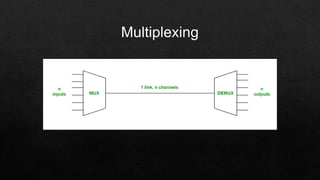
Multiplexing is a technique that
combines multiple signals for
transmission over a single data link. It
enables efficient use of resources and
increased data transmission capacity.
Types of Multiplexing
• Space Division Multiplexing (SDM)
SDM involves physically separating channels.
• Time Division Multiplexing (TDM)
TDM allocates specific time slots to different
channels.
• Frequency Division Multiplexing
(FDM)
FDM separates signals into different frequency
bands.
Multiplexing
TIME DIVISION
MULTIPLEXING
(TDM)
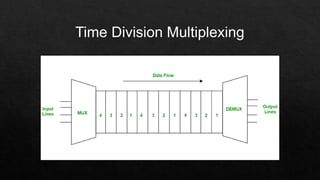
Time Division Multiplexing (TDM) allocates
fixed time slots for multiple data streams to
share a single communication channel.
It interleaves data from different sources by
assigning each source a unique time slot
within
a predefined cycle.
TDM is commonly used in
telecommunications for voice and data
transmission over
a single physical medium, optimizing
resource utilization through temporal
segmentation.
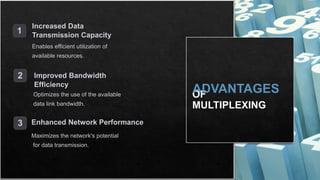
Time Division Multiplexing
FREQUENCY
DIVISION
MULTIPLEXING
(FDM)
Frequency Division Multiplexing (FDM)
allocates distinct frequency bands to
multiple signals for simultaneous
transmission.
It enables multiple users or channels to
share a
communication medium by dividing the
available frequency spectrum.
FDM is commonly used in radio, television
broadcasting, and traditional wired
telephone
systems for efficient utilization of
bandwidth.
Frequency Division Multiplexing
SPACE DIVISION
MULTIPLEXING
(SDM)
Space Division Multiplexing (SDM)
concurrently transmits multiple data
streams over separate physical paths
within a shared medium.
SDM boosts communication capacity by
utilizing parallel transmission paths, such
as
separate fiber strands or antennas.
It addresses increasing data demands by
enabling simultaneous transmission of data
streams, offering higher throughput
and efficiency.
OF
MULTIPLEXING
ADVANTAGES
1
3
2
Increased Data
Transmission Capacity
Improved Bandwidth
Efficiency
Enhanced Network Performance
Enables efficient utilization of
available resources.
Optimizes the use of the available
data link bandwidth.
Maximizes the network's potential
for data transmission.
OF
MULTIPLEXING
APPLICATIONS
1
2
Telecommunications
Supports efficient voice and data
transmission over networks.
Data Centers
Enables high-capacity data transfer and
storage capabilities.
Broadcasting
Combines multiple audio/video signals into a
single broadcast, enhancing spectral efficiency.
4
3
Satellite Communication
Maximizes bandwidth utilization in satellite systems,
facilitating diverse applications like TV broadcasting and
internet access.
THANK YOU!

Introduction to Multiplexing , Multiplexing PPT in short

  • 1.
  • 2.
    Definition and types MULTIPLEXIN G Multiplexing isa technique that combines multiple signals for transmission over a single data link. It enables efficient use of resources and increased data transmission capacity. Types of Multiplexing • Space Division Multiplexing (SDM) SDM involves physically separating channels. • Time Division Multiplexing (TDM) TDM allocates specific time slots to different channels. • Frequency Division Multiplexing (FDM) FDM separates signals into different frequency bands.
  • 3.
  • 4.
    TIME DIVISION MULTIPLEXING (TDM) Time DivisionMultiplexing (TDM) allocates fixed time slots for multiple data streams to share a single communication channel. It interleaves data from different sources by assigning each source a unique time slot within a predefined cycle. TDM is commonly used in telecommunications for voice and data transmission over a single physical medium, optimizing resource utilization through temporal segmentation.
  • 5.
  • 6.
    FREQUENCY DIVISION MULTIPLEXING (FDM) Frequency Division Multiplexing(FDM) allocates distinct frequency bands to multiple signals for simultaneous transmission. It enables multiple users or channels to share a communication medium by dividing the available frequency spectrum. FDM is commonly used in radio, television broadcasting, and traditional wired telephone systems for efficient utilization of bandwidth.
  • 7.
  • 8.
    SPACE DIVISION MULTIPLEXING (SDM) Space DivisionMultiplexing (SDM) concurrently transmits multiple data streams over separate physical paths within a shared medium. SDM boosts communication capacity by utilizing parallel transmission paths, such as separate fiber strands or antennas. It addresses increasing data demands by enabling simultaneous transmission of data streams, offering higher throughput and efficiency.
  • 9.
    OF MULTIPLEXING ADVANTAGES 1 3 2 Increased Data Transmission Capacity ImprovedBandwidth Efficiency Enhanced Network Performance Enables efficient utilization of available resources. Optimizes the use of the available data link bandwidth. Maximizes the network's potential for data transmission.
  • 10.
    OF MULTIPLEXING APPLICATIONS 1 2 Telecommunications Supports efficient voiceand data transmission over networks. Data Centers Enables high-capacity data transfer and storage capabilities. Broadcasting Combines multiple audio/video signals into a single broadcast, enhancing spectral efficiency. 4 3 Satellite Communication Maximizes bandwidth utilization in satellite systems, facilitating diverse applications like TV broadcasting and internet access.
  • 11.

Editor's Notes

  • #5 there is no central authority or control. Each node operates independently and makes decisions based on local information. Distributed algorithms often involve concurrent execution of multiple processes or nodes. Distributed algorithms involve techniques like distribution Distributed transactions, consensus protocols, and replication to maintain a consistent view of data across nodes. Nodes in a distributed system can fail due to hardware or software issues, and the algorithm should continue to operate correctly despite these failures. it is designed to work efficiently and able to contain a growing number of nodes without degradation in performance
  • #7 there is no central authority or control. Each node operates independently and makes decisions based on local information. Distributed algorithms often involve concurrent execution of multiple processes or nodes. Distributed algorithms involve techniques like distribution Distributed transactions, consensus protocols, and replication to maintain a consistent view of data across nodes. Nodes in a distributed system can fail due to hardware or software issues, and the algorithm should continue to operate correctly despite these failures. it is designed to work efficiently and able to contain a growing number of nodes without degradation in performance
  • #9 there is no central authority or control. Each node operates independently and makes decisions based on local information. Distributed algorithms often involve concurrent execution of multiple processes or nodes. Distributed algorithms involve techniques like distribution Distributed transactions, consensus protocols, and replication to maintain a consistent view of data across nodes. Nodes in a distributed system can fail due to hardware or software issues, and the algorithm should continue to operate correctly despite these failures. it is designed to work efficiently and able to contain a growing number of nodes without degradation in performance