INTRODUCTION TO
MARKETING
CONTENTS OF THIS COURSE
• Marketing Terminology
• Core Concepts of Marketing
• Group Exercise No.1
• Marketing Management
• Summary / Review
• Group Exercise No. 2
• Traditional Marketing
• Survival Requirements
• Total Quality Marketing
• Group Exercise No.3
• Marketing Planning
• 4Ps of Marketing
• 7 Ps of Marketing
• New Roles of Marketers
• Group Exercise No. 4
• Who are the Stakeholders in your Company ?
• Priority Setting for Marketing Activity
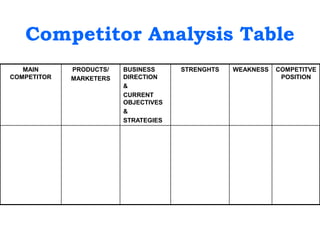
• Competitor Analysis
• Group Exercise No.5
MARKETING TERMINOLOGY
1. Marketing : What is it?
The ways in which a company encourages people to buy its
products by deciding on its product,price,promotion tactics and
place.
2. Market Forces : What are these ?
The economic influences that affect prices, salaries and he no. of
jobs available, which are not controlled by the government.
3. Market Share :
The percentage of the total amount of sales of a particular product
that a company has.
4. Market Leader :
A company that sells more of its product than any other company
of its type.
Contd….
5. Market Driven :
Controlled by what and how much people want to buy.
6. Market Price :
The price that a particular product can be sold for at a particular
time.
7. Market Research :
The process of collecting information about products people like to
buy , or what people like or dislike about particular product.
THE CORE CONCEPTS OF
MARKETING
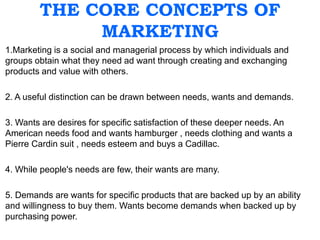
1.Marketing is a social and managerial process by which individuals and
groups obtain what they need ad want through creating and exchanging
products and value with others.
2. A useful distinction can be drawn between needs, wants and demands.
3. Wants are desires for specific satisfaction of these deeper needs. An
American needs food and wants hamburger , needs clothing and wants a
Pierre Cardin suit , needs esteem and buys a Cadillac.
4. While people's needs are few, their wants are many.
5. Demands are wants for specific products that are backed up by an ability
and willingness to buy them. Wants become demands when backed up by
purchasing power.
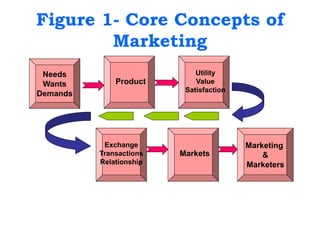
Figure 1- Core Concepts of
Marketing
Needs
Wants
Demands
Marketing
&
Marketers
Product
Utility
Value
Satisfaction
Exchange
Transactions
Relationship
Markets
Group Exercise No. 1
Examples of Needs
Contd…Examples of Wants
Contd…Examples of Demands
MARKETING MANAGEMENT
1. Marketing (management) is the process of planning and
executing the conception , pricing , promotion and distribution of
ideas, goods and services to create exchange that satisfy
individual and organizational objectives.
2. The popular image of the marketing manager is someone
whose task is primarily to stimulate demand for the company's
product.
SUMMARY/REVIEW
1. The marketing concept holds that the
main task of the company is to
determine the needs, wants and
preferences of a target group of
customers and to deliver the desired
satisfaction. Its four principles are
market focus, customer orientation ,
coordinated marketing and profitability.
Exercise No. 2
During the early 1980s, over 4400 auto
dealerships in US went out of business,
William Turnbull, president of NADA, stated
that if the remaining dealers were to survive,
they must change their orientation toward
consumers.
What might have he have meant
by that statement ?
Why Traditional Marketing is Not
Good Enough ?
1. Failure to view quality as a competitive weapon.
2. Failure to view marketing as a total integrated function
3. Failure to understand the customer requirements
4. Failure to identify the tool market
5. Failure to build up a long term relationship with all the stake
holders
6. Failure to measure the true value of the products and services
Survival Requirements
in Marketing
1. Respond to frequent changes in competitive environment
2. Cope with rapid saturation of markets
3. Take advantage of opportunities in new growth markets
4. Timeliness of introduction of new products/services relative to
new offers in the market
Total Quality Marketing
An Approach, a set of principles
and techniques for integrating
resources, policies and activities
with the aim to achieve the
needs of all the stake holders of
an organization.
Key Areas in Total Quality
Marketing
1. A new paradigm in customer , employee , supplier and other stakeholder
relationship
2. A long term commitment customer (internal & external) focus and satisfaction
3. A strategic quality focus to reach the highest quality level and serve the
changing needs of customers and other stakeholders
4. A continuous improvement philosophy focused on customer value in terms of
quality, cost efficiency , delivery and flexibility
5. A total marketing mix to maximize customer value
6. Total employee involvement to develop processes that are customer
oriented, flexible and responsive and constantly improving in quality
7. Continuous improvement to human capital
Exercise No.3
Why We Need Marketing
Planning?
What is Marketing Planning
Process ?
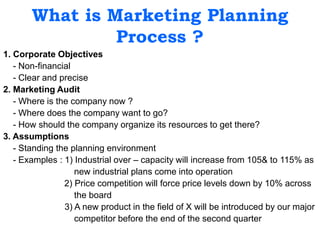
1. Corporate Objectives
- Non-financial
- Clear and precise
2. Marketing Audit
- Where is the company now ?
- Where does the company want to go?
- How should the company organize its resources to get there?
3. Assumptions
- Standing the planning environment
- Examples : 1) Industrial over – capacity will increase from 105& to 115% as
new industrial plans come into operation
2) Price competition will force price levels down by 10% across
the board
3) A new product in the field of X will be introduced by our major
competitor before the end of the second quarter
Marketing Planning Process
Contd….
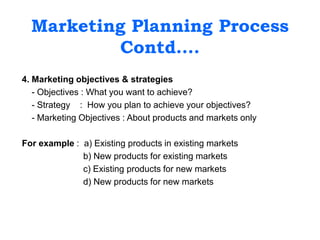
4. Marketing objectives & strategies
- Objectives : What you want to achieve?
- Strategy : How you plan to achieve your objectives?
- Marketing Objectives : About products and markets only
For example : a) Existing products in existing markets
b) New products for existing markets
c) Existing products for new markets
d) New products for new markets
The 4 Ps of Marketing
• Product
• Price
• Promotion
• Place
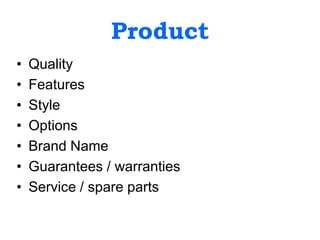
Product
• Quality
• Features
• Style
• Options
• Brand Name
• Guarantees / warranties
• Service / spare parts
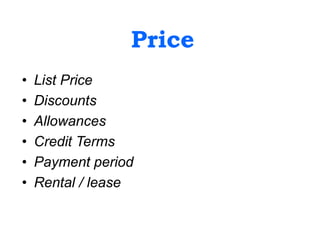
Price
• List Price
• Discounts
• Allowances
• Credit Terms
• Payment period
• Rental / lease
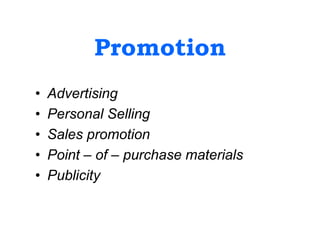
Promotion
• Advertising
• Personal Selling
• Sales promotion
• Point – of – purchase materials
• Publicity
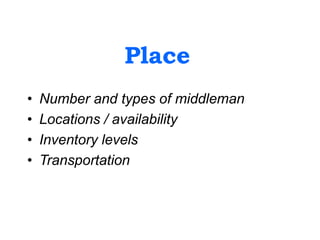
Place
• Number and types of middleman
• Locations / availability
• Inventory levels
• Transportation
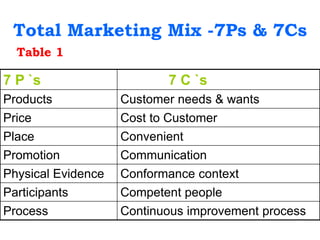
Total Marketing Mix -7Ps & 7Cs
Table 1
7 P `s 7 C `s
Products Customer needs & wants
Price Cost to Customer
Place Convenient
Promotion Communication
Physical Evidence Conformance context
Participants Competent people
Process Continuous improvement process
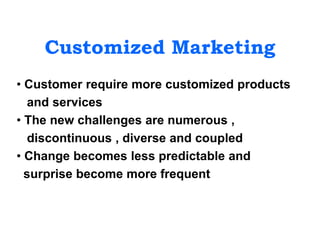
Customized Marketing
• Customer require more customized products
and services
• The new challenges are numerous ,
discontinuous , diverse and coupled
• Change becomes less predictable and
surprise become more frequent
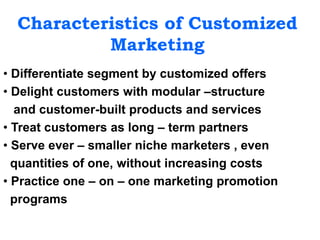
Characteristics of Customized
Marketing
• Differentiate segment by customized offers
• Delight customers with modular –structure
and customer-built products and services
• Treat customers as long – term partners
• Serve ever – smaller niche marketers , even
quantities of one, without increasing costs
• Practice one – on – one marketing promotion
programs
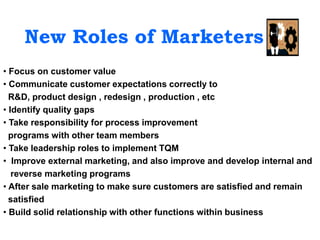
New Roles of Marketers
• Focus on customer value
• Communicate customer expectations correctly to
R&D, product design , redesign , production , etc
• Identify quality gaps
• Take responsibility for process improvement
programs with other team members
• Take leadership roles to implement TQM
• Improve external marketing, and also improve and develop internal and
reverse marketing programs
• After sale marketing to make sure customers are satisfied and remain
satisfied
• Build solid relationship with other functions within business
Exercise No. 4
Who are the Stakeholders in
your Company ?
• List them & Explain their Role in the
Company
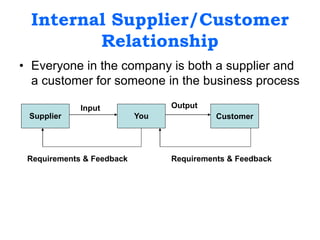
Internal Supplier/Customer
Relationship
• Everyone in the company is both a supplier and
a customer for someone in the business process
Supplier You Customer
Input Output
Requirements & Feedback Requirements & Feedback
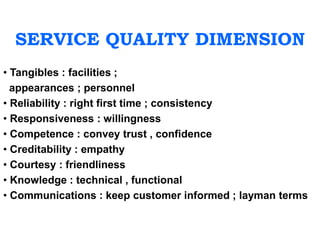
SERVICE QUALITY DIMENSION
• Tangibles : facilities ;
appearances ; personnel
• Reliability : right first time ; consistency
• Responsiveness : willingness
• Competence : convey trust , confidence
• Creditability : empathy
• Courtesy : friendliness
• Knowledge : technical , functional
• Communications : keep customer informed ; layman terms
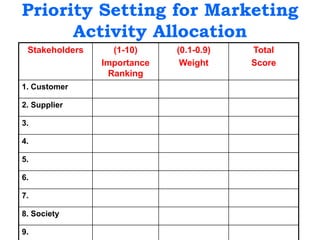
Priority Setting for Marketing
Activity Allocation
Stakeholders (1-10)
Importance
Ranking
(0.1-0.9)
Weight
Total
Score
1. Customer
2. Supplier
3.
4.
5.
6.
7.
8. Society
9.
Competitor Analysis Table
MAIN
COMPETITOR
PRODUCTS/
MARKETERS
BUSINESS
DIRECTION
&
CURRENT
OBJECTIVES
&
STRATEGIES
STRENGHTS WEAKNESS COMPETITVE
POSITION
Group Exercise No.5
CONDUCT A SWOT ANALYSIS OF YOUR
COMPANY’S MARKETING POSITION :
 STRENGTHS
 WEAKNESSES
 OPPORTUNITIES
 THREATS
REVIEW
• Summary of Marketing Programme
• Q & A
• Evaluation
• Close

INTRODUCTION TO MARKETING.ppt

  • 1.
  • 2.
    CONTENTS OF THISCOURSE • Marketing Terminology • Core Concepts of Marketing • Group Exercise No.1 • Marketing Management • Summary / Review • Group Exercise No. 2 • Traditional Marketing • Survival Requirements • Total Quality Marketing • Group Exercise No.3 • Marketing Planning • 4Ps of Marketing • 7 Ps of Marketing • New Roles of Marketers • Group Exercise No. 4 • Who are the Stakeholders in your Company ? • Priority Setting for Marketing Activity • Competitor Analysis • Group Exercise No.5
  • 3.
    MARKETING TERMINOLOGY 1. Marketing: What is it? The ways in which a company encourages people to buy its products by deciding on its product,price,promotion tactics and place. 2. Market Forces : What are these ? The economic influences that affect prices, salaries and he no. of jobs available, which are not controlled by the government. 3. Market Share : The percentage of the total amount of sales of a particular product that a company has. 4. Market Leader : A company that sells more of its product than any other company of its type.
  • 4.
    Contd…. 5. Market Driven: Controlled by what and how much people want to buy. 6. Market Price : The price that a particular product can be sold for at a particular time. 7. Market Research : The process of collecting information about products people like to buy , or what people like or dislike about particular product.
  • 5.
    THE CORE CONCEPTSOF MARKETING 1.Marketing is a social and managerial process by which individuals and groups obtain what they need ad want through creating and exchanging products and value with others. 2. A useful distinction can be drawn between needs, wants and demands. 3. Wants are desires for specific satisfaction of these deeper needs. An American needs food and wants hamburger , needs clothing and wants a Pierre Cardin suit , needs esteem and buys a Cadillac. 4. While people's needs are few, their wants are many. 5. Demands are wants for specific products that are backed up by an ability and willingness to buy them. Wants become demands when backed up by purchasing power.
  • 6.
    Figure 1- CoreConcepts of Marketing Needs Wants Demands Marketing & Marketers Product Utility Value Satisfaction Exchange Transactions Relationship Markets
  • 7.
    Group Exercise No.1 Examples of Needs
  • 8.
  • 9.
  • 10.
    MARKETING MANAGEMENT 1. Marketing(management) is the process of planning and executing the conception , pricing , promotion and distribution of ideas, goods and services to create exchange that satisfy individual and organizational objectives. 2. The popular image of the marketing manager is someone whose task is primarily to stimulate demand for the company's product.
  • 11.
    SUMMARY/REVIEW 1. The marketingconcept holds that the main task of the company is to determine the needs, wants and preferences of a target group of customers and to deliver the desired satisfaction. Its four principles are market focus, customer orientation , coordinated marketing and profitability.
  • 12.
    Exercise No. 2 Duringthe early 1980s, over 4400 auto dealerships in US went out of business, William Turnbull, president of NADA, stated that if the remaining dealers were to survive, they must change their orientation toward consumers. What might have he have meant by that statement ?
  • 13.
    Why Traditional Marketingis Not Good Enough ? 1. Failure to view quality as a competitive weapon. 2. Failure to view marketing as a total integrated function 3. Failure to understand the customer requirements 4. Failure to identify the tool market 5. Failure to build up a long term relationship with all the stake holders 6. Failure to measure the true value of the products and services
  • 14.
    Survival Requirements in Marketing 1.Respond to frequent changes in competitive environment 2. Cope with rapid saturation of markets 3. Take advantage of opportunities in new growth markets 4. Timeliness of introduction of new products/services relative to new offers in the market
  • 15.
    Total Quality Marketing AnApproach, a set of principles and techniques for integrating resources, policies and activities with the aim to achieve the needs of all the stake holders of an organization.
  • 16.
    Key Areas inTotal Quality Marketing 1. A new paradigm in customer , employee , supplier and other stakeholder relationship 2. A long term commitment customer (internal & external) focus and satisfaction 3. A strategic quality focus to reach the highest quality level and serve the changing needs of customers and other stakeholders 4. A continuous improvement philosophy focused on customer value in terms of quality, cost efficiency , delivery and flexibility 5. A total marketing mix to maximize customer value 6. Total employee involvement to develop processes that are customer oriented, flexible and responsive and constantly improving in quality 7. Continuous improvement to human capital
  • 17.
    Exercise No.3 Why WeNeed Marketing Planning?
  • 18.
    What is MarketingPlanning Process ? 1. Corporate Objectives - Non-financial - Clear and precise 2. Marketing Audit - Where is the company now ? - Where does the company want to go? - How should the company organize its resources to get there? 3. Assumptions - Standing the planning environment - Examples : 1) Industrial over – capacity will increase from 105& to 115% as new industrial plans come into operation 2) Price competition will force price levels down by 10% across the board 3) A new product in the field of X will be introduced by our major competitor before the end of the second quarter
  • 19.
    Marketing Planning Process Contd…. 4.Marketing objectives & strategies - Objectives : What you want to achieve? - Strategy : How you plan to achieve your objectives? - Marketing Objectives : About products and markets only For example : a) Existing products in existing markets b) New products for existing markets c) Existing products for new markets d) New products for new markets
  • 20.
    The 4 Psof Marketing • Product • Price • Promotion • Place
  • 21.
    Product • Quality • Features •Style • Options • Brand Name • Guarantees / warranties • Service / spare parts
  • 22.
    Price • List Price •Discounts • Allowances • Credit Terms • Payment period • Rental / lease
  • 23.
    Promotion • Advertising • PersonalSelling • Sales promotion • Point – of – purchase materials • Publicity
  • 24.
    Place • Number andtypes of middleman • Locations / availability • Inventory levels • Transportation
  • 25.
    Total Marketing Mix-7Ps & 7Cs Table 1 7 P `s 7 C `s Products Customer needs & wants Price Cost to Customer Place Convenient Promotion Communication Physical Evidence Conformance context Participants Competent people Process Continuous improvement process
  • 26.
    Customized Marketing • Customerrequire more customized products and services • The new challenges are numerous , discontinuous , diverse and coupled • Change becomes less predictable and surprise become more frequent
  • 27.
    Characteristics of Customized Marketing •Differentiate segment by customized offers • Delight customers with modular –structure and customer-built products and services • Treat customers as long – term partners • Serve ever – smaller niche marketers , even quantities of one, without increasing costs • Practice one – on – one marketing promotion programs
  • 28.
    New Roles ofMarketers • Focus on customer value • Communicate customer expectations correctly to R&D, product design , redesign , production , etc • Identify quality gaps • Take responsibility for process improvement programs with other team members • Take leadership roles to implement TQM • Improve external marketing, and also improve and develop internal and reverse marketing programs • After sale marketing to make sure customers are satisfied and remain satisfied • Build solid relationship with other functions within business
  • 29.
    Exercise No. 4 Whoare the Stakeholders in your Company ? • List them & Explain their Role in the Company
  • 30.
    Internal Supplier/Customer Relationship • Everyonein the company is both a supplier and a customer for someone in the business process Supplier You Customer Input Output Requirements & Feedback Requirements & Feedback
  • 31.
    SERVICE QUALITY DIMENSION •Tangibles : facilities ; appearances ; personnel • Reliability : right first time ; consistency • Responsiveness : willingness • Competence : convey trust , confidence • Creditability : empathy • Courtesy : friendliness • Knowledge : technical , functional • Communications : keep customer informed ; layman terms
  • 32.
    Priority Setting forMarketing Activity Allocation Stakeholders (1-10) Importance Ranking (0.1-0.9) Weight Total Score 1. Customer 2. Supplier 3. 4. 5. 6. 7. 8. Society 9.
  • 33.
  • 34.
    Group Exercise No.5 CONDUCTA SWOT ANALYSIS OF YOUR COMPANY’S MARKETING POSITION :  STRENGTHS  WEAKNESSES  OPPORTUNITIES  THREATS
  • 35.
    REVIEW • Summary ofMarketing Programme • Q & A • Evaluation • Close