Introduction
Machine learning isa subset of artificial intelligence that enables systems to learn
from data, identify patterns, and make decisions with minimal human intervention.
This presentation will explore the fundamentals of machine learning, its various types,
and its growing applications across different industries.
Definition and Fundamentals
Machinelearning involves algorithms that allow computers to learn and improve from
experience. It focuses on the development of systems that can process and analyze
large datasets, leading to better predictions and insights for decision-making.
5.
Types of MachineLearning
The main types of machine learning include supervised learning, unsupervised
learning, and reinforcement learning. Supervised learning relies on labeled data,
whereas unsupervised learning identifies patterns in unlabeled data. Reinforcement
learning optimizes actions through trial and error to maximize expected rewards.
6.
Key Algorithms and
Techniques
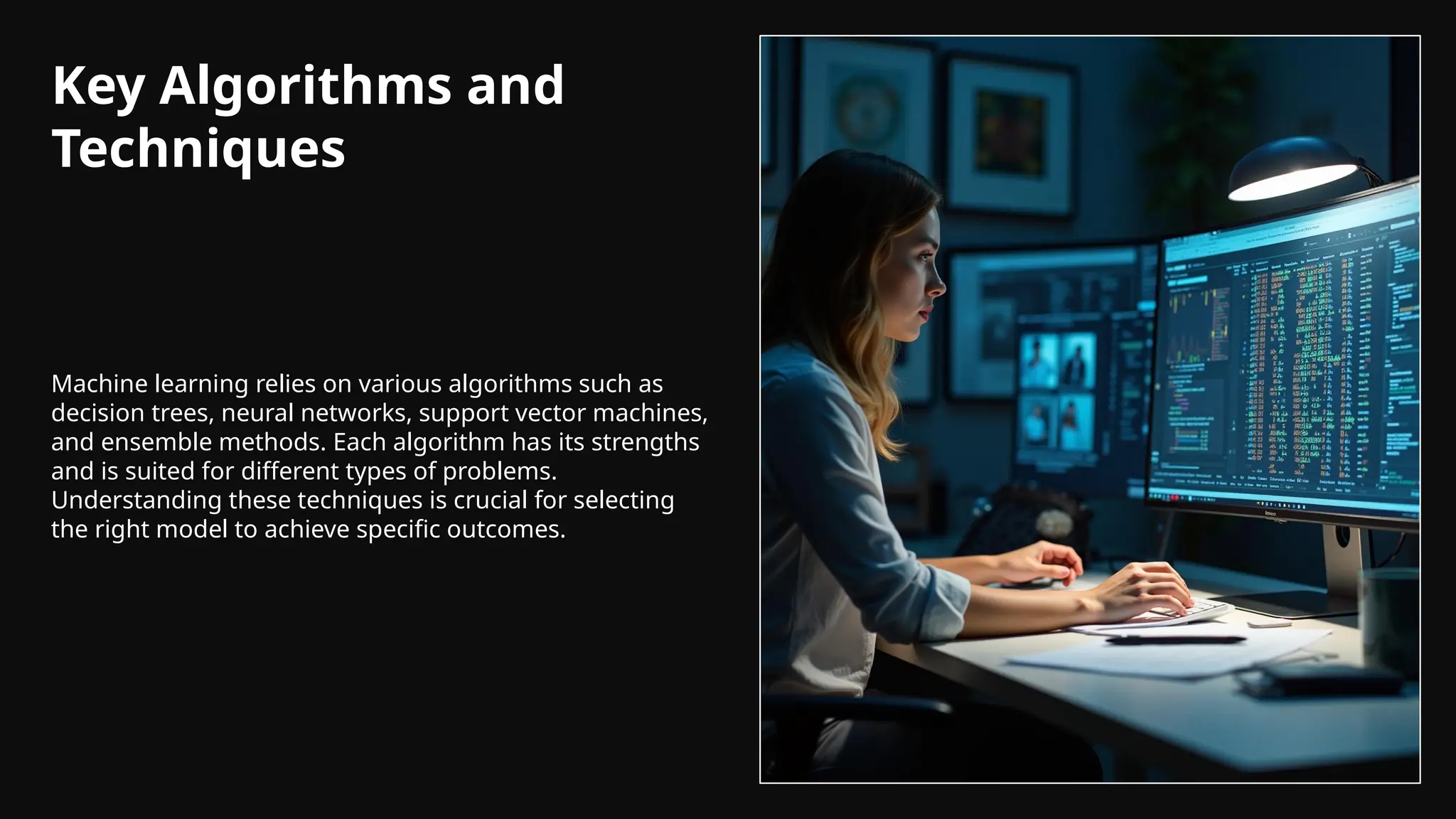
Machinelearning relies on various algorithms such as
decision trees, neural networks, support vector machines,
and ensemble methods. Each algorithm has its strengths
and is suited for different types of problems.
Understanding these techniques is crucial for selecting
the right model to achieve specific outcomes.
Industry Use Cases
Machinelearning is transforming industries like healthcare, finance, and retail. In
healthcare, it aids in disease diagnosis and treatment recommendations. In finance, it
enhances fraud detection and predictive analytics. Retail leverages machine learning
for personalized recommendations and inventory management.
9.
Benefits and Challenges
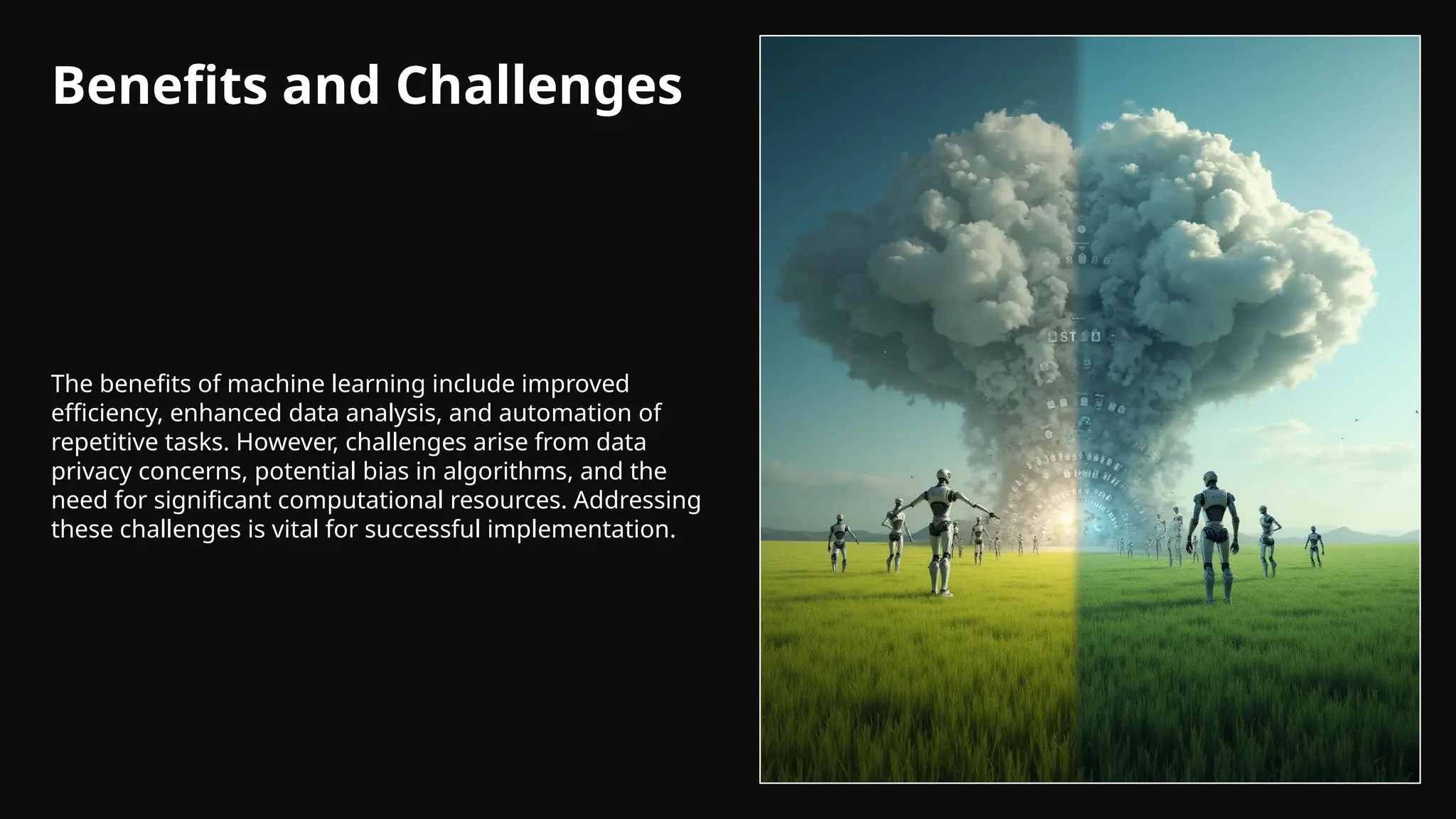
Thebenefits of machine learning include improved
efficiency, enhanced data analysis, and automation of
repetitive tasks. However, challenges arise from data
privacy concerns, potential bias in algorithms, and the
need for significant computational resources. Addressing
these challenges is vital for successful implementation.
10.
Future Trends inMachine Learning
Future trends in machine learning include the rise of explainable AI, natural language
processing advancements, and the integration of machine learning with IoT. These
developments will expand the capabilities of machine learning systems and enhance
their applicability across diverse sectors.
11.
Conclusions
In conclusion, machinelearning is a pivotal technology
that is shaping future innovation. Understanding its
algorithms, applications, and challenges is essential for
organizations aiming to leverage its potential effectively.
As machine learning continues to evolve, it will play a
critical role in driving progress across industries.
12.
CREDITS: This presentation
templatewas created by
Slidesgo, and includes icons,
infographics & images by
Freepik
Thank you!
Do you have any questions?
+00 000 000 000