Introduction to Logic
Circuits
Presented by:
KYREL JOY P. PABLO
Date: 07|04|2024
Objectives:
1.Define logic circuits and Boolean algebra.
2.Identify the symbols and functions of basic logic
gates.
3.Construct truth tables for basic logic gates.
4.Design simple logic circuits using Boolean
algebra.
KP
Logic circuits are the fundamental building
blocks of modern digital systems. They operate
on binary values, 0 and 1, representing "false"
and "true" respectively.
These circuits use logic gates to perform basic
operations like AND, OR, and NOT. They form the
basis for complex computations, data
processing, and control mechanisms.
LOGIC CIRCUITS
Boolean Algebra
Fundamentals
• Boolean algebra is a mathematical
system that deals with logical
operations.
• It uses variables representing truth
values (0 for false, 1 for true) and
logical operators like AND, OR,
and NOT to perform operations.
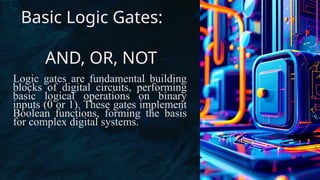
Basic Logic Gates:
AND, OR, NOT
Logic gates are fundamental building
blocks of digital circuits, performing
basic logical operations on binary
inputs (0 or 1). These gates implement
Boolean functions, forming the basis
for complex digital systems.
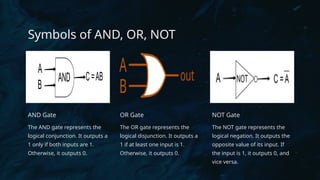
Symbols of AND, OR, NOT
AND Gate
The AND gate represents the
logical conjunction. It outputs a
1 only if both inputs are 1.
Otherwise, it outputs 0.
OR Gate
The OR gate represents the
logical disjunction. It outputs a
1 if at least one input is 1.
Otherwise, it outputs 0.
NOT Gate
The NOT gate represents the
logical negation. It outputs the
opposite value of its input. If
the input is 1, it outputs 0, and
vice versa.
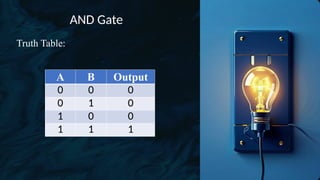
AND Gate
Truth Table:
A B Output
0 0 0
0 1 0
1 0 0
1 1 1
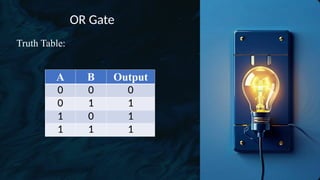
OR Gate
Truth Table:
A B Output
0 0 0
0 1 1
1 0 1
1 1 1
OR Gate
Truth Table:
A Output
0 1
0 1
1 0
1 0
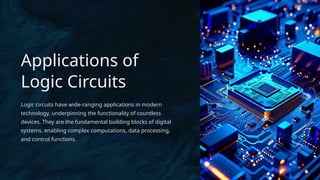
Applications of
Logic Circuits
Logic circuits have wide-ranging applications in modern
technology, underpinning the functionality of countless
devices. They are the fundamental building blocks of digital
systems, enabling complex computations, data processing,
and control functions.
Introduction-to-Logic-Circuits Presentation

Introduction-to-Logic-Circuits Presentation

  • 1.
    Introduction to Logic Circuits Presentedby: KYREL JOY P. PABLO Date: 07|04|2024
  • 2.
    Objectives: 1.Define logic circuitsand Boolean algebra. 2.Identify the symbols and functions of basic logic gates. 3.Construct truth tables for basic logic gates. 4.Design simple logic circuits using Boolean algebra.
  • 4.
    KP Logic circuits arethe fundamental building blocks of modern digital systems. They operate on binary values, 0 and 1, representing "false" and "true" respectively. These circuits use logic gates to perform basic operations like AND, OR, and NOT. They form the basis for complex computations, data processing, and control mechanisms. LOGIC CIRCUITS
  • 5.
    Boolean Algebra Fundamentals • Booleanalgebra is a mathematical system that deals with logical operations. • It uses variables representing truth values (0 for false, 1 for true) and logical operators like AND, OR, and NOT to perform operations.
  • 6.
    Basic Logic Gates: AND,OR, NOT Logic gates are fundamental building blocks of digital circuits, performing basic logical operations on binary inputs (0 or 1). These gates implement Boolean functions, forming the basis for complex digital systems.
  • 7.
    Symbols of AND,OR, NOT AND Gate The AND gate represents the logical conjunction. It outputs a 1 only if both inputs are 1. Otherwise, it outputs 0. OR Gate The OR gate represents the logical disjunction. It outputs a 1 if at least one input is 1. Otherwise, it outputs 0. NOT Gate The NOT gate represents the logical negation. It outputs the opposite value of its input. If the input is 1, it outputs 0, and vice versa.
  • 8.
    AND Gate Truth Table: AB Output 0 0 0 0 1 0 1 0 0 1 1 1
  • 9.
    OR Gate Truth Table: AB Output 0 0 0 0 1 1 1 0 1 1 1 1
  • 10.
    OR Gate Truth Table: AOutput 0 1 0 1 1 0 1 0
  • 11.
    Applications of Logic Circuits Logiccircuits have wide-ranging applications in modern technology, underpinning the functionality of countless devices. They are the fundamental building blocks of digital systems, enabling complex computations, data processing, and control functions.