Introduction to
Java Servlets
https://nareshit.com/courses/advanced-java-online-training
Introduction to Java Servlets
Java Servlets are server-side Java programs that handle client
requests and generate dynamic web content. They run on a web
server, extending its capabilities by processing incoming
requests, managing sessions, and generating responses,
typically in HTML. Servlets use the Java Servlet API and are a
key component of Java EE for building scalable, robust web
applications. They provide a powerful, efficient way to build
interactive web pages and can interact with databases, perform
business logic, and integrate with other web technologies.
What is Java Servlet?
A Java Servlet is a Java program that runs on a
server and handles requests from web clients,
typically browsers. Servlets are used to create
dynamic web content by interacting with web clients
via the HTTP protocol. Here's an overview of their
key features and functions:
nareshit.com/courses/advanced-java-online-training
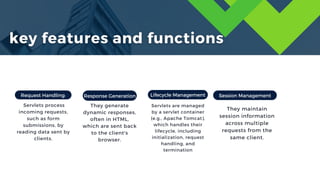
Request Handling: Response Generation Lifecycle Management Session Management
Servlets process
incoming requests,
such as form
submissions, by
reading data sent by
clients.
They generate
dynamic responses,
often in HTML,
which are sent back
to the client's
browser.
Servlets are managed
by a servlet container
(e.g., Apache Tomcat),
which handles their
lifecycle, including
initialization, request
handling, and
termination
They maintain
session information
across multiple
requests from the
same client.
Platform Independence: Servlets are written in
Java, making them platform-independent. They
can run on any server that supports the Java
Servlet API.
Performance: Servlets are designed for
performance. They are loaded once and can
handle multiple requests, reducing the overhead
associated with process creation and resource
allocation.
Portability: Since servlets follow the Java EE
standard, they can be deployed on any compliant
servlet container, such as Apache Tomcat, Jetty, or
JBoss.
Scalability: Servlets are well-suited for building
scalable applications. They can handle large numbers
of concurrent requests and can be easily integrated
with other Java EE components like EJBs, JMS, and
JDBC.
Security: Servlets support a range of security features,
including authentication, authorization, and data
encryption. They can be configured to run in a secure
environment and use Java's robust security model.
Extensibility: Servlets are highly extensible.
Developers can create complex web applications by
extending the basic functionality provided by the Java
Servlet API.
Contact Us
+91 8179191999
Phone
Mail
Website
Address
https://nareshit.com/courses/advanced-java-online-training
2nd Floor, Durga Bhavani Plaza, Ameerpet, Hyderabad, 500016
support@nareshit.com
Thank You!

Introduction to Java Servlets - Naresh IT

  • 1.
  • 2.
    Introduction to JavaServlets Java Servlets are server-side Java programs that handle client requests and generate dynamic web content. They run on a web server, extending its capabilities by processing incoming requests, managing sessions, and generating responses, typically in HTML. Servlets use the Java Servlet API and are a key component of Java EE for building scalable, robust web applications. They provide a powerful, efficient way to build interactive web pages and can interact with databases, perform business logic, and integrate with other web technologies.
  • 3.
    What is JavaServlet? A Java Servlet is a Java program that runs on a server and handles requests from web clients, typically browsers. Servlets are used to create dynamic web content by interacting with web clients via the HTTP protocol. Here's an overview of their key features and functions: nareshit.com/courses/advanced-java-online-training
  • 4.
    Request Handling: ResponseGeneration Lifecycle Management Session Management Servlets process incoming requests, such as form submissions, by reading data sent by clients. They generate dynamic responses, often in HTML, which are sent back to the client's browser. Servlets are managed by a servlet container (e.g., Apache Tomcat), which handles their lifecycle, including initialization, request handling, and termination They maintain session information across multiple requests from the same client.
  • 5.
    Platform Independence: Servletsare written in Java, making them platform-independent. They can run on any server that supports the Java Servlet API. Performance: Servlets are designed for performance. They are loaded once and can handle multiple requests, reducing the overhead associated with process creation and resource allocation. Portability: Since servlets follow the Java EE standard, they can be deployed on any compliant servlet container, such as Apache Tomcat, Jetty, or JBoss. Scalability: Servlets are well-suited for building scalable applications. They can handle large numbers of concurrent requests and can be easily integrated with other Java EE components like EJBs, JMS, and JDBC. Security: Servlets support a range of security features, including authentication, authorization, and data encryption. They can be configured to run in a secure environment and use Java's robust security model. Extensibility: Servlets are highly extensible. Developers can create complex web applications by extending the basic functionality provided by the Java Servlet API.
  • 6.
    Contact Us +91 8179191999 Phone Mail Website Address https://nareshit.com/courses/advanced-java-online-training 2ndFloor, Durga Bhavani Plaza, Ameerpet, Hyderabad, 500016 support@nareshit.com Thank You!