Introduction to GoIntroduction to Go
Commitmas vBrownBagCommitmas vBrownBag
Anthony Chow
Twitter: @vCloudernBeer
GitHub: vCloudernBeer
Blog: http://cloudn1n3.blogspot.com
Dec 30, 2015
Why do I want/need to learn Go?Why do I want/need to learn Go?
 Developer:
 Always good to know something new
 Open source projects written in Go
 Sharpen existing programming skill
 Operator:
 Software defined Data Center
 Automation/Scripting
 At least know how to read the code
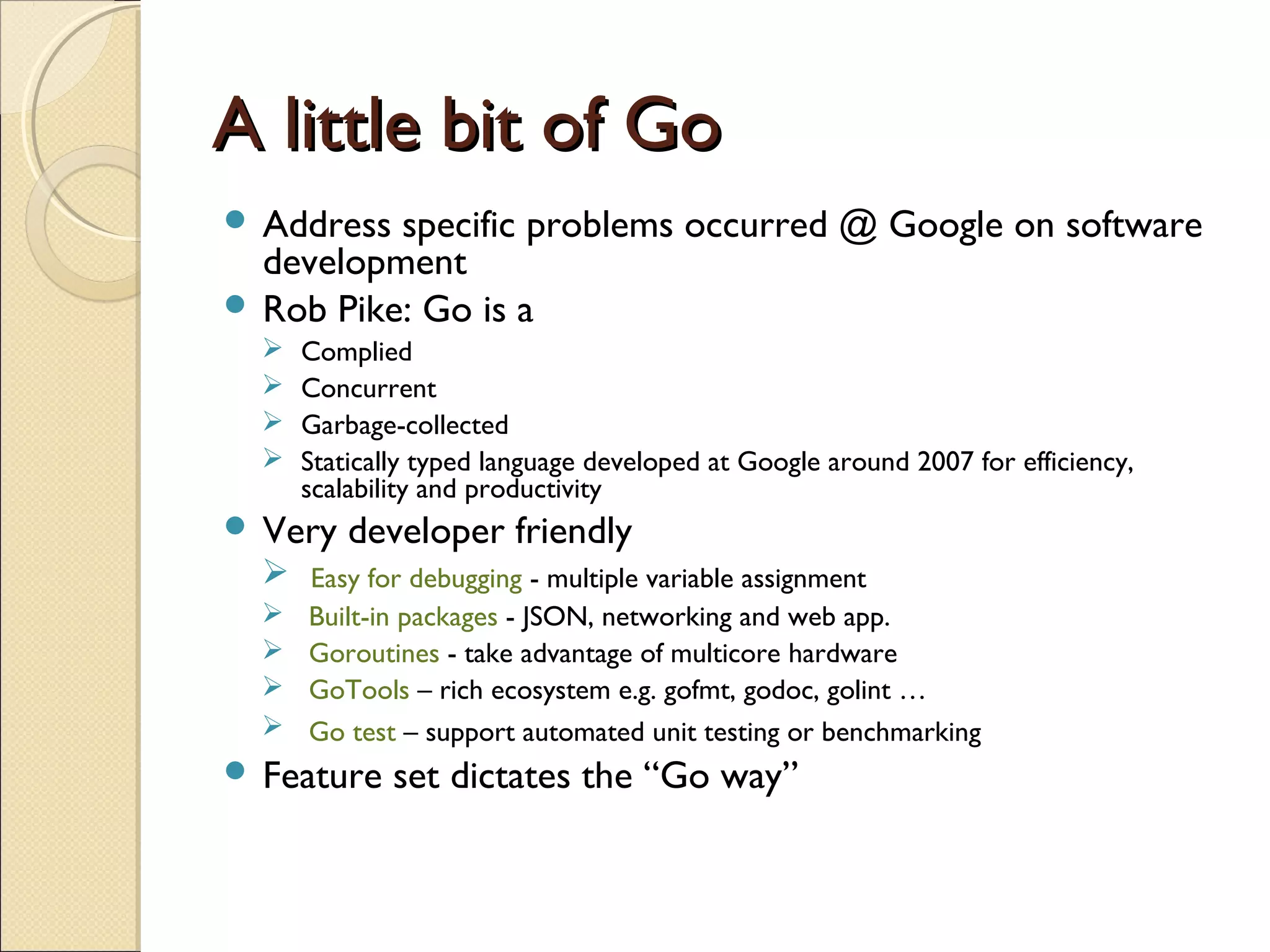
A little bit of GoA little bit of Go
 Address specific problems occurred @ Google on software
development
 Rob Pike: Go is a
 Complied
 Concurrent
 Garbage-collected
 Statically typed language developed at Google around 2007 for efficiency,
scalability and productivity
 Very developer friendly
 Easy for debugging - multiple variable assignment
 Built-in packages - JSON, networking and web app.
 Goroutines - take advantage of multicore hardware
 GoTools – rich ecosystem e.g. gofmt, godoc, golint …
 Go test – support automated unit testing or benchmarking
 Feature set dictates the “Go way”
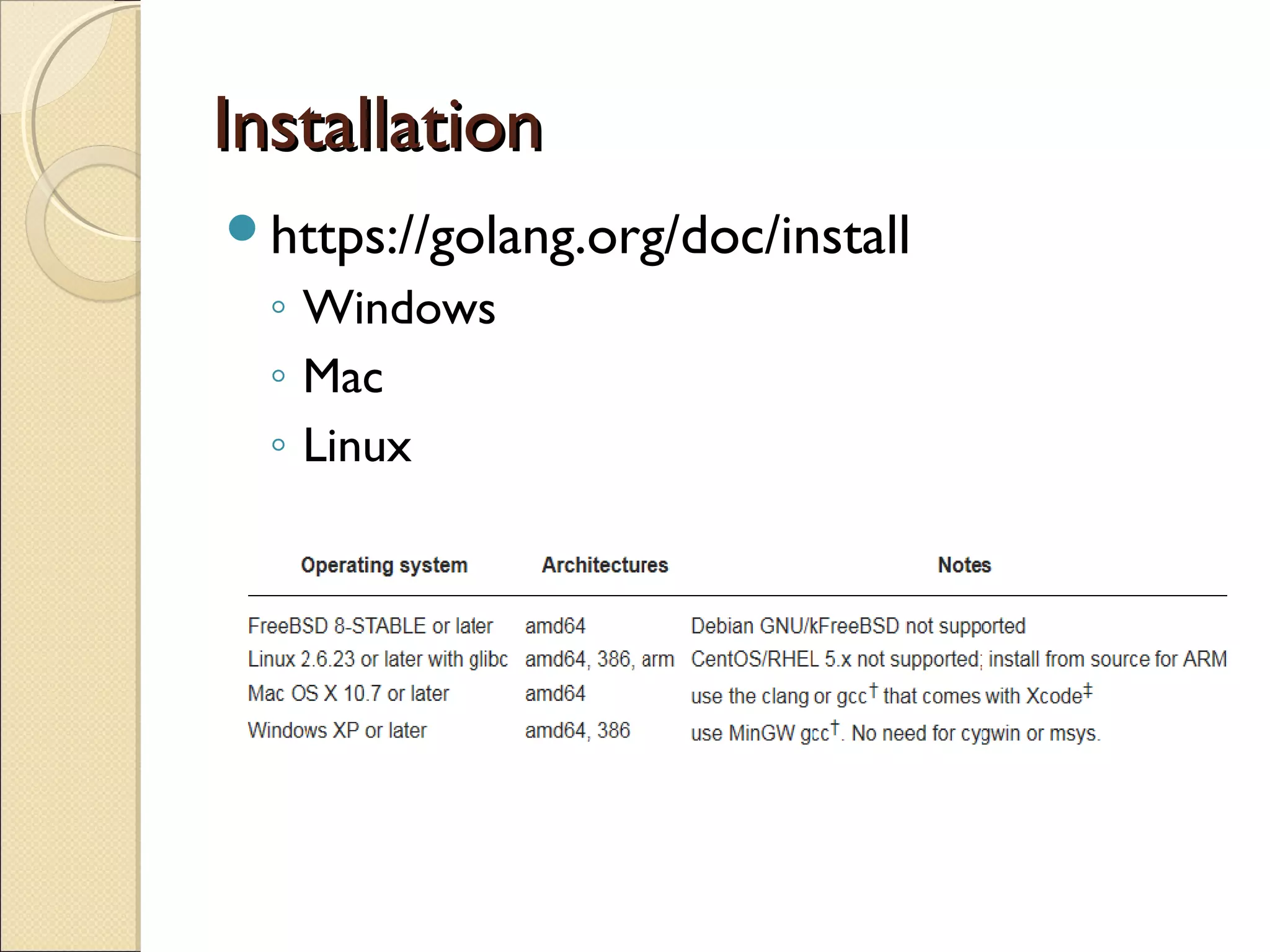
InstallationInstallation
https://golang.org/doc/install
◦ Windows
◦ Mac
◦ Linux
Go TerminologiesGo Terminologies
 Important to know:
◦ Able to understand the language
◦ Able to read compile error and warning.
 Terms:
◦ Package
◦ Block - Delimiter {}, (), []
◦ Scope
◦ Variable
◦ Type – value, reference
 Features:
◦ Memory management - garbage collection, stack size
◦ Slice – prefer over array
◦ Map – similar to the “dict” in Python (key-value store)
◦ Composition (no inheritance)
◦ Concurrency
◦ Interface
◦ Channels
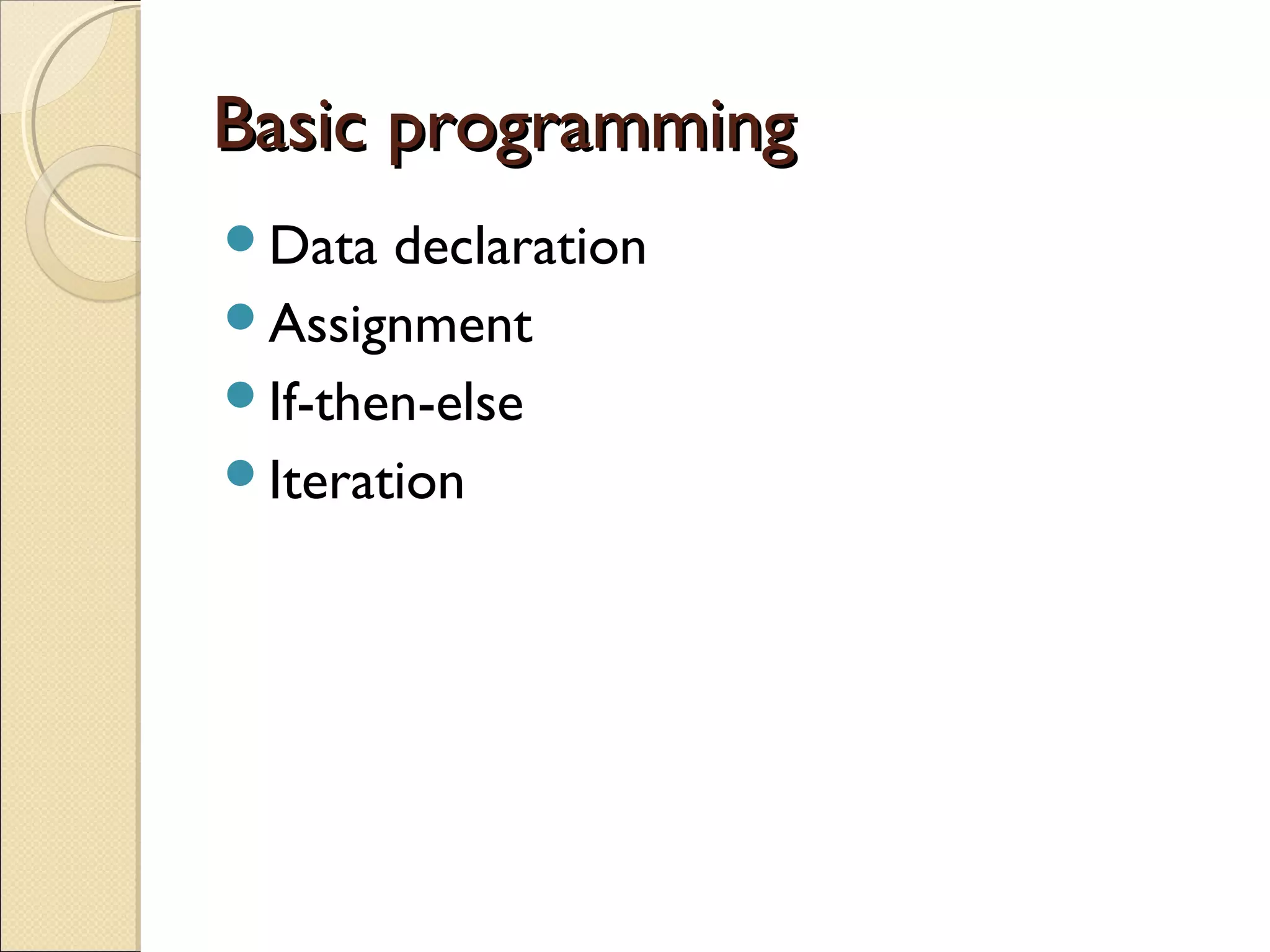
Basic programmingBasic programming
Data declaration
Assignment
If-then-else
Iteration
Demo #1
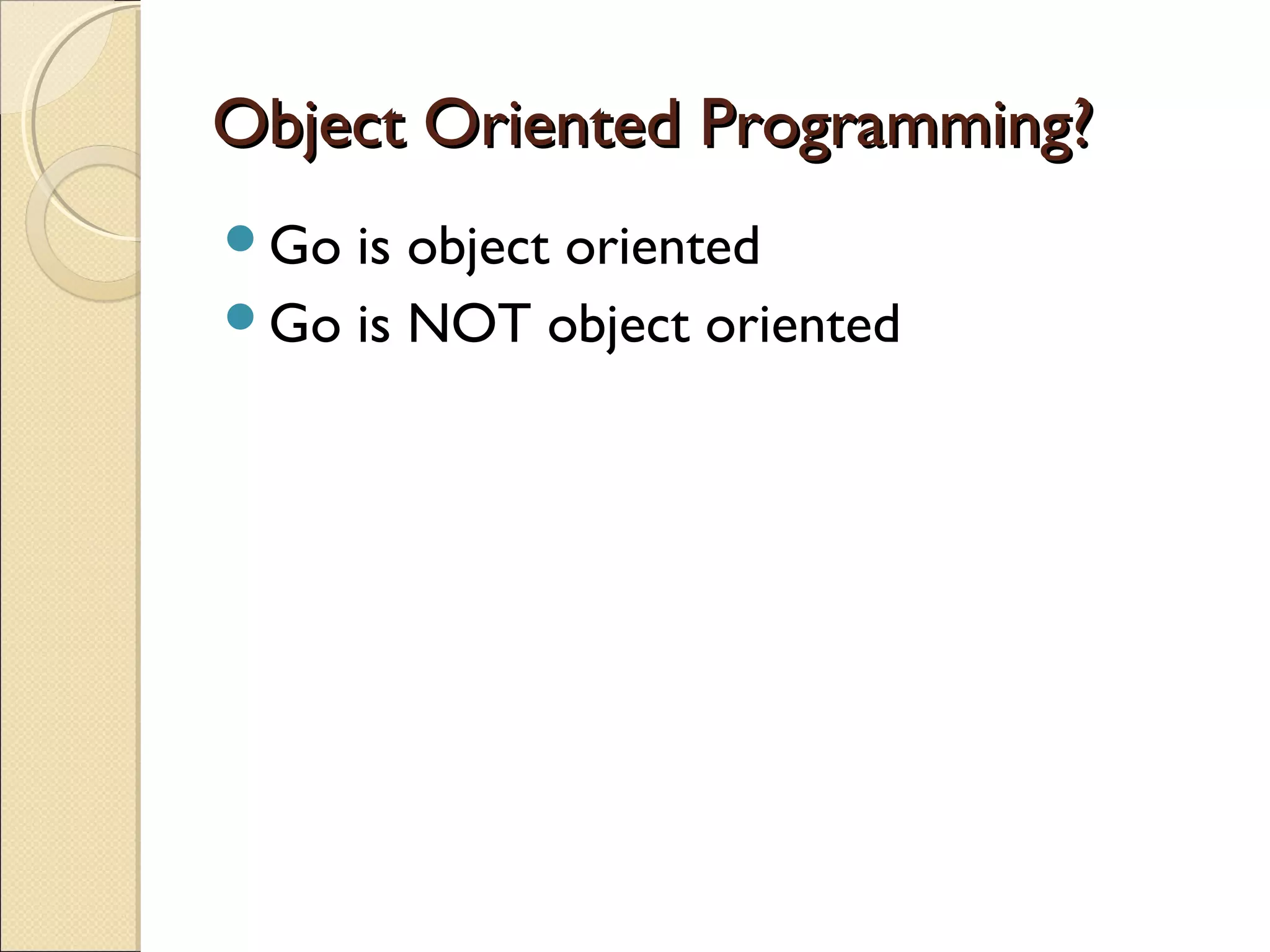
Object Oriented Programming?Object Oriented Programming?
Go is object oriented
Go is NOT object oriented
Demo #2
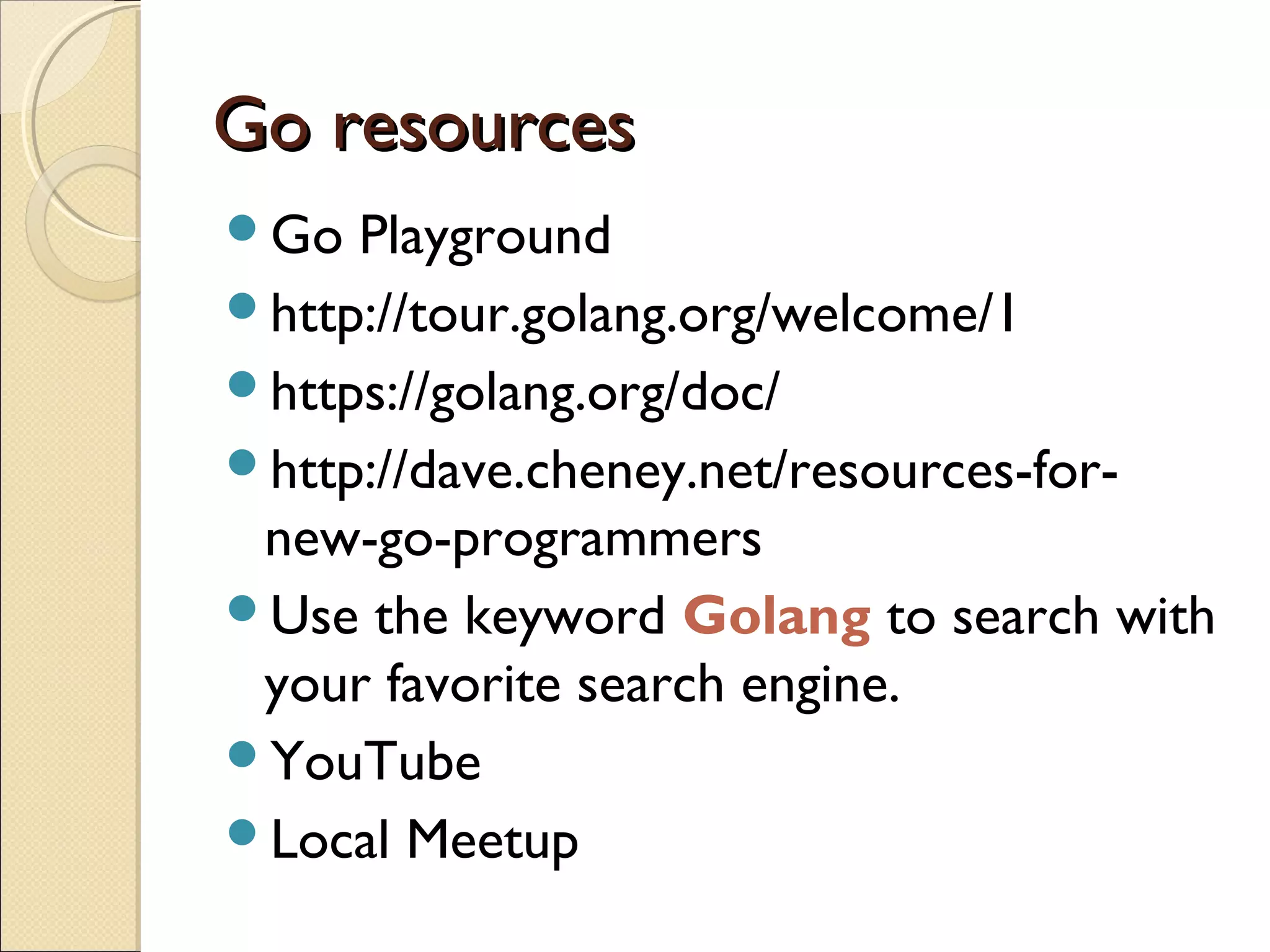
Go resourcesGo resources
Go Playground
http://tour.golang.org/welcome/1
https://golang.org/doc/
http://dave.cheney.net/resources-for-
new-go-programmers
Use the keyword Golang to search with
your favorite search engine.
YouTube
Local Meetup

Introduction to go

  • 1.
    Introduction to GoIntroductionto Go Commitmas vBrownBagCommitmas vBrownBag Anthony Chow Twitter: @vCloudernBeer GitHub: vCloudernBeer Blog: http://cloudn1n3.blogspot.com Dec 30, 2015
  • 2.
    Why do Iwant/need to learn Go?Why do I want/need to learn Go?  Developer:  Always good to know something new  Open source projects written in Go  Sharpen existing programming skill  Operator:  Software defined Data Center  Automation/Scripting  At least know how to read the code
  • 3.
    A little bitof GoA little bit of Go  Address specific problems occurred @ Google on software development  Rob Pike: Go is a  Complied  Concurrent  Garbage-collected  Statically typed language developed at Google around 2007 for efficiency, scalability and productivity  Very developer friendly  Easy for debugging - multiple variable assignment  Built-in packages - JSON, networking and web app.  Goroutines - take advantage of multicore hardware  GoTools – rich ecosystem e.g. gofmt, godoc, golint …  Go test – support automated unit testing or benchmarking  Feature set dictates the “Go way”
  • 4.
  • 5.
    Go TerminologiesGo Terminologies Important to know: ◦ Able to understand the language ◦ Able to read compile error and warning.  Terms: ◦ Package ◦ Block - Delimiter {}, (), [] ◦ Scope ◦ Variable ◦ Type – value, reference  Features: ◦ Memory management - garbage collection, stack size ◦ Slice – prefer over array ◦ Map – similar to the “dict” in Python (key-value store) ◦ Composition (no inheritance) ◦ Concurrency ◦ Interface ◦ Channels
  • 6.
    Basic programmingBasic programming Datadeclaration Assignment If-then-else Iteration
  • 7.
  • 8.
    Object Oriented Programming?ObjectOriented Programming? Go is object oriented Go is NOT object oriented
  • 9.
  • 10.
    Go resourcesGo resources GoPlayground http://tour.golang.org/welcome/1 https://golang.org/doc/ http://dave.cheney.net/resources-for- new-go-programmers Use the keyword Golang to search with your favorite search engine. YouTube Local Meetup