Lecture 1
 Data Structures By Seymour Lipschutz
[Schaum’s Outline]
 An Introduction to Data structures with
Applications by Tremblay and Sorenson
 Introduction to Data Structure
 Data Structures
 Data Structure Operations
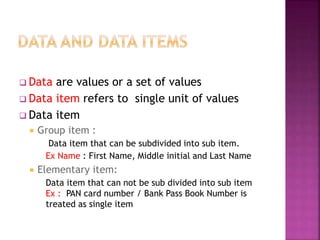
 Data are values or a set of values
 Data item refers to single unit of values
 Data item
 Group item :
Data item that can be subdivided into sub item.
Ex Name : First Name, Middle initial and Last Name
 Elementary item:
Data item that can not be sub divided into sub item
Ex : PAN card number / Bank Pass Book Number is
treated as single item
Collection of data are frequently organized
into a hierarchy of fields, records and files
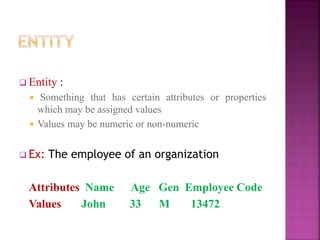
 Entity :
 Something that has certain attributes or properties
which may be assigned values
 Values may be numeric or non-numeric
 Ex: The employee of an organization
Attributes Name Age Gen Employee Code
Values John 33 M 13472
 Entity with similar attributes ( e.g all employees
of an organization) form an entity set
 Each attribute of an entity set has a range of
values [ the set of possible values that could be
assigned to the particular attribute]
 Information: Data with given attribute or
processed data
 Field is a single elementary unit of information
representing an attribute of an entity
 Record is the collection of field values of a given
entity
 File is the collection of records of the entities in a
given entity set
Nam
e
Age Gen Roll Number Branch
A 17 M 109cs0132 CSE
B 18 M 109ee1234 EE
C 19 F 109ce0012 CE
D 20 F 108mm0132 MM
 Record
 Fixed Length
 Variable Length
 Study of Data Structure includes the following
three steps
 Logical or Mathematical description of the structure
 Implementation of the structure on a computer
 Quantitative analysis of the structure, which includes
determining the amount of memory needed to store the
structure and the time required to process the structure
 A data type is a term which refers to the kind of
data that may appear in computation.
 Ex: in C
int, float, char, double, long double, etc.
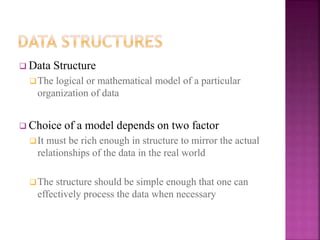
 Data Structure
The logical or mathematical model of a particular
organization of data
 Choice of a model depends on two factor
It must be rich enough in structure to mirror the actual
relationships of the data in the real world
The structure should be simple enough that one can
effectively process the data when necessary
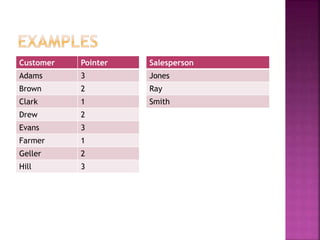
Customer Salesperson
Adams Smith
Brown Ray
Clark Jones
Drew Ray
Evans Smith
Farmer Jones
Geller Ray
Hill Smith
Customer Pointer
Adams 3
Brown 2
Clark 1
Drew 2
Evans 3
Farmer 1
Geller 2
Hill 3
Salesperson
Jones
Ray
Smith
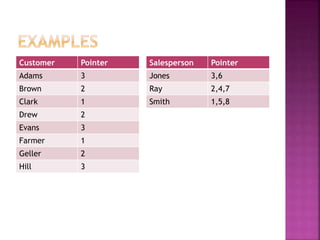
Customer Pointer
Adams 3
Brown 2
Clark 1
Drew 2
Evans 3
Farmer 1
Geller 2
Hill 3
Salesperson Pointer
Jones 3,6
Ray 2,4,7
Smith 1,5,8
 A data structure is a way to logically organize
data that specifies:
 A set of data elements i.e., a data object and
 A set of operations which may legally be applied
to elements of this data object.
 Data appearing in DS are processed by means of
certain operation
 Particular DS one chooses for a given situation
depends largely on the frequency with which
specific operations are performed
 Traversing: Accessing each record exactly once so
that certain items in the record may be processed
[ Also known as Visiting the record]
 Searching: Finding the location of the record with
a given key value, or finding the locations of all
record which satisfy one or more conditions
 Inserting : Adding a new record to the structure
 Deleting : Removing a record from the structure
 In real life applications, various kind of data
other than the primitive data are involved.
 Manipulation of real-life data (user data)
requires the following essential tasks:
a) Storage representation of user data: User data
should be stored in such a way that computer can
understand
b) Retrieval of stored data: Data stored in a
computer should be retrieved in such a way that user
can understand.
c) Transformation of user data: Various operations
which require to be performed on user data so that it
can be transformed from one form to another.
Introduction to DSA

Introduction to DSA

  • 1.
  • 2.
     Data StructuresBy Seymour Lipschutz [Schaum’s Outline]  An Introduction to Data structures with Applications by Tremblay and Sorenson
  • 3.
     Introduction toData Structure  Data Structures  Data Structure Operations
  • 4.
     Data arevalues or a set of values  Data item refers to single unit of values  Data item  Group item : Data item that can be subdivided into sub item. Ex Name : First Name, Middle initial and Last Name  Elementary item: Data item that can not be sub divided into sub item Ex : PAN card number / Bank Pass Book Number is treated as single item
  • 5.
    Collection of dataare frequently organized into a hierarchy of fields, records and files
  • 6.
     Entity : Something that has certain attributes or properties which may be assigned values  Values may be numeric or non-numeric  Ex: The employee of an organization Attributes Name Age Gen Employee Code Values John 33 M 13472
  • 7.
     Entity withsimilar attributes ( e.g all employees of an organization) form an entity set  Each attribute of an entity set has a range of values [ the set of possible values that could be assigned to the particular attribute]  Information: Data with given attribute or processed data
  • 8.
     Field isa single elementary unit of information representing an attribute of an entity  Record is the collection of field values of a given entity  File is the collection of records of the entities in a given entity set
  • 9.
    Nam e Age Gen RollNumber Branch A 17 M 109cs0132 CSE B 18 M 109ee1234 EE C 19 F 109ce0012 CE D 20 F 108mm0132 MM
  • 10.
     Record  FixedLength  Variable Length
  • 11.
     Study ofData Structure includes the following three steps  Logical or Mathematical description of the structure  Implementation of the structure on a computer  Quantitative analysis of the structure, which includes determining the amount of memory needed to store the structure and the time required to process the structure
  • 12.
     A datatype is a term which refers to the kind of data that may appear in computation.  Ex: in C int, float, char, double, long double, etc.
  • 13.
     Data Structure Thelogical or mathematical model of a particular organization of data  Choice of a model depends on two factor It must be rich enough in structure to mirror the actual relationships of the data in the real world The structure should be simple enough that one can effectively process the data when necessary
  • 14.
    Customer Salesperson Adams Smith BrownRay Clark Jones Drew Ray Evans Smith Farmer Jones Geller Ray Hill Smith
  • 15.
    Customer Pointer Adams 3 Brown2 Clark 1 Drew 2 Evans 3 Farmer 1 Geller 2 Hill 3 Salesperson Jones Ray Smith
  • 16.
    Customer Pointer Adams 3 Brown2 Clark 1 Drew 2 Evans 3 Farmer 1 Geller 2 Hill 3 Salesperson Pointer Jones 3,6 Ray 2,4,7 Smith 1,5,8
  • 17.
     A datastructure is a way to logically organize data that specifies:  A set of data elements i.e., a data object and  A set of operations which may legally be applied to elements of this data object.
  • 18.
     Data appearingin DS are processed by means of certain operation  Particular DS one chooses for a given situation depends largely on the frequency with which specific operations are performed
  • 19.
     Traversing: Accessingeach record exactly once so that certain items in the record may be processed [ Also known as Visiting the record]  Searching: Finding the location of the record with a given key value, or finding the locations of all record which satisfy one or more conditions
  • 20.
     Inserting :Adding a new record to the structure  Deleting : Removing a record from the structure
  • 21.
     In reallife applications, various kind of data other than the primitive data are involved.  Manipulation of real-life data (user data) requires the following essential tasks: a) Storage representation of user data: User data should be stored in such a way that computer can understand b) Retrieval of stored data: Data stored in a computer should be retrieved in such a way that user can understand. c) Transformation of user data: Various operations which require to be performed on user data so that it can be transformed from one form to another.