Mobile Technologies –Definition, Types, Uses,
Advantages
• Definition: A mobile application (also called a mobile app) is a type of application
designed to run on a mobile device, which can be a smartphone or tablet
computer. Even if apps are usually small software units with limited function, they
still manage to provide users with quality services and experiences.
• In which a user utilizes a mobile phone to perform communications-related tasks,
such as communicating with friends, relatives, and others.
• Applications: Data transmission, voice communication, video conferencing, and
mobile commerce.
• Examples: Banking apps, social media platforms, gaming applications, and fitness
tracking apps.
• Key Features: Enables seamless multitasking, GPS tracking, internet browsing,
high-speed connectivity, and mobile gaming.
3.
Evolution of MobileTechnology and Types of Mobile Apps
Evolution:
• Initial Phase: Early mobile phones were limited to calling and messaging.
• Progression: Transition from basic functionalities to internet browsing, high-
definition media streaming, and smart assistants.
• Future Trends: AI integration, 5G technology, enhanced security features, and
AR/VR applications.
Types:
• Native Apps: Developed for specific platforms like Android and iOS, providing
optimal performance.
• Web Apps: Accessible via a browser, requiring an internet connection for
operation.
4.
Evolution of MobileTechnology and Types of Mobile Apps
Categories:
• Gaming Apps: The equivalent of computer video games, they are among the
most popular types of apps. Interactive entertainment such as PUBG, Candy
Crush, and Call of Duty.
• Productivity Apps: These focus on improving business efficiency by easing
various tasks such as sending emails, tracking work progress, booking hotels, and
much more. Facilitate work efficiency with tools like Google Docs, Trello, and
Evernote.
• Lifestyle & Entertainment Apps: Increasingly popular, these encompass many
aspects of personal lifestyle and socialization such as communicating on social
media, as well as sharing (and watching) videos. Social media (Facebook,
Instagram), streaming platforms (Netflix, YouTube).
5.
Types of MobileTechnologies
Followings are the few famous mobile technologies:
• SMS (Short Message Service)
• MMS (Multimedia Messaging Service)
• 1G (First Generation)
• 2G (Second Generation)
• 3G (Third Generation)
• 4G (fourth generation)
• GSM (Global System for Mobile technology)
• CDMA (Code Division Multiple Access)
• Wi-Fi (Wireless Fidelity)
6.
1. SMS -Short Message Service:
• Definition: “SMS” stands for “Short Message Service.” It is now the most
widely used and oldest text messaging service. SMS allows users to send text
messages up to 140-160 characters
• Features:
1. Cost-effective communication tool.
2. Initially developed for GSM but now available on all cellular networks.
3. Used for notifications, alerts, promotions, and marketing campaigns.
Types of Mobile Technologies
7.
2. MMS -Multimedia Messaging Service:
• Definition: MMS (Multimedia Messaging Service) messaging is a standard
method of delivering multimedia material, including messages. can send up to
forty seconds of video, one picture, a multi-image slideshow, or audio. If you
enter in a text-only message, for example, it will be transmitted by SMS. If you
include a graphic or video, the multimedia part will be sent via MMS. Similarly,
if someone sends you a multimedia message, your phone will automatically
receive the file via MMS.
• Features:
1. Can deliver up to 40 seconds of video or multiple image slideshows.
2. Integrated within the messaging app.
3. Enhances communication with rich media content.
Types of Mobile Technologies
8.
3. 1G (FirstGeneration) - 1982: Analog voice-only communication with large,
heavy phones and poor network quality.
4. 2G(Second Generation) - 1992 : Introduced digital modulation, improving call
quality and enabling SMS (Short MessaginEnabled internet
connectivity on mobile phones, marking the beginning of
mainstream mobile internet use. Smartphones were introduced, and
networks used telephone towers for better signal transmission.g
Service) and low-data rate applications.
5. 3G (Third Generation) - 2001: Enabled internet connectivity on mobile
phones, marking the beginning of mainstream mobile internet use.
Smartphones were introduced, and networks used telephone towers for better
signal transmission.
Types of Mobile Technologies
9.
6.4G (Fourth Generation)- 2012 (UK launch): Known as 4G LTE, it
revolutionized mobile internet with high-speed browsing and HD streaming,
making smartphones as powerful as laptops. 5G is now emerging for even faster
connectivity.
7. Global System for Mobile technology : The (GSM) is an acronym for Global
System for Mobile Communication.GSM is a cellular technology that is open and
digital and is used for mobile communication.
8. Code Division Multiple Access: The (CDMA) is an acronym for code division
multiple access.It is a channel access mechanism that also serves as an example
of multiple access. Multiple access simply means that data from multiple
transmitters can be delivered onto a single communication channel at the same
time.
Types of Mobile Technologies
10.
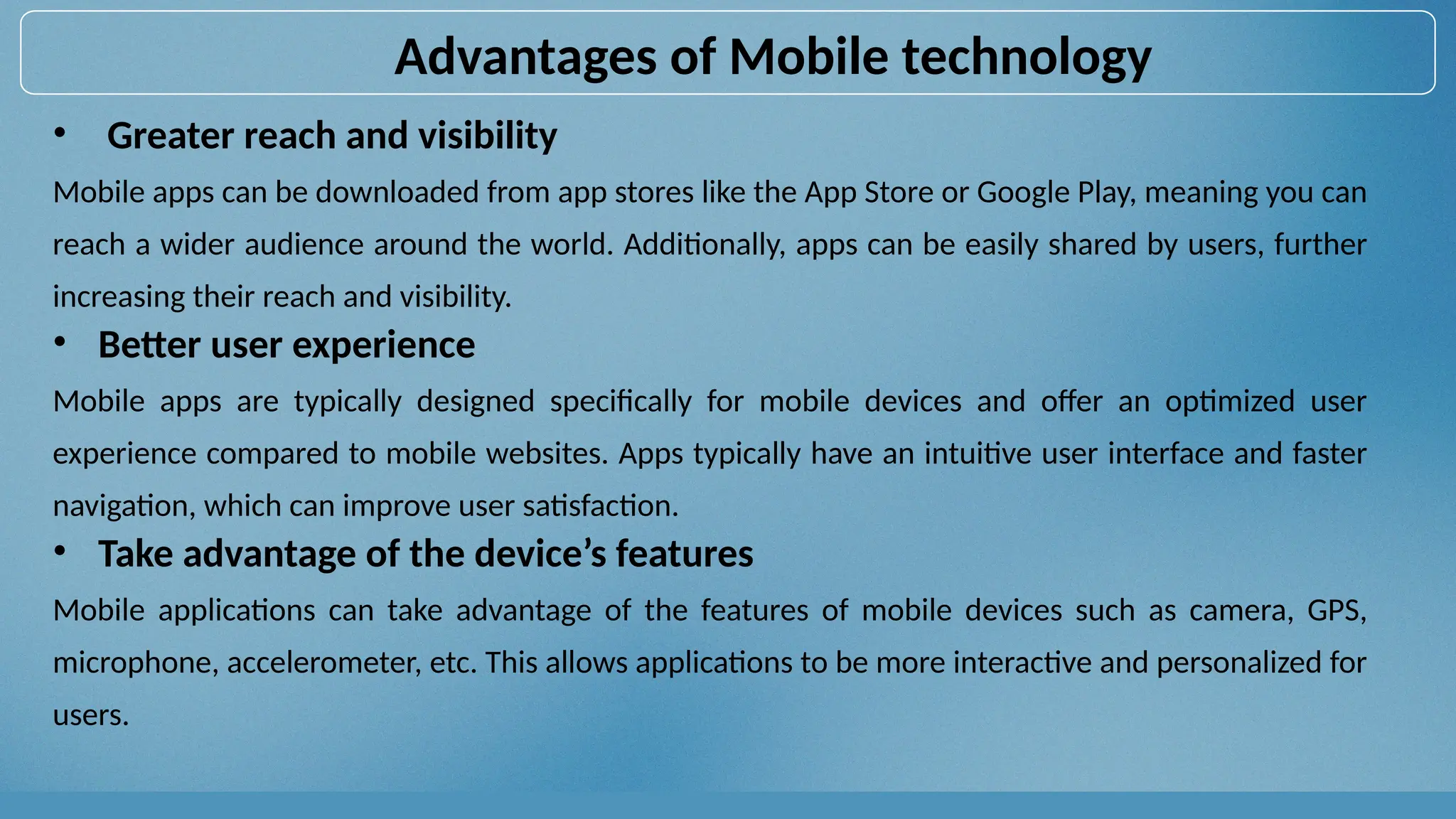
• Greater reachand visibility
Mobile apps can be downloaded from app stores like the App Store or Google Play, meaning you can
reach a wider audience around the world. Additionally, apps can be easily shared by users, further
increasing their reach and visibility.
• Better user experience
Mobile apps are typically designed specifically for mobile devices and offer an optimized user
experience compared to mobile websites. Apps typically have an intuitive user interface and faster
navigation, which can improve user satisfaction.
• Take advantage of the device’s features
Mobile applications can take advantage of the features of mobile devices such as camera, GPS,
microphone, accelerometer, etc. This allows applications to be more interactive and personalized for
users.
Advantages of Mobile technology
11.
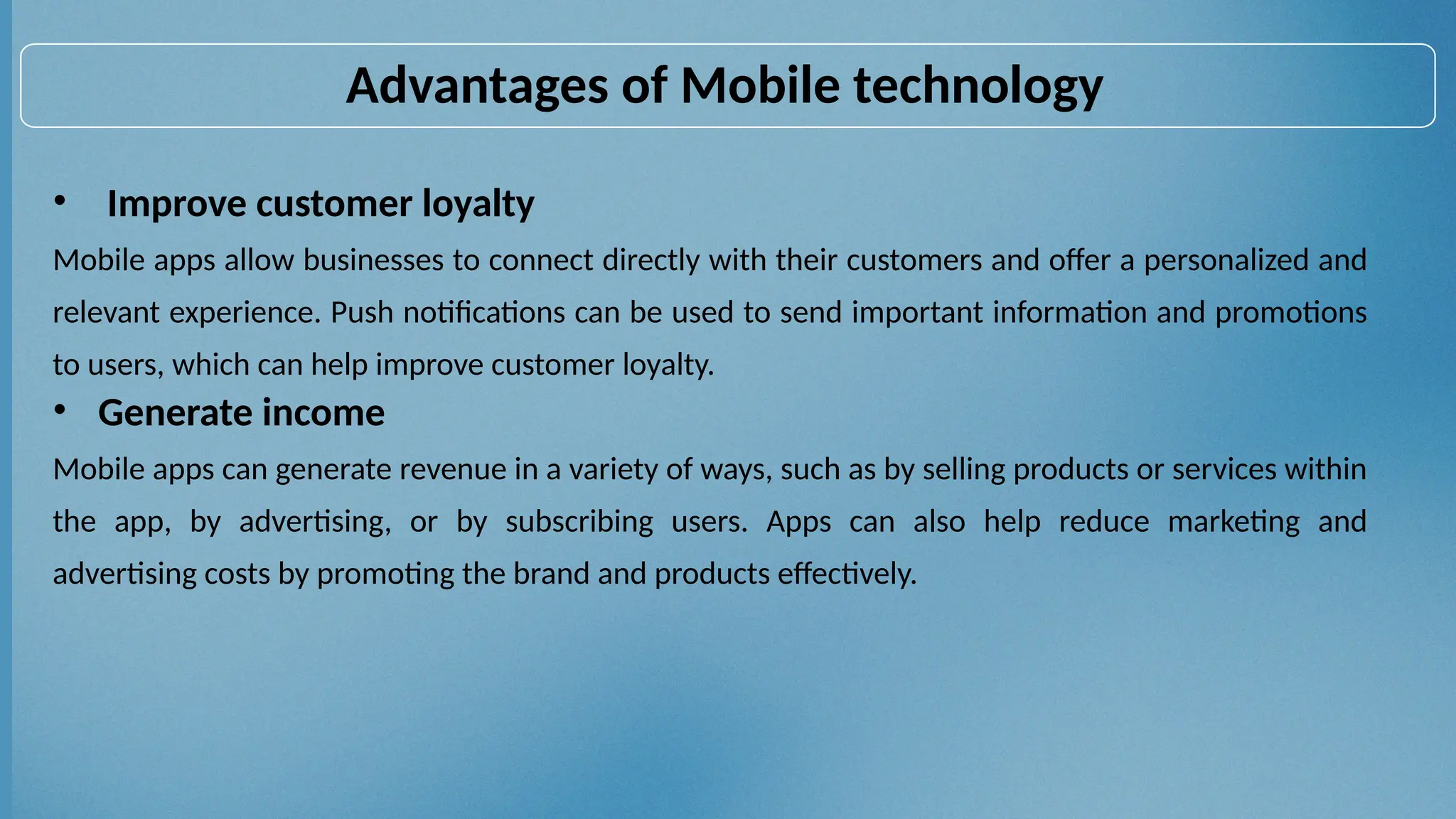
• Improve customerloyalty
Mobile apps allow businesses to connect directly with their customers and offer a personalized and
relevant experience. Push notifications can be used to send important information and promotions
to users, which can help improve customer loyalty.
• Generate income
Mobile apps can generate revenue in a variety of ways, such as by selling products or services within
the app, by advertising, or by subscribing users. Apps can also help reduce marketing and
advertising costs by promoting the brand and products effectively.
Advantages of Mobile technology
12.
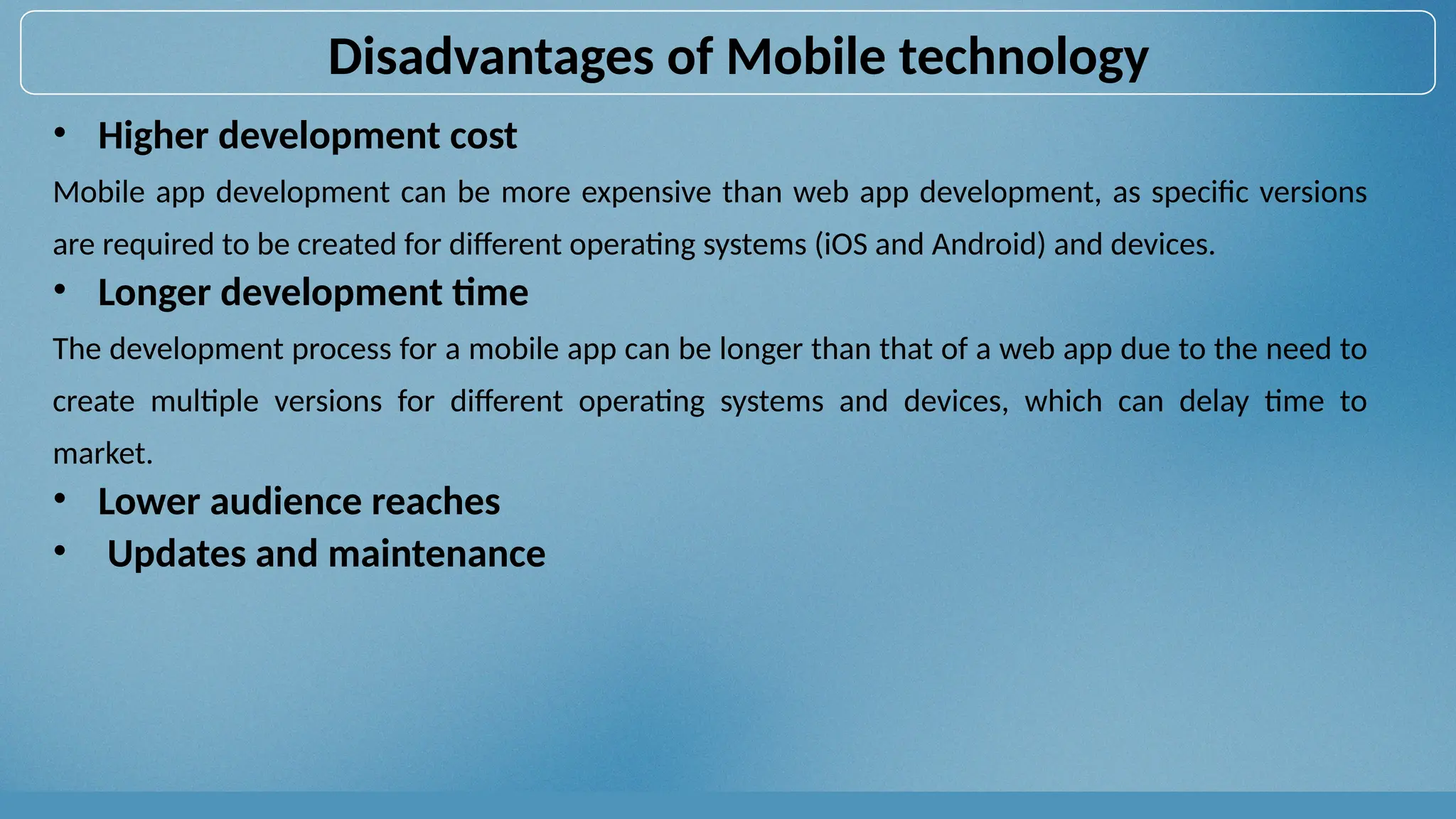
• Higher developmentcost
Mobile app development can be more expensive than web app development, as specific versions
are required to be created for different operating systems (iOS and Android) and devices.
• Longer development time
The development process for a mobile app can be longer than that of a web app due to the need to
create multiple versions for different operating systems and devices, which can delay time to
market.
• Lower audience reaches
• Updates and maintenance
Disadvantages of Mobile technology
13.
• Higher developmentcost
Mobile app development can be more expensive than web app development, as specific versions
are required to be created for different operating systems (iOS and Android) and devices.
• Longer development time
The development process for a mobile app can be longer than that of a web app due to the need to
create multiple versions for different operating systems and devices, which can delay time to
market.
• Lower audience reaches
• Updates and maintenance
Introduction to Activities in Android



![Artificial_Intellgence[1].pptxDatabase Management Systems.pptx](https://cdn.slidesharecdn.com/ss_thumbnails/artificialintellgence1-250811054319-2dddbf4f-thumbnail.jpg?width=640&height=640&fit=bounds)


