Data Structures
CS-2001
Introduction
Guidelines
 Be attentive in class and always expect a quiz
 There will be no retake of any quiz/activity,
whatever circumstances are
 Strictly follow your deadlines otherwise be
ready for penalties
 Follow SLATE/Classromm and report your
query in time otherwise don’t complaint
2
Guidelines
 There will be no re-evaluation for any marks,
when report time is over
 If you don’t want to study leave the class, let
others study.
 You will be given zero (negative marks) for
copy cases (Both parties)
3
Important
Classroom Conduct
 All students are expected to behave as scholars at a
leading institute of technology. This includes arriving
on time, not talking during lecture (unless addressing
the instructor), and not leaving the classroom before
the end of the lecture.
 Disruptive students will be warned and potentially
dismissed from the classroom
Academic Dishonesty
 Academic dishonesty in any portion of the academic
work for a course shall be grounds for awarding a
grade of F for the entire course
4
Some Rules
• Raise your hand before asking any question and then WAIT for
the permission
• Never ever Miss a class
• Never ever “sleep” in the class
• Never even think about using mobile during the class
5
Distribution (Tentative)
Assignments /
Home Work
5 % 3 to 5
Quizzes 5% 7 to 10
Sessional-I 15% 1
Sessional-II 15% 1
Project 10% 2 to 3 phases
Final 50% 1
 Attendance 100%
 Weight-ages
6
Assignment/Quizzes
•A number of assignments and quizzes will be taken
•Announced and/or unannounced quizzes may be
given to students any time during the lecture
7
Submissions
 All submissions (Assignments, Home Works, Project)
would be on Slate/Classroom, unless otherwise
announced.
 The file naming convention should be as:
Roll Number_Assignment_Number_Course
 For example: 23_1234_Assignment_2_DS
8
Prerequisite
•Enforced
• CS1004 Object Oriented Programming
• CL1004 Object Oriented Programming
9
Why should we study this course?
• Well, because it is the core computer sciences course
• Any other reason to study this course?
• We want to make a successful career after graduation
• The most common programming interviews questions
• Linked lists
• Strings
• Binary Trees
• Arrays
• Queues
Source: http://maxnoy.com/interviews.html
10
Course Objective
• Introduce the basic concepts of data structures /ADTs, and
use them efficiently in algorithms for solving various
problems using C/C++
• What should you expect in this course?
• Extensive programming
• A lot of thinking
• What should you learn by the end of this course
• Ability to understand common programming problems and design and
implement efficient data structures to solve them
11
Books
•Data Structures
•Seymour Lipschutz
•Data Structures Using C and C++
•Y. Langsam, M. J. Augenstein, A. M.
Tenenbaum
12
Reference Books
•Introduction to Algorithms
•Thomas H. Cormen et al
•Data Structures and Algorithms
•A. V. Aho, J. E. Hopcroft, J. D. Ullman
13
Course Outline
•In this course you will learn
• Introduction
• Algorithm Analysis
• Abstract Data Types (ADTs)
• Lists
• Stacks
• Queues
• Trees
• Hashing
• Sorting
• Graph
14
What is a data structure exactly?
15
To answer that, we must first understand:
What is a computer program?
Input
Some mysterious
processing
Output
16
How to solve the following problems:
1. Input 3 numbers, print out the maximum.
2. Input 30000 numbers, print out the largest 10 numbers.
17
Data structures let the input and output be represented
in a way that can be handled efficiently and effectively.
array
Linked list
tree
queue
stack 18
Input
Some mysterious
processing
Output
Data structures+Algorithms=Programs
19
Definition
•Data may be organized in different ways
•Data structure is the logical or mathematical
model of a particular organization of data
• Must be rich enough to mirror the actual
relationships of the data in the real world
sample
20
Thank you
21
Introduction-2
What is a Data Structure?
•Data structures are used in almost every program or
software system
• In computer sciences, a data structure is a particular way of storing and
organizing data in a computer so that it can be used efficiently
• Efficient data structures  Efficient algorithms
•Focus: Efficiency and performance
• Time and space analysis of algorithms
Source: http://en.wikipedia.org/wiki/Data_structure
23
Performance vs Efficiency
• Performance is the measure of quality of the work done by any
machine.
• Efficiency is the ratio of desired output to the required input for
any machine.
24
Some Example Data Structures
Arrays Stack Tree
Data structure = representation and
operations associated with a data type
Linked List
25
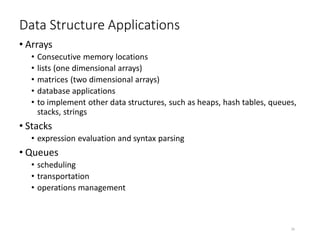
Data Structure Applications
• Arrays
• Consecutive memory locations
• lists (one dimensional arrays)
• matrices (two dimensional arrays)
• database applications
• to implement other data structures, such as heaps, hash tables, queues,
stacks, strings
• Stacks
• expression evaluation and syntax parsing
• Queues
• scheduling
• transportation
• operations management
26
Data Structure Applications
• Trees
• efficient searching of data (Binary search tree)
• manipulate hierarchical data
• manipulate sorted data
• Linked lists
• can be used to implement several other common abstract data
structures, such as
• stacks
• queues
• symbolic expressions, and etc
27
Abstract data type
• In computer science, an abstract data type (ADT) is a mathematical
model for data types, where a data type is defined by its behavior
(semantics) from the point of view of a user of the data, specifically
in terms of possible values, possible operations on data of this type,
and the behavior of these operations
• ADT users are NOT concerned with how the task is done but rather
what it can do.
• An abstract data type is a data declaration packaged together with
the operations that are meaningful for the data type.
28
Arrays
1 Ali
2 Salam
3 Usman
4 Danial
5 Saeed
6 Zaka
Linear Arrays
Array
Ali
Salam A B C
Usman
Danial
Saeed Y
Zaka X
Ali Y
Salam X
Usman Y
Danial X
Saeed Y
X
Arrays
Sale
Item 1 2 8 85
Item 2 5 8 5
Item 3 5 8 5
Item 4 4 8 5
Item 5 5 5 5
Two Dimensional Arra
Arrays
Customer Salesperson
1 Jamal Tony
2 Sana Tony
3 Saeed Nadia
4 Farooq Owais
5 Salman Owais
6 Danial Nadia
Link List
Jamal 1
Sana 1
Saeed 2
Farooq 3
Salman 3 Salman 3
Trees
Employee
Name Age
First N Last N
Address Salary
Street Area
City Province Post Code
34
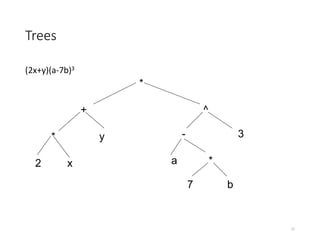
Trees
(2x+y)(a-7b)3
*
+ ^
* y
2 x
- 3
a *
7 b
35
Stacks
2132
123
123
123
123
123
123
546
45
543
3
3
2544
IN
OUT
Queue
2132
123
123
123
123
123
3
3
2544
33
IN
OUT
The Need for Data Structures
• Goal: to organize data
• Criteria: to facilitate efficient
• storage of data
• retrieval of data
• manipulation of data
• Design Issue:
• select and design appropriate data types.
(This is the real essence of OOP.)
38
Data Structure Operations
• Update
• Searching
• Insertion
• Deletion
• Sorting
• Merging
Dictionary Operations
39
Thank you
40

Introduction to Data Structures on C++ Language

  • 1.
  • 2.
    Guidelines  Be attentivein class and always expect a quiz  There will be no retake of any quiz/activity, whatever circumstances are  Strictly follow your deadlines otherwise be ready for penalties  Follow SLATE/Classromm and report your query in time otherwise don’t complaint 2
  • 3.
    Guidelines  There willbe no re-evaluation for any marks, when report time is over  If you don’t want to study leave the class, let others study.  You will be given zero (negative marks) for copy cases (Both parties) 3
  • 4.
    Important Classroom Conduct  Allstudents are expected to behave as scholars at a leading institute of technology. This includes arriving on time, not talking during lecture (unless addressing the instructor), and not leaving the classroom before the end of the lecture.  Disruptive students will be warned and potentially dismissed from the classroom Academic Dishonesty  Academic dishonesty in any portion of the academic work for a course shall be grounds for awarding a grade of F for the entire course 4
  • 5.
    Some Rules • Raiseyour hand before asking any question and then WAIT for the permission • Never ever Miss a class • Never ever “sleep” in the class • Never even think about using mobile during the class 5
  • 6.
    Distribution (Tentative) Assignments / HomeWork 5 % 3 to 5 Quizzes 5% 7 to 10 Sessional-I 15% 1 Sessional-II 15% 1 Project 10% 2 to 3 phases Final 50% 1  Attendance 100%  Weight-ages 6
  • 7.
    Assignment/Quizzes •A number ofassignments and quizzes will be taken •Announced and/or unannounced quizzes may be given to students any time during the lecture 7
  • 8.
    Submissions  All submissions(Assignments, Home Works, Project) would be on Slate/Classroom, unless otherwise announced.  The file naming convention should be as: Roll Number_Assignment_Number_Course  For example: 23_1234_Assignment_2_DS 8
  • 9.
    Prerequisite •Enforced • CS1004 ObjectOriented Programming • CL1004 Object Oriented Programming 9
  • 10.
    Why should westudy this course? • Well, because it is the core computer sciences course • Any other reason to study this course? • We want to make a successful career after graduation • The most common programming interviews questions • Linked lists • Strings • Binary Trees • Arrays • Queues Source: http://maxnoy.com/interviews.html 10
  • 11.
    Course Objective • Introducethe basic concepts of data structures /ADTs, and use them efficiently in algorithms for solving various problems using C/C++ • What should you expect in this course? • Extensive programming • A lot of thinking • What should you learn by the end of this course • Ability to understand common programming problems and design and implement efficient data structures to solve them 11
  • 12.
    Books •Data Structures •Seymour Lipschutz •DataStructures Using C and C++ •Y. Langsam, M. J. Augenstein, A. M. Tenenbaum 12
  • 13.
    Reference Books •Introduction toAlgorithms •Thomas H. Cormen et al •Data Structures and Algorithms •A. V. Aho, J. E. Hopcroft, J. D. Ullman 13
  • 14.
    Course Outline •In thiscourse you will learn • Introduction • Algorithm Analysis • Abstract Data Types (ADTs) • Lists • Stacks • Queues • Trees • Hashing • Sorting • Graph 14
  • 15.
    What is adata structure exactly? 15
  • 16.
    To answer that,we must first understand: What is a computer program? Input Some mysterious processing Output 16
  • 17.
    How to solvethe following problems: 1. Input 3 numbers, print out the maximum. 2. Input 30000 numbers, print out the largest 10 numbers. 17
  • 18.
    Data structures letthe input and output be represented in a way that can be handled efficiently and effectively. array Linked list tree queue stack 18
  • 19.
  • 20.
    Definition •Data may beorganized in different ways •Data structure is the logical or mathematical model of a particular organization of data • Must be rich enough to mirror the actual relationships of the data in the real world sample 20
  • 21.
  • 22.
  • 23.
    What is aData Structure? •Data structures are used in almost every program or software system • In computer sciences, a data structure is a particular way of storing and organizing data in a computer so that it can be used efficiently • Efficient data structures  Efficient algorithms •Focus: Efficiency and performance • Time and space analysis of algorithms Source: http://en.wikipedia.org/wiki/Data_structure 23
  • 24.
    Performance vs Efficiency •Performance is the measure of quality of the work done by any machine. • Efficiency is the ratio of desired output to the required input for any machine. 24
  • 25.
    Some Example DataStructures Arrays Stack Tree Data structure = representation and operations associated with a data type Linked List 25
  • 26.
    Data Structure Applications •Arrays • Consecutive memory locations • lists (one dimensional arrays) • matrices (two dimensional arrays) • database applications • to implement other data structures, such as heaps, hash tables, queues, stacks, strings • Stacks • expression evaluation and syntax parsing • Queues • scheduling • transportation • operations management 26
  • 27.
    Data Structure Applications •Trees • efficient searching of data (Binary search tree) • manipulate hierarchical data • manipulate sorted data • Linked lists • can be used to implement several other common abstract data structures, such as • stacks • queues • symbolic expressions, and etc 27
  • 28.
    Abstract data type •In computer science, an abstract data type (ADT) is a mathematical model for data types, where a data type is defined by its behavior (semantics) from the point of view of a user of the data, specifically in terms of possible values, possible operations on data of this type, and the behavior of these operations • ADT users are NOT concerned with how the task is done but rather what it can do. • An abstract data type is a data declaration packaged together with the operations that are meaningful for the data type. 28
  • 29.
    Arrays 1 Ali 2 Salam 3Usman 4 Danial 5 Saeed 6 Zaka Linear Arrays
  • 30.
    Array Ali Salam A BC Usman Danial Saeed Y Zaka X Ali Y Salam X Usman Y Danial X Saeed Y X
  • 31.
    Arrays Sale Item 1 28 85 Item 2 5 8 5 Item 3 5 8 5 Item 4 4 8 5 Item 5 5 5 5 Two Dimensional Arra
  • 32.
    Arrays Customer Salesperson 1 JamalTony 2 Sana Tony 3 Saeed Nadia 4 Farooq Owais 5 Salman Owais 6 Danial Nadia
  • 33.
    Link List Jamal 1 Sana1 Saeed 2 Farooq 3 Salman 3 Salman 3
  • 34.
    Trees Employee Name Age First NLast N Address Salary Street Area City Province Post Code 34
  • 35.
  • 36.
  • 37.
  • 38.
    The Need forData Structures • Goal: to organize data • Criteria: to facilitate efficient • storage of data • retrieval of data • manipulation of data • Design Issue: • select and design appropriate data types. (This is the real essence of OOP.) 38
  • 39.
    Data Structure Operations •Update • Searching • Insertion • Deletion • Sorting • Merging Dictionary Operations 39
  • 40.