The Ethical Side of Data
Science: Balancing Innovation
and Responsibility
Data science has emerged as a transformative force in today’s world, driving innovation across
various sectors and reshaping decision-making processes. Its applications range from predictive
analytics in healthcare to tailored marketing strategies in retail, illustrating its vast and impactful
scope. However, with this potential comes a significant responsibility. As the field evolves, it is
crucial to address ethical concerns to ensure sustainable and responsible development.
The Promise and Power of Data Science
At its core, data science combines statistical techniques, machine learning algorithms, and data
analysis to extract valuable insights from large datasets. This ability to identify patterns and
forecast future trends has revolutionized industries such as healthcare, finance, and education.
For example, data science enhances personalized medicine by developing treatment plans
based on individual genetic profiles. In finance, it plays a vital role in detecting fraud and
managing risk. The possibilities within data science are vast, limited only by our imagination.
However, this immense power brings forth complex ethical dilemmas. The fundamental activities
of data science—collecting, processing, and analyzing data—often intersect with critical issues
surrounding privacy, fairness, and accountability. As data scientists and organizations push
technological boundaries, they must navigate the accompanying ethical challenges.
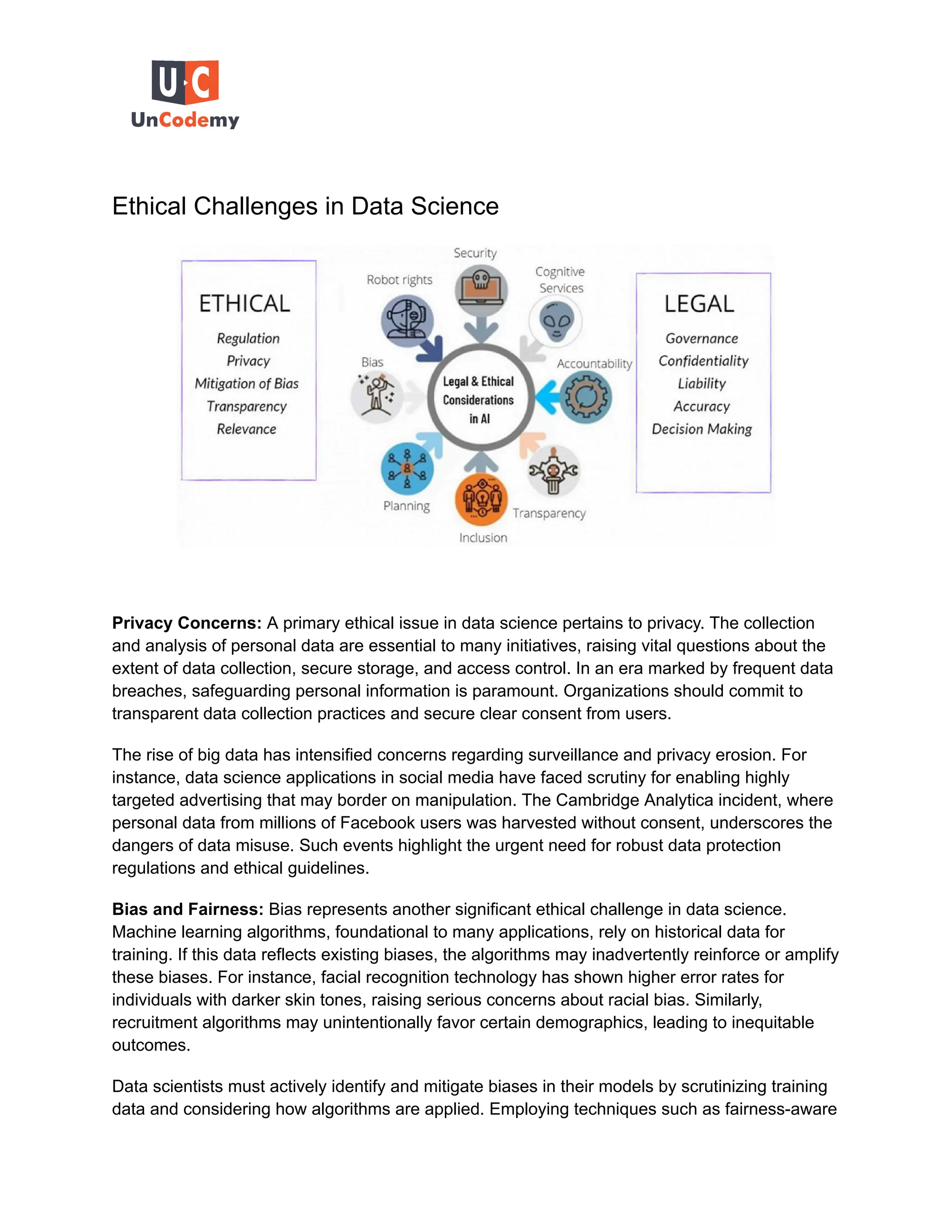
Ethical Challenges in Data Science
Privacy Concerns: A primary ethical issue in data science pertains to privacy. The collection
and analysis of personal data are essential to many initiatives, raising vital questions about the
extent of data collection, secure storage, and access control. In an era marked by frequent data
breaches, safeguarding personal information is paramount. Organizations should commit to
transparent data collection practices and secure clear consent from users.
The rise of big data has intensified concerns regarding surveillance and privacy erosion. For
instance, data science applications in social media have faced scrutiny for enabling highly
targeted advertising that may border on manipulation. The Cambridge Analytica incident, where
personal data from millions of Facebook users was harvested without consent, underscores the
dangers of data misuse. Such events highlight the urgent need for robust data protection
regulations and ethical guidelines.
Bias and Fairness: Bias represents another significant ethical challenge in data science.
Machine learning algorithms, foundational to many applications, rely on historical data for
training. If this data reflects existing biases, the algorithms may inadvertently reinforce or amplify
these biases. For instance, facial recognition technology has shown higher error rates for
individuals with darker skin tones, raising serious concerns about racial bias. Similarly,
recruitment algorithms may unintentionally favor certain demographics, leading to inequitable
outcomes.
Data scientists must actively identify and mitigate biases in their models by scrutinizing training
data and considering how algorithms are applied. Employing techniques such as fairness-aware
machine learning, which aims to create equitable models across different groups, is crucial for
ensuring that data science benefits all individuals fairly.
Accountability and Transparency: Accountability and transparency are foundational to ethical
data science. As algorithms increasingly shape decisions in critical sectors like criminal justice,
healthcare, and finance, it is vital that their processes are clear and comprehensible. The
concept of "algorithmic accountability" emphasizes the need for organizations to explain how
their algorithms work and be accountable for their outcomes.
However, many machine learning models, especially deep learning ones, are often termed
"black boxes" due to their complex and opaque decision-making processes. This lack of
transparency complicates accountability, particularly when algorithms make decisions that
significantly affect individuals’ lives. To address this challenge, there is a growing emphasis on
"explainable AI," which seeks to create models that are not only accurate but also interpretable.
Ethical Use of Data: The ethical use of data encompasses broader issues beyond privacy and
bias, including the sourcing and application of data. Questions arise, such as whether it is
ethical to use data collected from individuals without their informed consent, or to repurpose
data gathered for one purpose for entirely different uses. These concerns are particularly
relevant in scenarios like predictive policing, where algorithms predict potential crime hotspots
and risk reinforcing existing societal inequalities. Data scientists must contemplate the broader
societal impacts of their work to ensure their innovations do not cause unintentional harm.
The Role of Regulations and Guidelines
As data science progresses, there is a growing recognition of the need for regulations and
ethical guidelines to govern its use. Frameworks like the EU's General Data Protection
Regulation (GDPR) impose strict rules on data privacy and security, emphasizing the necessity
of obtaining explicit consent from individuals prior to data collection and granting them rights to
access and delete their data.
In addition to legal frameworks, industry-specific guidelines have emerged to promote ethical
practices in data science. For instance, the IEEE has developed ethical guidelines for AI and
data science that stress transparency, accountability, and fairness. These guidelines serve as a
valuable reference for data scientists aiming to align their work with ethical principles.
However, regulations and guidelines alone are not enough. Ethical data science demands a
cultural shift within organizations, integrating ethics into decision-making processes. This
involves cultivating a culture of ethical awareness, encouraging data scientists to critically
evaluate their work's implications, and equipping them with the tools and training needed to
navigate these complexities.
Striking a Balance Between Innovation and Responsibility
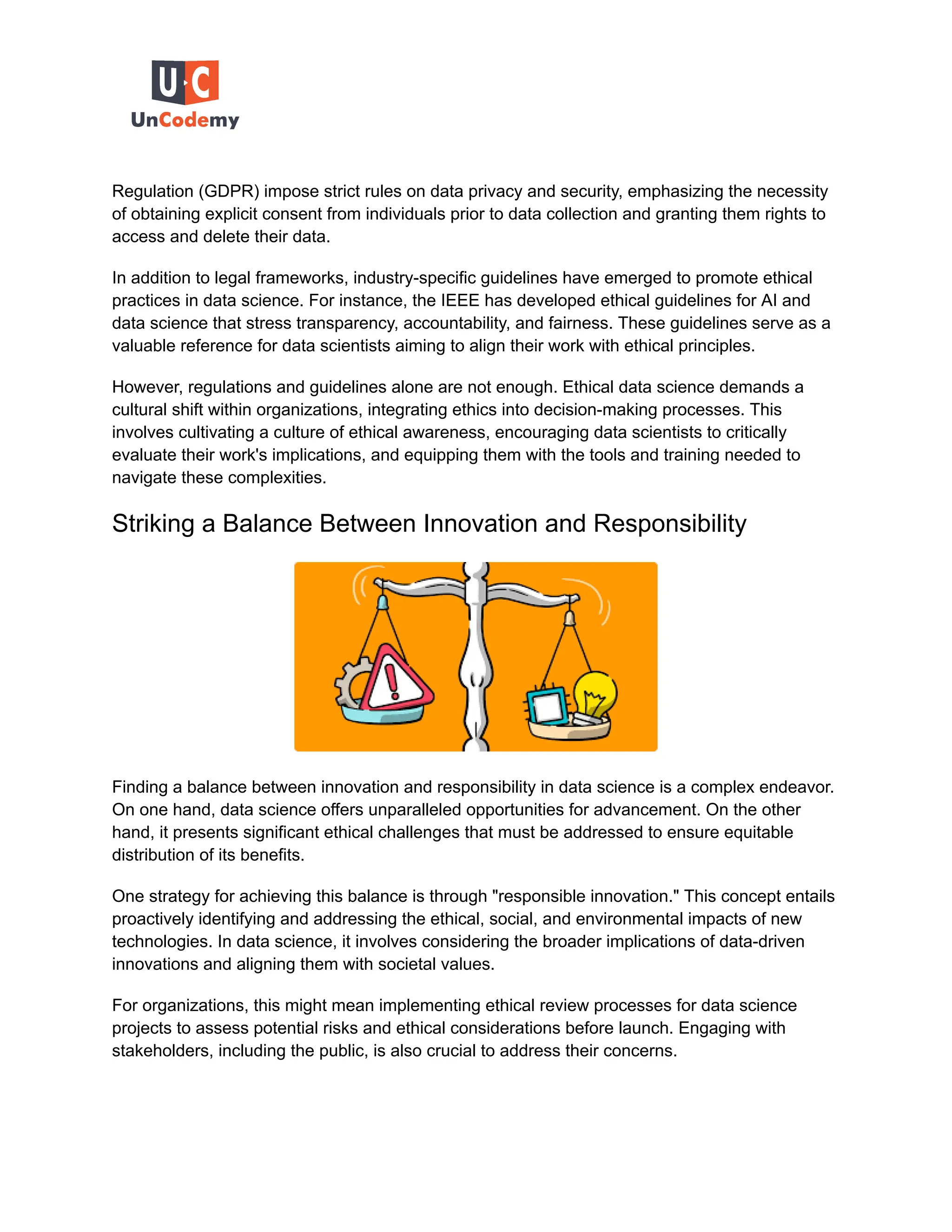
Finding a balance between innovation and responsibility in data science is a complex endeavor.
On one hand, data science offers unparalleled opportunities for advancement. On the other
hand, it presents significant ethical challenges that must be addressed to ensure equitable
distribution of its benefits.
One strategy for achieving this balance is through "responsible innovation." This concept entails
proactively identifying and addressing the ethical, social, and environmental impacts of new
technologies. In data science, it involves considering the broader implications of data-driven
innovations and aligning them with societal values.
For organizations, this might mean implementing ethical review processes for data science
projects to assess potential risks and ethical considerations before launch. Engaging with
stakeholders, including the public, is also crucial to address their concerns.
Moreover, data science education and training programs should incorporate ethics as a core
element. By providing future data scientists with a strong ethical foundation, we can better
prepare them to navigate the intricate ethical landscape of their field.
Conclusion
Data science possesses tremendous potential to drive innovation and foster positive change.
However, realizing this potential necessitates ethical and responsible practices in data science.
For data scientists and organizations to ensure that their innovations are not only effective but
also just and equitable, it is essential to tackle ethical challenges such as privacy, bias,
accountability, and the ethical use of data.
For individuals seeking to enter this field or advance their careers, pursuing the best data
science course in Thane, Mumbai, Navi Mumbai, Delhi, Noida, and other locations across India
is a strategic move. These programs not only provide the technical skills needed to excel in data
science but also emphasize ethical practices, preparing students to responsibly navigate the
industry’s complexities. Balancing innovation with responsibility is not just a moral obligation; it
is a strategic necessity. As data science continues to evolve, ethical considerations must remain
central to decision-making. Only then can we fully harness the power of data science to create a
better, more equitable future.
Source link:
https://pallavichauhan2501.livepositively.com/the-ethical-side-of-data-science-balancing-innovation-and-r
esponsibility/new=1

The Ethical Side of Data Science: Balancing Innovation and Responsibility

  • 1.
    The Ethical Sideof Data Science: Balancing Innovation and Responsibility Data science has emerged as a transformative force in today’s world, driving innovation across various sectors and reshaping decision-making processes. Its applications range from predictive analytics in healthcare to tailored marketing strategies in retail, illustrating its vast and impactful scope. However, with this potential comes a significant responsibility. As the field evolves, it is crucial to address ethical concerns to ensure sustainable and responsible development. The Promise and Power of Data Science At its core, data science combines statistical techniques, machine learning algorithms, and data analysis to extract valuable insights from large datasets. This ability to identify patterns and forecast future trends has revolutionized industries such as healthcare, finance, and education. For example, data science enhances personalized medicine by developing treatment plans based on individual genetic profiles. In finance, it plays a vital role in detecting fraud and managing risk. The possibilities within data science are vast, limited only by our imagination. However, this immense power brings forth complex ethical dilemmas. The fundamental activities of data science—collecting, processing, and analyzing data—often intersect with critical issues surrounding privacy, fairness, and accountability. As data scientists and organizations push technological boundaries, they must navigate the accompanying ethical challenges.
  • 2.
    Ethical Challenges inData Science Privacy Concerns: A primary ethical issue in data science pertains to privacy. The collection and analysis of personal data are essential to many initiatives, raising vital questions about the extent of data collection, secure storage, and access control. In an era marked by frequent data breaches, safeguarding personal information is paramount. Organizations should commit to transparent data collection practices and secure clear consent from users. The rise of big data has intensified concerns regarding surveillance and privacy erosion. For instance, data science applications in social media have faced scrutiny for enabling highly targeted advertising that may border on manipulation. The Cambridge Analytica incident, where personal data from millions of Facebook users was harvested without consent, underscores the dangers of data misuse. Such events highlight the urgent need for robust data protection regulations and ethical guidelines. Bias and Fairness: Bias represents another significant ethical challenge in data science. Machine learning algorithms, foundational to many applications, rely on historical data for training. If this data reflects existing biases, the algorithms may inadvertently reinforce or amplify these biases. For instance, facial recognition technology has shown higher error rates for individuals with darker skin tones, raising serious concerns about racial bias. Similarly, recruitment algorithms may unintentionally favor certain demographics, leading to inequitable outcomes. Data scientists must actively identify and mitigate biases in their models by scrutinizing training data and considering how algorithms are applied. Employing techniques such as fairness-aware
  • 3.
    machine learning, whichaims to create equitable models across different groups, is crucial for ensuring that data science benefits all individuals fairly. Accountability and Transparency: Accountability and transparency are foundational to ethical data science. As algorithms increasingly shape decisions in critical sectors like criminal justice, healthcare, and finance, it is vital that their processes are clear and comprehensible. The concept of "algorithmic accountability" emphasizes the need for organizations to explain how their algorithms work and be accountable for their outcomes. However, many machine learning models, especially deep learning ones, are often termed "black boxes" due to their complex and opaque decision-making processes. This lack of transparency complicates accountability, particularly when algorithms make decisions that significantly affect individuals’ lives. To address this challenge, there is a growing emphasis on "explainable AI," which seeks to create models that are not only accurate but also interpretable. Ethical Use of Data: The ethical use of data encompasses broader issues beyond privacy and bias, including the sourcing and application of data. Questions arise, such as whether it is ethical to use data collected from individuals without their informed consent, or to repurpose data gathered for one purpose for entirely different uses. These concerns are particularly relevant in scenarios like predictive policing, where algorithms predict potential crime hotspots and risk reinforcing existing societal inequalities. Data scientists must contemplate the broader societal impacts of their work to ensure their innovations do not cause unintentional harm. The Role of Regulations and Guidelines As data science progresses, there is a growing recognition of the need for regulations and ethical guidelines to govern its use. Frameworks like the EU's General Data Protection
  • 4.
    Regulation (GDPR) imposestrict rules on data privacy and security, emphasizing the necessity of obtaining explicit consent from individuals prior to data collection and granting them rights to access and delete their data. In addition to legal frameworks, industry-specific guidelines have emerged to promote ethical practices in data science. For instance, the IEEE has developed ethical guidelines for AI and data science that stress transparency, accountability, and fairness. These guidelines serve as a valuable reference for data scientists aiming to align their work with ethical principles. However, regulations and guidelines alone are not enough. Ethical data science demands a cultural shift within organizations, integrating ethics into decision-making processes. This involves cultivating a culture of ethical awareness, encouraging data scientists to critically evaluate their work's implications, and equipping them with the tools and training needed to navigate these complexities. Striking a Balance Between Innovation and Responsibility Finding a balance between innovation and responsibility in data science is a complex endeavor. On one hand, data science offers unparalleled opportunities for advancement. On the other hand, it presents significant ethical challenges that must be addressed to ensure equitable distribution of its benefits. One strategy for achieving this balance is through "responsible innovation." This concept entails proactively identifying and addressing the ethical, social, and environmental impacts of new technologies. In data science, it involves considering the broader implications of data-driven innovations and aligning them with societal values. For organizations, this might mean implementing ethical review processes for data science projects to assess potential risks and ethical considerations before launch. Engaging with stakeholders, including the public, is also crucial to address their concerns.
  • 5.
    Moreover, data scienceeducation and training programs should incorporate ethics as a core element. By providing future data scientists with a strong ethical foundation, we can better prepare them to navigate the intricate ethical landscape of their field. Conclusion Data science possesses tremendous potential to drive innovation and foster positive change. However, realizing this potential necessitates ethical and responsible practices in data science. For data scientists and organizations to ensure that their innovations are not only effective but also just and equitable, it is essential to tackle ethical challenges such as privacy, bias, accountability, and the ethical use of data. For individuals seeking to enter this field or advance their careers, pursuing the best data science course in Thane, Mumbai, Navi Mumbai, Delhi, Noida, and other locations across India is a strategic move. These programs not only provide the technical skills needed to excel in data science but also emphasize ethical practices, preparing students to responsibly navigate the industry’s complexities. Balancing innovation with responsibility is not just a moral obligation; it is a strategic necessity. As data science continues to evolve, ethical considerations must remain central to decision-making. Only then can we fully harness the power of data science to create a better, more equitable future. Source link: https://pallavichauhan2501.livepositively.com/the-ethical-side-of-data-science-balancing-innovation-and-r esponsibility/new=1