
www.luxoft.com
The Blockchain land:
Is there Consensus over Consensus?
Vasily Suvorov, VP Technology Strategy
March 18, 2016
www.luxoft.com 2
Can we talk about blockchain
without the Hype?
www.luxoft.com
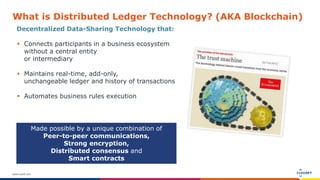
What is Distributed Ledger Technology? (AKA Blockchain)
Decentralized Data-Sharing Technology that:
 Connects participants in a business ecosystem
without a central entity
or intermediary
 Maintains real-time, add-only,
unchangeable ledger and history of transactions
 Automates business rules execution
Made possible by a unique combination of
Peer-to-peer communications,
Strong encryption,
Distributed consensus and
Smart contracts
www.luxoft.com 4
Consensus is the most fundamental part of the DLT/Blockchain tech
and yet
poorly understood
www.luxoft.com
What I’ll cover
• What is consensus?
• Examples of consensus mechanisms
• PoW, PoS, Byzantine, Federated and Crypto-Based
• The Big Question
• Do we need Consensus Protocols and Distributed Shared Ledgers?
5
www.luxoft.com 6
www.luxoft.com
Back to School Time!
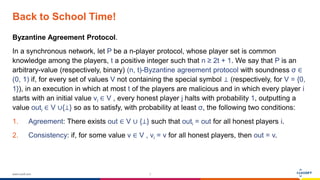
Byzantine Agreement Protocol.
In a synchronous network, let P be a n-player protocol, whose player set is common
knowledge among the players, t a positive integer such that n ≥ 2t + 1. We say that P is an
arbitrary-value (respectively, binary) (n, t)-Byzantine agreement protocol with soundness σ ∈
(0, 1) if, for every set of values V not containing the special symbol ⊥ (respectively, for V = {0,
1}), in an execution in which at most t of the players are malicious and in which every player i
starts with an initial value vi ∈ V , every honest player j halts with probability 1, outputting a
value outi ∈ V ∪{⊥} so as to satisfy, with probability at least σ, the following two conditions:
1. Agreement: There exists out ∈ V ∪ {⊥} such that outi = out for all honest players i.
2. Consistency: if, for some value v ∈ V , vi = v for all honest players, then out = v.
7
www.luxoft.com
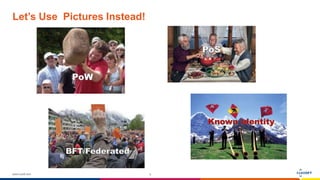
Let’s Use Pictures Instead!
8
www.luxoft.com
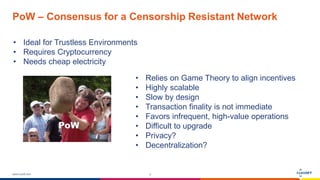
PoW – Consensus for a Censorship Resistant Network
9
• Ideal for Trustless Environments
• Requires Cryptocurrency
• Needs cheap electricity
• Relies on Game Theory to align incentives
• Highly scalable
• Slow by design
• Transaction finality is not immediate
• Favors infrequent, high-value operations
• Difficult to upgrade
• Privacy?
• Decentralization?
www.luxoft.com
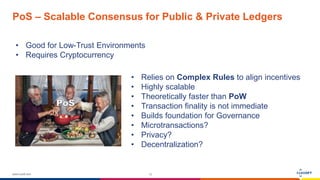
PoS – Scalable Consensus for Public & Private Ledgers
10
• Good for Low-Trust Environments
• Requires Cryptocurrency
• Relies on Complex Rules to align incentives
• Highly scalable
• Theoretically faster than PoW
• Transaction finality is not immediate
• Builds foundation for Governance
• Microtransactions?
• Privacy?
• Decentralization?
www.luxoft.com
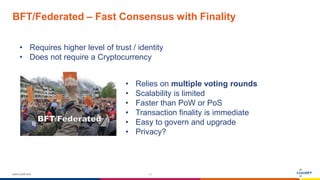
BFT/Federated – Fast Consensus with Finality
11
• Requires higher level of trust / identity
• Does not require a Cryptocurrency
• Relies on multiple voting rounds
• Scalability is limited
• Faster than PoW or PoS
• Transaction finality is immediate
• Easy to govern and upgrade
• Privacy?
www.luxoft.com
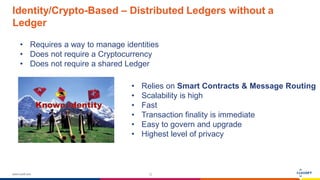
Identity/Crypto-Based – Distributed Ledgers without a
Ledger
12
• Requires a way to manage identities
• Does not require a Cryptocurrency
• Does not require a shared Ledger
• Relies on Smart Contracts & Message Routing
• Scalability is high
• Fast
• Transaction finality is immediate
• Easy to govern and upgrade
• Highest level of privacy
www.luxoft.com
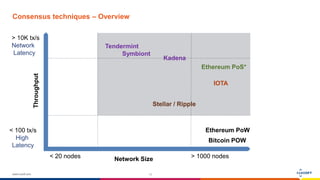
Consensus techniques – Overview
13
Network Size
Throughput
< 100 tx/s
High
Latency
> 10K tx/s
Network
Latency
< 20 nodes > 1000 nodes
Stellar / Ripple
IOTA
Ethereum PoW
Bitcoin POW
Kadena
Tendermint
Symbiont
Ethereum PoS*
www.luxoft.com
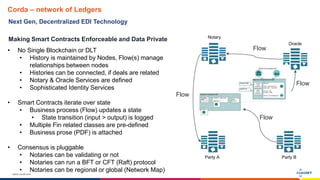
Next Gen, Decentralized EDI Technology
Making Smart Contracts Enforceable and Data Private
• No Single Blockchain or DLT
• History is maintained by Nodes, Flow(s) manage
relationships between nodes
• Histories can be connected, if deals are related
• Notary & Oracle Services are defined
• Sophisticated Identity Services
• Smart Contracts iterate over state
• Business process (Flow) updates a state
• State transition (input > output) is logged
• Multiple Fin related classes are pre-defined
• Business prose (PDF) is attached
• Consensus is pluggable
• Notaries can be validating or not
• Notaries can run a BFT or CFT (Raft) protocol
• Notaries can be regional or global (Network Map)
Party A Party B
Notary
Oracle
Flow
Flow
Flow
Flow
Corda – network of Ledgers
www.luxoft.com
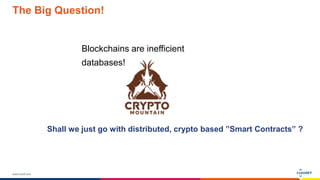
Blockchains are inefficient
databases!
The Big Question!
Shall we just go with distributed, crypto based ”Smart Contracts” ?
www.luxoft.com
Thank You!
&
Questions?

Introduction to Consensus techniques

  • 1.
    www.luxoft.com The Blockchain land: Isthere Consensus over Consensus? Vasily Suvorov, VP Technology Strategy March 18, 2016
  • 2.
    www.luxoft.com 2 Can wetalk about blockchain without the Hype?
  • 3.
    www.luxoft.com What is DistributedLedger Technology? (AKA Blockchain) Decentralized Data-Sharing Technology that:  Connects participants in a business ecosystem without a central entity or intermediary  Maintains real-time, add-only, unchangeable ledger and history of transactions  Automates business rules execution Made possible by a unique combination of Peer-to-peer communications, Strong encryption, Distributed consensus and Smart contracts
  • 4.
    www.luxoft.com 4 Consensus isthe most fundamental part of the DLT/Blockchain tech and yet poorly understood
  • 5.
    www.luxoft.com What I’ll cover •What is consensus? • Examples of consensus mechanisms • PoW, PoS, Byzantine, Federated and Crypto-Based • The Big Question • Do we need Consensus Protocols and Distributed Shared Ledgers? 5
  • 6.
  • 7.
    www.luxoft.com Back to SchoolTime! Byzantine Agreement Protocol. In a synchronous network, let P be a n-player protocol, whose player set is common knowledge among the players, t a positive integer such that n ≥ 2t + 1. We say that P is an arbitrary-value (respectively, binary) (n, t)-Byzantine agreement protocol with soundness σ ∈ (0, 1) if, for every set of values V not containing the special symbol ⊥ (respectively, for V = {0, 1}), in an execution in which at most t of the players are malicious and in which every player i starts with an initial value vi ∈ V , every honest player j halts with probability 1, outputting a value outi ∈ V ∪{⊥} so as to satisfy, with probability at least σ, the following two conditions: 1. Agreement: There exists out ∈ V ∪ {⊥} such that outi = out for all honest players i. 2. Consistency: if, for some value v ∈ V , vi = v for all honest players, then out = v. 7
  • 8.
  • 9.
    www.luxoft.com PoW – Consensusfor a Censorship Resistant Network 9 • Ideal for Trustless Environments • Requires Cryptocurrency • Needs cheap electricity • Relies on Game Theory to align incentives • Highly scalable • Slow by design • Transaction finality is not immediate • Favors infrequent, high-value operations • Difficult to upgrade • Privacy? • Decentralization?
  • 10.
    www.luxoft.com PoS – ScalableConsensus for Public & Private Ledgers 10 • Good for Low-Trust Environments • Requires Cryptocurrency • Relies on Complex Rules to align incentives • Highly scalable • Theoretically faster than PoW • Transaction finality is not immediate • Builds foundation for Governance • Microtransactions? • Privacy? • Decentralization?
  • 11.
    www.luxoft.com BFT/Federated – FastConsensus with Finality 11 • Requires higher level of trust / identity • Does not require a Cryptocurrency • Relies on multiple voting rounds • Scalability is limited • Faster than PoW or PoS • Transaction finality is immediate • Easy to govern and upgrade • Privacy?
  • 12.
    www.luxoft.com Identity/Crypto-Based – DistributedLedgers without a Ledger 12 • Requires a way to manage identities • Does not require a Cryptocurrency • Does not require a shared Ledger • Relies on Smart Contracts & Message Routing • Scalability is high • Fast • Transaction finality is immediate • Easy to govern and upgrade • Highest level of privacy
  • 13.
    www.luxoft.com Consensus techniques –Overview 13 Network Size Throughput < 100 tx/s High Latency > 10K tx/s Network Latency < 20 nodes > 1000 nodes Stellar / Ripple IOTA Ethereum PoW Bitcoin POW Kadena Tendermint Symbiont Ethereum PoS*
  • 14.
    www.luxoft.com Next Gen, DecentralizedEDI Technology Making Smart Contracts Enforceable and Data Private • No Single Blockchain or DLT • History is maintained by Nodes, Flow(s) manage relationships between nodes • Histories can be connected, if deals are related • Notary & Oracle Services are defined • Sophisticated Identity Services • Smart Contracts iterate over state • Business process (Flow) updates a state • State transition (input > output) is logged • Multiple Fin related classes are pre-defined • Business prose (PDF) is attached • Consensus is pluggable • Notaries can be validating or not • Notaries can run a BFT or CFT (Raft) protocol • Notaries can be regional or global (Network Map) Party A Party B Notary Oracle Flow Flow Flow Flow Corda – network of Ledgers
  • 15.
    www.luxoft.com Blockchains are inefficient databases! TheBig Question! Shall we just go with distributed, crypto based ”Smart Contracts” ?
  • 16.