1. Introduction to
Common Sense Reasoning
Course: Common Sense Reasoning
Martin Molina
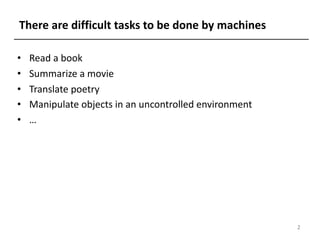
There are difficult tasks to be done by machines
• Read a book
• Summarize a movie
• Translate poetry
• Manipulate objects in an uncontrolled environment
• …
2
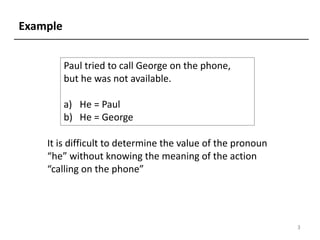
Paul tried to call George on the phone,
but he was not available.
a) He = Paul
b) He = George
It is difficult to determine the value of the pronoun
“he” without knowing the meaning of the action
“calling on the phone”
3
Example
Two well-known truths about computers
[Davis, 2012]
Ernest Davis
New York University
4
a) Computers are great and
amazing and a lot of fun to deal
with
b) Computers are stupid and
frustrating and it can be a huge
amount of work to get what you
want out of them
Marvin Lee Minsky
(1927, 2016)
MIT
A machine that truly learns by itself
requires common sense knowledge
[Minsky, 2000]
5
The trouble with computers today is
they’re always starting from scratch.
To make them more worth dealing
with, we’ll have to aim toward
supplying them commonsense
knowledge.
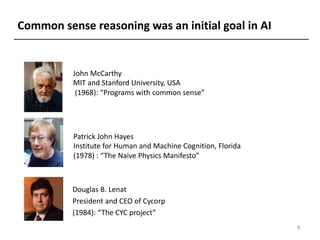
John McCarthy
MIT and Stanford University, USA
(1968): “Programs with common sense”
Patrick John Hayes
Institute for Human and Machine Cognition, Florida
(1978) : “The Naive Physics Manifesto”
Common sense reasoning was an initial goal in AI
Douglas B. Lenat
President and CEO of Cycorp
(1984): “The CYC project”
6
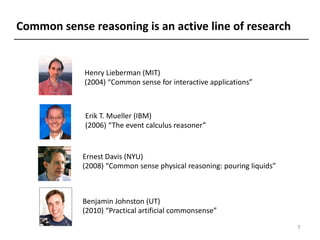
Erik T. Mueller (IBM)
(2006) “The event calculus reasoner”
Henry Lieberman (MIT)
(2004) “Common sense for interactive applications”
Ernest Davis (NYU)
(2008) “Common sense physical reasoning: pouring liquids”
Benjamin Johnston (UT)
(2010) “Practical artificial commonsense”
Common sense reasoning is an active line of research
7
What is common sense?
• Everyday knowledge about the world that is too obvious to say
– Things fall down, not up
– You can use a string to pull, but not push
– A wedding has a bride and a groom
– If you are hungry, you can go to a restaurant to eat
• And the ability to use it
8
[Lieberman, 2004]
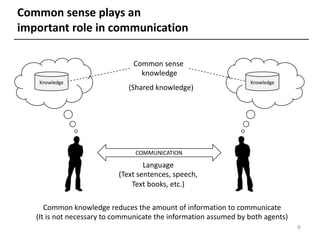
Knowledge Knowledge
Common sense
knowledge
Language
(Text sentences, speech,
Text books, etc.)
Common sense plays an
important role in communication
COMMUNICATION
Common knowledge reduces the amount of information to communicate
(It is not necessary to communicate the information assumed by both agents)
9
(Shared knowledge)
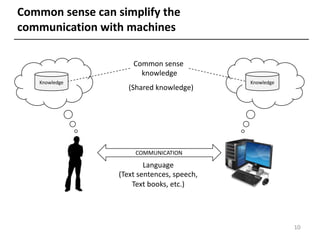
Knowledge Knowledge
Common sense
knowledge
Language
(Text sentences, speech,
Text books, etc.)
COMMUNICATION
Common sense can simplify the
communication with machines
10
(Shared knowledge)
• Large amount of knowledge
– Reasoning about the world requires a large amount of
knowledge [Mueller, 2006]
• Implicit knowledge difficult to be acquired
– Much of our commonsense knowledge information has never
been recorded at all because it has always seemed so obvious
we never thought of describing it [Minsky, 2000]
• Reasoning is complex
– Vagueness, plausibility, contingencies, assumptions, exceptional
cases, logical paradoxes, etc. [Lieberman et al., 2004]
Why is it difficult to be used by machines?
11
There has been significant progress in
common sense reasoning in AI
• Theoretical approaches
– Logic based models
– Physical reasoning
• Large knowledge bases
– Manual acquisition methods
– Automatic acquisition methods
• Semantic technologies
– Ontology languages and upper ontologies
• Applications
– Natural language, mobile phones, etc.
12
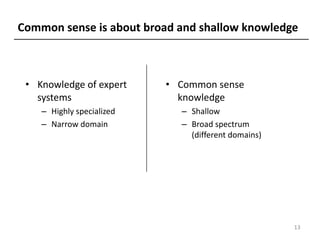
Common sense is about broad and shallow knowledge
13
• Knowledge of expert
systems
– Highly specialized
– Narrow domain
• Common sense
knowledge
– Shallow
– Broad spectrum
(different domains)
What are the challenges
of common sense reasoning?
• How to simulate human reasoning?
– Find efficient ways to reason with common sense knowledge
considering default reasoning, indirect effects, low of inertia,
continuous change, etc.
• How to build knowledge bases?
– Formalize commonsense knowledge (objects, actions, time,
space, beliefs, etc.) using multiple representation methods
– Acquire huge amounts of common sense knowledge (collective,
automatic, etc.)
14
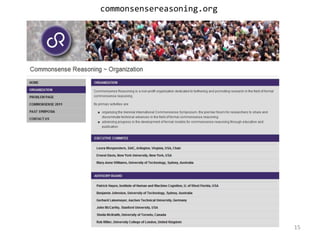
commonsensereasoning.org
15
Course “Common sense reasoning”.
© 2019 Martin Molina
This work is licensed under Creative Commons license CC BY-NC-SA 4.0:
https://creativecommons.org/licenses/by-nc-sa/4.0/legalcode
16
Work citation in APA style:
Molina, M. (2019). Common sense reasoning [Lecture slides]. OpenCourseWare,
Universidad Politécnica de Madrid. Retrieved from http://ocw.upm.es/course

Introduction to common sense reasoning

  • 1.
    1. Introduction to CommonSense Reasoning Course: Common Sense Reasoning Martin Molina
  • 2.
    There are difficulttasks to be done by machines • Read a book • Summarize a movie • Translate poetry • Manipulate objects in an uncontrolled environment • … 2
  • 3.
    Paul tried tocall George on the phone, but he was not available. a) He = Paul b) He = George It is difficult to determine the value of the pronoun “he” without knowing the meaning of the action “calling on the phone” 3 Example
  • 4.
    Two well-known truthsabout computers [Davis, 2012] Ernest Davis New York University 4 a) Computers are great and amazing and a lot of fun to deal with b) Computers are stupid and frustrating and it can be a huge amount of work to get what you want out of them
  • 5.
    Marvin Lee Minsky (1927,2016) MIT A machine that truly learns by itself requires common sense knowledge [Minsky, 2000] 5 The trouble with computers today is they’re always starting from scratch. To make them more worth dealing with, we’ll have to aim toward supplying them commonsense knowledge.
  • 6.
    John McCarthy MIT andStanford University, USA (1968): “Programs with common sense” Patrick John Hayes Institute for Human and Machine Cognition, Florida (1978) : “The Naive Physics Manifesto” Common sense reasoning was an initial goal in AI Douglas B. Lenat President and CEO of Cycorp (1984): “The CYC project” 6
  • 7.
    Erik T. Mueller(IBM) (2006) “The event calculus reasoner” Henry Lieberman (MIT) (2004) “Common sense for interactive applications” Ernest Davis (NYU) (2008) “Common sense physical reasoning: pouring liquids” Benjamin Johnston (UT) (2010) “Practical artificial commonsense” Common sense reasoning is an active line of research 7
  • 8.
    What is commonsense? • Everyday knowledge about the world that is too obvious to say – Things fall down, not up – You can use a string to pull, but not push – A wedding has a bride and a groom – If you are hungry, you can go to a restaurant to eat • And the ability to use it 8 [Lieberman, 2004]
  • 9.
    Knowledge Knowledge Common sense knowledge Language (Textsentences, speech, Text books, etc.) Common sense plays an important role in communication COMMUNICATION Common knowledge reduces the amount of information to communicate (It is not necessary to communicate the information assumed by both agents) 9 (Shared knowledge)
  • 10.
    Knowledge Knowledge Common sense knowledge Language (Textsentences, speech, Text books, etc.) COMMUNICATION Common sense can simplify the communication with machines 10 (Shared knowledge)
  • 11.
    • Large amountof knowledge – Reasoning about the world requires a large amount of knowledge [Mueller, 2006] • Implicit knowledge difficult to be acquired – Much of our commonsense knowledge information has never been recorded at all because it has always seemed so obvious we never thought of describing it [Minsky, 2000] • Reasoning is complex – Vagueness, plausibility, contingencies, assumptions, exceptional cases, logical paradoxes, etc. [Lieberman et al., 2004] Why is it difficult to be used by machines? 11
  • 12.
    There has beensignificant progress in common sense reasoning in AI • Theoretical approaches – Logic based models – Physical reasoning • Large knowledge bases – Manual acquisition methods – Automatic acquisition methods • Semantic technologies – Ontology languages and upper ontologies • Applications – Natural language, mobile phones, etc. 12
  • 13.
    Common sense isabout broad and shallow knowledge 13 • Knowledge of expert systems – Highly specialized – Narrow domain • Common sense knowledge – Shallow – Broad spectrum (different domains)
  • 14.
    What are thechallenges of common sense reasoning? • How to simulate human reasoning? – Find efficient ways to reason with common sense knowledge considering default reasoning, indirect effects, low of inertia, continuous change, etc. • How to build knowledge bases? – Formalize commonsense knowledge (objects, actions, time, space, beliefs, etc.) using multiple representation methods – Acquire huge amounts of common sense knowledge (collective, automatic, etc.) 14
  • 15.
  • 16.
    Course “Common sensereasoning”. © 2019 Martin Molina This work is licensed under Creative Commons license CC BY-NC-SA 4.0: https://creativecommons.org/licenses/by-nc-sa/4.0/legalcode 16 Work citation in APA style: Molina, M. (2019). Common sense reasoning [Lecture slides]. OpenCourseWare, Universidad Politécnica de Madrid. Retrieved from http://ocw.upm.es/course