collection management
What is ERP?
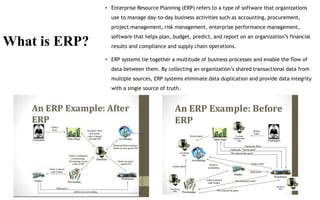
• Enterprise Resource Planning (ERP) refers to a type of software that organizations
use to manage day-to-day business activities such as accounting, procurement,
project management, risk management, enterprise performance management,
software that helps plan, budget, predict, and report on an organization’s financial
results and compliance and supply chain operations.
• ERP systems tie together a multitude of business processes and enable the flow of
data between them. By collecting an organization’s shared transactional data from
multiple sources, ERP systems eliminate data duplication and provide data integrity
with a single source of truth.
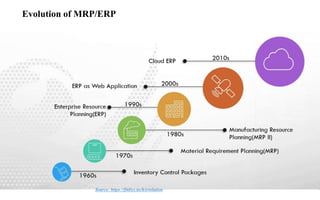
Evolution of MRP/ERP
Source: https://finbyz.tech/evolution
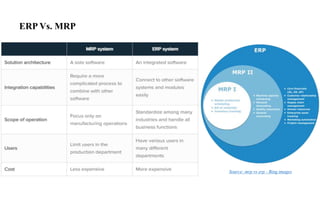
ERP Vs. MRP
Source: mrp vs erp - Bing images
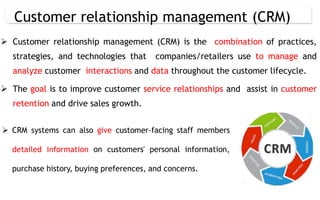
 Customer relationship management (CRM) is the combination of practices,
strategies, and technologies that companies/retailers use to manage and
analyze customer interactions and data throughout the customer lifecycle.
 The goal is to improve customer service relationships and assist in customer
retention and drive sales growth.
Customer relationship management (CRM)
 CRM systems can also give customer-facing staff members
detailed information on customers' personal information,
purchase history, buying preferences, and concerns.
Merits of
CRM
• Software systems can make sense of huge amounts
of data
• Simplifies complex business processes
• CRM can be used at two different levels
– On-demand
– On-premises
Demerit of CRM
• Requires companywide commitment and knowledge to
use the CRM system
• Failure to effectively reorganize firm’s people and 6
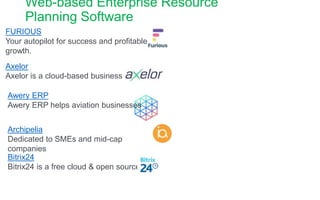
Web-based Enterprise Resource
Planning Software
Bitrix24
Bitrix24 is a free cloud & open source
Archipelia
Dedicated to SMEs and mid-cap
companies
Awery ERP
Awery ERP helps aviation businesses
Axelor
Axelor is a cloud-based business
FURIOUS
Your autopilot for success and profitable
growth.
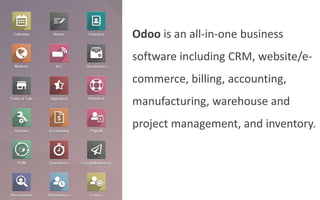
Odoo is an all-in-one business
software including CRM, website/e-
commerce, billing, accounting,
manufacturing, warehouse and
project management, and inventory.

Introduction to collection management.pptx

  • 1.
  • 2.
    What is ERP? •Enterprise Resource Planning (ERP) refers to a type of software that organizations use to manage day-to-day business activities such as accounting, procurement, project management, risk management, enterprise performance management, software that helps plan, budget, predict, and report on an organization’s financial results and compliance and supply chain operations. • ERP systems tie together a multitude of business processes and enable the flow of data between them. By collecting an organization’s shared transactional data from multiple sources, ERP systems eliminate data duplication and provide data integrity with a single source of truth.
  • 3.
    Evolution of MRP/ERP Source:https://finbyz.tech/evolution
  • 4.
    ERP Vs. MRP Source:mrp vs erp - Bing images
  • 5.
     Customer relationshipmanagement (CRM) is the combination of practices, strategies, and technologies that companies/retailers use to manage and analyze customer interactions and data throughout the customer lifecycle.  The goal is to improve customer service relationships and assist in customer retention and drive sales growth. Customer relationship management (CRM)  CRM systems can also give customer-facing staff members detailed information on customers' personal information, purchase history, buying preferences, and concerns.
  • 6.
    Merits of CRM • Softwaresystems can make sense of huge amounts of data • Simplifies complex business processes • CRM can be used at two different levels – On-demand – On-premises Demerit of CRM • Requires companywide commitment and knowledge to use the CRM system • Failure to effectively reorganize firm’s people and 6
  • 7.
    Web-based Enterprise Resource PlanningSoftware Bitrix24 Bitrix24 is a free cloud & open source Archipelia Dedicated to SMEs and mid-cap companies Awery ERP Awery ERP helps aviation businesses Axelor Axelor is a cloud-based business FURIOUS Your autopilot for success and profitable growth.
  • 8.
    Odoo is anall-in-one business software including CRM, website/e- commerce, billing, accounting, manufacturing, warehouse and project management, and inventory.

Editor's Notes

  • #9 Customer relationship management (CRM) is an approach to manage a company's interaction with current and potential customers. It uses data analysis about customers' history with a company to improve business relationships with customers, specifically focusing on customer retention and ultimately driving sales growth.