Introduction to
Circuit Switching
and Virtual Circuit
Circuit switching and virtual circuit are two primary methods of data
transmission in communication networks. They each offer distinct
advantages and disadvantages, influencing their suitability for different
applications. Understanding these methods is crucial for grasping the
fundamental concepts of network communication.
Made by:
Name:ABHAY BHARGAVA
enrollment no.:04220602023
Circuit Switching: Definition and
Characteristics
Circuit switching is a network technology where a dedicated physical path is established between two communicating devices
for the duration of their communication. This dedicated path guarantees the bandwidth and latency required for real-time
applications. The connection is established during a connection setup phase and remains active until the connection is
terminated.
Dedicated Path
A physical path is established
between the sender and receiver for
the entire duration of communication.
Guaranteed
Bandwidth
The allocated bandwidth is exclusively
used by the communicating parties,
ensuring predictable performance.
Real-Time
Communication
Circuit switching is suitable for
applications requiring low latency,
such as voice calls and video
conferencing.
Establishment of a Circuit-Switched
Connection
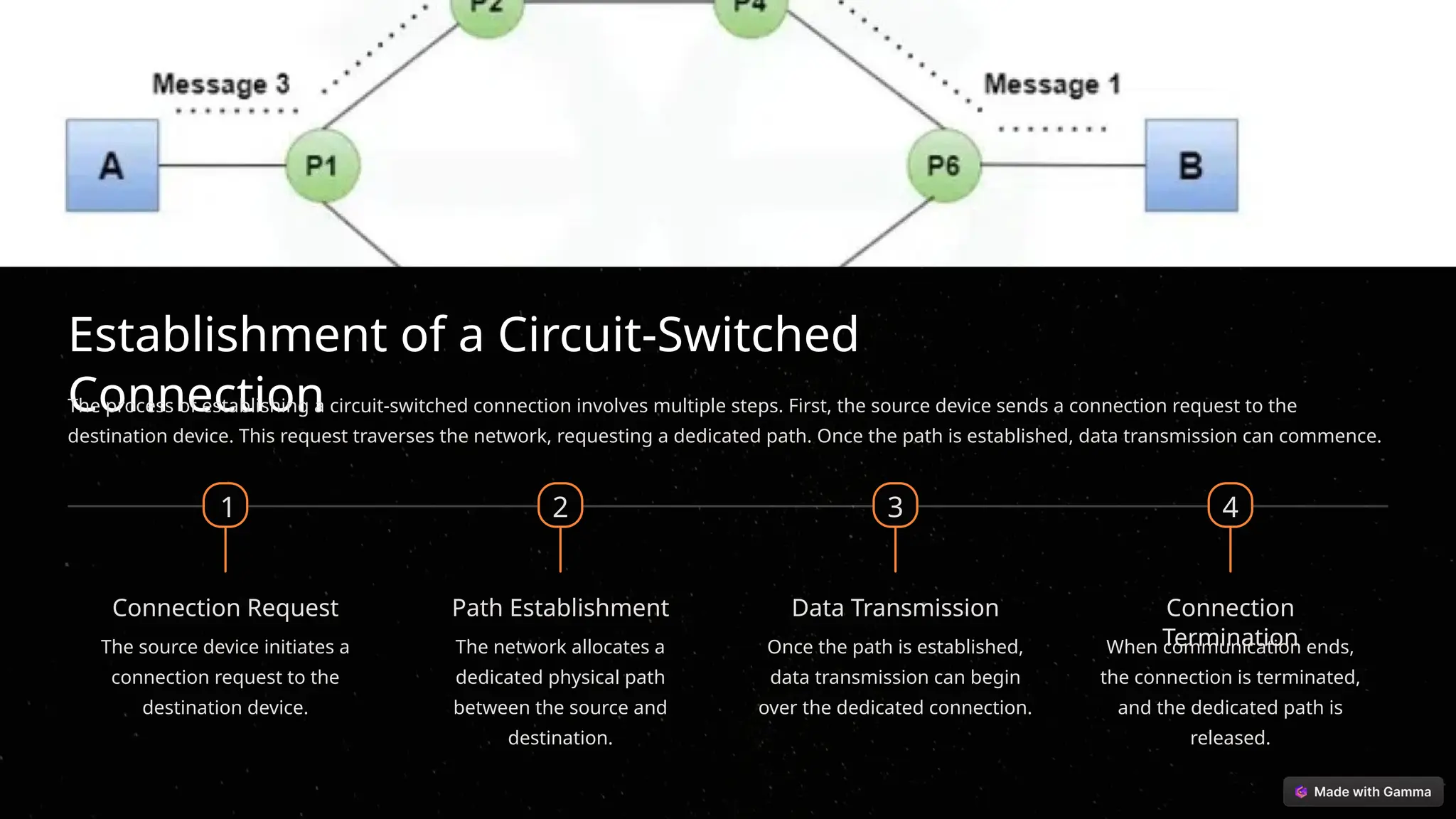
The process of establishing a circuit-switched connection involves multiple steps. First, the source device sends a connection request to the
destination device. This request traverses the network, requesting a dedicated path. Once the path is established, data transmission can commence.
1
Connection Request
The source device initiates a
connection request to the
destination device.
2
Path Establishment
The network allocates a
dedicated physical path
between the source and
destination.
3
Data Transmission
Once the path is established,
data transmission can begin
over the dedicated connection.
4
Connection
Termination
When communication ends,
the connection is terminated,
and the dedicated path is
released.
Advantages of Circuit Switching
Circuit switching offers several advantages, making it suitable for specific
applications. The dedicated path ensures real-time performance, ideal for
applications sensitive to latency and jitter. Additionally, the predictable bandwidth
allocation ensures consistent quality for real-time communication.
1 Real-Time
Performance
Dedicated paths guarantee low
latency and jitter, crucial for real-
time applications like voice and
video calls.
2 Guaranteed
Bandwidth
The allocated bandwidth is
reserved for the communicating
devices, ensuring consistent data
rate and predictable
performance.
3 Security
The dedicated path provides a secure channel, as data is transmitted over a
single, isolated route.
Disadvantages of Circuit
Switching
Despite its advantages, circuit switching has limitations. The dedicated path
requires a significant amount of network resources, making it inefficient for
applications with intermittent data transmission. The connection setup process also
adds overhead, increasing latency for short messages.
Inefficient for Intermittent
Data
The dedicated path is reserved
even when no data is being
transmitted, wasting bandwidth
and resources.
Connection Setup
Overhead
The connection setup process adds
latency, making it unsuitable for
short messages or bursty data
transmissions.
Scalability Issues
Managing a large number of dedicated paths can be challenging and can limit
the scalability of the network.
Virtual Circuit: Definition and
Concept
Virtual circuit technology establishes a logical connection between communicating devices, mimicking the behavior of a dedicated physical path. It
uses packet switching for data transmission, offering flexibility and efficiency compared to circuit switching. The connection setup phase establishes
a virtual path, and data packets follow this path for the entire duration of communication.
Connection Setup
A virtual path is established between the
source and destination devices.
Data Transmission
Data packets are transmitted along the
virtual path, with each packet containing a
virtual circuit identifier.
Data Delivery
The packets arrive at the destination device
in the same order they were sent,
maintaining communication flow.
Establishment of a Virtual Circuit
Connection
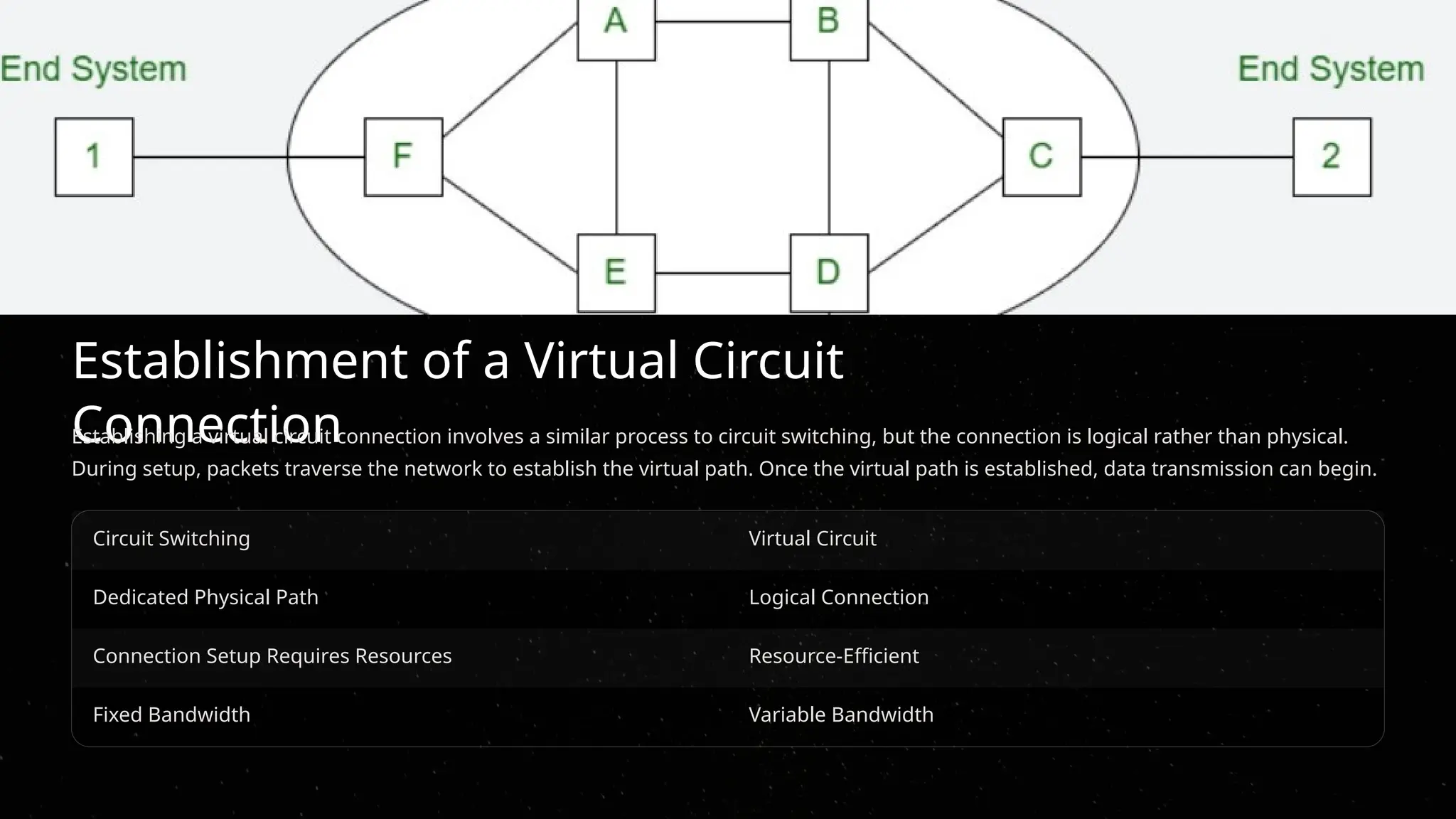
Establishing a virtual circuit connection involves a similar process to circuit switching, but the connection is logical rather than physical.
During setup, packets traverse the network to establish the virtual path. Once the virtual path is established, data transmission can begin.
Circuit Switching Virtual Circuit
Dedicated Physical Path Logical Connection
Connection Setup Requires Resources Resource-Efficient
Fixed Bandwidth Variable Bandwidth
Advantages
1.Packets are delivered to the receiver in
the same order sent by the sender.
2.Virtual circuit is a reliable network circuit.
3.There is no need for overhead in each
packet.
4.Single global packet overhead is used in
virtual circuit.
Disadvantages
1.Virtual circuit is costly to
implement.
2.It provides only connection-
oriented service.
3.Always a new connection set up is
required for transmission.
Of virtual circuit
Comparison of Circuit
Switching and Virtual Circuit
Circuit switching and virtual circuit offer distinct advantages and disadvantages, making them
suitable for different applications. Circuit switching provides real-time performance and
guaranteed bandwidth but is resource-intensive. Virtual circuit technology offers flexibility,
efficiency, and scalability but may introduce variable latency.
Speed
Circuit switching offers faster data
transmission speeds due to
dedicated bandwidth.
Efficiency
Virtual circuit technology is more
efficient in terms of network
resource utilization.
Flexibility
Virtual circuit technology allows
for flexible and dynamic data
transmission, accommodating
variable bandwidth needs.
Cost
Circuit switching can be more
expensive due to the dedicated
resource allocation.
Introduction-to-Circuit-Switching-and-Virtual-Circuit.pptx.pptx

Introduction-to-Circuit-Switching-and-Virtual-Circuit.pptx.pptx

  • 1.
    Introduction to Circuit Switching andVirtual Circuit Circuit switching and virtual circuit are two primary methods of data transmission in communication networks. They each offer distinct advantages and disadvantages, influencing their suitability for different applications. Understanding these methods is crucial for grasping the fundamental concepts of network communication. Made by: Name:ABHAY BHARGAVA enrollment no.:04220602023
  • 2.
    Circuit Switching: Definitionand Characteristics Circuit switching is a network technology where a dedicated physical path is established between two communicating devices for the duration of their communication. This dedicated path guarantees the bandwidth and latency required for real-time applications. The connection is established during a connection setup phase and remains active until the connection is terminated. Dedicated Path A physical path is established between the sender and receiver for the entire duration of communication. Guaranteed Bandwidth The allocated bandwidth is exclusively used by the communicating parties, ensuring predictable performance. Real-Time Communication Circuit switching is suitable for applications requiring low latency, such as voice calls and video conferencing.
  • 3.
    Establishment of aCircuit-Switched Connection The process of establishing a circuit-switched connection involves multiple steps. First, the source device sends a connection request to the destination device. This request traverses the network, requesting a dedicated path. Once the path is established, data transmission can commence. 1 Connection Request The source device initiates a connection request to the destination device. 2 Path Establishment The network allocates a dedicated physical path between the source and destination. 3 Data Transmission Once the path is established, data transmission can begin over the dedicated connection. 4 Connection Termination When communication ends, the connection is terminated, and the dedicated path is released.
  • 4.
    Advantages of CircuitSwitching Circuit switching offers several advantages, making it suitable for specific applications. The dedicated path ensures real-time performance, ideal for applications sensitive to latency and jitter. Additionally, the predictable bandwidth allocation ensures consistent quality for real-time communication. 1 Real-Time Performance Dedicated paths guarantee low latency and jitter, crucial for real- time applications like voice and video calls. 2 Guaranteed Bandwidth The allocated bandwidth is reserved for the communicating devices, ensuring consistent data rate and predictable performance. 3 Security The dedicated path provides a secure channel, as data is transmitted over a single, isolated route.
  • 5.
    Disadvantages of Circuit Switching Despiteits advantages, circuit switching has limitations. The dedicated path requires a significant amount of network resources, making it inefficient for applications with intermittent data transmission. The connection setup process also adds overhead, increasing latency for short messages. Inefficient for Intermittent Data The dedicated path is reserved even when no data is being transmitted, wasting bandwidth and resources. Connection Setup Overhead The connection setup process adds latency, making it unsuitable for short messages or bursty data transmissions. Scalability Issues Managing a large number of dedicated paths can be challenging and can limit the scalability of the network.
  • 6.
    Virtual Circuit: Definitionand Concept Virtual circuit technology establishes a logical connection between communicating devices, mimicking the behavior of a dedicated physical path. It uses packet switching for data transmission, offering flexibility and efficiency compared to circuit switching. The connection setup phase establishes a virtual path, and data packets follow this path for the entire duration of communication. Connection Setup A virtual path is established between the source and destination devices. Data Transmission Data packets are transmitted along the virtual path, with each packet containing a virtual circuit identifier. Data Delivery The packets arrive at the destination device in the same order they were sent, maintaining communication flow.
  • 7.
    Establishment of aVirtual Circuit Connection Establishing a virtual circuit connection involves a similar process to circuit switching, but the connection is logical rather than physical. During setup, packets traverse the network to establish the virtual path. Once the virtual path is established, data transmission can begin. Circuit Switching Virtual Circuit Dedicated Physical Path Logical Connection Connection Setup Requires Resources Resource-Efficient Fixed Bandwidth Variable Bandwidth
  • 8.
    Advantages 1.Packets are deliveredto the receiver in the same order sent by the sender. 2.Virtual circuit is a reliable network circuit. 3.There is no need for overhead in each packet. 4.Single global packet overhead is used in virtual circuit. Disadvantages 1.Virtual circuit is costly to implement. 2.It provides only connection- oriented service. 3.Always a new connection set up is required for transmission. Of virtual circuit
  • 9.
    Comparison of Circuit Switchingand Virtual Circuit Circuit switching and virtual circuit offer distinct advantages and disadvantages, making them suitable for different applications. Circuit switching provides real-time performance and guaranteed bandwidth but is resource-intensive. Virtual circuit technology offers flexibility, efficiency, and scalability but may introduce variable latency. Speed Circuit switching offers faster data transmission speeds due to dedicated bandwidth. Efficiency Virtual circuit technology is more efficient in terms of network resource utilization. Flexibility Virtual circuit technology allows for flexible and dynamic data transmission, accommodating variable bandwidth needs. Cost Circuit switching can be more expensive due to the dedicated resource allocation.

Editor's Notes