CIRCUIT AND VIRTUAL CIRCUIT
SWITCHING
Mrs. A.SEETHA
Assistant Professor
Information Technology Department
S.A.Engineering College
CIRCUIT AND VIRTUAL CIRCUIT
SWITCHING
• CIRCUIT: Circuit refers to the logical or physical
pathway established for data communication between
two or more devices.
• It originates from traditional telecommunication
systems, such as telephone networks, it was created
for a call. This concept extends to computer
networking, with a focus on how connections are
established, managed, and maintained.
TYPES OF CIRCUIT
Types of Circuits in Computer Networks:
1.Physical Circuits:
2.Logical Circuits:
1.Physical Circuits:
• It is hardware-based connections, such as wires, fiber optics,
or radio links, that connect devices.
• Examples
Ethernet cables, coaxial cables, and wireless radio signals.
• 2.Logical Circuits:
• Virtual pathways established over a physical
network.
Examples:
virtual private networks (VPNs) and routing paths
in packet-switched networks
TYPES OF CIRCUIT
SWITCHING
•Switching is the process of transferring data
packets from one device to another in a
network device.
•A switch is a hardware device in a network that
connects other devices, like computers and
servers.
SWITCHING TECHNIQUES
What is a Network Switching?
• A Network switch is a dedicated to computer hardware
that facilitates the process of switching
Example:
• Data link layer of the OSI Layer model
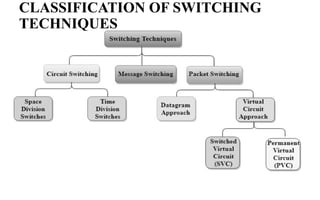
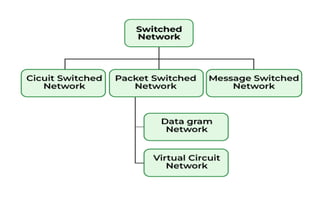
CLASSIFICATION OF SWITCHING
TECHNIQUES
CIRCUIT SWITCHING
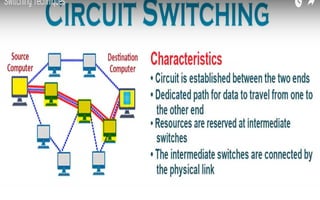
• Establishes a dedicated path between sender and
receiver.
• Dedicated path will remain to exist until the connection
is terminated.
• Circuit switching is used in public telephone network.
• It is used for voice transmission.
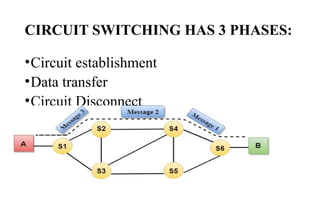
CIRCUIT SWITCHING HAS 3 PHASES:
•Circuit establishment
•Data transfer
•Circuit Disconnect
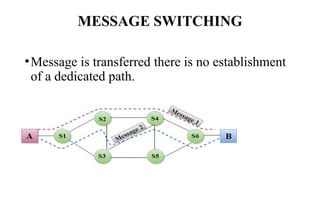
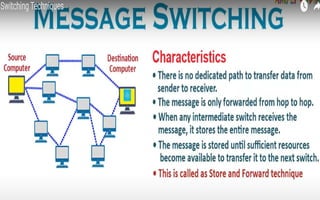
MESSAGE SWITCHING
•Message is transferred there is no establishment
of a dedicated path.
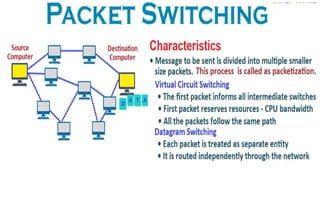
PACKET SWITCHING
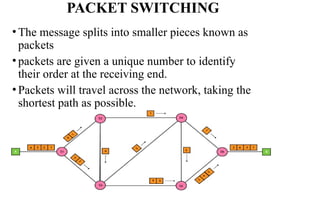
• The message splits into smaller pieces known as
packets
• packets are given a unique number to identify
their order at the receiving end.
• Packets will travel across the network, taking the
shortest path as possible.
QUESTION-1
1. Which of the following is a characteristic of circuit
switching?
a) Packets are transmitted independently.
b) A dedicated communication path is established.
c) No setup is required before communication.
d) Data is transmitted as datagrams.
• Answer: b) A dedicated communication path is established
Memory Management (16) 17
QUESTION-2
2. Which type of communication uses circuit
switching?
a) HTTP requests
b) File transfers over the internet
c) Traditional telephone calls
d) Streaming videos
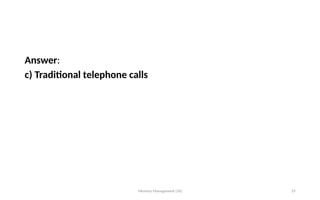
Answer:
c) Traditional telephone calls
Memory Management (16) 19
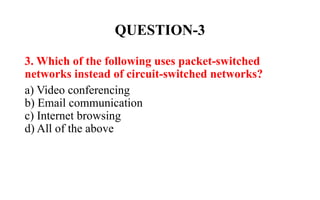
QUESTION-3
3. Which of the following uses packet-switched
networks instead of circuit-switched networks?
a) Video conferencing
b) Email communication
c) Internet browsing
d) All of the above
• Answer: d) All of the above
Memory Management (16) 21
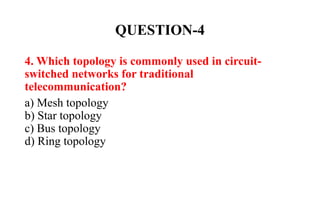
QUESTION-4
4. Which topology is commonly used in circuit-
switched networks for traditional
telecommunication?
a) Mesh topology
b) Star topology
c) Bus topology
d) Ring topology
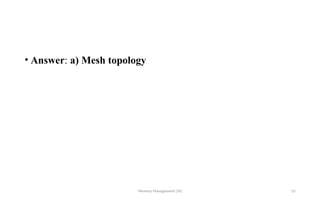
• Answer: a) Mesh topology
Memory Management (16) 23
QUESTION-5
5. What does each packet contain in a virtual circuit network?
a) only source address
b) only destination address
c) full source and destination address
d) a short VC number
Answer: d
Explanation: A short VC number also called as VCID (virtual
circuit identifier) is a type of identifier which is used to
distinguish between several virtual circuits in a connection
oriented circuit switched network. Each virtual circuit is used to
transfer data over a larger packet switched network.
QUESTION-6
6. If a link transmits 4000 frames per second, and each
slot has 8 bits, what is the transmission rate of the circuit
using Time Division Multiplexing (TDM)?
a) 500kbps
b) 32kbps
c) 32bps
d) 500bps
View Answer
Answer: b
QUESTION-6
Explanation:
Transmission rate= frame rate * number of bits in a slot.
Given: Frame rate = 4000/sec and number of bits in slot
= 8
Thus, Transmission rate = (4000 * 8) bps
= 32000bps
= 32kbps
QUESTION-7
7. A local telephone network is an example of a _______ network.
a) Packet switched
b) Circuit switched
c) Bit switched
d) Line switched
View Answer
Answer: b
Explanation: Circuit switching is connection oriented switching
technique, whereas in the case of packet switching, it is connectionless.
Circuit switching is implemented in the Physical layer, whereas packet
switching is implemented in the Network layer. Internet too is based on
the concept of circuit switching.
QUESTION-8
8. Most packet switches use this principle ____________
a) Stop and wait
b) Store and forward
c) Store and wait
d) Stop and forward
View Answer
Answer: b
Explanation: The packet switch will not transmit the first bit to
outbound link until it receives the entire packet. If the entire
packet is not received and the time-out period expires, the packet
switch will inform the sender to resend the part of packet or the
entire packet based on the algorithm being used.
QUESTION-9
9. What are the Methods to move data through a network of links and
switches?
a) Packet switching and Line switching
b) Circuit switching and Line switching
c) Line switching and bit switching
d) Packet switching and Circuit switching
View Answer
Answer: d
Explanation: Packet switching and Circuit switching are two different types
of switching methods used to connect the multiple communicating devices
with one another. Packet switching is used in conventional LAN systems
and circuit switching is used in telephonic systems.
QUESTION-10
10. In _________ systems, resources are allocated on demand.
a) packet switching
b) circuit switching
c) line switching
d) frequency switching
View Answer
Answer: a
Explanation: In packet switching, the bits are received in out of order
and need to be assembled at the receiver end, whereas in the case of
Circuit switching, all the bits are received in order. All transmissions
may not occur through the same path in case of packet switching.
THANK YOU
Memory Management (16) 31

GATE - CIRCUIT SWITCHING technique concept.pptx

  • 1.
    CIRCUIT AND VIRTUALCIRCUIT SWITCHING Mrs. A.SEETHA Assistant Professor Information Technology Department S.A.Engineering College
  • 2.
    CIRCUIT AND VIRTUALCIRCUIT SWITCHING • CIRCUIT: Circuit refers to the logical or physical pathway established for data communication between two or more devices. • It originates from traditional telecommunication systems, such as telephone networks, it was created for a call. This concept extends to computer networking, with a focus on how connections are established, managed, and maintained.
  • 3.
    TYPES OF CIRCUIT Typesof Circuits in Computer Networks: 1.Physical Circuits: 2.Logical Circuits: 1.Physical Circuits: • It is hardware-based connections, such as wires, fiber optics, or radio links, that connect devices. • Examples Ethernet cables, coaxial cables, and wireless radio signals.
  • 4.
    • 2.Logical Circuits: •Virtual pathways established over a physical network. Examples: virtual private networks (VPNs) and routing paths in packet-switched networks TYPES OF CIRCUIT
  • 5.
    SWITCHING •Switching is theprocess of transferring data packets from one device to another in a network device. •A switch is a hardware device in a network that connects other devices, like computers and servers.
  • 6.
    SWITCHING TECHNIQUES What isa Network Switching? • A Network switch is a dedicated to computer hardware that facilitates the process of switching Example: • Data link layer of the OSI Layer model
  • 7.
  • 8.
    CIRCUIT SWITCHING • Establishesa dedicated path between sender and receiver. • Dedicated path will remain to exist until the connection is terminated. • Circuit switching is used in public telephone network. • It is used for voice transmission.
  • 9.
    CIRCUIT SWITCHING HAS3 PHASES: •Circuit establishment •Data transfer •Circuit Disconnect
  • 10.
    MESSAGE SWITCHING •Message istransferred there is no establishment of a dedicated path.
  • 11.
    PACKET SWITCHING • Themessage splits into smaller pieces known as packets • packets are given a unique number to identify their order at the receiving end. • Packets will travel across the network, taking the shortest path as possible.
  • 16.
    QUESTION-1 1. Which ofthe following is a characteristic of circuit switching? a) Packets are transmitted independently. b) A dedicated communication path is established. c) No setup is required before communication. d) Data is transmitted as datagrams.
  • 17.
    • Answer: b)A dedicated communication path is established Memory Management (16) 17
  • 18.
    QUESTION-2 2. Which typeof communication uses circuit switching? a) HTTP requests b) File transfers over the internet c) Traditional telephone calls d) Streaming videos
  • 19.
    Answer: c) Traditional telephonecalls Memory Management (16) 19
  • 20.
    QUESTION-3 3. Which ofthe following uses packet-switched networks instead of circuit-switched networks? a) Video conferencing b) Email communication c) Internet browsing d) All of the above
  • 21.
    • Answer: d)All of the above Memory Management (16) 21
  • 22.
    QUESTION-4 4. Which topologyis commonly used in circuit- switched networks for traditional telecommunication? a) Mesh topology b) Star topology c) Bus topology d) Ring topology
  • 23.
    • Answer: a)Mesh topology Memory Management (16) 23
  • 24.
    QUESTION-5 5. What doeseach packet contain in a virtual circuit network? a) only source address b) only destination address c) full source and destination address d) a short VC number Answer: d Explanation: A short VC number also called as VCID (virtual circuit identifier) is a type of identifier which is used to distinguish between several virtual circuits in a connection oriented circuit switched network. Each virtual circuit is used to transfer data over a larger packet switched network.
  • 25.
    QUESTION-6 6. If alink transmits 4000 frames per second, and each slot has 8 bits, what is the transmission rate of the circuit using Time Division Multiplexing (TDM)? a) 500kbps b) 32kbps c) 32bps d) 500bps View Answer Answer: b
  • 26.
    QUESTION-6 Explanation: Transmission rate= framerate * number of bits in a slot. Given: Frame rate = 4000/sec and number of bits in slot = 8 Thus, Transmission rate = (4000 * 8) bps = 32000bps = 32kbps
  • 27.
    QUESTION-7 7. A localtelephone network is an example of a _______ network. a) Packet switched b) Circuit switched c) Bit switched d) Line switched View Answer Answer: b Explanation: Circuit switching is connection oriented switching technique, whereas in the case of packet switching, it is connectionless. Circuit switching is implemented in the Physical layer, whereas packet switching is implemented in the Network layer. Internet too is based on the concept of circuit switching.
  • 28.
    QUESTION-8 8. Most packetswitches use this principle ____________ a) Stop and wait b) Store and forward c) Store and wait d) Stop and forward View Answer Answer: b Explanation: The packet switch will not transmit the first bit to outbound link until it receives the entire packet. If the entire packet is not received and the time-out period expires, the packet switch will inform the sender to resend the part of packet or the entire packet based on the algorithm being used.
  • 29.
    QUESTION-9 9. What arethe Methods to move data through a network of links and switches? a) Packet switching and Line switching b) Circuit switching and Line switching c) Line switching and bit switching d) Packet switching and Circuit switching View Answer Answer: d Explanation: Packet switching and Circuit switching are two different types of switching methods used to connect the multiple communicating devices with one another. Packet switching is used in conventional LAN systems and circuit switching is used in telephonic systems.
  • 30.
    QUESTION-10 10. In _________systems, resources are allocated on demand. a) packet switching b) circuit switching c) line switching d) frequency switching View Answer Answer: a Explanation: In packet switching, the bits are received in out of order and need to be assembled at the receiver end, whereas in the case of Circuit switching, all the bits are received in order. All transmissions may not occur through the same path in case of packet switching.
  • 31.