Cardiovascular System - Introduction
Dr Ken MacLeod
Cardiac Medicine, NHLI, Faculty of Medicine, Imperial College London, UK
k.t.macleod@imperial.ac.uk
© Imperial College London
Life Support Systems
Cardiovascular System
Cardiovascular course
• Students often find cardiovascular
course difficult
• Concepts are new, lot to learn
• Review material as soon as possible
following lecture
• Test yourself – questionnaires
• Use self-study sessions wisely
• Take good notes
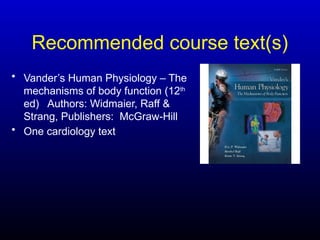
Recommended course text(s)
• Vander’s Human Physiology – The
mechanisms of body function (12th
ed) Authors: Widmaier, Raff &
Strang, Publishers: McGraw-Hill
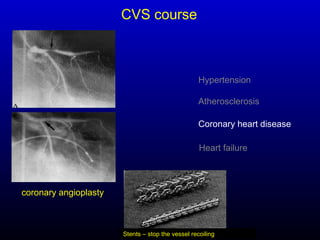
• One cardiology text
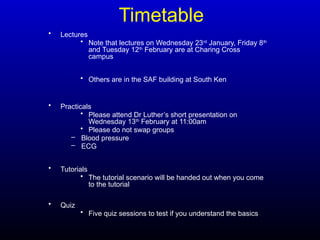
Timetable
• Lectures
• Note that lectures on Wednesday 23rd
January, Friday 8th
and Tuesday 12th
February are at Charing Cross
campus
• Others are in the SAF building at South Ken
• Practicals
• Please attend Dr Luther’s short presentation on
Wednesday 13th
February at 11:00am
• Please do not swap groups
– Blood pressure
– ECG
• Tutorials
• The tutorial scenario will be handed out when you come
to the tutorial
• Quiz
• Five quiz sessions to test if you understand the basics
Course guide
• The learning objectives help clarify, organize and
prioritize your learning
• All lectures available on the intranet in advance
• Encourage you to take responsibility for your learning
• Evaluate your progress with the small quiz sessions
• For some lectures, additional material will be provided
and put on the intranet and your attention also drawn to
various useful web sites
• Some material may be duplicated – this is usually
because it is important
The CVS course has produced a course guide book
containing learning objectives and what we consider to
be the key points in each lecture
Student behaviour
Don’t talk - think!
If you don’t understand, ask the
lecturer at the end or email; don’t
get stressed…
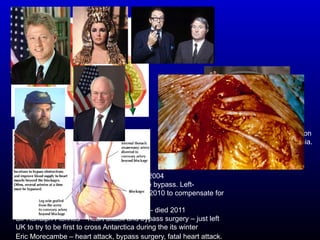
Bill Clinton – quadruple bypass surgery in 2004
Dick Cheney – (VP to GW Bush) quadruple bypass. Left-
ventricular assist device (LVAD) fitted July 2010 to compensate for
increasing congestive heart failure.
Elizabeth Taylor – congestive heart failure – died 2011
Sir Ranulph Fiennes – heart attack and bypass surgery – just left
UK to try to be first to cross Antarctica during the its winter
Eric Morecambe – heart attack, bypass surgery, fatal heart attack.
John Candy died aged 43 from advanced
atherosclerosis, which caused a coronary
embolism, leading to a myocardial infarction
(heart attack) and a fatal cardiac arrhythmia.
His father died aged 35.
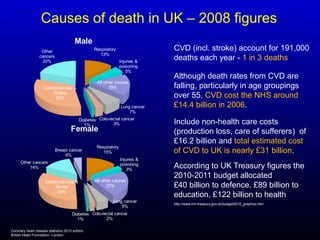
Causes of death in UK – 2008 figures
Respiratory
13%
Injuries &
poisoning
5%
All other causes
18%
Lung cancer
7%
Colo-rectal cancer
3%
Diabetes
1%
Cardiovascular &
Stroke
33%
Other
cancers
20%
Male
CVD (incl. stroke) account for 191,000
deaths each year - 1 in 3 deaths
Although death rates from CVD are
falling, particularly in age groupings
over 55, CVD cost the NHS around
£14.4 billion in 2006.
Include non-health care costs
(production loss, care of sufferers) of
£16.2 billion and total estimated cost
of CVD to UK is nearly £31 billion.
Coronary heart disease statistics 2010 edition.
British Heart Foundation: London.
http://www.hm-treasury.gov.uk/budget2010_graphics.htm
According to UK Treasury figures the
2010-2011 budget allocated
£40 billion to defence, £89 billion to
education, £122 billion to health
Respiratory
15%
Injuries &
poisoning
3%
All other causes
23%
Lung cancer
5%
Colo-rectal cancer
2%
Diabetes
1%
Cardiovascular &
Stroke
33%
Other cancers
14%
Breast cancer
4%
Female
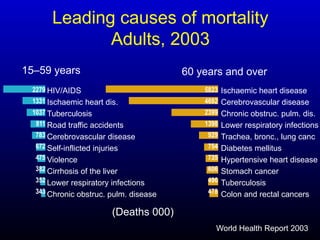
5823
4692
2399
1398
929
754
735
606
496
478
HIV/AIDS
Ischaemic heart dis.
Tuberculosis
Road traffic accidents
Cerebrovascular disease
Self-inflicted injuries
Violence
Cirrhosis of the liver
Lower respiratory infections
Chronic obstruc. pulm. disease
2279
1331
1037
811
783
672
475
382
352
343
Ischaemic heart disease
Cerebrovascular disease
Chronic obstruc. pulm. dis.
Lower respiratory infections
Trachea, bronc., lung canc
Diabetes mellitus
Hypertensive heart disease
Stomach cancer
Tuberculosis
Colon and rectal cancers
15–59 years 60 years and over
World Health Report 2003
(Deaths 000)
Leading causes of mortality
Adults, 2003
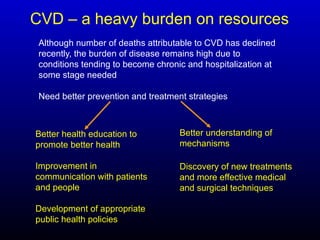
CVD – a heavy burden on resources
Although number of deaths attributable to CVD has declined
recently, the burden of disease remains high due to
conditions tending to become chronic and hospitalization at
some stage needed
Need better prevention and treatment strategies
Better health education to
promote better health
Improvement in
communication with patients
and people
Development of appropriate
public health policies
Better understanding of
mechanisms
Discovery of new treatments
and more effective medical
and surgical techniques
How far have we come?
A long way in a short time
Improvements in:
(1) public health
(2) medical care
(3) pharmacy
(4) diet
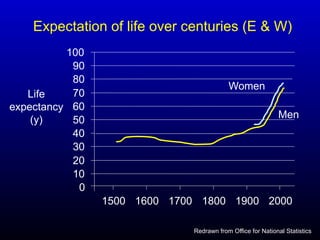
0
10
20
30
40
50
60
70
80
90
100
1500 1600 1700 1800 1900 2000
Women
Men
Expectation of life over centuries (E & W)
Life
expectancy
(y)
Redrawn from Office for National Statistics
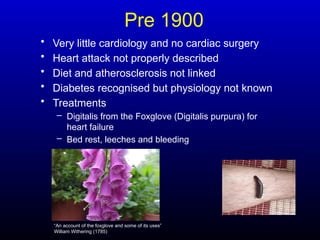
Pre 1900
• Very little cardiology and no cardiac surgery
• Heart attack not properly described
• Diet and atherosclerosis not linked
• Diabetes recognised but physiology not known
• Treatments
– Digitalis from the Foxglove (Digitalis purpura) for
heart failure
– Bed rest, leeches and bleeding
“An account of the foxglove and some of its uses”
William Withering (1785)
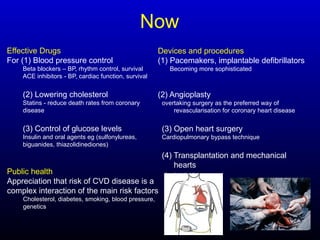
Now
Effective Drugs
For (1) Blood pressure control
Beta blockers – BP, rhythm control, survival
ACE inhibitors - BP, cardiac function, survival
(2) Lowering cholesterol
Statins - reduce death rates from coronary
disease
(3) Control of glucose levels
Insulin and oral agents eg (sulfonylureas,
biguanides, thiazolidinediones)
Public health
Appreciation that risk of CVD disease is a
complex interaction of the main risk factors
Cholesterol, diabetes, smoking, blood pressure,
genetics
Devices and procedures
(1) Pacemakers, implantable defibrillators
Becoming more sophisticated
(2) Angioplasty
overtaking surgery as the preferred way of
revascularisation for coronary heart disease
(3) Open heart surgery
Cardiopulmonary bypass technique
(4) Transplantation and mechanical
hearts
Assist devices
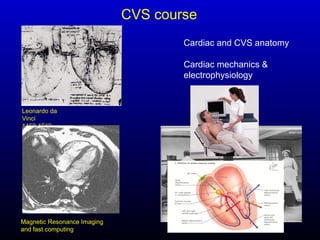
Magnetic Resonance Imaging
and fast computing
Leonardo da
Vinci
1452-1519
CVS course
Cardiac and CVS anatomy
Cardiac mechanics &
electrophysiology
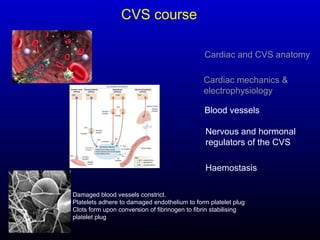
Blood vessels
Nervous and hormonal
regulators of the CVS
Haemostasis
Cardiac and CVS anatomy
Cardiac mechanics &
electrophysiology
CVS course
Damaged blood vessels constrict.
Platelets adhere to damaged endothelium to form platelet plug
Clots form upon conversion of fibrinogen to fibrin stabilising
platelet plug
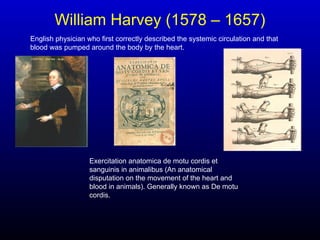
William Harvey (1578 – 1657)
English physician who first correctly described the systemic circulation and that
blood was pumped around the body by the heart.
Exercitation anatomica de motu cordis et
sanguinis in animalibus (An anatomical
disputation on the movement of the heart and
blood in animals). Generally known as De motu
cordis.
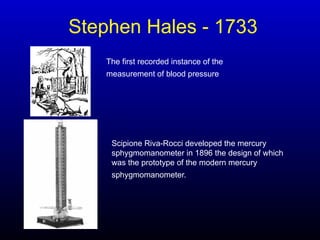
Stephen Hales - 1733
The first recorded instance of the
measurement of blood pressure
Scipione Riva-Rocci developed the mercury
sphygmomanometer in 1896 the design of which
was the prototype of the modern mercury
sphygmomanometer.
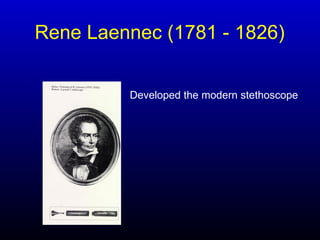
Developed the modern stethoscope
Rene Laennec (1781 - 1826)
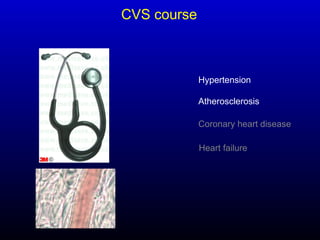
Hypertension
Atherosclerosis
Coronary heart disease
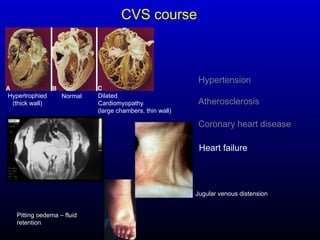
Heart failure
CVS course
Hypertension
Atherosclerosis
Coronary heart disease
Heart failure
coronary angioplasty
CVS course
Stents – stop the vessel recoiling
Hypertension
Atherosclerosis
Coronary heart disease
Heart failure
CVS course
Dilated
Cardiomyopathy
(large chambers, thin wall)
Normal
Hypertrophied
(thick wall)
Jugular venous distension
Pitting oedema – fluid
retention
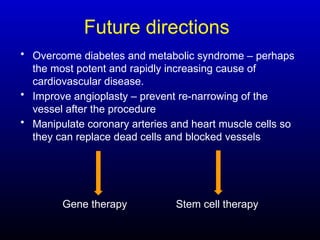
Future directions
• Overcome diabetes and metabolic syndrome – perhaps
the most potent and rapidly increasing cause of
cardiovascular disease.
• Improve angioplasty – prevent re-narrowing of the
vessel after the procedure
• Manipulate coronary arteries and heart muscle cells so
they can replace dead cells and blocked vessels
Gene therapy Stem cell therapy
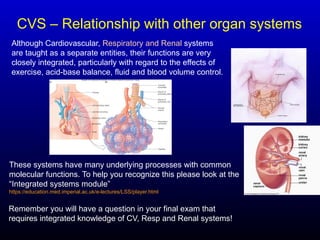
CVS – Relationship with other organ systems
Although Cardiovascular, Respiratory and Renal systems
are taught as a separate entities, their functions are very
closely integrated, particularly with regard to the effects of
exercise, acid-base balance, fluid and blood volume control.
These systems have many underlying processes with common
molecular functions. To help you recognize this please look at the
“Integrated systems module”
https://education.med.imperial.ac.uk/e-lectures/LSS/player.html
Remember you will have a question in your final exam that
requires integrated knowledge of CV, Resp and Renal systems!
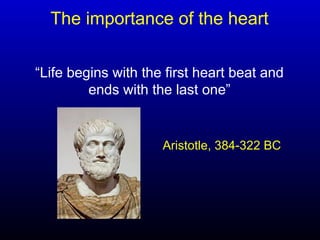
The importance of the heart
“Life begins with the first heart beat and
ends with the last one”
Aristotle, 384-322 BC
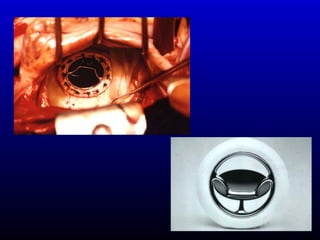
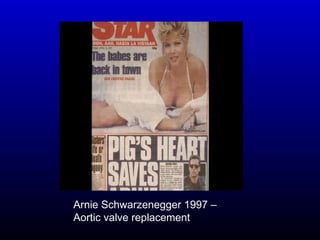
Arnie Schwarzenegger 1997 –
Aortic valve replacement
Introduction to Cardio functions - Human anatomy

Introduction to Cardio functions - Human anatomy

  • 1.
    Cardiovascular System -Introduction Dr Ken MacLeod Cardiac Medicine, NHLI, Faculty of Medicine, Imperial College London, UK k.t.macleod@imperial.ac.uk © Imperial College London Life Support Systems Cardiovascular System
  • 2.
    Cardiovascular course • Studentsoften find cardiovascular course difficult • Concepts are new, lot to learn • Review material as soon as possible following lecture • Test yourself – questionnaires • Use self-study sessions wisely • Take good notes
  • 3.
    Recommended course text(s) •Vander’s Human Physiology – The mechanisms of body function (12th ed) Authors: Widmaier, Raff & Strang, Publishers: McGraw-Hill • One cardiology text
  • 4.
    Timetable • Lectures • Notethat lectures on Wednesday 23rd January, Friday 8th and Tuesday 12th February are at Charing Cross campus • Others are in the SAF building at South Ken • Practicals • Please attend Dr Luther’s short presentation on Wednesday 13th February at 11:00am • Please do not swap groups – Blood pressure – ECG • Tutorials • The tutorial scenario will be handed out when you come to the tutorial • Quiz • Five quiz sessions to test if you understand the basics
  • 5.
    Course guide • Thelearning objectives help clarify, organize and prioritize your learning • All lectures available on the intranet in advance • Encourage you to take responsibility for your learning • Evaluate your progress with the small quiz sessions • For some lectures, additional material will be provided and put on the intranet and your attention also drawn to various useful web sites • Some material may be duplicated – this is usually because it is important The CVS course has produced a course guide book containing learning objectives and what we consider to be the key points in each lecture
  • 6.
    Student behaviour Don’t talk- think! If you don’t understand, ask the lecturer at the end or email; don’t get stressed…
  • 7.
    Bill Clinton –quadruple bypass surgery in 2004 Dick Cheney – (VP to GW Bush) quadruple bypass. Left- ventricular assist device (LVAD) fitted July 2010 to compensate for increasing congestive heart failure. Elizabeth Taylor – congestive heart failure – died 2011 Sir Ranulph Fiennes – heart attack and bypass surgery – just left UK to try to be first to cross Antarctica during the its winter Eric Morecambe – heart attack, bypass surgery, fatal heart attack. John Candy died aged 43 from advanced atherosclerosis, which caused a coronary embolism, leading to a myocardial infarction (heart attack) and a fatal cardiac arrhythmia. His father died aged 35.
  • 8.
    Causes of deathin UK – 2008 figures Respiratory 13% Injuries & poisoning 5% All other causes 18% Lung cancer 7% Colo-rectal cancer 3% Diabetes 1% Cardiovascular & Stroke 33% Other cancers 20% Male CVD (incl. stroke) account for 191,000 deaths each year - 1 in 3 deaths Although death rates from CVD are falling, particularly in age groupings over 55, CVD cost the NHS around £14.4 billion in 2006. Include non-health care costs (production loss, care of sufferers) of £16.2 billion and total estimated cost of CVD to UK is nearly £31 billion. Coronary heart disease statistics 2010 edition. British Heart Foundation: London. http://www.hm-treasury.gov.uk/budget2010_graphics.htm According to UK Treasury figures the 2010-2011 budget allocated £40 billion to defence, £89 billion to education, £122 billion to health Respiratory 15% Injuries & poisoning 3% All other causes 23% Lung cancer 5% Colo-rectal cancer 2% Diabetes 1% Cardiovascular & Stroke 33% Other cancers 14% Breast cancer 4% Female
  • 9.
    5823 4692 2399 1398 929 754 735 606 496 478 HIV/AIDS Ischaemic heart dis. Tuberculosis Roadtraffic accidents Cerebrovascular disease Self-inflicted injuries Violence Cirrhosis of the liver Lower respiratory infections Chronic obstruc. pulm. disease 2279 1331 1037 811 783 672 475 382 352 343 Ischaemic heart disease Cerebrovascular disease Chronic obstruc. pulm. dis. Lower respiratory infections Trachea, bronc., lung canc Diabetes mellitus Hypertensive heart disease Stomach cancer Tuberculosis Colon and rectal cancers 15–59 years 60 years and over World Health Report 2003 (Deaths 000) Leading causes of mortality Adults, 2003
  • 10.
    CVD – aheavy burden on resources Although number of deaths attributable to CVD has declined recently, the burden of disease remains high due to conditions tending to become chronic and hospitalization at some stage needed Need better prevention and treatment strategies Better health education to promote better health Improvement in communication with patients and people Development of appropriate public health policies Better understanding of mechanisms Discovery of new treatments and more effective medical and surgical techniques
  • 11.
    How far havewe come? A long way in a short time Improvements in: (1) public health (2) medical care (3) pharmacy (4) diet
  • 12.
    0 10 20 30 40 50 60 70 80 90 100 1500 1600 17001800 1900 2000 Women Men Expectation of life over centuries (E & W) Life expectancy (y) Redrawn from Office for National Statistics
  • 13.
    Pre 1900 • Verylittle cardiology and no cardiac surgery • Heart attack not properly described • Diet and atherosclerosis not linked • Diabetes recognised but physiology not known • Treatments – Digitalis from the Foxglove (Digitalis purpura) for heart failure – Bed rest, leeches and bleeding “An account of the foxglove and some of its uses” William Withering (1785)
  • 14.
    Now Effective Drugs For (1)Blood pressure control Beta blockers – BP, rhythm control, survival ACE inhibitors - BP, cardiac function, survival (2) Lowering cholesterol Statins - reduce death rates from coronary disease (3) Control of glucose levels Insulin and oral agents eg (sulfonylureas, biguanides, thiazolidinediones) Public health Appreciation that risk of CVD disease is a complex interaction of the main risk factors Cholesterol, diabetes, smoking, blood pressure, genetics Devices and procedures (1) Pacemakers, implantable defibrillators Becoming more sophisticated (2) Angioplasty overtaking surgery as the preferred way of revascularisation for coronary heart disease (3) Open heart surgery Cardiopulmonary bypass technique (4) Transplantation and mechanical hearts Assist devices
  • 15.
    Magnetic Resonance Imaging andfast computing Leonardo da Vinci 1452-1519 CVS course Cardiac and CVS anatomy Cardiac mechanics & electrophysiology
  • 16.
    Blood vessels Nervous andhormonal regulators of the CVS Haemostasis Cardiac and CVS anatomy Cardiac mechanics & electrophysiology CVS course Damaged blood vessels constrict. Platelets adhere to damaged endothelium to form platelet plug Clots form upon conversion of fibrinogen to fibrin stabilising platelet plug
  • 17.
    William Harvey (1578– 1657) English physician who first correctly described the systemic circulation and that blood was pumped around the body by the heart. Exercitation anatomica de motu cordis et sanguinis in animalibus (An anatomical disputation on the movement of the heart and blood in animals). Generally known as De motu cordis.
  • 18.
    Stephen Hales -1733 The first recorded instance of the measurement of blood pressure Scipione Riva-Rocci developed the mercury sphygmomanometer in 1896 the design of which was the prototype of the modern mercury sphygmomanometer.
  • 19.
    Developed the modernstethoscope Rene Laennec (1781 - 1826)
  • 20.
  • 21.
    Hypertension Atherosclerosis Coronary heart disease Heartfailure coronary angioplasty CVS course Stents – stop the vessel recoiling
  • 22.
    Hypertension Atherosclerosis Coronary heart disease Heartfailure CVS course Dilated Cardiomyopathy (large chambers, thin wall) Normal Hypertrophied (thick wall) Jugular venous distension Pitting oedema – fluid retention
  • 24.
    Future directions • Overcomediabetes and metabolic syndrome – perhaps the most potent and rapidly increasing cause of cardiovascular disease. • Improve angioplasty – prevent re-narrowing of the vessel after the procedure • Manipulate coronary arteries and heart muscle cells so they can replace dead cells and blocked vessels Gene therapy Stem cell therapy
  • 25.
    CVS – Relationshipwith other organ systems Although Cardiovascular, Respiratory and Renal systems are taught as a separate entities, their functions are very closely integrated, particularly with regard to the effects of exercise, acid-base balance, fluid and blood volume control. These systems have many underlying processes with common molecular functions. To help you recognize this please look at the “Integrated systems module” https://education.med.imperial.ac.uk/e-lectures/LSS/player.html Remember you will have a question in your final exam that requires integrated knowledge of CV, Resp and Renal systems!
  • 26.
    The importance ofthe heart “Life begins with the first heart beat and ends with the last one” Aristotle, 384-322 BC
  • 27.
    Arnie Schwarzenegger 1997– Aortic valve replacement