Introduction to Business
Role of Business
Module Learning Outcomes
Discuss the role of business in society, the primary functions within a business,
and external forces that affect business activities
1.1: Explain the concept of business
1.2: Distinguish between for-profit and nonprofit businesses
1.3: List and explain the four factors of production required to sustain a business
1.4: Identify the primary functional areas within a business and describe their contribution
to the organization
1.5: Identify business stakeholders and describe their relationship with business organizatio
ns
1.6: Identify the external forces that shape the business environment
What Is Business?
Learning Outcomes: What Is Business?
1.1: Explain the concept of business
1.1.1: Define the term business
1.1.2: Distinguish between profit, loss, and value
1.1.3: Distinguish between goods and services
What is a
business?
Any activity that provides
goods or services to
consumers for the purpose of
making a profit.
Goods and Services
Examples of goods are tangible items such as cars, televisions, or soda.
Examples of services (action or work performed for monetary compensation)
are haircuts, hotel stays, or roller-coaster rides.
Businesses can generate profits from the sale of goods and/or services
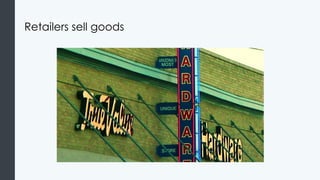
Retailers sell goods
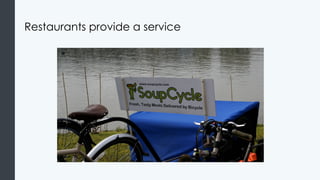
Restaurants provide a service
Profit, Loss, and Value
Profit is the amount of revenue or income that a business owner retains after
paying all the expenses associated with the operation of the business.
If the expenses of the business exceed the revenue or income generated from
operations, then the business will suffer a loss. Businesses that suffer
extraordinary losses during a short period of time or slowly see their profits
decline may end up closing or filing for bankruptcy.
When businesses talk about value they are referring to the relationship between
the price a customer pays for the good or service and the perceived benefits
the customer receives in exchange for their time or money.
Practice Question 1
How do you define “profit”?
A. when revenue exceeds costs
B. when costs exceed revenue
C. when revenue achieves planned target
D. when the bottom line is in the red
Practice Question 2
How do you define “loss”?
A. when costs fall lower than projection
B. when the bottom line is in the black
C. when revenue exceeds costs
D. when costs exceed revenue
Practice Question 3
How do you define “value”?
A. when the perception of competition is
too expensive
B. the perceived benefits by a customer
of price to the time and money spent
C. when market research establishes the
floor price
D. when a customer purchases for the
lowest price in town
For-Profit vs. Nonprofit
Learning Outcomes: For-Profit vs. Nonprofit
1.2: Distinguish between for-profit and nonprofit businesses
1.2.1: Explain the purpose of for-profit businesses
1.2.2: Explain the purpose of nonprofit businesses
1.2.3: Distinguish between for-profit and nonprofit businesses
Nonprofit Businesses
A nonprofit or not-for-profit business is one that provides goods and services to
consumers, but its primary goal is no to return profit to the owners of the business
(as is the case with a for-profit business).
Instead, it uses those profits to provide a public service, advance a cause, or
assist others.
Examples
• American Red Cross
• SPCA
• American Cancer Society
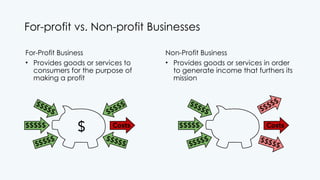
For-profit vs. Non-profit Businesses
For-Profit Business
• Provides goods or services to
consumers for the purpose of
making a profit
Non-Profit Business
• Provides goods or services in order
to generate income that furthers its
mission
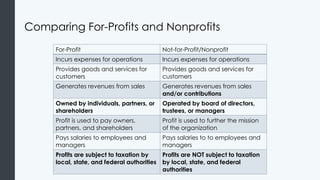
Comparing For-Profits and Nonprofits
For-Profit Not-for-Profit/Nonprofit
Incurs expenses for operations Incurs expenses for operations
Provides goods and services for
customers
Provides goods and services for
customers
Generates revenues from sales Generates revenues from sales
and/or contributions
Owned by individuals, partners, or
shareholders
Operated by board of directors,
trustees, or managers
Profit is used to pay owners,
partners, and shareholders
Profit is used to further the mission
of the organization
Pays salaries to employees and
managers
Pays salaries to to employees and
managers
Profits are subject to taxation by
local, state, and federal authorities
Profits are NOT subject to taxation
by local, state, and federal
authorities
Class Discussion: Profit or Mission?
Do you think that for-profit businesses can be mission driven?
Do you think that non-profit businesses can serve themselves rather than their
stated mission?
Factors of Production
Learning Outcomes: Factors of Production
1.3: List and explain the four factors of production required to sustain
a business
1.3.1: List the four factors of production
1.3.2: Explain the four factors of production
Resources and Factors of Production
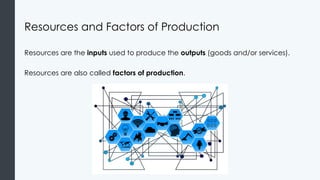
Resources are the inputs used to produce the outputs (goods and/or services).
Resources are also called factors of production.
Understanding Factors of Production
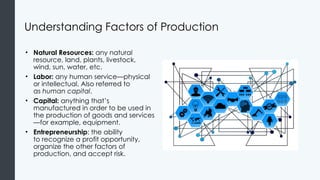
• Natural Resources: any natural
resource, land, plants, livestock,
wind, sun, water, etc.
• Labor: any human service—physical
or intellectual. Also referred to
as human capital.
• Capital: anything that’s
manufactured in order to be used in
the production of goods and services
—for example, equipment.
• Entrepreneurship: the ability
to recognize a profit opportunity,
organize the other factors of
production, and accept risk.
Factors of Production: Baking a Cake
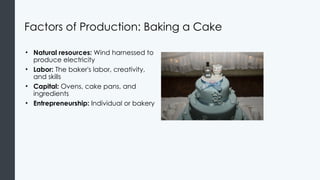
• Natural resources: Wind harnessed to
produce electricity
• Labor: The baker's labor, creativity,
and skills
• Capital: Ovens, cake pans, and
ingredients
• Entrepreneurship: Individual or bakery
Functional Areas
Learning Outcomes: Functional Areas
1.4: Identify the primary functional areas within a business and
describe their contribution to the organization
1.4.1: Identify the primary functional areas within a business
1.4.2: Identify key people and explain the activities within each functional
area
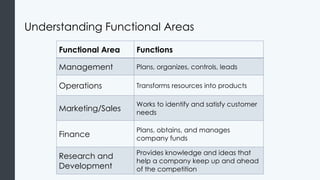
Understanding Functional Areas
Functional Area Functions
Management Plans, organizes, controls, leads
Operations Transforms resources into products
Marketing/Sales
Works to identify and satisfy customer
needs
Finance
Plans, obtains, and manages
company funds
Research and
Development
Provides knowledge and ideas that
help a company keep up and ahead
of the competition
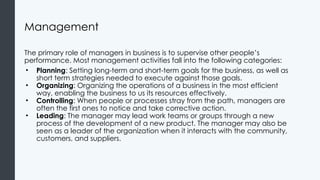
Management
The primary role of managers in business is to supervise other people’s
performance. Most management activities fall into the following categories:
• Planning: Setting long-term and short-term goals for the business, as well as
short term strategies needed to execute against those goals.
• Organizing: Organizing the operations of a business in the most efficient
way, enabling the business to us its resources effectively.
• Controlling: When people or processes stray from the path, managers are
often the first ones to notice and take corrective action.
• Leading: The manager may lead work teams or groups through a new
process of the development of a new product. The manager may also be
seen as a leader of the organization when it interacts with the community,
customers, and suppliers.
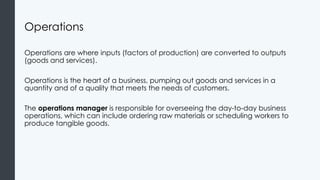
Operations
Operations are where inputs (factors of production) are converted to outputs
(goods and services).
Operations is the heart of a business, pumping out goods and services in a
quantity and of a quality that meets the needs of customers.
The operations manager is responsible for overseeing the day-to-day business
operations, which can include ordering raw materials or scheduling workers to
produce tangible goods.
Marketing
Marketing identifies customers’ needs and designs products and services that
meet those needs.
The marketing function includes:
• Promoting goods and services
• Determining how the goods and services will be delivered
• Developing a pricing strategy to capture market share while remaining
competitive
• Building and overseeing businesses’ Internet presence
Finance
Finance involves planning for, obtaining, and managing a company’s funds.
Finance managers plan for both short- and long-term financial capital needs
and analyze the impact that borrowing will have on the financial well-being of
a business.
The finance department answer questions about how funds should be raised,
the long-term cost of borrowing funds, and the implications of financing
decisions for the long-term health of the business.
Accounting is a crucial part of the Finance functional area. Accountants
provide managers with information needed to make decisions about the
allocation of company resources.
Research and Development (R&D)
Research and Development is the lifeblood of manufacturing businesses. R&D is
staffed with scientists, thought-leaders, subject-matter experts, and industry
analysts striving to provide the organization with knowledge and ideas to keep
up and ahead of the competition.
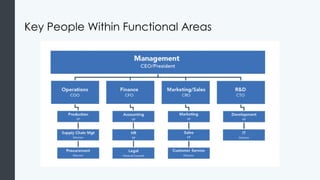
R&D is led by the Chief Technology Officer (CTO) who manages a
Development VP or similar title depending on what technology products are
being produced.
Key People Within Functional Areas
Practice Question 4
Which functional area of a business is responsible for converting the factors of
production into goods and services?
A. Management
B. Operations
C. Marketing / Sales
D. Finance
Practice Question 5
Sea-Worthy is an ocean shipping company. The company decided to develop
their own internal ERP (Enterprise Resource Management) system since none of
the existing commercial packages met the specific needs of their unique
business segment. Halfway into development by their IT department, the
company came to the realization that this system could be licensed to their
competitors to offset their development cost and fund future enhancements.
Which functional area of the company would be responsible for creating
revenue from this internal system?
A. Marketing
B. Operations
C. Finance
D. R&D
Stakeholders
Learning Outcomes: Stakeholders
1.5: Identify business stakeholders and describe their relationship with
business organizations
1.5.1: Define internal and external stakeholder
1.5.2: Describe stakeholders' relationship with business organizations
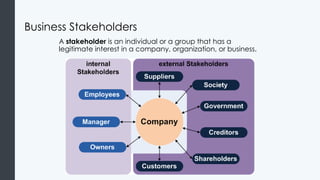
Business Stakeholders
A stakeholder is an individual or a group that has a
legitimate interest in a company, organization, or business.
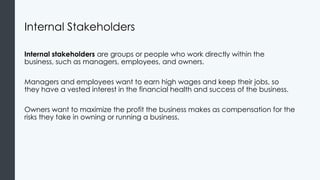
Internal Stakeholders
Internal stakeholders are groups or people who work directly within the
business, such as managers, employees, and owners.
Managers and employees want to earn high wages and keep their jobs, so
they have a vested interest in the financial health and success of the business.
Owners want to maximize the profit the business makes as compensation for the
risks they take in owning or running a business.
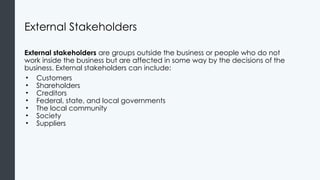
External Stakeholders
External stakeholders are groups outside the business or people who do not
work inside the business but are affected in some way by the decisions of the
business. External stakeholders can include:
• Customers
• Shareholders
• Creditors
• Federal, state, and local governments
• The local community
• Society
• Suppliers
External Forces
Learning Outcomes: External Forces
1.6: Identify the external forces that shape the business environment
1.6.1: List the external forces that affect businesses
1.6.2: Give examples of how various external forces affect the participants in
a business and its functional areas
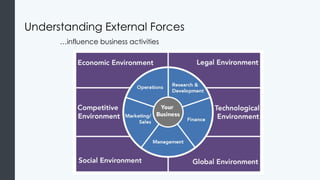
Understanding External Forces
…influence business activities
Economic Environment
After decades of growth and dominance, the US economy is now challenged
by the developing economies of other nations.
Since the financial crisis of 2008, the US economy and businesses have struggled
to recover from the greatest economic crisis since the Great Depression of the
1930s.
Thus far, the US economy has proven resilient, and since the Great Recession in
2008, progress has been made to stabilize the housing industry, maintain low
and affordable interest rates, and provide additional incentives for businesses
to open and/or expand.
Legal Environment
There is a minefield of regulations, laws, and liabilities that companies must
cope with in order to stay in business.
Legal developments in our culture at large – for instance, the legalization of
marijuana and same-sex marriage or the strengthening of privacy laws – can
have an enormous impact on the ways companies do business. These legal
developments can affect:
• What companies sell
• How their products are manufactured
• How their products are labeled
• How their products are marketed.
Competitive Environment
The competitive environment has intensified with the development of new
technologies, the opening up of foreign markets, and the rise of consumer
expectations.
Example: The local hardware store now finds itself competing with big box
stores like Lowe’s and Home Depot. Larger stores can often sell a product at a
lower price and offer an online shopping option or same day delivery. It can be
difficult for independent stores to compete with these features.
Staying competitive is a challenge for every business, and business owners are
finding that benefits such as customer service, employee knowledge, and high
quality can help them survive.
Technological Environment
Businesses are often driven to rethink the business technology (digital tools such
as computers, telecommunications, and the internet) they use to reach
customers, produce their products, and provide their services.
The expansion of internet access all over the world has forced many traditional
brick-and-mortar businesses into e-commerce or online sales.
The advantage to businesses is that customers no longer have to live in
proximity to their stores to purchase goods and services. The disadvantage to
businesses is that consumers are also able to compare competitors’ prices,
benefits, features, and services.
Social Environment
The social environment of business encompasses the values, attitudes, beliefs,
wants, and desires of the consuming public.
The demographics that describe the American population are changing: by
2050 the Hispanic and Asian populations in America are expected to double. At
the same time, America is aging, and with the current median age at 36, it
won’t be long until the majority of America is ready to retire.
Corporate Social Responsibility (CSR) also compels businesses to be “good
corporate citizens” by supporting charities, contributing to local communities,
adhering to ethical standards, and adopting environmentally responsible
practices.
Global Environment
Free trade among nations has allowed goods and services to flow across
international borders more efficiently and cheaply.
Formal trade agreements among nations has forged unprecedented links and
interdependence among economies.
It’s not just the local economy or even the national economy that business must
track – they must also keep an eye on the world economy in order to anticipate
and adapt to changes that will impact their products and services.
Class Activity: Identifying External Stakeholders
• Identify a business with which everyone in the group is familiar. This can be a
local business or a national chain.
• For the selected business, identify at least four external stakeholders. Be as
specific as possible.
• For each external stakeholder, consider how it would be impacted by:
• The rapid expansion of the business to include new markets or new products
• A downturn in the economy that would negatively affect the company’s revenues
Present: Identifying External
Stakeholders
Class Discussion: Identifying External Stakeholders
• What did you learn from this activity?
• Did this change the way you view business in general?
• How can the health of a single business can have an impact on the larger
community and economy?
Quick Review
• What is a business?
• What are the primary differences between a for-profit and a non-profit
business?
• What factors of production sustain businesses?
• How do resources flow between businesses and households?
• What are the major business functions and what does each do?
• Define a business stakeholder.
• What external forces impact businesses?

Introduction to business slides chapter one

  • 1.
  • 2.
    Module Learning Outcomes Discussthe role of business in society, the primary functions within a business, and external forces that affect business activities 1.1: Explain the concept of business 1.2: Distinguish between for-profit and nonprofit businesses 1.3: List and explain the four factors of production required to sustain a business 1.4: Identify the primary functional areas within a business and describe their contribution to the organization 1.5: Identify business stakeholders and describe their relationship with business organizatio ns 1.6: Identify the external forces that shape the business environment
  • 3.
  • 4.
    Learning Outcomes: WhatIs Business? 1.1: Explain the concept of business 1.1.1: Define the term business 1.1.2: Distinguish between profit, loss, and value 1.1.3: Distinguish between goods and services
  • 5.
    What is a business? Anyactivity that provides goods or services to consumers for the purpose of making a profit.
  • 6.
    Goods and Services Examplesof goods are tangible items such as cars, televisions, or soda. Examples of services (action or work performed for monetary compensation) are haircuts, hotel stays, or roller-coaster rides. Businesses can generate profits from the sale of goods and/or services
  • 7.
  • 8.
  • 9.
    Profit, Loss, andValue Profit is the amount of revenue or income that a business owner retains after paying all the expenses associated with the operation of the business. If the expenses of the business exceed the revenue or income generated from operations, then the business will suffer a loss. Businesses that suffer extraordinary losses during a short period of time or slowly see their profits decline may end up closing or filing for bankruptcy. When businesses talk about value they are referring to the relationship between the price a customer pays for the good or service and the perceived benefits the customer receives in exchange for their time or money.
  • 10.
    Practice Question 1 Howdo you define “profit”? A. when revenue exceeds costs B. when costs exceed revenue C. when revenue achieves planned target D. when the bottom line is in the red
  • 11.
    Practice Question 2 Howdo you define “loss”? A. when costs fall lower than projection B. when the bottom line is in the black C. when revenue exceeds costs D. when costs exceed revenue
  • 12.
    Practice Question 3 Howdo you define “value”? A. when the perception of competition is too expensive B. the perceived benefits by a customer of price to the time and money spent C. when market research establishes the floor price D. when a customer purchases for the lowest price in town
  • 13.
  • 14.
    Learning Outcomes: For-Profitvs. Nonprofit 1.2: Distinguish between for-profit and nonprofit businesses 1.2.1: Explain the purpose of for-profit businesses 1.2.2: Explain the purpose of nonprofit businesses 1.2.3: Distinguish between for-profit and nonprofit businesses
  • 15.
    Nonprofit Businesses A nonprofitor not-for-profit business is one that provides goods and services to consumers, but its primary goal is no to return profit to the owners of the business (as is the case with a for-profit business). Instead, it uses those profits to provide a public service, advance a cause, or assist others. Examples • American Red Cross • SPCA • American Cancer Society
  • 16.
    For-profit vs. Non-profitBusinesses For-Profit Business • Provides goods or services to consumers for the purpose of making a profit Non-Profit Business • Provides goods or services in order to generate income that furthers its mission
  • 17.
    Comparing For-Profits andNonprofits For-Profit Not-for-Profit/Nonprofit Incurs expenses for operations Incurs expenses for operations Provides goods and services for customers Provides goods and services for customers Generates revenues from sales Generates revenues from sales and/or contributions Owned by individuals, partners, or shareholders Operated by board of directors, trustees, or managers Profit is used to pay owners, partners, and shareholders Profit is used to further the mission of the organization Pays salaries to employees and managers Pays salaries to to employees and managers Profits are subject to taxation by local, state, and federal authorities Profits are NOT subject to taxation by local, state, and federal authorities
  • 18.
    Class Discussion: Profitor Mission? Do you think that for-profit businesses can be mission driven? Do you think that non-profit businesses can serve themselves rather than their stated mission?
  • 19.
  • 20.
    Learning Outcomes: Factorsof Production 1.3: List and explain the four factors of production required to sustain a business 1.3.1: List the four factors of production 1.3.2: Explain the four factors of production
  • 21.
    Resources and Factorsof Production Resources are the inputs used to produce the outputs (goods and/or services). Resources are also called factors of production.
  • 22.
    Understanding Factors ofProduction • Natural Resources: any natural resource, land, plants, livestock, wind, sun, water, etc. • Labor: any human service—physical or intellectual. Also referred to as human capital. • Capital: anything that’s manufactured in order to be used in the production of goods and services —for example, equipment. • Entrepreneurship: the ability to recognize a profit opportunity, organize the other factors of production, and accept risk.
  • 23.
    Factors of Production:Baking a Cake • Natural resources: Wind harnessed to produce electricity • Labor: The baker's labor, creativity, and skills • Capital: Ovens, cake pans, and ingredients • Entrepreneurship: Individual or bakery
  • 24.
  • 25.
    Learning Outcomes: FunctionalAreas 1.4: Identify the primary functional areas within a business and describe their contribution to the organization 1.4.1: Identify the primary functional areas within a business 1.4.2: Identify key people and explain the activities within each functional area
  • 26.
    Understanding Functional Areas FunctionalArea Functions Management Plans, organizes, controls, leads Operations Transforms resources into products Marketing/Sales Works to identify and satisfy customer needs Finance Plans, obtains, and manages company funds Research and Development Provides knowledge and ideas that help a company keep up and ahead of the competition
  • 27.
    Management The primary roleof managers in business is to supervise other people’s performance. Most management activities fall into the following categories: • Planning: Setting long-term and short-term goals for the business, as well as short term strategies needed to execute against those goals. • Organizing: Organizing the operations of a business in the most efficient way, enabling the business to us its resources effectively. • Controlling: When people or processes stray from the path, managers are often the first ones to notice and take corrective action. • Leading: The manager may lead work teams or groups through a new process of the development of a new product. The manager may also be seen as a leader of the organization when it interacts with the community, customers, and suppliers.
  • 28.
    Operations Operations are whereinputs (factors of production) are converted to outputs (goods and services). Operations is the heart of a business, pumping out goods and services in a quantity and of a quality that meets the needs of customers. The operations manager is responsible for overseeing the day-to-day business operations, which can include ordering raw materials or scheduling workers to produce tangible goods.
  • 29.
    Marketing Marketing identifies customers’needs and designs products and services that meet those needs. The marketing function includes: • Promoting goods and services • Determining how the goods and services will be delivered • Developing a pricing strategy to capture market share while remaining competitive • Building and overseeing businesses’ Internet presence
  • 30.
    Finance Finance involves planningfor, obtaining, and managing a company’s funds. Finance managers plan for both short- and long-term financial capital needs and analyze the impact that borrowing will have on the financial well-being of a business. The finance department answer questions about how funds should be raised, the long-term cost of borrowing funds, and the implications of financing decisions for the long-term health of the business. Accounting is a crucial part of the Finance functional area. Accountants provide managers with information needed to make decisions about the allocation of company resources.
  • 31.
    Research and Development(R&D) Research and Development is the lifeblood of manufacturing businesses. R&D is staffed with scientists, thought-leaders, subject-matter experts, and industry analysts striving to provide the organization with knowledge and ideas to keep up and ahead of the competition. R&D is led by the Chief Technology Officer (CTO) who manages a Development VP or similar title depending on what technology products are being produced.
  • 32.
    Key People WithinFunctional Areas
  • 33.
    Practice Question 4 Whichfunctional area of a business is responsible for converting the factors of production into goods and services? A. Management B. Operations C. Marketing / Sales D. Finance
  • 34.
    Practice Question 5 Sea-Worthyis an ocean shipping company. The company decided to develop their own internal ERP (Enterprise Resource Management) system since none of the existing commercial packages met the specific needs of their unique business segment. Halfway into development by their IT department, the company came to the realization that this system could be licensed to their competitors to offset their development cost and fund future enhancements. Which functional area of the company would be responsible for creating revenue from this internal system? A. Marketing B. Operations C. Finance D. R&D
  • 35.
  • 36.
    Learning Outcomes: Stakeholders 1.5:Identify business stakeholders and describe their relationship with business organizations 1.5.1: Define internal and external stakeholder 1.5.2: Describe stakeholders' relationship with business organizations
  • 37.
    Business Stakeholders A stakeholderis an individual or a group that has a legitimate interest in a company, organization, or business.
  • 38.
    Internal Stakeholders Internal stakeholdersare groups or people who work directly within the business, such as managers, employees, and owners. Managers and employees want to earn high wages and keep their jobs, so they have a vested interest in the financial health and success of the business. Owners want to maximize the profit the business makes as compensation for the risks they take in owning or running a business.
  • 39.
    External Stakeholders External stakeholdersare groups outside the business or people who do not work inside the business but are affected in some way by the decisions of the business. External stakeholders can include: • Customers • Shareholders • Creditors • Federal, state, and local governments • The local community • Society • Suppliers
  • 40.
  • 41.
    Learning Outcomes: ExternalForces 1.6: Identify the external forces that shape the business environment 1.6.1: List the external forces that affect businesses 1.6.2: Give examples of how various external forces affect the participants in a business and its functional areas
  • 42.
  • 43.
    Economic Environment After decadesof growth and dominance, the US economy is now challenged by the developing economies of other nations. Since the financial crisis of 2008, the US economy and businesses have struggled to recover from the greatest economic crisis since the Great Depression of the 1930s. Thus far, the US economy has proven resilient, and since the Great Recession in 2008, progress has been made to stabilize the housing industry, maintain low and affordable interest rates, and provide additional incentives for businesses to open and/or expand.
  • 44.
    Legal Environment There isa minefield of regulations, laws, and liabilities that companies must cope with in order to stay in business. Legal developments in our culture at large – for instance, the legalization of marijuana and same-sex marriage or the strengthening of privacy laws – can have an enormous impact on the ways companies do business. These legal developments can affect: • What companies sell • How their products are manufactured • How their products are labeled • How their products are marketed.
  • 45.
    Competitive Environment The competitiveenvironment has intensified with the development of new technologies, the opening up of foreign markets, and the rise of consumer expectations. Example: The local hardware store now finds itself competing with big box stores like Lowe’s and Home Depot. Larger stores can often sell a product at a lower price and offer an online shopping option or same day delivery. It can be difficult for independent stores to compete with these features. Staying competitive is a challenge for every business, and business owners are finding that benefits such as customer service, employee knowledge, and high quality can help them survive.
  • 46.
    Technological Environment Businesses areoften driven to rethink the business technology (digital tools such as computers, telecommunications, and the internet) they use to reach customers, produce their products, and provide their services. The expansion of internet access all over the world has forced many traditional brick-and-mortar businesses into e-commerce or online sales. The advantage to businesses is that customers no longer have to live in proximity to their stores to purchase goods and services. The disadvantage to businesses is that consumers are also able to compare competitors’ prices, benefits, features, and services.
  • 47.
    Social Environment The socialenvironment of business encompasses the values, attitudes, beliefs, wants, and desires of the consuming public. The demographics that describe the American population are changing: by 2050 the Hispanic and Asian populations in America are expected to double. At the same time, America is aging, and with the current median age at 36, it won’t be long until the majority of America is ready to retire. Corporate Social Responsibility (CSR) also compels businesses to be “good corporate citizens” by supporting charities, contributing to local communities, adhering to ethical standards, and adopting environmentally responsible practices.
  • 48.
    Global Environment Free tradeamong nations has allowed goods and services to flow across international borders more efficiently and cheaply. Formal trade agreements among nations has forged unprecedented links and interdependence among economies. It’s not just the local economy or even the national economy that business must track – they must also keep an eye on the world economy in order to anticipate and adapt to changes that will impact their products and services.
  • 49.
    Class Activity: IdentifyingExternal Stakeholders • Identify a business with which everyone in the group is familiar. This can be a local business or a national chain. • For the selected business, identify at least four external stakeholders. Be as specific as possible. • For each external stakeholder, consider how it would be impacted by: • The rapid expansion of the business to include new markets or new products • A downturn in the economy that would negatively affect the company’s revenues
  • 50.
  • 51.
    Class Discussion: IdentifyingExternal Stakeholders • What did you learn from this activity? • Did this change the way you view business in general? • How can the health of a single business can have an impact on the larger community and economy?
  • 52.
    Quick Review • Whatis a business? • What are the primary differences between a for-profit and a non-profit business? • What factors of production sustain businesses? • How do resources flow between businesses and households? • What are the major business functions and what does each do? • Define a business stakeholder. • What external forces impact businesses?

Editor's Notes

  • #1 Cover Image: "My desk at home." Authored by: STIL. Provided by: Unsplash. Located at: https://unsplash.com/photos/zv5QSKaP8G8. Content Type: CC Licensed Content, Shared Previously. License: CC0: No Rights Reserved. License Terms: Unsplash License. All text in these slides is taken from https://courses.lumenlearning.com/wmopen-introductiontobusiness where it is published under one or more open licenses. All images in these slides are attributed in the notes of the slide on which they appear and licensed as indicated.
  • #7 Hardware Store Sign. Authored by: Elizabeth Freniere. Located at: https://www.flickr.com/photos/fethernutter/2931616307/. License: CC BY-NC-ND: Attribution-NonCommercial-NoDerivatives
  • #8 Soup Cycle. Authored by: Travis. Located at: https://www.flickr.com/photos/wittcogmbh/6804429230/. License: CC BY: Attribution
  • #10 Correct answer: A—Profit is created when revenue generated is greater than cost expenses and the reverse is realized as a loss. Untitled Image. Authored by: geralt. Provided by: Pixabay. Located at: https://pixabay.com/photos/dollar-currency-money-us-dollar-499481/.  License: CC0: No Rights Reserved
  • #11 Correct answer: D—Profit is created when revenue generated is greater than cost expenses and the reverse is realized as a loss. Untitled Image. Authored by: geralt. Provided by: Pixabay. Located at: https://pixabay.com/photos/dollar-currency-money-us-dollar-499481/.  License: CC0: No Rights Reserved
  • #12 Correct answer: B—Value is a term where the customer judges the price paid/time spent with the business being justified by utility received from their experience. Untitled Image. Authored by: geralt. Provided by: Pixabay. Located at: https://pixabay.com/photos/dollar-currency-money-us-dollar-499481/.  License: CC0: No Rights Reserved
  • #18 Discussion topics might include *B-Corps like TOMS (one-for-one model), Kickstarter (mission to help others’ creative projects come to life), Patagonia (conservation efforts, including donating 100% of Black Friday profits in 2016), etc. *Charity Navigator and CharityWatch act as watchdogs to monitor how charities use donations
  • #21 Untitled Image. Authored by: geralt. Provided by: Pixabay. Located at: https://pixabay.com/photos/web-network-points-lines-2496193//. License: CC0: No Rights Reserved
  • #22 Untitled Image. Authored by: geralt. Provided by: Pixabay. Located at: https://pixabay.com/photos/web-network-points-lines-2496193//. License: CC0: No Rights Reserved
  • #23 Natural resources: Wind is harnessed to produce electricity that powers the electric mixer and oven. Labor: The baker's labor combined with the creativity and skills needed to actually bake and decorate it Capital: Ovens, cake pans, flour, sugar, butter, and other ingredients used to make the cake Entrepreneurship: An individual who starts the bakery or runs a home-based business baking and selling cakes to customers The Cake 2. Authored by: Son of Groucho. Located at: https://www.flickr.com/photos/sonofgroucho/13959809504/. License: CC BY: Attribution
  • #33 Correct answer: B— Operations is responsible for converting inputs into outputs. Andrew's Stone. Authored by: Ethan Fox. Located at: https://www.flickr.com/photos/spartacusjunkie/157687091/. License: CC BY-NC: Attribution-NonCommercial Tide Pods Laundry Detergent Capsules. Authored by: Austin Kirk. Located at: https://www.flickr.com/photos/aukirk/8422844630/. License: CC BY: Attribution Charging Bullu2014New York City. Authored by: Sam Valadi. Located at: https://www.flickr.com/photos/132084522@N05/17086570218/. License: CC BY: Attribution
  • #34 Correct answer: A—Marketing would serve as the “voice of the customer” to work with IT to ensure the system was adaptable to other companies. Andrew's Stone. Authored by: Ethan Fox. Located at: https://www.flickr.com/photos/spartacusjunkie/157687091/. License: CC BY-NC: Attribution-NonCommercial Tide Pods Laundry Detergent Capsules. Authored by: Austin Kirk. Located at: https://www.flickr.com/photos/aukirk/8422844630/. License: CC BY: Attribution Charging Bullu2014New York City. Authored by: Sam Valadi. Located at: https://www.flickr.com/photos/132084522@N05/17086570218/. License: CC BY: Attribution
  • #37 Business Stakeholders. Provided by: Boundless . Located at: https://www.boundless.com/accounting/textbooks/boundless-accounting-textbook/introduction-to-accounting-1/overview-of-key-elements-of-the-business-19/business-stakeholders-internal-and-external-117-6595/.. License: CC BY-SA: Attribution-ShareAlike
  • #42 External Forces. Authored by: Lumen Learning. License: CC BY: Attribution
  • #49 Divide students into small groups. Each group will complete the questions and then report to the class.
  • #51 Divide students into small groups. Each group will complete the questions and then report to the class.