Business Ethics and
Social Responsibility
4
pp. 48-61
Chapter 4
Introduction to Business, Business Ethics and Social Responsibility Slide 2 of 44
Learning Objectives
After completing this chapter, you’ll be
able to:
1. Explain business ethics.
2. Give reasons why ethical behavior is
good for business.
continued
Chapter 4
Introduction to Business, Business Ethics and Social Responsibility Slide 3 of 44
Learning Objectives
After completing this chapter, you’ll be
able to:
3. Define social responsibility.
4. Describe the social responsibilities
businesses have to society.
Chapter 4
Introduction to Business, Business Ethics and Social Responsibility Slide 4 of 44
Why It’s Important
Understanding business ethics
and social responsibility makes
you informed of your rights as a
consumer, an employee, and a
citizen.
Chapter 4
Introduction to Business, Business Ethics and Social Responsibility Slide 5 of 44
Key Words
Ethics
Business ethics
Sweatshops
Occupational Safety and Health
Administration (OSHA)
code of ethics
social responsibility continued
Chapter 4
Introduction to Business, Business Ethics and Social Responsibility Slide 6 of 44
Key Words
Conflict of interest
Food and Drug Administration (FDA)
Equal Pay Act
Environmental Protection Agency (EPA)
Chapter 4
Introduction to Business, Business Ethics and Social Responsibility Slide 7 of 44
What Is Ethics?
Ethics is the set of moral principles by
which people conduct themselves
personally, socially, or professionally.
Chapter 4
Introduction to Business, Business Ethics and Social Responsibility Slide 8 of 44
What Is Ethics?
Business ethics is a set of laws about
how a business should conduct itself.
In general, for any business to be
successful, it must operate legally and
humanely.
Chapter 4
Introduction to Business, Business Ethics and Social Responsibility Slide 9 of 44
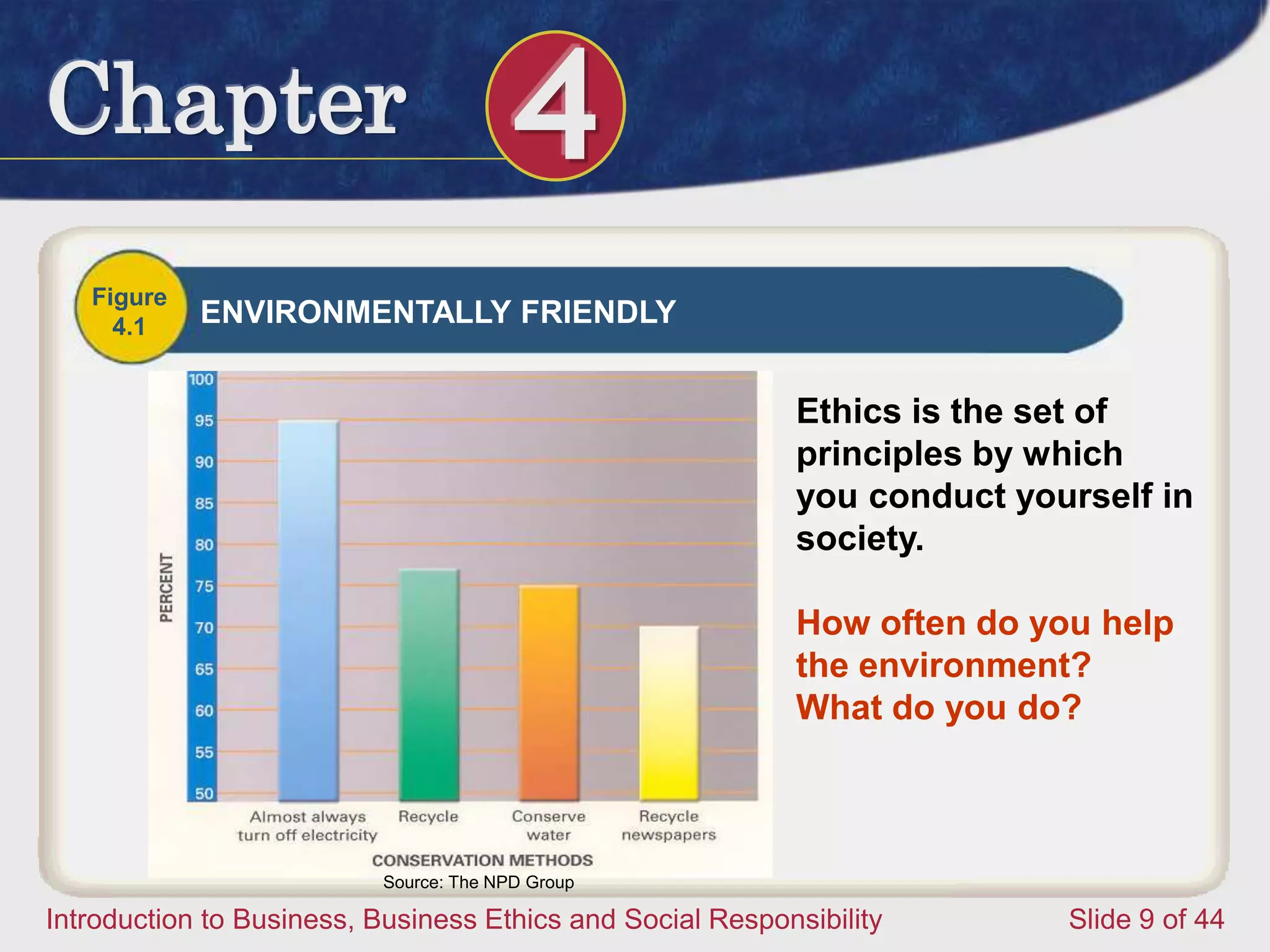
Ethics is the set of
principles by which
you conduct yourself in
society.
How often do you help
the environment?
What do you do?
Source: The NPD Group
Figure
4.1 ENVIRONMENTALLY FRIENDLY
Chapter 4
Introduction to Business, Business Ethics and Social Responsibility Slide 10 of 44
Legal Responsibility
Sweatshops are factories that pay
workers poorly, are unhealthy, and
treat workers badly.
Chapter 4
Introduction to Business, Business Ethics and Social Responsibility Slide 11 of 44
Legal Responsibility
The Occupational Safety and Health
Administration (OSHA) is a division
of the Department of Labor that sets
and enforces work-related health and
safety rules.
Chapter 4
Introduction to Business, Business Ethics and Social Responsibility Slide 12 of 44
Legal Responsibility
Other independent agencies protect
consumers, monitor broadcast
communications, and address
discrimination in the workplace.
Chapter 4
Introduction to Business, Business Ethics and Social Responsibility Slide 13 of 44
Legal Responsibility
Most businesses police themselves by
distributing codes of ethics.
A code of ethics is a set of strict
guidelines for maintaining ethics in the
workplace.
Chapter 4
Introduction to Business, Business Ethics and Social Responsibility Slide 14 of 44
Legal Responsibility
Businesses that regulate themselves
are able to operate more freely.
Chapter 4
Introduction to Business, Business Ethics and Social Responsibility Slide 15 of 44
Ethics as Good Business
Unethical business practices can affect
your business indirectly.
The amount you make in profits from
one unhappy customer can translate
into a lot more lost because of missed
repeat business.
Chapter 4
Introduction to Business, Business Ethics and Social Responsibility Slide 16 of 44
Ethics as Good Business
Treating employees unethically can
also backfire.
Mistreating employees leads to a high
turnover rate. This increases the cost
of hiring and training new employees.
Chapter 4
Introduction to Business, Business Ethics and Social Responsibility Slide 17 of 44
Important Ethical Questions
When considering a questionable
course of action, you have to ask
yourself these important questions:
• Is it against the law? Does it violate
company or professional policies?
continued
Chapter 4
Introduction to Business, Business Ethics and Social Responsibility Slide 18 of 44
Important Ethical Questions
• What if everyone did this? How
would I feel if someone did this to
me?
• Am I sacrificing long-term benefits for
short-term gains?
Chapter 4
Introduction to Business, Business Ethics and Social Responsibility Slide 19 of 44
Making Decisions on
Ethical Issues
Here are some steps if you find
yourself in an ethical dilemma:
1. Identify the ethical dilemma.
2. Discover alternative actions.
continued
Chapter 4
Introduction to Business, Business Ethics and Social Responsibility Slide 20 of 44
Making Decisions on
Ethical Issues
3. Decide who might be affected.
4. List the probable effects of the
alternatives.
5. Select the best alternative.
Chapter 4
Introduction to Business, Business Ethics and Social Responsibility Slide 21 of 44
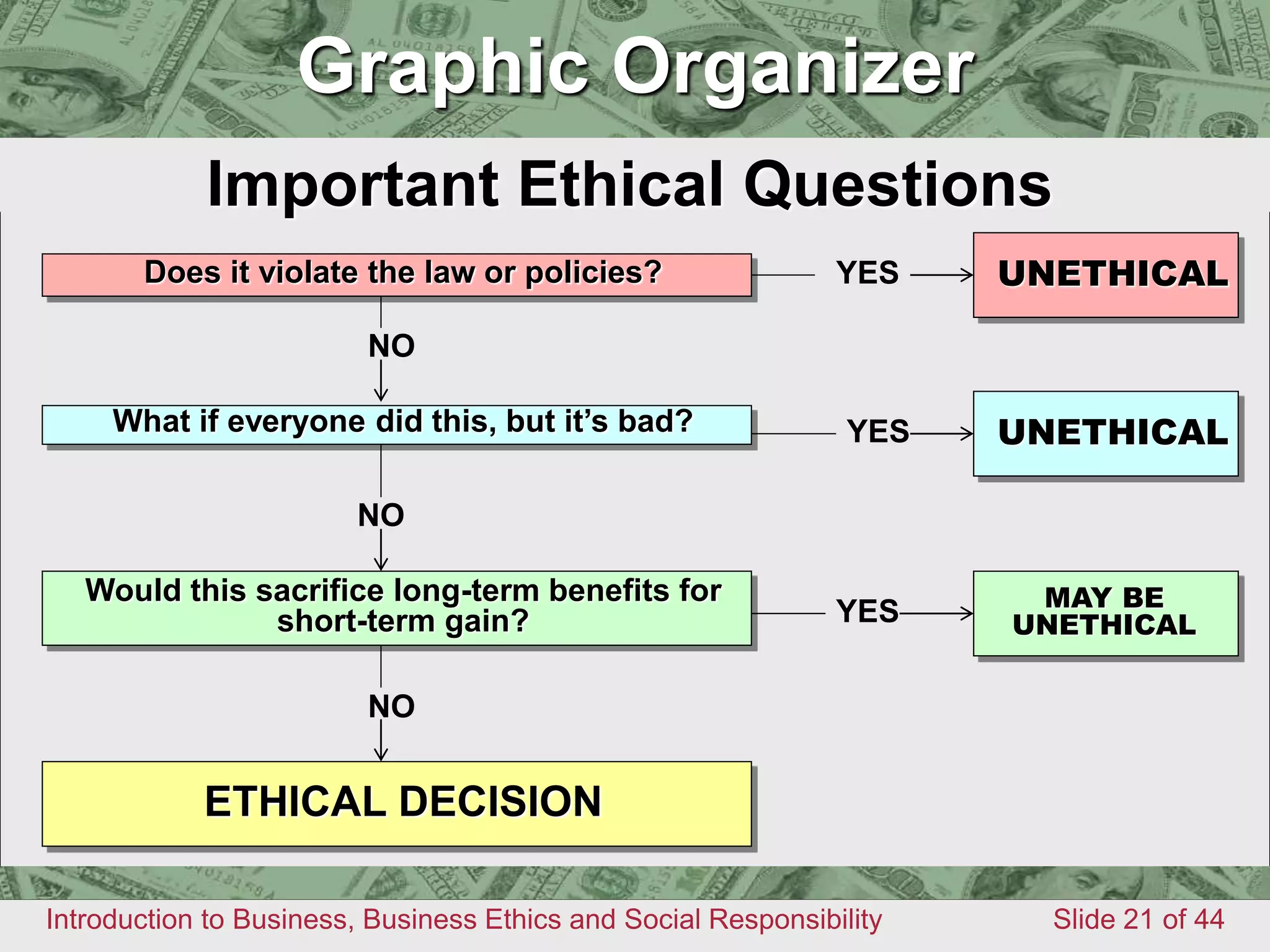
Graphic Organizer
Important Ethical Questions
Graphic Organizer
Does it violate the law or policies?
ETHICAL DECISION
Would this sacrifice long-term benefits for
short-term gain?
What if everyone did this, but it’s bad?
UNETHICAL
NO
NO
NO
YES
YES
YES
MAY BE
UNETHICAL
UNETHICAL
Chapter 4
Introduction to Business, Business Ethics and Social Responsibility Slide 22 of 44
Fast Review
1. How do companies benefit by
enforcing their own codes of ethics?
2. Why does it pay to treat customers
ethically?
continued
Chapter 4
Introduction to Business, Business Ethics and Social Responsibility Slide 23 of 44
Fast Review
3. What are some important ethical
questions to ask?
Chapter 4
Introduction to Business, Business Ethics and Social Responsibility Slide 24 of 44
Social Responsibility
Social responsibility is the duty to do
what is best for the good of society.
Chapter 4
Introduction to Business, Business Ethics and Social Responsibility Slide 25 of 44
Social Responsibility
The ethical obligations of a business
are to:
• Provide safe products
• Create jobs
• Protect the environment
• Contribute to the standard of living in
society
Chapter 4
Introduction to Business, Business Ethics and Social Responsibility Slide 26 of 44
Social Responsibility
A conflict of interest is when a
business is tempted to put profits
before social welfare.
Chapter 4
Introduction to Business, Business Ethics and Social Responsibility Slide 27 of 44
Responsibility to Customers
The Food and Drug Administration
(FDA), a government agency, protects
consumers from dangerous or falsely
advertised products.
Chapter 4
Introduction to Business, Business Ethics and Social Responsibility Slide 28 of 44
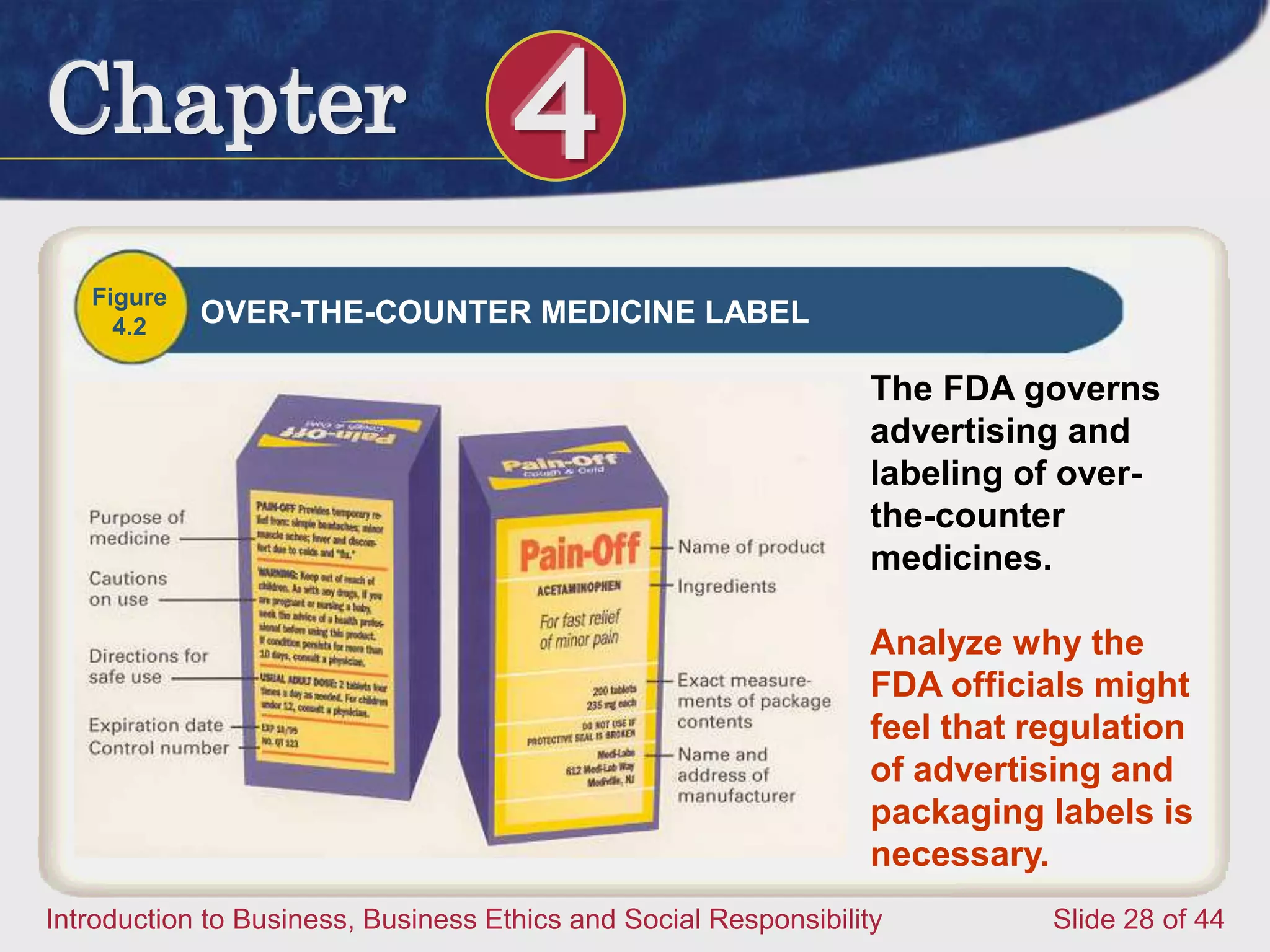
Figure
4.2 OVER-THE-COUNTER MEDICINE LABEL
The FDA governs
advertising and
labeling of over-
the-counter
medicines.
Analyze why the
FDA officials might
feel that regulation
of advertising and
packaging labels is
necessary.
Chapter 4
Introduction to Business, Business Ethics and Social Responsibility Slide 29 of 44
Responsibility to Customers
Fair competition between businesses
is healthy for the marketplace, but
some companies don’t always play
reasonably.
Chapter 4
Introduction to Business, Business Ethics and Social Responsibility Slide 30 of 44
Responsibility to Customers
Some companies use unethical means
to eliminate competition.
One of the most common means is to
conspire with other companies to
control the market for a product.
Chapter 4
Introduction to Business, Business Ethics and Social Responsibility Slide 31 of 44
Responsibility to Employees
Businesses have a social
responsibility to create jobs.
They are expected to provide
employees with safe working
conditions, equal treatment, and fair
pay.
Chapter 4
Introduction to Business, Business Ethics and Social Responsibility Slide 32 of 44
Responsibility to Employees
The Equal Employment Opportunity
requires that men and women be
provided employment opportunities
and paid the same salaries and wages
for doing equal work.
Chapter 4
Introduction to Business, Business Ethics and Social Responsibility Slide 33 of 44
Responsibility to Employees
The Americans with Disabilities Act
bans discrimination against persons
with physical or mental disability.
Chapter 4
Introduction to Business, Business Ethics and Social Responsibility Slide 34 of 44
Responsibility to Employees
It’s in a company’s best interest to
treat its workers fairly otherwise low
morale, poor productivity, and a high
turnover rate are its troubles.
Chapter 4
Introduction to Business, Business Ethics and Social Responsibility Slide 35 of 44
Responsibility to Society
Businesses have responsibilities not
only to customers and to employees
but also to society as a whole.
Chapter 4
Introduction to Business, Business Ethics and Social Responsibility Slide 36 of 44
Responsibility to Society
Government created the
Environmental Protection Agency
(EPA), a federal agency that enforces
rules that protect the environment and
control pollution.
Chapter 4
Introduction to Business, Business Ethics and Social Responsibility Slide 37 of 44
Responsibility to Society
Many businesses plan for their social
responsibilities just like planning for
production and
sale of their products.
Chapter 4
Introduction to Business, Business Ethics and Social Responsibility Slide 38 of 44
Fast Review
1. Define social responsibility.
2. What is a conflict of interest?
continued
Chapter 4
Introduction to Business, Business Ethics and Social Responsibility Slide 39 of 44
Fast Review
3. What do companies adopt in the
workplace to treat their workers
fairly?
Chapter 4
Introduction to Business, Business Ethics and Social Responsibility Slide 40 of 44
Why should a company make a
vested interest in nature over its
products?
continued
Chapter 4
Introduction to Business, Business Ethics and Social Responsibility Slide 41 of 44
How does the consumer pay for a
company’s environmentally
responsible inventions?
continued
Chapter 4
Introduction to Business, Business Ethics and Social Responsibility Slide 42 of 44
What are social issues you’re
interested in pursuing?
How are businesses involved?
continued
Chapter 4
Introduction to Business, Business Ethics and Social Responsibility Slide 43 of 44
What government agency has a
responsibility to protect society
from genetically modified
organisms?
End of Chapter 4
Business Ethics and Social Responsibility

Introduction to Business Lecturer 2.ppt

  • 1.
    Business Ethics and SocialResponsibility 4 pp. 48-61
  • 2.
    Chapter 4 Introduction toBusiness, Business Ethics and Social Responsibility Slide 2 of 44 Learning Objectives After completing this chapter, you’ll be able to: 1. Explain business ethics. 2. Give reasons why ethical behavior is good for business. continued
  • 3.
    Chapter 4 Introduction toBusiness, Business Ethics and Social Responsibility Slide 3 of 44 Learning Objectives After completing this chapter, you’ll be able to: 3. Define social responsibility. 4. Describe the social responsibilities businesses have to society.
  • 4.
    Chapter 4 Introduction toBusiness, Business Ethics and Social Responsibility Slide 4 of 44 Why It’s Important Understanding business ethics and social responsibility makes you informed of your rights as a consumer, an employee, and a citizen.
  • 5.
    Chapter 4 Introduction toBusiness, Business Ethics and Social Responsibility Slide 5 of 44 Key Words Ethics Business ethics Sweatshops Occupational Safety and Health Administration (OSHA) code of ethics social responsibility continued
  • 6.
    Chapter 4 Introduction toBusiness, Business Ethics and Social Responsibility Slide 6 of 44 Key Words Conflict of interest Food and Drug Administration (FDA) Equal Pay Act Environmental Protection Agency (EPA)
  • 7.
    Chapter 4 Introduction toBusiness, Business Ethics and Social Responsibility Slide 7 of 44 What Is Ethics? Ethics is the set of moral principles by which people conduct themselves personally, socially, or professionally.
  • 8.
    Chapter 4 Introduction toBusiness, Business Ethics and Social Responsibility Slide 8 of 44 What Is Ethics? Business ethics is a set of laws about how a business should conduct itself. In general, for any business to be successful, it must operate legally and humanely.
  • 9.
    Chapter 4 Introduction toBusiness, Business Ethics and Social Responsibility Slide 9 of 44 Ethics is the set of principles by which you conduct yourself in society. How often do you help the environment? What do you do? Source: The NPD Group Figure 4.1 ENVIRONMENTALLY FRIENDLY
  • 10.
    Chapter 4 Introduction toBusiness, Business Ethics and Social Responsibility Slide 10 of 44 Legal Responsibility Sweatshops are factories that pay workers poorly, are unhealthy, and treat workers badly.
  • 11.
    Chapter 4 Introduction toBusiness, Business Ethics and Social Responsibility Slide 11 of 44 Legal Responsibility The Occupational Safety and Health Administration (OSHA) is a division of the Department of Labor that sets and enforces work-related health and safety rules.
  • 12.
    Chapter 4 Introduction toBusiness, Business Ethics and Social Responsibility Slide 12 of 44 Legal Responsibility Other independent agencies protect consumers, monitor broadcast communications, and address discrimination in the workplace.
  • 13.
    Chapter 4 Introduction toBusiness, Business Ethics and Social Responsibility Slide 13 of 44 Legal Responsibility Most businesses police themselves by distributing codes of ethics. A code of ethics is a set of strict guidelines for maintaining ethics in the workplace.
  • 14.
    Chapter 4 Introduction toBusiness, Business Ethics and Social Responsibility Slide 14 of 44 Legal Responsibility Businesses that regulate themselves are able to operate more freely.
  • 15.
    Chapter 4 Introduction toBusiness, Business Ethics and Social Responsibility Slide 15 of 44 Ethics as Good Business Unethical business practices can affect your business indirectly. The amount you make in profits from one unhappy customer can translate into a lot more lost because of missed repeat business.
  • 16.
    Chapter 4 Introduction toBusiness, Business Ethics and Social Responsibility Slide 16 of 44 Ethics as Good Business Treating employees unethically can also backfire. Mistreating employees leads to a high turnover rate. This increases the cost of hiring and training new employees.
  • 17.
    Chapter 4 Introduction toBusiness, Business Ethics and Social Responsibility Slide 17 of 44 Important Ethical Questions When considering a questionable course of action, you have to ask yourself these important questions: • Is it against the law? Does it violate company or professional policies? continued
  • 18.
    Chapter 4 Introduction toBusiness, Business Ethics and Social Responsibility Slide 18 of 44 Important Ethical Questions • What if everyone did this? How would I feel if someone did this to me? • Am I sacrificing long-term benefits for short-term gains?
  • 19.
    Chapter 4 Introduction toBusiness, Business Ethics and Social Responsibility Slide 19 of 44 Making Decisions on Ethical Issues Here are some steps if you find yourself in an ethical dilemma: 1. Identify the ethical dilemma. 2. Discover alternative actions. continued
  • 20.
    Chapter 4 Introduction toBusiness, Business Ethics and Social Responsibility Slide 20 of 44 Making Decisions on Ethical Issues 3. Decide who might be affected. 4. List the probable effects of the alternatives. 5. Select the best alternative.
  • 21.
    Chapter 4 Introduction toBusiness, Business Ethics and Social Responsibility Slide 21 of 44 Graphic Organizer Important Ethical Questions Graphic Organizer Does it violate the law or policies? ETHICAL DECISION Would this sacrifice long-term benefits for short-term gain? What if everyone did this, but it’s bad? UNETHICAL NO NO NO YES YES YES MAY BE UNETHICAL UNETHICAL
  • 22.
    Chapter 4 Introduction toBusiness, Business Ethics and Social Responsibility Slide 22 of 44 Fast Review 1. How do companies benefit by enforcing their own codes of ethics? 2. Why does it pay to treat customers ethically? continued
  • 23.
    Chapter 4 Introduction toBusiness, Business Ethics and Social Responsibility Slide 23 of 44 Fast Review 3. What are some important ethical questions to ask?
  • 24.
    Chapter 4 Introduction toBusiness, Business Ethics and Social Responsibility Slide 24 of 44 Social Responsibility Social responsibility is the duty to do what is best for the good of society.
  • 25.
    Chapter 4 Introduction toBusiness, Business Ethics and Social Responsibility Slide 25 of 44 Social Responsibility The ethical obligations of a business are to: • Provide safe products • Create jobs • Protect the environment • Contribute to the standard of living in society
  • 26.
    Chapter 4 Introduction toBusiness, Business Ethics and Social Responsibility Slide 26 of 44 Social Responsibility A conflict of interest is when a business is tempted to put profits before social welfare.
  • 27.
    Chapter 4 Introduction toBusiness, Business Ethics and Social Responsibility Slide 27 of 44 Responsibility to Customers The Food and Drug Administration (FDA), a government agency, protects consumers from dangerous or falsely advertised products.
  • 28.
    Chapter 4 Introduction toBusiness, Business Ethics and Social Responsibility Slide 28 of 44 Figure 4.2 OVER-THE-COUNTER MEDICINE LABEL The FDA governs advertising and labeling of over- the-counter medicines. Analyze why the FDA officials might feel that regulation of advertising and packaging labels is necessary.
  • 29.
    Chapter 4 Introduction toBusiness, Business Ethics and Social Responsibility Slide 29 of 44 Responsibility to Customers Fair competition between businesses is healthy for the marketplace, but some companies don’t always play reasonably.
  • 30.
    Chapter 4 Introduction toBusiness, Business Ethics and Social Responsibility Slide 30 of 44 Responsibility to Customers Some companies use unethical means to eliminate competition. One of the most common means is to conspire with other companies to control the market for a product.
  • 31.
    Chapter 4 Introduction toBusiness, Business Ethics and Social Responsibility Slide 31 of 44 Responsibility to Employees Businesses have a social responsibility to create jobs. They are expected to provide employees with safe working conditions, equal treatment, and fair pay.
  • 32.
    Chapter 4 Introduction toBusiness, Business Ethics and Social Responsibility Slide 32 of 44 Responsibility to Employees The Equal Employment Opportunity requires that men and women be provided employment opportunities and paid the same salaries and wages for doing equal work.
  • 33.
    Chapter 4 Introduction toBusiness, Business Ethics and Social Responsibility Slide 33 of 44 Responsibility to Employees The Americans with Disabilities Act bans discrimination against persons with physical or mental disability.
  • 34.
    Chapter 4 Introduction toBusiness, Business Ethics and Social Responsibility Slide 34 of 44 Responsibility to Employees It’s in a company’s best interest to treat its workers fairly otherwise low morale, poor productivity, and a high turnover rate are its troubles.
  • 35.
    Chapter 4 Introduction toBusiness, Business Ethics and Social Responsibility Slide 35 of 44 Responsibility to Society Businesses have responsibilities not only to customers and to employees but also to society as a whole.
  • 36.
    Chapter 4 Introduction toBusiness, Business Ethics and Social Responsibility Slide 36 of 44 Responsibility to Society Government created the Environmental Protection Agency (EPA), a federal agency that enforces rules that protect the environment and control pollution.
  • 37.
    Chapter 4 Introduction toBusiness, Business Ethics and Social Responsibility Slide 37 of 44 Responsibility to Society Many businesses plan for their social responsibilities just like planning for production and sale of their products.
  • 38.
    Chapter 4 Introduction toBusiness, Business Ethics and Social Responsibility Slide 38 of 44 Fast Review 1. Define social responsibility. 2. What is a conflict of interest? continued
  • 39.
    Chapter 4 Introduction toBusiness, Business Ethics and Social Responsibility Slide 39 of 44 Fast Review 3. What do companies adopt in the workplace to treat their workers fairly?
  • 40.
    Chapter 4 Introduction toBusiness, Business Ethics and Social Responsibility Slide 40 of 44 Why should a company make a vested interest in nature over its products? continued
  • 41.
    Chapter 4 Introduction toBusiness, Business Ethics and Social Responsibility Slide 41 of 44 How does the consumer pay for a company’s environmentally responsible inventions? continued
  • 42.
    Chapter 4 Introduction toBusiness, Business Ethics and Social Responsibility Slide 42 of 44 What are social issues you’re interested in pursuing? How are businesses involved? continued
  • 43.
    Chapter 4 Introduction toBusiness, Business Ethics and Social Responsibility Slide 43 of 44 What government agency has a responsibility to protect society from genetically modified organisms?
  • 44.
    End of Chapter4 Business Ethics and Social Responsibility