Lecture 11-12
Introduction to Business
CSR
Dr Yousuf Kamal
Associate Professor
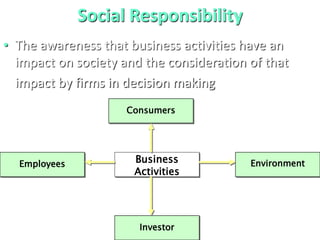
Social Responsibility
• The awareness that business activities have an
impact on society and the consideration of that
impact by firms in decision making
Business
Activities
EnvironmentEmployees
Consumers
Investor
Responsibility to Consumers
• Firms trying to provide products that satisfy the needs of
their customers, since dissatisfied customers eventually
take their business elsewhere.
• President john F. Kennedy established the consumer “bill of
rights” in 1960s.
• Consumerism includes the activities of individuals, groups
and organizations aimed at protecting consumer rights.
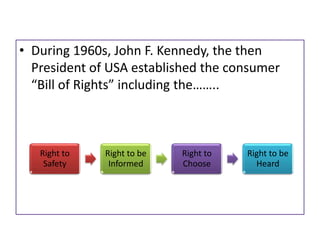
• The Right to Safety – Right to products that are safe to
possess and use. To ensure safety of goods, manufacturers
should test them and provide buyers with explicit
directions for use.
Responsibility to Consumers
• The Right to be Informed – Right to receive information
available about a product before they purchase it. E.G.
Ingredients, instructions for use.
• The Right to Choose – Right to choose and make purchases
from a variety of products at competitive prices. Also the
right to expect quality service at a fair price.
• The Right to be Heard – Right to have their (consumers)
opinions considered in the formation of government
policies and in business firm’s decisions that affect them.
Responsibility to Employees
• Employees hold certain expectations of business
firms.
• They expect safe working conditions, fair
compensation, equal opportunities (regardless of
age, race, gender, religion or national origin) and
adequate benefits (e.G. Health insurance, vacation
etc).
• Occupational Safety and Health Administration
(OSHA)
• Equal Employment Opportunity Commission (EEOC)
Responsibility to Environment
• Pollution – contamination of air, water and land
• Water pollution– caused by dumping of toxic chemicals,
sewage and garbage into rivers etc and by using pesticides
and fertilizers etc.
• Land pollution– results from strip mining of coal and
minerals, forest fires, garbage disposal and dumping of
industrial wastes including chemicals and medical supplies
such as used hypodermic needles.
• Often results in land pollution.
• Recycling – reusing materials such as paper, plastic, glass
and aluminum to make other products.
Responsibility to Environment
• Air Pollution– Caused by carbon monoxide and
hydrocarbons that come from motor vehicles and by smoke
and other pollutants from manufacturing plants (emission
standards for automobiles, factories, catalytic converters
are there to help control air pollution)
• Ozone layer– Shields the planet from the sun’s deadly
ultraviolet rays. This is being destroyed with a global
warming trend as a result (major cause is
Chlorofluorocarbons (CFCs) that are used to cool
refrigerators and air conditioners)
• Acid rain– When sulphur dioxide is pumped into the air
(often by manufacturing and power plants burning high
sulphur coal) and mixes with air, rain with a high acid
content is created
Responsibility to Investors
• Business firms have responsibility to the people
who invest money in them.
• There are problems such as mishandling of
investor’s funds, insider trading (the practice of
buying and selling stock on the basis of information
gained through positions or contacts with others
that is not available to other investors or the
general public)
• Excessive compensation of executives
Business Ethics
• Ethics– The principles of behavior that distinguish between
right and wrong
• Business Ethics– The evaluation of business activities and
behavior as right or wrong
• Ethical standards in business are based on commonly
accepted principles or behavior established by the
expectations of society, the firm, the industry and an
individual’s personal values
• A violation of ethics makes trust and goodwill difficult to
maintain
Factors Influencing Ethical Behavior
The Business Environment
• Business managers are challenged to meet sales
quotas, cut costs, increase efficiency or overtake
competitors (survive by deception or cheating)
• Conflict of interest (offer special favors or gifts,
bribes) damages the organization in the long run
Factors Influencing Ethical Behavior
The Organization
• Individuals learn from ethical and unethical
behaviors by interacting with other in the
organization
• By rewarding for ethical conduct and punishing
unethical behavior may help the organization to
promote ethical behavior among the employees
Factors Influencing Ethical Behavior
The Individual
• A person’s own moral philosophy influences his or
her ethical behavior
• Moral philosophy – the set of principles (learned
from family, school, co-workers, friends) that dictate
acceptable behavior
Developing Moral Philosophy
• Individuals can follow two approaches:
1. Humanistic Philosophy
• A set of moral principles focusing on individual
rights and values
• Individuals & organizations adopting this philosophy
would honor their moral duties to customers and
workers
Developing Moral Philosophy
2. Utilitarian Philosophy
• A set of moral principles focusing on the greatest
good for the largest number of people
• CNG case in Bangladesh
• Vaccine Tests on Children
Encouraging Ethical Behavior
• Many organizations take positive steps to encourage
ethical behavior. E.g. Ethics training programs etc.
• A basic way for an organization to encourage ethical
behavior is to establish a code of ethics (a
statement spelling out exactly what an organization
considers ethical behavior)
Encouraging Ethical Behavior
• Whistle Blower – an employee who informs
superiors, the media or a government regulatory
agency about unethical behavior within an
organization (they often risk great professional and
personal danger by reporting the unethical behavior
of others
• Efforts to encourage ethical behavior will e
effective only with the support of top-level
management
What is Social Responsibility (SR)?
• The awareness that business activities have an
impact on society, and the consideration of that
impact by firms in decision making.
• Firms voluntarily engage themselves to socially
desirable & welfare related activities.
• A socially responsible Firm tries to increase the
positive impact on society while reducing its negative
impact
• For instance, DBBL provides more than crore
taka scholarships to poor but meritorious
students, builds educational institutions,
mosque and madrasa etc.
• Newman’s own Inc., donates all profits to
charities around USA.
• McDonald’s has switched from disposable to
reusable containers.
• Firms, those initiating environment friendly
machinery and pollution preventing device to
production are also practicing SR.
• Practicing SR costs money, not free of cost.
• But, failing to enforce SR has its costs-whether
in fines, increased regulation, negative
publicity, public dissatisfaction, or loss of
consumers.
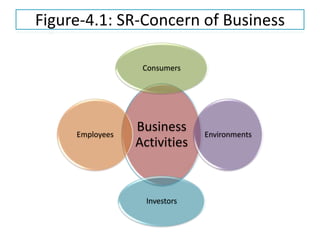
Figure-4.1: SR-Concern of Business
Business
Activities
Consumers
Environments
Investors
Employees
Responsibility to Consumers
• When a consumer consumes a product or service of any particular
brands, s/he promotes it by recommending to friends, relatives,
family members & others when the product or service is good.
• But, dissatisfied customers/consumers take their business to
elsewhere.
• Shopping for a Better World, a research journal rates different
companies with different products based on categories including
Environmental Protection, Involvement in Weapons, Promotion of
Women & Minorities in upper classes, Availability of employee
benefits such as leave for Pregnancy issues, Corporate day-care
centers and Charitable contributions.
• Pressure from consumers and special interest groups
has prompted many business firms to adopt socially
responsible policies like Consumerism.
• Consumerism refers to the activities of individuals,
groups, and organizations aimed at protecting consumer
rights.
• Consumer group perform many activities like testing and
reporting on safety and performance of products,
informing the public and govt. officials & advocating
legislation.
• Many people think consumer movement as a 1960s
phenomenon, rather it was originated with Industrial
Revolution.
• Rapid growth of production between 1970 and 1900
led to poor working conditions, sale of harmful food
& drugs, and false advertising.
• This movement gained momentum during the 1920s
and 1930s. During Great Depression, many
consumers blamed firms for job-lessness and difficult
economic times.
• During 1960s, John F. Kennedy, the then
President of USA established the consumer
“Bill of Rights” including the……..
Right to
Safety
Right to be
Informed
Right to
Choose
Right to be
Heard
Responsibility to Employees
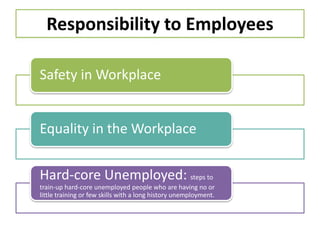
Safety in Workplace
Equality in the Workplace
Hard-core Unemployed: steps to
train-up hard-core unemployed people who are having no or
little training or few skills with a long history unemployment.
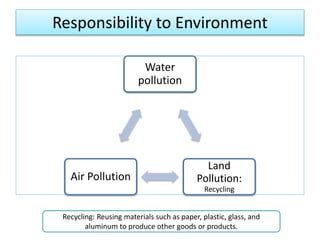
Responsibility to Environment
Water
pollution
Land
Pollution:
Recycling
Air Pollution
Recycling: Reusing materials such as paper, plastic, glass, and
aluminum to produce other goods or products.
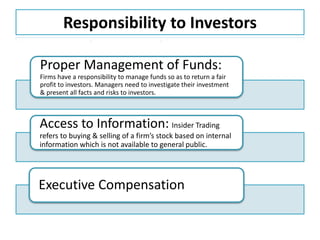
Responsibility to Investors
Proper Management of Funds:
Firms have a responsibility to manage funds so as to return a fair
profit to investors. Managers need to investigate their investment
& present all facts and risks to investors.
Access to Information: Insider Trading
refers to buying & selling of a firm’s stock based on internal
information which is not available to general public.
Executive Compensation
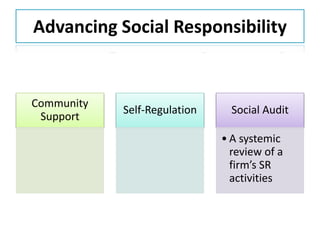
Advancing Social Responsibility
Community
Support
Self-Regulation Social Audit
• A systemic
review of a
firm’s SR
activities
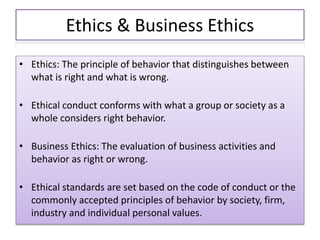
Ethics & Business Ethics
• Ethics: The principle of behavior that distinguishes between
what is right and what is wrong.
• Ethical conduct conforms with what a group or society as a
whole considers right behavior.
• Business Ethics: The evaluation of business activities and
behavior as right or wrong.
• Ethical standards are set based on the code of conduct or the
commonly accepted principles of behavior by society, firm,
industry and individual personal values.
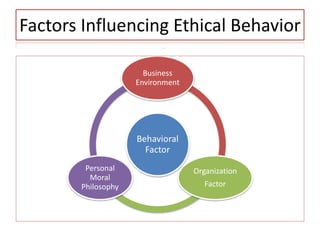
Factors Influencing Ethical Behavior
Behavioral
Factor
Business
Environment
Organization
Factor
Personal
Moral
Philosophy
• Moral Philosophy: The set of principles that dictate
acceptable behavior.
• Humanistic Philosophy: The set of moral principles
focusing on individual rights and values.
• Code of Ethics: A statement spelling out exactly what
an organization considers ethical behavior.
• Whistler-Blower: An employee who informs
superiors, the media, or a govt. regulatory agency
about unethical behavior within the organization.
Further Reading
• Kamal and Deegan 2013, Australian
Accounting Review
• Kamal and Deegan, 2013.pdf

Csr lecture slides

  • 1.
    Lecture 11-12 Introduction toBusiness CSR Dr Yousuf Kamal Associate Professor
  • 2.
    Social Responsibility • Theawareness that business activities have an impact on society and the consideration of that impact by firms in decision making Business Activities EnvironmentEmployees Consumers Investor
  • 3.
    Responsibility to Consumers •Firms trying to provide products that satisfy the needs of their customers, since dissatisfied customers eventually take their business elsewhere. • President john F. Kennedy established the consumer “bill of rights” in 1960s. • Consumerism includes the activities of individuals, groups and organizations aimed at protecting consumer rights. • The Right to Safety – Right to products that are safe to possess and use. To ensure safety of goods, manufacturers should test them and provide buyers with explicit directions for use.
  • 4.
    Responsibility to Consumers •The Right to be Informed – Right to receive information available about a product before they purchase it. E.G. Ingredients, instructions for use. • The Right to Choose – Right to choose and make purchases from a variety of products at competitive prices. Also the right to expect quality service at a fair price. • The Right to be Heard – Right to have their (consumers) opinions considered in the formation of government policies and in business firm’s decisions that affect them.
  • 5.
    Responsibility to Employees •Employees hold certain expectations of business firms. • They expect safe working conditions, fair compensation, equal opportunities (regardless of age, race, gender, religion or national origin) and adequate benefits (e.G. Health insurance, vacation etc). • Occupational Safety and Health Administration (OSHA) • Equal Employment Opportunity Commission (EEOC)
  • 6.
    Responsibility to Environment •Pollution – contamination of air, water and land • Water pollution– caused by dumping of toxic chemicals, sewage and garbage into rivers etc and by using pesticides and fertilizers etc. • Land pollution– results from strip mining of coal and minerals, forest fires, garbage disposal and dumping of industrial wastes including chemicals and medical supplies such as used hypodermic needles. • Often results in land pollution. • Recycling – reusing materials such as paper, plastic, glass and aluminum to make other products.
  • 7.
    Responsibility to Environment •Air Pollution– Caused by carbon monoxide and hydrocarbons that come from motor vehicles and by smoke and other pollutants from manufacturing plants (emission standards for automobiles, factories, catalytic converters are there to help control air pollution) • Ozone layer– Shields the planet from the sun’s deadly ultraviolet rays. This is being destroyed with a global warming trend as a result (major cause is Chlorofluorocarbons (CFCs) that are used to cool refrigerators and air conditioners) • Acid rain– When sulphur dioxide is pumped into the air (often by manufacturing and power plants burning high sulphur coal) and mixes with air, rain with a high acid content is created
  • 8.
    Responsibility to Investors •Business firms have responsibility to the people who invest money in them. • There are problems such as mishandling of investor’s funds, insider trading (the practice of buying and selling stock on the basis of information gained through positions or contacts with others that is not available to other investors or the general public) • Excessive compensation of executives
  • 9.
    Business Ethics • Ethics–The principles of behavior that distinguish between right and wrong • Business Ethics– The evaluation of business activities and behavior as right or wrong • Ethical standards in business are based on commonly accepted principles or behavior established by the expectations of society, the firm, the industry and an individual’s personal values • A violation of ethics makes trust and goodwill difficult to maintain
  • 10.
    Factors Influencing EthicalBehavior The Business Environment • Business managers are challenged to meet sales quotas, cut costs, increase efficiency or overtake competitors (survive by deception or cheating) • Conflict of interest (offer special favors or gifts, bribes) damages the organization in the long run
  • 11.
    Factors Influencing EthicalBehavior The Organization • Individuals learn from ethical and unethical behaviors by interacting with other in the organization • By rewarding for ethical conduct and punishing unethical behavior may help the organization to promote ethical behavior among the employees
  • 12.
    Factors Influencing EthicalBehavior The Individual • A person’s own moral philosophy influences his or her ethical behavior • Moral philosophy – the set of principles (learned from family, school, co-workers, friends) that dictate acceptable behavior
  • 13.
    Developing Moral Philosophy •Individuals can follow two approaches: 1. Humanistic Philosophy • A set of moral principles focusing on individual rights and values • Individuals & organizations adopting this philosophy would honor their moral duties to customers and workers
  • 14.
    Developing Moral Philosophy 2.Utilitarian Philosophy • A set of moral principles focusing on the greatest good for the largest number of people • CNG case in Bangladesh • Vaccine Tests on Children
  • 15.
    Encouraging Ethical Behavior •Many organizations take positive steps to encourage ethical behavior. E.g. Ethics training programs etc. • A basic way for an organization to encourage ethical behavior is to establish a code of ethics (a statement spelling out exactly what an organization considers ethical behavior)
  • 16.
    Encouraging Ethical Behavior •Whistle Blower – an employee who informs superiors, the media or a government regulatory agency about unethical behavior within an organization (they often risk great professional and personal danger by reporting the unethical behavior of others • Efforts to encourage ethical behavior will e effective only with the support of top-level management
  • 17.
    What is SocialResponsibility (SR)? • The awareness that business activities have an impact on society, and the consideration of that impact by firms in decision making. • Firms voluntarily engage themselves to socially desirable & welfare related activities. • A socially responsible Firm tries to increase the positive impact on society while reducing its negative impact
  • 18.
    • For instance,DBBL provides more than crore taka scholarships to poor but meritorious students, builds educational institutions, mosque and madrasa etc. • Newman’s own Inc., donates all profits to charities around USA. • McDonald’s has switched from disposable to reusable containers.
  • 19.
    • Firms, thoseinitiating environment friendly machinery and pollution preventing device to production are also practicing SR. • Practicing SR costs money, not free of cost. • But, failing to enforce SR has its costs-whether in fines, increased regulation, negative publicity, public dissatisfaction, or loss of consumers.
  • 20.
    Figure-4.1: SR-Concern ofBusiness Business Activities Consumers Environments Investors Employees
  • 21.
    Responsibility to Consumers •When a consumer consumes a product or service of any particular brands, s/he promotes it by recommending to friends, relatives, family members & others when the product or service is good. • But, dissatisfied customers/consumers take their business to elsewhere. • Shopping for a Better World, a research journal rates different companies with different products based on categories including Environmental Protection, Involvement in Weapons, Promotion of Women & Minorities in upper classes, Availability of employee benefits such as leave for Pregnancy issues, Corporate day-care centers and Charitable contributions.
  • 22.
    • Pressure fromconsumers and special interest groups has prompted many business firms to adopt socially responsible policies like Consumerism. • Consumerism refers to the activities of individuals, groups, and organizations aimed at protecting consumer rights. • Consumer group perform many activities like testing and reporting on safety and performance of products, informing the public and govt. officials & advocating legislation.
  • 23.
    • Many peoplethink consumer movement as a 1960s phenomenon, rather it was originated with Industrial Revolution. • Rapid growth of production between 1970 and 1900 led to poor working conditions, sale of harmful food & drugs, and false advertising. • This movement gained momentum during the 1920s and 1930s. During Great Depression, many consumers blamed firms for job-lessness and difficult economic times.
  • 24.
    • During 1960s,John F. Kennedy, the then President of USA established the consumer “Bill of Rights” including the…….. Right to Safety Right to be Informed Right to Choose Right to be Heard
  • 25.
    Responsibility to Employees Safetyin Workplace Equality in the Workplace Hard-core Unemployed: steps to train-up hard-core unemployed people who are having no or little training or few skills with a long history unemployment.
  • 26.
    Responsibility to Environment Water pollution Land Pollution: Recycling AirPollution Recycling: Reusing materials such as paper, plastic, glass, and aluminum to produce other goods or products.
  • 27.
    Responsibility to Investors ProperManagement of Funds: Firms have a responsibility to manage funds so as to return a fair profit to investors. Managers need to investigate their investment & present all facts and risks to investors. Access to Information: Insider Trading refers to buying & selling of a firm’s stock based on internal information which is not available to general public. Executive Compensation
  • 28.
    Advancing Social Responsibility Community Support Self-RegulationSocial Audit • A systemic review of a firm’s SR activities
  • 29.
    Ethics & BusinessEthics • Ethics: The principle of behavior that distinguishes between what is right and what is wrong. • Ethical conduct conforms with what a group or society as a whole considers right behavior. • Business Ethics: The evaluation of business activities and behavior as right or wrong. • Ethical standards are set based on the code of conduct or the commonly accepted principles of behavior by society, firm, industry and individual personal values.
  • 30.
    Factors Influencing EthicalBehavior Behavioral Factor Business Environment Organization Factor Personal Moral Philosophy
  • 31.
    • Moral Philosophy:The set of principles that dictate acceptable behavior. • Humanistic Philosophy: The set of moral principles focusing on individual rights and values. • Code of Ethics: A statement spelling out exactly what an organization considers ethical behavior. • Whistler-Blower: An employee who informs superiors, the media, or a govt. regulatory agency about unethical behavior within the organization.
  • 32.
    Further Reading • Kamaland Deegan 2013, Australian Accounting Review • Kamal and Deegan, 2013.pdf