Introduction to Apache Airflow & Workflow
Orchestration
OPTIMIZING DATA PIPELINES WITH APACHE AIRFLOW
What is Apache Airflow?
• Open-source workflow automation and orchestration tool.
• Developed by Apache Software Foundation.
• Manages complex workflows as Directed Acyclic Graphs
(DAGs).
• Ensures task scheduling, monitoring, and dependency
management.
Why Use Apache Airflow?
Scalability: Manages workflows from small tasks to large
enterprise pipelines.
Flexibility: Define workflows as Python scripts.
Extensibility: Supports plugins and integrates with cloud
services (AWS, GCP, Azure).
Monitoring: Web UI for tracking workflows and logs.
Automation: Schedule and trigger workflows efficiently.
Key Components of Apache Airflow
• DAGs (Directed Acyclic Graphs): Define workflows and
dependencies.
• Operators: Pre-built tasks (Bash, Python, SQL, etc.).
• Scheduler: Automates execution timing.
• Executor: Runs tasks (LocalExecutor, CeleryExecutor,
KubernetesExecutor).
• Web UI: Provides visibility into DAG runs and logs.
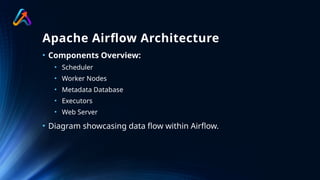
Apache Airflow Architecture
• Components Overview:
• Scheduler
• Worker Nodes
• Metadata Database
• Executors
• Web Server
• Diagram showcasing data flow within Airflow.
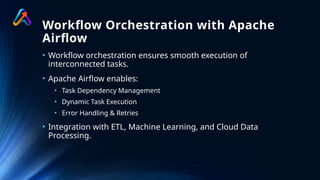
Workflow Orchestration with Apache
Airflow
• Workflow orchestration ensures smooth execution of
interconnected tasks.
• Apache Airflow enables:
• Task Dependency Management
• Dynamic Task Execution
• Error Handling & Retries
• Integration with ETL, Machine Learning, and Cloud Data
Processing.
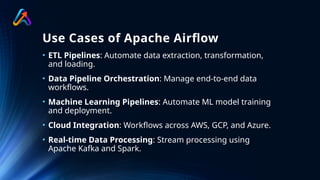
Use Cases of Apache Airflow
• ETL Pipelines: Automate data extraction, transformation,
and loading.
• Data Pipeline Orchestration: Manage end-to-end data
workflows.
• Machine Learning Pipelines: Automate ML model training
and deployment.
• Cloud Integration: Workflows across AWS, GCP, and Azure.
• Real-time Data Processing: Stream processing using
Apache Kafka and Spark.
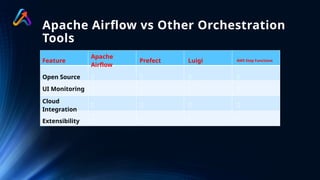
Apache Airflow vs Other Orchestration
Tools
Feature
Apache
Airflow
Prefect Luigi AWS Step Functions
Open Source ✅ ✅ ✅ ❌
UI Monitoring ✅ ✅ ❌ ✅
Cloud
Integration
✅ ✅ ❌ ✅
Extensibility ✅ ✅ ❌ ❌
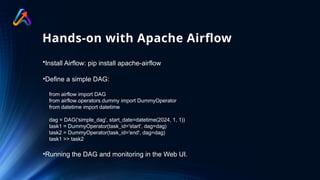
Hands-on with Apache Airflow
•Install Airflow: pip install apache-airflow
•Define a simple DAG:
from airflow import DAG
from airflow.operators.dummy import DummyOperator
from datetime import datetime
dag = DAG('simple_dag', start_date=datetime(2024, 1, 1))
task1 = DummyOperator(task_id='start', dag=dag)
task2 = DummyOperator(task_id='end', dag=dag)
task1 >> task2
•Running the DAG and monitoring in the Web UI.
Learn Apache Airflow with
Accentfuture
• Course Highlights:
• Hands-on training with real-world projects.
• Expert trainers from the industry.
• Certification guidance for Apache Airflow.
• Career support and job placement assistance.
• Enroll Now! Visit Accentfuture for more details.

Introduction to Apache Airflow & Workflow Orchestration.pptx

  • 1.
    Introduction to ApacheAirflow & Workflow Orchestration OPTIMIZING DATA PIPELINES WITH APACHE AIRFLOW
  • 2.
    What is ApacheAirflow? • Open-source workflow automation and orchestration tool. • Developed by Apache Software Foundation. • Manages complex workflows as Directed Acyclic Graphs (DAGs). • Ensures task scheduling, monitoring, and dependency management.
  • 3.
    Why Use ApacheAirflow? Scalability: Manages workflows from small tasks to large enterprise pipelines. Flexibility: Define workflows as Python scripts. Extensibility: Supports plugins and integrates with cloud services (AWS, GCP, Azure). Monitoring: Web UI for tracking workflows and logs. Automation: Schedule and trigger workflows efficiently.
  • 4.
    Key Components ofApache Airflow • DAGs (Directed Acyclic Graphs): Define workflows and dependencies. • Operators: Pre-built tasks (Bash, Python, SQL, etc.). • Scheduler: Automates execution timing. • Executor: Runs tasks (LocalExecutor, CeleryExecutor, KubernetesExecutor). • Web UI: Provides visibility into DAG runs and logs.
  • 5.
    Apache Airflow Architecture •Components Overview: • Scheduler • Worker Nodes • Metadata Database • Executors • Web Server • Diagram showcasing data flow within Airflow.
  • 6.
    Workflow Orchestration withApache Airflow • Workflow orchestration ensures smooth execution of interconnected tasks. • Apache Airflow enables: • Task Dependency Management • Dynamic Task Execution • Error Handling & Retries • Integration with ETL, Machine Learning, and Cloud Data Processing.
  • 7.
    Use Cases ofApache Airflow • ETL Pipelines: Automate data extraction, transformation, and loading. • Data Pipeline Orchestration: Manage end-to-end data workflows. • Machine Learning Pipelines: Automate ML model training and deployment. • Cloud Integration: Workflows across AWS, GCP, and Azure. • Real-time Data Processing: Stream processing using Apache Kafka and Spark.
  • 8.
    Apache Airflow vsOther Orchestration Tools Feature Apache Airflow Prefect Luigi AWS Step Functions Open Source ✅ ✅ ✅ ❌ UI Monitoring ✅ ✅ ❌ ✅ Cloud Integration ✅ ✅ ❌ ✅ Extensibility ✅ ✅ ❌ ❌
  • 9.
    Hands-on with ApacheAirflow •Install Airflow: pip install apache-airflow •Define a simple DAG: from airflow import DAG from airflow.operators.dummy import DummyOperator from datetime import datetime dag = DAG('simple_dag', start_date=datetime(2024, 1, 1)) task1 = DummyOperator(task_id='start', dag=dag) task2 = DummyOperator(task_id='end', dag=dag) task1 >> task2 •Running the DAG and monitoring in the Web UI.
  • 10.
    Learn Apache Airflowwith Accentfuture • Course Highlights: • Hands-on training with real-world projects. • Expert trainers from the industry. • Certification guidance for Apache Airflow. • Career support and job placement assistance. • Enroll Now! Visit Accentfuture for more details.