ASIAN
LITERAT
URE
Primary activity
LOOK Closely at the landmarks and to
identify them. Name the country to
where each is found.
Guess what
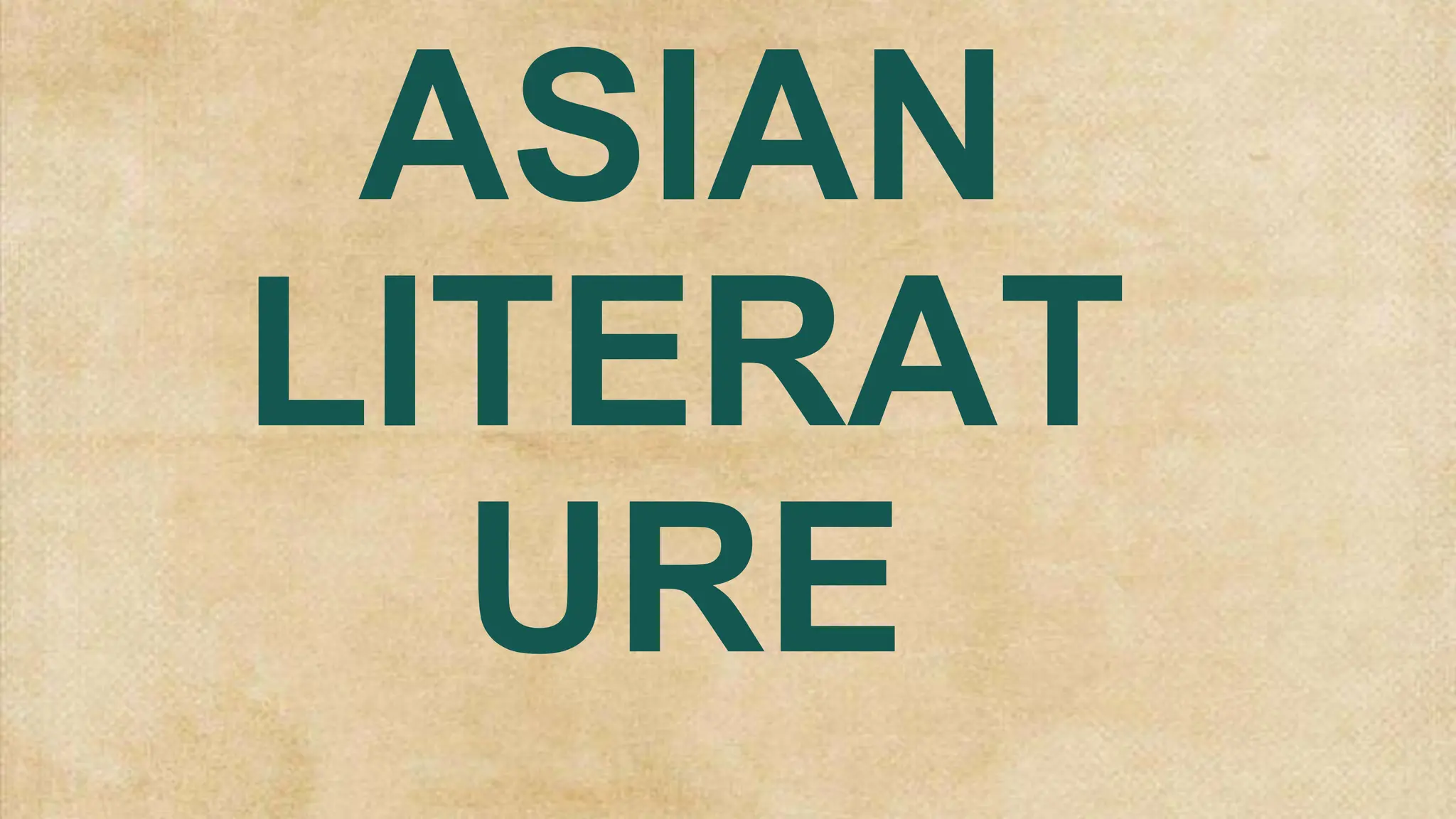
G_ _ _T S_ _ _NX OF
_ _ Z_
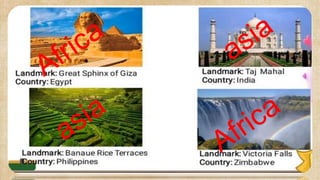
GREAT SPHINX OF GIZA
EGYPT
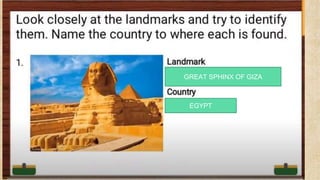
Taj Mahal
India
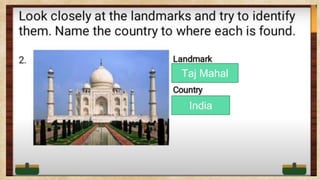
Banaue Rice Terraces
Philippines
Victoria Falls
Zimbabwe
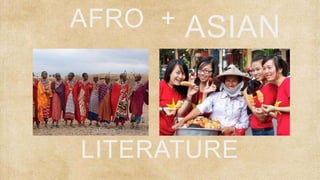
AFRO + ASIAN
LITERATURE
Definition of Terms
• A hairstyle originating with black people
• a combining form of Africa/
Definition of Terms
• Relating to Asia or its people,
customs or language
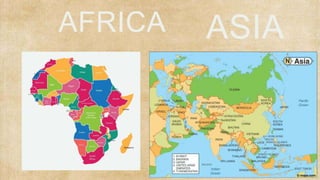
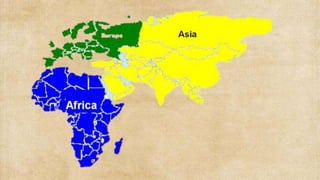
AFRICA ASIA
AFRICA
✗ It is the second largest continent (after Asia), covering
about one-fifth of the total land surface of Earth. The
continent is bounded on the west by the Atlantic
Ocean, on the north by the Mediterranean Sea, on the
east by the Red Sea and the Indian Ocean, and on
the south by the mingling waters of the Atlantic and
Indian oceans.
✗ ETYMOLOGY: The name Africa came into
Western use through the Romans, who used the
name Africa terra – “land of the Afri” (plural, or
“Afer” singular) – for the northern part of the
continent, as the province of Africa with its capital
Carthage, corresponding to modern-day Tunisia.
ASIA
✗ Asia is bounded by the Arctic Ocean to the north,
the Pacific Ocean to the east, the Indian Ocean to
the south, the Red Sea (as well as the inland seas
of the Atlantic Ocean – the Mediterranean and the
Black) to the southwest, and Europe to the west.
ASIA
✗ ETYMOLOGY: The word Asia is originated from
the Ancient Greek word Aoia, first attributed to
Herodotus (about 440BCE) in reference to Anatolia
or to the Persian Empire, in contrast to Greece and
Egypt. It originally was a name for the east bank of
the Aegean Sea, an area known to the Hittites as
Assuwa.
What is afro-
Asian literature?
QUESTION # 1
AFRO-ASIAN LITERATURE
✗ It is a term for writing written by people from
mixed African-Arab ethnicity, or African-Asian
ethnicity.
✗ It mirrors not only the customs and traditions of
African and Asian countries but also their
philosophy of life which on the whole are deeply
and predominantly contemplative and hauntingly
sweet.
AFRO-ASIAN LITERATURE
✗ It refers to the literary output of the various countries and
cultures in Africa and Asia. This includes their oral
traditions and from the first to the contemporary written
and/or published prose and poetry.
✗ Asian Literature alone is diverse and vibrant. Add to
that the splendor of African Literature, and you get
enriching Afro Asian Literature.
AFRO-ASIAN LITERATURE
✗ Generally, literary works of Afro-Asian tell people
about the unique struggles and successes of Afro-
Asian people.
✗ GENRES: playwriting, poems, prose
AFRO-ASIAN LITERATURE
POEMS – tell about the history and culture of the Afro-Asian people.
Today, Afro-Asians still express their creativity and honor their culture
by crafting beautiful poems such as haikus, ballads or sonnets.
PLAYWRIGHTS – celebrate their own culture and ancestry by setting
plays in the past and referencing historical events in their storylines.
When performed, this will feature backdrops and costumes which will
reflects the culture and unique spirit of Afro-Asian people.
PROSE – it is used to expose truth, to describe objects, places and
people, to draw a reader deeper into a story.
CITE AT LEAST
3 COUNTRIES
UNDER THE
AFRO-ASIAN
QUESTION # 2
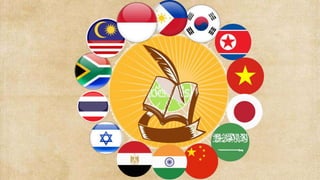
AFRO-ASIAN
LITERATURE
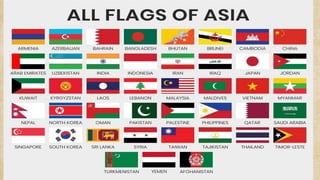
Philippines
South
Korea
North
Korea
Vietnam
Japan
Saudi
Arabia
China
India
Egypt
Israel
Thailand
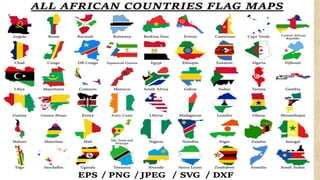
Africa
Malaysia
Indoenesia
Enumerate the norms
and culture associated
with the
aforementioned
countries
QUESTION # 3
NORMS AND CULTURE
✗ NORMS - a standard or pattern, especially of social behavior,
that is typical or expected of a group
✗ CULTURE - is defined as the shared patterns of behaviors and
interactions, cognitive constructs, and affective understanding
that are learned through a process of socialization. These
shared patterns identify the members of a culture group while
also distinguishing those of another group.
NORMS AND CULTURE: africa
✗ AFRICA - Africa has 300 distinct ethnic groups, 2000 language.
Home to the most genetically diverse people on Earth. So
diverse that two Africans are more genetically different from
each other than a Chinese and European are from each other.
Africa is the world's second largest and second most populous
continent. There are generations, which do define Africa, but
none that are exclusive.
✗ Sense of Community - A popular African proverb comes to
mind here to express the African sense of community. It says:
"Go the way that many people go; if you go alone, you will have
reason to lament“. The African idea of security and its value
depends on personal identification with and within the
community.
NORMS AND CULTURE: africa
✗ Sense of Good Human Relations - The art of dialogue
and conversation is a cherished value in African human
relations. People freely discuss their problems and look for
suggestions and solutions together. The unwillingness to
talk to people about either private or public affairs can be
interpreted as bad manners or sign of enmity.
✗ Sense of hospitality - The African sense of hospitality is one of
the African values that is still quite alive. The Africans easily
incorporate strangers and give them lands to settle hoping that they
would go one day, and the land would revert to the owner. Africans
have symbolic ways of expressing welcome. These are in forms of
presentation of kola nuts, traditional gin, coconuts, etc; in various
communities.
NORMS AND CULTURE: asia
✗ ASIA - Asian values are very much inter-related. They all support the view of the
individual as being a part of a much larger group or family, and place great
importance on the well-being of the group, even at the expense of the individual.
✗ Family and Education - A number of Asian students have done conspicuously
well in terms of test scores, gifted student programs, admissions to prestigious
schools, academic awards, and in classical music. Though obviously not all
Asians fit this pattern, this trend can be attributed primarily to the basic notion of
the family, and the central role that education plays in the family. Great importance
is placed on child rearing, and education is a fundamental aspect of this. Asian
parents are more likely to spend much more time with their children, and drive
them harder, sometimes even at the expense of their personal time and ambitions
of the parents themselves.
NORMS AND CULTURE: asia
✗ Reserve Conformity and Harmony - Since the well-being of the
larger group is most important in Asian culture, great importance is
placed on maintaining harmony. The greatest virtue that can achieve
is not greatness of one’s self, which is viewed as being selfish and
self-centered, but of fulfilling his or her role in the whole of the family
or group. The achievement of an individual may be seen as really the
result of the effort of one’s family, or group.
NORMS AND CULTURE: asia
✗ Benevolence and Obligation - Asian societies tend to be very hierarchical, in contrast
to African culture, where in some cases it is not unusual to consider teacher and student,
or even parent and child as equals. Asian hierarchical relationships involve a lot of
obligation, and what might be viewed as dependence or domination. But a good deal of
responsibility and benevolence is expected in return. While children might be obligated to
follow their parent’s wishes very closely at the expense of their own independence,
the parents are also expected to raise support, and educate them far in excess of what
might be expected by African standards.
✗ Loss of face, shame and honor - Losing face is one of the better known Asian
concepts among others society. Unlike individualisticcultures, shame and honor go
far beyond the individual, and reflect directly upon ones’ family, nation,or other group,
and so is taken very seriously. Maintaining good face is a kind of measurement
of howwell one has maintained faith to traditional values, and ones’ social standing
among others. It serves asa strong control mechanism which reinforces all other Asian
values.
NORMS AND CULTURE: GENERAL
✗ The Afro-Asian countries usually cared for their family first;
then they are fond of their social values; and specially, their
love for their own country.
✗ They are also active in celebrating festivals that reflects their
own characteristics as an Asian.
✗ They are religious because they give importance to 'The
Creator' by giving thanks and offering prayers to Him.
✗ They are also active if we talk about literature because they
are good writers.
✗ They are talented on different branch of sports and arts that
they are about to compete worldwide.

INTRODUCTION TO AFRO-ASIAN LIT..pptx

  • 1.
  • 2.
  • 3.
    LOOK Closely atthe landmarks and to identify them. Name the country to where each is found. Guess what G_ _ _T S_ _ _NX OF _ _ Z_ GREAT SPHINX OF GIZA EGYPT
  • 4.
  • 5.
  • 6.
  • 8.
  • 9.
    Definition of Terms •A hairstyle originating with black people • a combining form of Africa/
  • 11.
    Definition of Terms •Relating to Asia or its people, customs or language
  • 12.
  • 17.
    AFRICA ✗ It isthe second largest continent (after Asia), covering about one-fifth of the total land surface of Earth. The continent is bounded on the west by the Atlantic Ocean, on the north by the Mediterranean Sea, on the east by the Red Sea and the Indian Ocean, and on the south by the mingling waters of the Atlantic and Indian oceans.
  • 18.
    ✗ ETYMOLOGY: Thename Africa came into Western use through the Romans, who used the name Africa terra – “land of the Afri” (plural, or “Afer” singular) – for the northern part of the continent, as the province of Africa with its capital Carthage, corresponding to modern-day Tunisia.
  • 20.
    ASIA ✗ Asia isbounded by the Arctic Ocean to the north, the Pacific Ocean to the east, the Indian Ocean to the south, the Red Sea (as well as the inland seas of the Atlantic Ocean – the Mediterranean and the Black) to the southwest, and Europe to the west.
  • 21.
    ASIA ✗ ETYMOLOGY: Theword Asia is originated from the Ancient Greek word Aoia, first attributed to Herodotus (about 440BCE) in reference to Anatolia or to the Persian Empire, in contrast to Greece and Egypt. It originally was a name for the east bank of the Aegean Sea, an area known to the Hittites as Assuwa.
  • 22.
    What is afro- Asianliterature? QUESTION # 1
  • 23.
    AFRO-ASIAN LITERATURE ✗ Itis a term for writing written by people from mixed African-Arab ethnicity, or African-Asian ethnicity. ✗ It mirrors not only the customs and traditions of African and Asian countries but also their philosophy of life which on the whole are deeply and predominantly contemplative and hauntingly sweet.
  • 24.
    AFRO-ASIAN LITERATURE ✗ Itrefers to the literary output of the various countries and cultures in Africa and Asia. This includes their oral traditions and from the first to the contemporary written and/or published prose and poetry. ✗ Asian Literature alone is diverse and vibrant. Add to that the splendor of African Literature, and you get enriching Afro Asian Literature.
  • 25.
    AFRO-ASIAN LITERATURE ✗ Generally,literary works of Afro-Asian tell people about the unique struggles and successes of Afro- Asian people. ✗ GENRES: playwriting, poems, prose
  • 26.
    AFRO-ASIAN LITERATURE POEMS –tell about the history and culture of the Afro-Asian people. Today, Afro-Asians still express their creativity and honor their culture by crafting beautiful poems such as haikus, ballads or sonnets. PLAYWRIGHTS – celebrate their own culture and ancestry by setting plays in the past and referencing historical events in their storylines. When performed, this will feature backdrops and costumes which will reflects the culture and unique spirit of Afro-Asian people. PROSE – it is used to expose truth, to describe objects, places and people, to draw a reader deeper into a story.
  • 27.
    CITE AT LEAST 3COUNTRIES UNDER THE AFRO-ASIAN QUESTION # 2
  • 28.
  • 29.
    Enumerate the norms andculture associated with the aforementioned countries QUESTION # 3
  • 30.
    NORMS AND CULTURE ✗NORMS - a standard or pattern, especially of social behavior, that is typical or expected of a group ✗ CULTURE - is defined as the shared patterns of behaviors and interactions, cognitive constructs, and affective understanding that are learned through a process of socialization. These shared patterns identify the members of a culture group while also distinguishing those of another group.
  • 31.
    NORMS AND CULTURE:africa ✗ AFRICA - Africa has 300 distinct ethnic groups, 2000 language. Home to the most genetically diverse people on Earth. So diverse that two Africans are more genetically different from each other than a Chinese and European are from each other. Africa is the world's second largest and second most populous continent. There are generations, which do define Africa, but none that are exclusive. ✗ Sense of Community - A popular African proverb comes to mind here to express the African sense of community. It says: "Go the way that many people go; if you go alone, you will have reason to lament“. The African idea of security and its value depends on personal identification with and within the community.
  • 32.
    NORMS AND CULTURE:africa ✗ Sense of Good Human Relations - The art of dialogue and conversation is a cherished value in African human relations. People freely discuss their problems and look for suggestions and solutions together. The unwillingness to talk to people about either private or public affairs can be interpreted as bad manners or sign of enmity. ✗ Sense of hospitality - The African sense of hospitality is one of the African values that is still quite alive. The Africans easily incorporate strangers and give them lands to settle hoping that they would go one day, and the land would revert to the owner. Africans have symbolic ways of expressing welcome. These are in forms of presentation of kola nuts, traditional gin, coconuts, etc; in various communities.
  • 33.
    NORMS AND CULTURE:asia ✗ ASIA - Asian values are very much inter-related. They all support the view of the individual as being a part of a much larger group or family, and place great importance on the well-being of the group, even at the expense of the individual. ✗ Family and Education - A number of Asian students have done conspicuously well in terms of test scores, gifted student programs, admissions to prestigious schools, academic awards, and in classical music. Though obviously not all Asians fit this pattern, this trend can be attributed primarily to the basic notion of the family, and the central role that education plays in the family. Great importance is placed on child rearing, and education is a fundamental aspect of this. Asian parents are more likely to spend much more time with their children, and drive them harder, sometimes even at the expense of their personal time and ambitions of the parents themselves.
  • 34.
    NORMS AND CULTURE:asia ✗ Reserve Conformity and Harmony - Since the well-being of the larger group is most important in Asian culture, great importance is placed on maintaining harmony. The greatest virtue that can achieve is not greatness of one’s self, which is viewed as being selfish and self-centered, but of fulfilling his or her role in the whole of the family or group. The achievement of an individual may be seen as really the result of the effort of one’s family, or group.
  • 35.
    NORMS AND CULTURE:asia ✗ Benevolence and Obligation - Asian societies tend to be very hierarchical, in contrast to African culture, where in some cases it is not unusual to consider teacher and student, or even parent and child as equals. Asian hierarchical relationships involve a lot of obligation, and what might be viewed as dependence or domination. But a good deal of responsibility and benevolence is expected in return. While children might be obligated to follow their parent’s wishes very closely at the expense of their own independence, the parents are also expected to raise support, and educate them far in excess of what might be expected by African standards. ✗ Loss of face, shame and honor - Losing face is one of the better known Asian concepts among others society. Unlike individualisticcultures, shame and honor go far beyond the individual, and reflect directly upon ones’ family, nation,or other group, and so is taken very seriously. Maintaining good face is a kind of measurement of howwell one has maintained faith to traditional values, and ones’ social standing among others. It serves asa strong control mechanism which reinforces all other Asian values.
  • 36.
    NORMS AND CULTURE:GENERAL ✗ The Afro-Asian countries usually cared for their family first; then they are fond of their social values; and specially, their love for their own country. ✗ They are also active in celebrating festivals that reflects their own characteristics as an Asian. ✗ They are religious because they give importance to 'The Creator' by giving thanks and offering prayers to Him. ✗ They are also active if we talk about literature because they are good writers. ✗ They are talented on different branch of sports and arts that they are about to compete worldwide.