Introduction to 7 Technical Analysis Indicators – MACD, RSI, Ichimoku & More
Technical Analysis Indicators, based on historical market data, help identify the next potential price movement. These tools analyze market volume and momentum to detect areas with the highest probability of price reaction.
Introduction to 7 Technical Analysis Indicators – MACD, RSI, Ichimoku & More
1.
TradingFinder
tradingfindercom
TradingFinder
Educational link
Introduction to7 Technical Analysis Indicators –
MACD, RSI, Ichimoku & More
Technical Analysis Indicators, based on historical market data, help identify the next
potential price movement. These tools analyze market volume and momentum to
detect areas with the highest probability of price reaction.
Introduction to 7 Useful Technical Indicators
Introduction to 7 Technical Analysis Indicators
In the realm of technical analysis for financial markets like Forex market, Analysis
Indicators are primarily used to identify the overall long-term trend. Below, we explore 7
widely-used technical indicators in the market:
2.
MACD Indicator
The MACD(Moving Average Convergence Divergence) indicator belongs to the
Oscillators category and is designed to detect momentum and trend reversals.
The MACD is constructed from a combination of moving averages and is commonly
used for medium- to long-term analysis.
MACD Indicator Signal Types
This indicator generates three primary signals in technical analysis:
Crossover between the MACD Line and the Signal Line
Crossing the zero line
Price divergence
Analysis Indicators like the MACD have greater reliability when they align with the
market trend or are combined with other trading tools, such as support and resistance
levels or classic patterns.
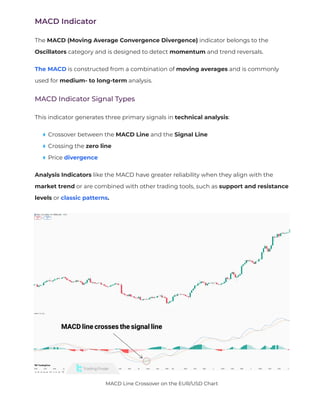
MACD Line Crossover on the EUR/USD Chart
3.
RSI
The RSI (RelativeStrength Index) is a momentum-based oscillator that measures the
strength of market price movements, comparing upward and downward movements. It
oscillates between 0 and 100 and is mostly used to identify overbought and oversold
zones.
RSI Indicator Signal Types
Though often used to assess long-term trends, this technical indicator provides two
main types of signals:
Detecting reversal points through identifying overbought or oversold zones
Identifying divergence between price and the RSI
The RSI alone is not suf
fi
cient for trade entries and is commonly combined with price
action.
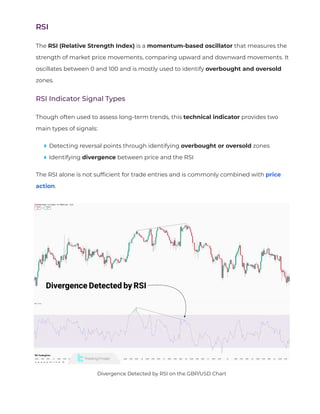
Divergence Detected by RSI on the GBP/USD Chart
4.
Ichimoku
Ichimoku is acomprehensive Japanese analysis system that simultaneously offers
insights on trend, support/resistance, momentum, and entry/exit signals. It consists of
fi
ve key components:
Tenkan-sen (Conversion Line)
Kijun-sen (Base Line)
Senkou Span A (Leading Span A)
Senkou Span B (Leading Span B)
Chikou Span (Lagging Span)
Ichimoku Indicator Signal Types
The Ichimoku indicator offers numerous entry signals. Here are three of the most
commonly used ones in technical analysis:
Crossover between Tenkan-sen and Kijun-sen
Price crossing the Kumo Cloud
Chikou Span forming above or below the price
The Ichimoku is one of the few technical analysis indicators that does not necessarily
need to be combined with other tools.
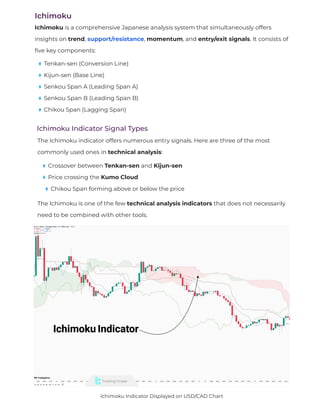
Ichimoku Indicator Displayed on USD/CAD Chart
5.
Moving Average (MA)
TheMoving Average is a trend-following indicator that smooths price
fl
uctuations to
identify the general market direction. It is used in technical analysis to detect reversal
points, trend structures, and support/resistance zones.
There are two main types of Moving Averages:
Simple Moving Average (SMA)
Exponential Moving Average (EMA)
Moving Average Signal Types
This Analysis Indicator offers signals in three primary ways:
Price crossing the Moving Average
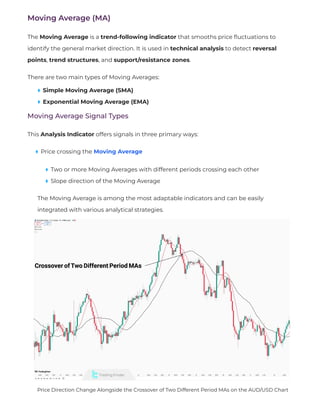
Two or more Moving Averages with different periods crossing each other
Slope direction of the Moving Average
The Moving Average is among the most adaptable indicators and can be easily
integrated with various analytical strategies.
Price Direction Change Alongside the Crossover of Two Different Period MAs on the AUD/USD Chart
6.
Bollinger Bands
The BollingerBands indicator is a volatility-based indicator, consisting of a simple
moving average (SMA) and two upper and lower bands.
The distance between the bands and the moving average is calculated using historical
market data. The Bollinger Band is used to identify overbought and oversold
conditions, price squeezes, and key breakout levels.
Bollinger Bands Signal Types
This technical analysis indicator provides trading signals in three ways:
Price touching or moving outside the bands
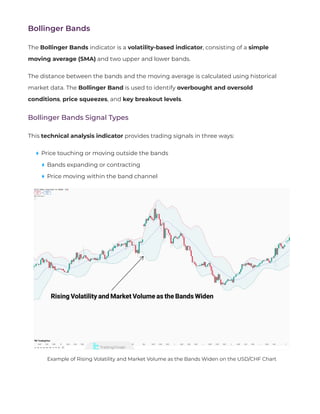
Bands expanding or contracting
Price moving within the band channel
Example of Rising Volatility and Market Volume as the Bands Widen on the USD/CHF Chart
7.
Average True Range(ATR)
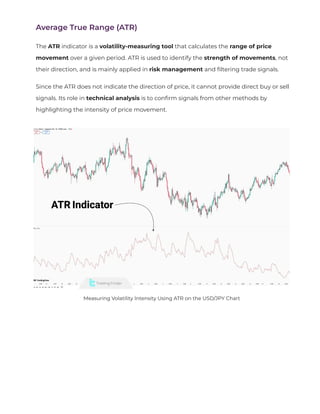
The ATR indicator is a volatility-measuring tool that calculates the range of price
movement over a given period. ATR is used to identify the strength of movements, not
their direction, and is mainly applied in risk management and
fi
ltering trade signals.
Since the ATR does not indicate the direction of price, it cannot provide direct buy or sell
signals. Its role in technical analysis is to con
fi
rm signals from other methods by
highlighting the intensity of price movement.
Measuring Volatility Intensity Using ATR on the USD/JPY Chart
8.
SuperTrend
The SuperTrend isa trend-following indicator that combines ATR and price to mark
entry and exit points directly on the chart. Unlike momentum indicators like RSI, the
SuperTrend is plotted directly on price and is suitable for tracking trends across various
timeframes.
SuperTrend Signal Types
The SuperTrend indicator generates trade signals in three ways:
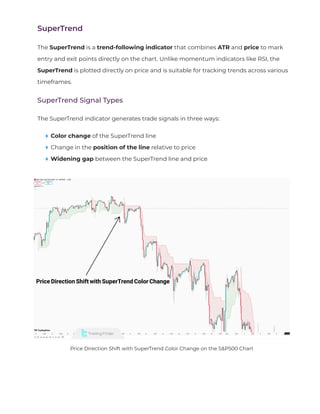
Color change of the SuperTrend line
Change in the position of the line relative to price
Widening gap between the SuperTrend line and price
Price Direction Shift with SuperTrend Color Change on the S&P500 Chart
9.
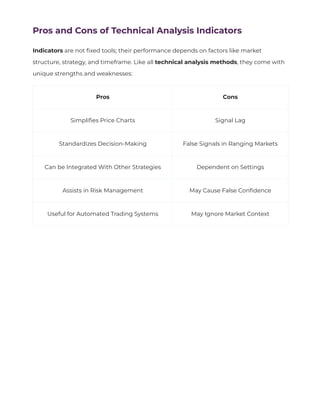
Pros and Consof Technical Analysis Indicators
Indicators are not
fi
xed tools; their performance depends on factors like market
structure, strategy, and timeframe. Like all technical analysis methods, they come with
unique strengths and weaknesses:
Pros Cons
Simpli
fi
es Price Charts Signal Lag
Standardizes Decision-Making False Signals in Ranging Markets
Can be Integrated With Other Strategies Dependent on Settings
Assists in Risk Management May Cause False Con
fi
dence
Useful for Automated Trading Systems May Ignore Market Context
10.
TradingFinder
tradingfindercom
TradingFinder
Educational link
Sources:
Our WebsiteLink :
https://tradingfinder.com/education/articles/technical-
analysis-indicators/
All Education :
https://tradingfinder.com/education/articles/
TradingFinder Support Team (Telgram):
https://t.me/TFLABS
Conclusion
To choose the right technical analysis indicators, you must consider factors such as
market structure, volatility, and the price phase. Combining indicators in technical
analysis enables diverse applications — for instance, using divergence signals from RSI
along with MACD crossovers can help detect momentum shifts in slow-moving trends.
All indicators rely on past market data, which is often seen as a weakness when using
indicators for future predictions.



![What Is Cryptocurrency? [Decentralized & Secure P2P Financial Transactions]](https://cdn.slidesharecdn.com/ss_thumbnails/whatiscryptocurrencydecentralizedsecurep2pfinancialtransactions-250609051556-6e359d34-thumbnail.jpg?width=640&height=640&fit=bounds)
![What is Blockchain? [Applications of Blockchain in Cryptocurrency and Banking]](https://cdn.slidesharecdn.com/ss_thumbnails/blockchaindecentralizedstoragepowposmechanisms-250609045147-b01d52eb-thumbnail.jpg?width=640&height=640&fit=bounds)


![ICT Trading Style Abbreviations and Terminologies [FVGs, OBs, PO3 & MMXM]](https://cdn.slidesharecdn.com/ss_thumbnails/icttradingstyleabbreviationsandterminologiesfvgsobspo3mmxm-250527052348-38610370-thumbnail.jpg?width=640&height=640&fit=bounds)
![What is Inflation? [Examining the PPI, CPI, and PCE Indices]](https://cdn.slidesharecdn.com/ss_thumbnails/inflationcpimonetaryandcostpushinflation2-250524044427-996efc14-thumbnail.jpg?width=640&height=640&fit=bounds)
![Economic Recession [2008 Recession and Government Actions].pdf](https://cdn.slidesharecdn.com/ss_thumbnails/economicrecession2008recessionandgovernmentactions-250519053549-486f743e-thumbnail.jpg?width=640&height=640&fit=bounds)


![The Impact of Monetary Policy on Inflation [Contractionary and Expansionary]](https://cdn.slidesharecdn.com/ss_thumbnails/theimpactofmonetarypolicyoninflation-250515064846-124938d8-thumbnail.jpg?width=640&height=640&fit=bounds)


![Complete TradingView Tutorial [Registration, Symbols, and Screener]](https://cdn.slidesharecdn.com/ss_thumbnails/tradingviewtutorialscreenerpineeditortradingpanel-250508074809-27de5bc8-thumbnail.jpg?width=640&height=640&fit=bounds)


