TradingFinder
tradingfindercom
TradingFinder
Educational link
Advanced Elliott Waves Education; Impulse and
Corrective Waves
The Elliott Wave Theory in technical analysis is used to describe price movements in
financial markets.
This concept was developed by Ralph Nelson Elliott after identifying repetitive fractal
wave patterns and was divided into two parts: impulse waves and corrective waves.
Elliott Waves in Technical Analysis
Inspired by the Dow Theory, Elliott's theory was able to simulate repetitive market
patterns and provide accurate predictions.
In this method, market movements are defined as sequential and fractal waves that can
be identified in prices and consumer behavior.
What Are Elliott Waves?
The Elliott Wave Theory (Elliott Wave) generally examines price movements in the
direction of the main trend in
fi
ve waves, called impulse waves, and trend corrections in
three waves, called corrective waves.
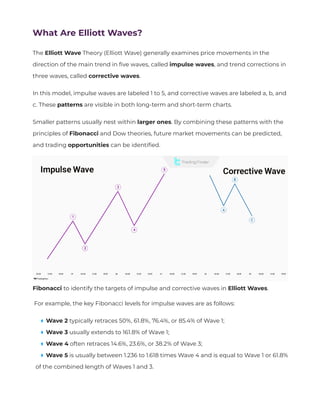
In this model, impulse waves are labeled 1 to 5, and corrective waves are labeled a, b, and
c. These patterns are visible in both long-term and short-term charts.
Smaller patterns usually nest within larger ones. By combining these patterns with the
principles of Fibonacci and Dow theories, future market movements can be predicted,
and trading opportunities can be identifi
ed.
Fibonacci Settings in Elliott Waves
Elliott Waves are based on Fibonacci levels (e.g., 0, 1, 1, 2, 3, 5, 8, 13, ...). Therefore, we use
Fibonacci to identify the targets of impulse and corrective waves in Elliott Waves.
Display of numbers 1 to 5 and letters a, b, and c in impulse and corrective waves in Elliott Waves
For example, the key Fibonacci levels for impulse waves are as follows:
Wave 2 typically retraces 50%, 61.8%, 76.4%, or 85.4% of Wave 1;
Wave 3 usually extends to 161.8% of Wave 1;
Wave 4 often retraces 14.6%, 23.6%, or 38.2% of Wave 3;
Wave 5 is usually between 1.236 to 1.618 times Wave 4 and is equal to Wave 1 or 61.8%
of the combined length of Waves 1 and 3.
Characteristics of Impulse Waves
Impulse waves consist of 5 waves that are drawn in the direction of the main market
trend. Below, we examine each wave.
Wave 1 of Elliott Impulse
Wave 1 marks the beginning of a new trend in the market and usually indicates a major
market trend reversal.
At the start of Wave 1, trading volume is low because the market has not yet recognized
the trend change, and most traders have not con
fi
rmed the reversal.
Wave 2 of Elliott Impulse
Wave 2 in impulse waves is known as the
fi
rst corrective wave after Wave 1. This wave is
usually a corrective movement in the opposite direction of Wave 1, providing an
opportunity to re-enter the new trend. Rules for forming Wave 2 in Elliott Waves:
Volume in Wave 2 should be lower than in Wave 1;
The price increase is usually less than 61.8% of the movement in Wave 1;
The price movement is accompanied by a decline.
How Wave 2 of Elliott Impulse Waves (Elliott Wave) works
Wave 3 of Elliott Impulse
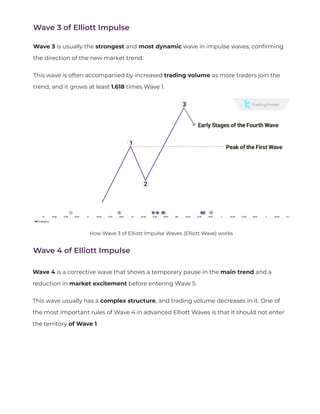
Wave 3 is usually the strongest and most dynamic wave in impulse waves, con
fi
rming
the direction of the new market trend.
This wave is often accompanied by increased trading volume as more traders join the
trend, and it grows at least 1.618 times Wave 1.
Wave 4 of Elliott Impulse
How Wave 3 of Elliott Impulse Waves (Elliott Wave) works
Wave 4 is a corrective wave that shows a temporary pause in the main trend and a
reduction in market excitement before entering Wave 5.
This wave usually has a complex structure, and trading volume decreases in it. One of
the most important rules of Wave 4 in advanced Elliott Waves is that it should not enter
the territory of Wave 1.
Wave 5 of Elliott Impulse
Wave 5 is usually the
fi
nal movement in the direction of the main trend, after which a
major correction (a-b-c pattern) occurs.
Professional traders exit the market at this stage, while novice traders may enter due to
excessive excitement.
Types of Impulse Waves
Elliott Impulse Waves consist of
fi
ve waves that move in the direction of the main trend
and may form a larger wave in higher timeframes. Types of Elliott Impulse Waves:
Impulse Wave
Impulse with Extension
Diagonal Wave
Impulse Waves
Impulse Waves are one of the main phenomena in Elliott Theory, forming a powerful
movement in the direction of the main market trend.
These waves usually consist of five sub-waves, including three impulse waves and two
corrective waves.
Fibonacci Settings for Impulse Waves
Fibonacci settings for impulse waves are as follows:
Wave 2 typically retraces 50% to 61.8% of Wave 1;
Wave 3 is usually 1.618 times Wave 2 or more;
Wave 4 often retraces 23.6% to 38.2% of Wave 3;
Wave 5 can be equal to Wave 1 or 0.618 to 1.618 times Wave 3.
Impulse with Extension
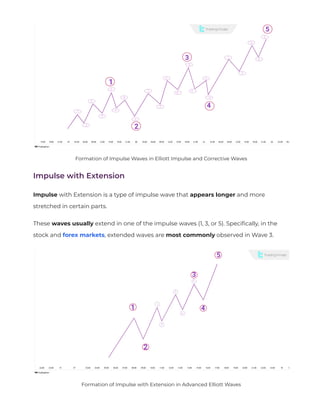
Impulse with Extension is a type of impulse wave that appears longer and more
stretched in certain parts.
These waves usually extend in one of the impulse waves (1, 3, or 5). Speci
fi
cally, in the
stock and forex markets, extended waves are most commonly observed in Wave 3.
Formation of Impulse Waves in Elliott Impulse and Corrective Waves
Formation of Impulse with Extension in Advanced Elliott Waves
Diagonal Waves
Diagonal Waves, instead of having a clear 5-wave movement structure, form with more
slope and overlap. These waves usually appear at the beginning or end of a strong trend.
Types of Elliott Diagonal Waves:
Leading Diagonal
Ending Diagonal
Formation of Leading and Ending Diagonal Waves in Advanced Elliott Waves
Characteristics of Corrective Waves
Corrective waves consist of waves a, b, and c, which are drawn during market corrections.
Below, we examine these waves.
Wave a of Elliott Correction
Wave a is the first part of a three-wave correction (a-b-c) that occurs after a five-wave
impulse movement.
This wave indicates the beginning of the corrective phase and usually moves the
market against the previous trend.
Wave a is often accompanied by lower trading volume and a relative price decline.
Wave b of Elliott Correction
Wave b moves in the opposite direction of Wave a and is considered a correction within
a correction.
This wave often creates a false impression of the continuation of the previous trend.
Wave b typically retraces 38.2% to 78.6% of Wave a.
Wave c of Elliott Correction
Wave c indicates the end of the corrective phase in a complete trend of impulse and
corrective waves in Elliott Waves.
This wave is usually accompanied by a strong movement in the direction of Wave a and
is the largest corrective wave in the a-b-c structure.
Wave c is equal to or larger than Wave a and, in many cases, marks the end of the
correction and the beginning of a new trend.
Types of Corrective Waves
Corrective waves are more diverse than impulse waves and are harder to identify.
Corrective waves always move in three waves and are never
fi
ve-wave structures. There
are four types of corrective patterns:
Zigzag
Flat
Triangles
Zigzag
Zigzag is one of the three-wave corrective patterns (a-b-c) in Elliott Wave Theory, where
the market moves sharply against the main trend.
This correction is often sharp and represents a deep correction relative to the previous
trend.
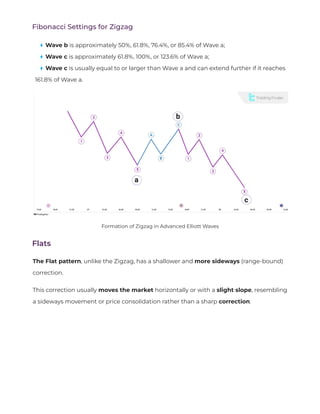
Fibonacci Settings for Zigzag
Wave b is approximately 50%, 61.8%, 76.4%, or 85.4% of Wave a;
Wave c is approximately 61.8%, 100%, or 123.6% of Wave a;
Wave c is usually equal to or larger than Wave a and can extend further if it reaches
161.8% of Wave a.
Flats
Formation of Zigzag in Advanced Elliott Waves
The Flat pattern, unlike the Zigzag, has a shallower and more sideways (range-bound)
correction.
This correction usually moves the market horizontally or with a slight slope, resembling
a sideways movement or price consolidation rather than a sharp correction.
Types of Elliott Flat Patterns:
Pattern
Type
Wave b to
Wave a Ratio
Wave c to Wave
a Ratio
Description
Regular
Flat
90% to 100%
Equal to or
slightly more
Neutral correction with
sideways movement
Expanded
Flat
More than
100% (usually
123.6%)
Longer than
Wave a (usually
1.618 times)
Strong upward or
downward movement in
Wave c
Running
Flat
More than
100%
Shorter than
Wave a
Strength in Wave b and
failure of Wave C to
surpass Wave a
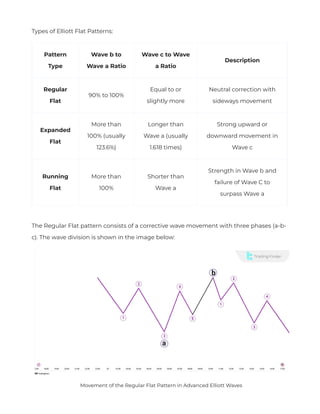
The Regular Flat pattern consists of a corrective wave movement with three phases (a-b-
c). The wave division is shown in the image below:
Movement of the Regular Flat Pattern in Advanced Elliott Waves
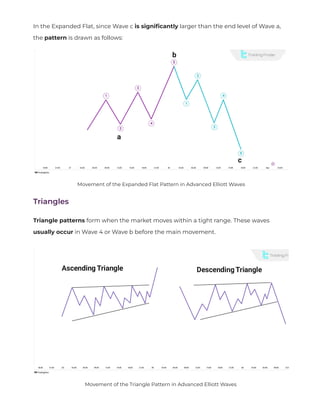
In the Expanded Flat, since Wave c is signi
fi
cantly larger than the end level of Wave a,
the pattern is drawn as follows:
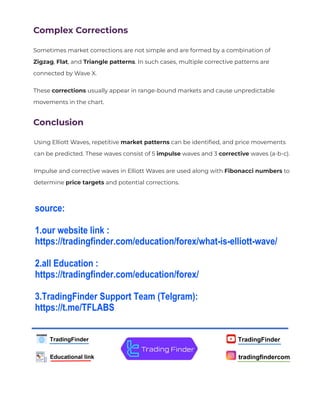
Triangles
Triangle patterns form when the market moves within a tight range. These waves
usually occur in Wave 4 or Wave b before the main movement.
Movement of the Expanded Flat Pattern in Advanced Elliott Waves
Movement of the Triangle Pattern in Advanced Elliott Waves
TradingFinder
tradingfindercom
TradingFinder
Educational link
Complex Corrections
Sometimes market corrections are not simple and are formed by a combination of
Zigzag, Flat, and Triangle patterns. In such cases, multiple corrective patterns are
connected by Wave X.
These corrections usually appear in range-bound markets and cause unpredictable
movements in the chart.
Conclusion
Using Elliott Waves, repetitive market patterns can be identified, and price movements
can be predicted. These waves consist of 5 impulse waves and 3 corrective waves (a-b-c).
Impulse and corrective waves in Elliott Waves are used along with Fibonacci numbers to
determine price targets and potential corrections.
source:
1.our website link :
https://tradingfinder.com/education/forex/what-is-elliott-wave/
2.all Education :
https://tradingfinder.com/education/forex/
3.TradingFinder Support Team (Telgram):
https://t.me/TFLABS

Advanced Elliott Waves Education; Impulse and Corrective Waves

  • 1.
    TradingFinder tradingfindercom TradingFinder Educational link Advanced ElliottWaves Education; Impulse and Corrective Waves The Elliott Wave Theory in technical analysis is used to describe price movements in financial markets. This concept was developed by Ralph Nelson Elliott after identifying repetitive fractal wave patterns and was divided into two parts: impulse waves and corrective waves. Elliott Waves in Technical Analysis Inspired by the Dow Theory, Elliott's theory was able to simulate repetitive market patterns and provide accurate predictions. In this method, market movements are defined as sequential and fractal waves that can be identified in prices and consumer behavior.
  • 2.
    What Are ElliottWaves? The Elliott Wave Theory (Elliott Wave) generally examines price movements in the direction of the main trend in fi ve waves, called impulse waves, and trend corrections in three waves, called corrective waves. In this model, impulse waves are labeled 1 to 5, and corrective waves are labeled a, b, and c. These patterns are visible in both long-term and short-term charts. Smaller patterns usually nest within larger ones. By combining these patterns with the principles of Fibonacci and Dow theories, future market movements can be predicted, and trading opportunities can be identifi ed. Fibonacci Settings in Elliott Waves Elliott Waves are based on Fibonacci levels (e.g., 0, 1, 1, 2, 3, 5, 8, 13, ...). Therefore, we use Fibonacci to identify the targets of impulse and corrective waves in Elliott Waves. Display of numbers 1 to 5 and letters a, b, and c in impulse and corrective waves in Elliott Waves For example, the key Fibonacci levels for impulse waves are as follows: Wave 2 typically retraces 50%, 61.8%, 76.4%, or 85.4% of Wave 1; Wave 3 usually extends to 161.8% of Wave 1; Wave 4 often retraces 14.6%, 23.6%, or 38.2% of Wave 3; Wave 5 is usually between 1.236 to 1.618 times Wave 4 and is equal to Wave 1 or 61.8% of the combined length of Waves 1 and 3.
  • 3.
    Characteristics of ImpulseWaves Impulse waves consist of 5 waves that are drawn in the direction of the main market trend. Below, we examine each wave. Wave 1 of Elliott Impulse Wave 1 marks the beginning of a new trend in the market and usually indicates a major market trend reversal. At the start of Wave 1, trading volume is low because the market has not yet recognized the trend change, and most traders have not con fi rmed the reversal. Wave 2 of Elliott Impulse Wave 2 in impulse waves is known as the fi rst corrective wave after Wave 1. This wave is usually a corrective movement in the opposite direction of Wave 1, providing an opportunity to re-enter the new trend. Rules for forming Wave 2 in Elliott Waves: Volume in Wave 2 should be lower than in Wave 1; The price increase is usually less than 61.8% of the movement in Wave 1; The price movement is accompanied by a decline. How Wave 2 of Elliott Impulse Waves (Elliott Wave) works
  • 4.
    Wave 3 ofElliott Impulse Wave 3 is usually the strongest and most dynamic wave in impulse waves, con fi rming the direction of the new market trend. This wave is often accompanied by increased trading volume as more traders join the trend, and it grows at least 1.618 times Wave 1. Wave 4 of Elliott Impulse How Wave 3 of Elliott Impulse Waves (Elliott Wave) works Wave 4 is a corrective wave that shows a temporary pause in the main trend and a reduction in market excitement before entering Wave 5. This wave usually has a complex structure, and trading volume decreases in it. One of the most important rules of Wave 4 in advanced Elliott Waves is that it should not enter the territory of Wave 1.
  • 5.
    Wave 5 ofElliott Impulse Wave 5 is usually the fi nal movement in the direction of the main trend, after which a major correction (a-b-c pattern) occurs. Professional traders exit the market at this stage, while novice traders may enter due to excessive excitement. Types of Impulse Waves Elliott Impulse Waves consist of fi ve waves that move in the direction of the main trend and may form a larger wave in higher timeframes. Types of Elliott Impulse Waves: Impulse Wave Impulse with Extension Diagonal Wave Impulse Waves Impulse Waves are one of the main phenomena in Elliott Theory, forming a powerful movement in the direction of the main market trend. These waves usually consist of five sub-waves, including three impulse waves and two corrective waves. Fibonacci Settings for Impulse Waves Fibonacci settings for impulse waves are as follows: Wave 2 typically retraces 50% to 61.8% of Wave 1; Wave 3 is usually 1.618 times Wave 2 or more; Wave 4 often retraces 23.6% to 38.2% of Wave 3; Wave 5 can be equal to Wave 1 or 0.618 to 1.618 times Wave 3.
  • 6.
    Impulse with Extension Impulsewith Extension is a type of impulse wave that appears longer and more stretched in certain parts. These waves usually extend in one of the impulse waves (1, 3, or 5). Speci fi cally, in the stock and forex markets, extended waves are most commonly observed in Wave 3. Formation of Impulse Waves in Elliott Impulse and Corrective Waves Formation of Impulse with Extension in Advanced Elliott Waves
  • 7.
    Diagonal Waves Diagonal Waves,instead of having a clear 5-wave movement structure, form with more slope and overlap. These waves usually appear at the beginning or end of a strong trend. Types of Elliott Diagonal Waves: Leading Diagonal Ending Diagonal Formation of Leading and Ending Diagonal Waves in Advanced Elliott Waves Characteristics of Corrective Waves Corrective waves consist of waves a, b, and c, which are drawn during market corrections. Below, we examine these waves. Wave a of Elliott Correction Wave a is the first part of a three-wave correction (a-b-c) that occurs after a five-wave impulse movement. This wave indicates the beginning of the corrective phase and usually moves the market against the previous trend. Wave a is often accompanied by lower trading volume and a relative price decline.
  • 8.
    Wave b ofElliott Correction Wave b moves in the opposite direction of Wave a and is considered a correction within a correction. This wave often creates a false impression of the continuation of the previous trend. Wave b typically retraces 38.2% to 78.6% of Wave a. Wave c of Elliott Correction Wave c indicates the end of the corrective phase in a complete trend of impulse and corrective waves in Elliott Waves. This wave is usually accompanied by a strong movement in the direction of Wave a and is the largest corrective wave in the a-b-c structure. Wave c is equal to or larger than Wave a and, in many cases, marks the end of the correction and the beginning of a new trend. Types of Corrective Waves Corrective waves are more diverse than impulse waves and are harder to identify. Corrective waves always move in three waves and are never fi ve-wave structures. There are four types of corrective patterns: Zigzag Flat Triangles Zigzag Zigzag is one of the three-wave corrective patterns (a-b-c) in Elliott Wave Theory, where the market moves sharply against the main trend. This correction is often sharp and represents a deep correction relative to the previous trend.
  • 9.
    Fibonacci Settings forZigzag Wave b is approximately 50%, 61.8%, 76.4%, or 85.4% of Wave a; Wave c is approximately 61.8%, 100%, or 123.6% of Wave a; Wave c is usually equal to or larger than Wave a and can extend further if it reaches 161.8% of Wave a. Flats Formation of Zigzag in Advanced Elliott Waves The Flat pattern, unlike the Zigzag, has a shallower and more sideways (range-bound) correction. This correction usually moves the market horizontally or with a slight slope, resembling a sideways movement or price consolidation rather than a sharp correction.
  • 10.
    Types of ElliottFlat Patterns: Pattern Type Wave b to Wave a Ratio Wave c to Wave a Ratio Description Regular Flat 90% to 100% Equal to or slightly more Neutral correction with sideways movement Expanded Flat More than 100% (usually 123.6%) Longer than Wave a (usually 1.618 times) Strong upward or downward movement in Wave c Running Flat More than 100% Shorter than Wave a Strength in Wave b and failure of Wave C to surpass Wave a The Regular Flat pattern consists of a corrective wave movement with three phases (a-b- c). The wave division is shown in the image below: Movement of the Regular Flat Pattern in Advanced Elliott Waves
  • 11.
    In the ExpandedFlat, since Wave c is signi fi cantly larger than the end level of Wave a, the pattern is drawn as follows: Triangles Triangle patterns form when the market moves within a tight range. These waves usually occur in Wave 4 or Wave b before the main movement. Movement of the Expanded Flat Pattern in Advanced Elliott Waves Movement of the Triangle Pattern in Advanced Elliott Waves
  • 12.
    TradingFinder tradingfindercom TradingFinder Educational link Complex Corrections Sometimesmarket corrections are not simple and are formed by a combination of Zigzag, Flat, and Triangle patterns. In such cases, multiple corrective patterns are connected by Wave X. These corrections usually appear in range-bound markets and cause unpredictable movements in the chart. Conclusion Using Elliott Waves, repetitive market patterns can be identified, and price movements can be predicted. These waves consist of 5 impulse waves and 3 corrective waves (a-b-c). Impulse and corrective waves in Elliott Waves are used along with Fibonacci numbers to determine price targets and potential corrections. source: 1.our website link : https://tradingfinder.com/education/forex/what-is-elliott-wave/ 2.all Education : https://tradingfinder.com/education/forex/ 3.TradingFinder Support Team (Telgram): https://t.me/TFLABS