Introduction aux
humanités numériques /
  Digital Humanities


  Forum des archivistes, Genève, 2 avril 2012


                Enrico Natale
                 infoclio.ch

                                        info@infoclio.ch
                                      T +41 31 311 75 72
Plan de la présentation:

3. Définitions
4. Origines et précurseurs
5. Apparition des « Digital Humanities »
6. Typologie des projets en DH
7. Modes d’institutionnalisation des DH
8. Développements récents en Suisse
9.Sociologie des Humanités Numériques
10. Bibliographie


                                        info@infoclio.ch
                                      T +41 31 311 75 72
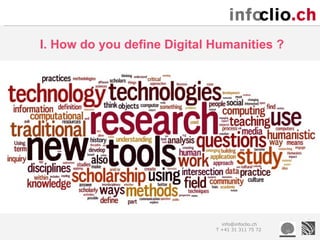
I. How do you define Digital Humanities ?


                               info@infoclio.ch
                             T +41 31 311 75 72
I. How do you define Digital Humanities ?


„If you think you are doing it, then you probably
are, but the UCLDH definition is: the
application of computational methods to
humanities research or to cultural heritage; or
of humanities research methods to digital
phenomena.“
—Claire Warwick


Source:http://dayofdh2012.artsrn.ualberta.ca/dh/     info@infoclio.ch
                                                   T +41 31 311 75 72
I. How do you define Digital Humanities ?

I think of digital humanities as an umbrella term that
covers a wide variety of digital work in the humanities:
development of multimedia pedagogies and
scholarship, designing & building tools, human
computer interaction, designing & building archives
[collections], etc. DH is interdisciplinary; by
necessity it breaks down boundaries between
disciplines at the local (e.g., English and history) and
global (e.g., humanities and computer sciences) levels.
—Kathie Gossett

Source:http://dayofdh2012.artsrn.ualberta.ca/dh/     info@infoclio.ch
                                                   T +41 31 311 75 72
I. How do you define Digital Humanities ?

I guess I define DH twofold : Using technology
to do Humanities research and doing
Humanities research about technology. Plus a
commitment to the openness of knowledge.
Plus a commitment to build new scholarly
objects.
— My Definition (in poor English)


Source:http://dayofdh2012.artsrn.ualberta.ca/dh/     info@infoclio.ch
                                                   T +41 31 311 75 72
I. How do you define Digital Humanities ?

The great opportunity to burn down academic walls
— Enrica Salvatori


DH is what critical theory is or was--an opportunity
to ask new questions, try new methods, engage in
new conversations.
— ssenier


Source:http://dayofdh2012.artsrn.ualberta.ca/dh/     info@infoclio.ch
                                                   T +41 31 311 75 72
I. How do you define Digital Humanities ?

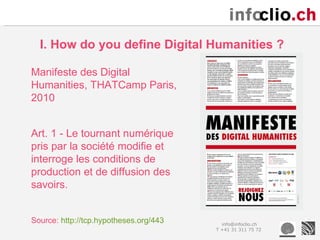
Manifeste des Digital
Humanities, THATCamp Paris,
2010


Art. 1 - Le tournant numérique
pris par la société modifie et
interroge les conditions de
production et de diffusion des
savoirs.


Source: http://tcp.hypotheses.org/443     info@infoclio.ch
                                        T +41 31 311 75 72
II. Origines et précurseurs des DH

Une histoire qui reste à écrire...


- Histoire des sciences et des techniques
- Application de l‘informatique aux sciences humaines
- Utopies informationelles / PC Revolution
- Structuralisme / Post-modernisme


                                        info@infoclio.ch
                                      T +41 31 311 75 72
II. Origines et précurseurs des DH

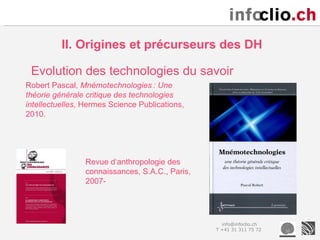
 Evolution des technologies du savoir
Robert Pascal, Mnémotechnologies : Une
théorie générale critique des technologies
intellectuelles, Hermes Science Publications,
2010.


                Revue d‘anthropologie des
                connaissances, S.A.C., Paris,
                2007-


                                                  info@infoclio.ch
                                                T +41 31 311 75 72
II. Origines et précurseurs des DH
  Application de l‘informatique aux sciences
  humaines
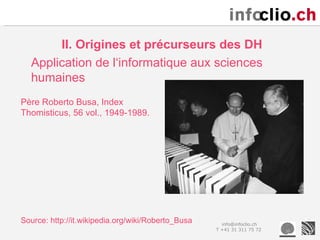
Père Roberto Busa, Index
Thomisticus, 56 vol., 1949-1989.


Source: http://it.wikipedia.org/wiki/Roberto_Busa     info@infoclio.ch
                                                    T +41 31 311 75 72
II. Origines et précurseurs des DH
Utopies informationelles
Bush Vannevar, As We May Think, The Atlantic, may 1945.
Consider a future device for individual use, which is a sort of mechanized
private file and library. It needs a name, and, to coin one at random,
"memex" will do. A memex is a device in which an individual stores all his
books, records, and communications, and which is mechanized so that it
may be consulted with exceeding speed and flexibility. It is an enlarged
intimate supplement to his memory.
It consists of a desk, and while it can presumably be operated from a
distance, it is primarily the piece of furniture at which he works. On the top
are slanting translucent screens, on which material can be projected for
convenient reading. There is a keyboard, and sets of buttons and levers.
Otherwise it looks like an ordinary desk.


                                                         info@infoclio.ch
                                                       T +41 31 311 75 72
II. Origines et précurseurs des DH
    Utopies informationelles
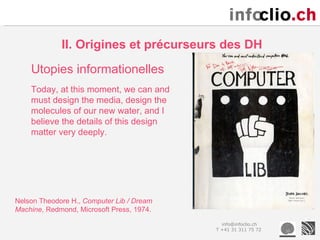
    Today, at this moment, we can and
    must design the media, design the
    molecules of our new water, and I
    believe the details of this design
    matter very deeply.


Nelson Theodore H., Computer Lib / Dream
Machine, Redmond, Microsoft Press, 1974.
                                             info@infoclio.ch
                                           T +41 31 311 75 72
II. Origines et précurseurs des DH
     Utopies informationelles
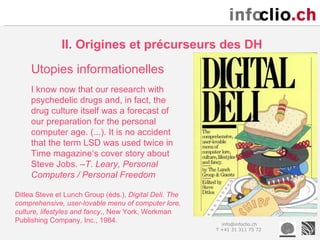
     I know now that our research with
     psychedelic drugs and, in fact, the
     drug culture itself was a forecast of
     our preparation for the personal
     computer age. (...). It is no accident
     that the term LSD was used twice in
     Time magazine‘s cover story about
     Steve Jobs. –T. Leary, Personal
     Computers / Personal Freedom

Ditlea Steve et Lunch Group (éds.), Digital Deli. The
comprehensive, user-lovable menu of computer lore,
culture, lifestyles and fancy., New York, Workman
Publishing Company, Inc., 1984.                           info@infoclio.ch
                                                        T +41 31 311 75 72
II. Origines et précurseurs des DH
Structuralisme / Post-modernisme

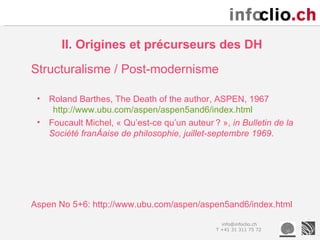
 •   Roland Barthes, The Death of the author, ASPEN, 1967
      http://www.ubu.com/aspen/aspen5and6/index.html
 •   Foucault Michel, « Qu’est-ce qu’un auteur ? », in Bulletin de la
     Société française de philosophie, juillet-septembre 1969.


Aspen No 5+6: http://www.ubu.com/aspen/aspen5and6/index.html

                                                  info@infoclio.ch
                                                T +41 31 311 75 72
II. Origines et précurseurs des DH

Structuralisme / Post-modernisme
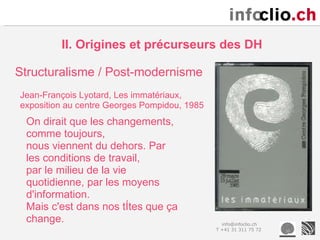
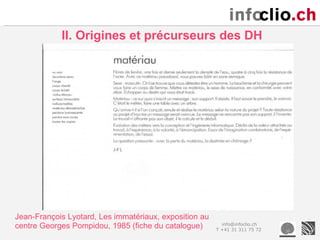
Jean-François Lyotard, Les immatériaux,
exposition au centre Georges Pompidou, 1985
 On dirait que les changements,
 comme toujours,
 nous viennent du dehors. Par
 les conditions de travail,
 par le milieu de la vie
 quotidienne, par les moyens
 d'information.
 Mais c'est dans nos têtes que ça
 change.                                        info@infoclio.ch
                                              T +41 31 311 75 72
II. Origines et précurseurs des DH


Jean-François Lyotard, Les immatériaux, exposition au
centre Georges Pompidou, 1985 (fiche du catalogue)        info@infoclio.ch
                                                        T +41 31 311 75 72
III. Apparition des DH

2001
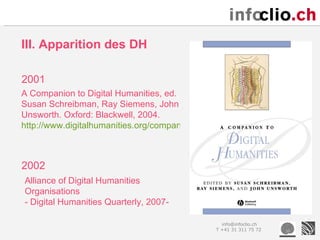
A Companion to Digital Humanities, ed.
Susan Schreibman, Ray Siemens, John
Unsworth. Oxford: Blackwell, 2004.
http://www.digitalhumanities.org/companion/


2002
Alliance of Digital Humanities
Organisations
- Digital Humanities Quarterly, 2007-

                                                info@infoclio.ch
                                              T +41 31 311 75 72
III. Apparition des DH


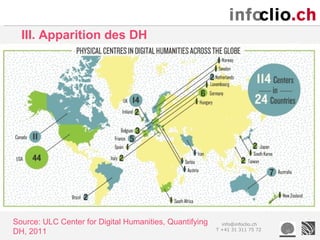
Source: ULC Center for Digital Humanities, Quantifying     info@infoclio.ch
                                                         T +41 31 311 75 72
DH, 2011
IV. Typologie des activités en DH


   Projets de recherche
   Editions de sources
   Développement d‘outils
   Modes de communication scientifique
   Médiation culturelle
   Enseignement


                                       info@infoclio.ch
                                     T +41 31 311 75 72
IV. Typologie des activités en DH

   Projets de recherche

The Valley of Shadows, Uni. Virginia, 1993-
    http://valley.lib.virginia.edu/
Base de données des élite de Suisse au XXe siècle, UNIL, 2007-
    http://www2.unil.ch/elitessuisses/
Viaticalpes, UNIL, 2010-
    http://www.unil.ch/viaticalpes


                                                 info@infoclio.ch
                                               T +41 31 311 75 72
IV. Typologie des activités en DH

    Editions de sources

Documents diplomatiques suisses
     http://www.dodis.ch/
Virtual Manuscript Library of Switzerland, UniFri, 2005-
     http://www.e-codices.unifr.ch/
Rennaissance Melancholy, ed. By Radu Suciu, 2011-
     http://melancholystories.com/


                                                    info@infoclio.ch
                                                  T +41 31 311 75 72
IV. Typologie des activités en DH

    Développement d‘outils

Zotero
     http://www.zotero.org
Lit-Link
     http://www.lit-link.ch/
Salsah
     http://www.salsah.org/


                                  info@infoclio.ch
                                T +41 31 311 75 72
IV. Typologie des activités en DH

    Modes de communication scientifique

THATCamp – The Technology and Humanities Camp
    http://www.thatcamp.org / www.switzerland2011.thatcamp.org
Scholarly Blogging
    http://hypotheses.org/
    http://dayofdh2012.artsrn.ualberta.ca/
Twitter
    https://twitter.com/ #digitalhumanities
Nouvelles formes de publications scientifiques
    http://hackingtheacademy.org/
    http://livingbooksaboutlife.org/

                                                info@infoclio.ch
                                              T +41 31 311 75 72
IV. Typologie des activités en DH

    Médiation culturelle

British Library - Timelines
     http://www.bl.uk/learning/histcitizen/timeline/historytimeline.html
Musée national suisse – Transferts virtuels
     http://vtms.musee-suisse.ch/
Notrehistoire.ch
     http://www.notrehistoire.ch/
Memorado.ch
     http://www.memorado.ch/


                                                      info@infoclio.ch
                                                    T +41 31 311 75 72
IV. Typologie des activités en DH

   Enseignement

DH Bachelor and Master Programs
    http://is.gd/JklT8N / http://is.gd/C8S6jJ
DH Summer schools
    http://digital.humanities.ox.ac.uk/dhoxss/
    Swiss Digital Humanities Summer school 2012 ?
Online educational ressources
    http://www.adfontes.uzh.ch/
    infoclio.ch Digital Literacy Toolkit


                                               info@infoclio.ch
                                             T +41 31 311 75 72
V. Modes d’institutionnalisation des DH
Centre interdisciplinaire universitaire
    http://chnm.gmu.edu/; http://www.ucl.ac.uk/dh/;
http://dhh.anu.edu.au/
    http://www.abmt.unibas.ch/
Laboratoire de bibliothèque
    http://www.nypl.org/collections/labs
    http://library.rice.edu/services/dmc/
    http://www2.lib.virginia.edu/scholarslab/
Organes de financement de la recherche
    http://www.neh.gov/odh/; http://www.dfg.de/ ; http://www.cnrs.fr/
    http://www.snf.ch/
Académies des sciences
    www.sagw.ch
Appels d‘offre
    Google Grants for Digital Humanities
    infoclio.ch Presenting History Online (http://is.gd/gSd81W )
                                                       info@infoclio.ch
                                                     T +41 31 311 75 72
VI. Développements récents en Suisse

•   Humanités Digitales@unil 2011
    http://www3.unil.ch/wpmu/digitalera2011/
•   THATCamp Switzerland 2011
    http://switzerland2011.thatcamp.org/
•   NCCR Digital Culture UNIL/EPFL/UNIBE
•   „Culture digitale“ OFC 2012-2016
•   Bulletin SAGW 2012/1 Digital Humanities
•   Infoclio.ch Call for projects Presenting History Online (30/4/2012)
•   Swiss Digital Humanities Summer school 2012 ?


                                                     info@infoclio.ch
                                                   T +41 31 311 75 72
VI. Sociologie des DH @ Day of DH
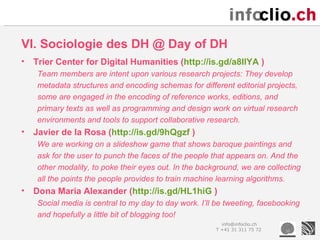
•   Trier Center for Digital Humanities (http://is.gd/a8IlYA )
     Team members are intent upon various research projects: They develop
     metadata structures and encoding schemas for different editorial projects,
     some are engaged in the encoding of reference works, editions, and
     primary texts as well as programming and design work on virtual research
     environments and tools to support collaborative research.
•   Javier de la Rosa (http://is.gd/9hQgzf )
     We are working on a slideshow game that shows baroque paintings and
     ask for the user to punch the faces of the people that appears on. And the
     other modality, to poke their eyes out. In the background, we are collecting
     all the points the people provides to train machine learning algorithms.
•   Dona Maria Alexander (http://is.gd/HL1hiG )
     Social media is central to my day to day work. I’ll be tweeting, facebooking
     and hopefully a little bit of blogging too!
                                                          info@infoclio.ch
                                                        T +41 31 311 75 72
VII. Courte bibliographie récente (1/2)

•   Schreibman Susan, A companion to digital humanities, Malden,
    Blackwell Pub, 2004.
•   McCarty Willard, Humanities computing, Basingstoke, Hampshire [etc.],
    Palgrave Macmillan, 2005.
•   Siemens Ray, A companion to digital literary studies, Oxford, Blackwell,
    2007.
•   Kirschenbaum Matthew G., Mechanisms : new media and the forensic
    imagination, Cambridge, Mass, MIT Press, 2008.
•   McGann Jerome J., Online Humanities Scholarship: The Shape of
    Things to Come, 2010.
•   Bartscherer Thomas et Coover Roderick, Switching codes : thinking
    through digital technology in the humanities and the arts, Chicago,
    London, University of Chicago Press, 2011.        info@infoclio.ch
                                                    T +41 31 311 75 72
VII. Courte bibliographie récente (2/2)


•   Fitzpatrick Kathleen, Planned Obsolescence, New York University
    Press, 2011.
•   Berry David M., Understanding Digital Humanities, Palgrave Macmillan,
    2012.
•   Gold Matthew K., Debates in the Digital Humanities, Univ of Minnesota,
    2012.
•   Hayles N. Katherine, How We Think: Digital Media and Contemporary
    Technogenesis, Univ of Chicago, 2012.
•   Ramsay Stephen, Reading Machines: Toward and Algorithmic
    Criticism, Univ of Illinois, 2012.

                                                     info@infoclio.ch
                                                   T +41 31 311 75 72
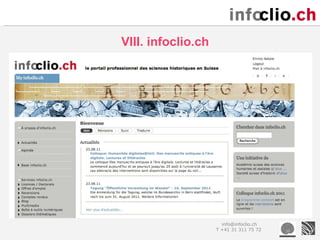
VIII. infoclio.ch


                      info@infoclio.ch
                    T +41 31 311 75 72

Introduction aux Digital Humanities

  • 1.
    Introduction aux humanités numériques/ Digital Humanities Forum des archivistes, Genève, 2 avril 2012 Enrico Natale infoclio.ch info@infoclio.ch T +41 31 311 75 72
  • 2.
    Plan de laprésentation: 3. Définitions 4. Origines et précurseurs 5. Apparition des « Digital Humanities » 6. Typologie des projets en DH 7. Modes d’institutionnalisation des DH 8. Développements récents en Suisse 9.Sociologie des Humanités Numériques 10. Bibliographie info@infoclio.ch T +41 31 311 75 72
  • 3.
    I. How doyou define Digital Humanities ? info@infoclio.ch T +41 31 311 75 72
  • 4.
    I. How doyou define Digital Humanities ? „If you think you are doing it, then you probably are, but the UCLDH definition is: the application of computational methods to humanities research or to cultural heritage; or of humanities research methods to digital phenomena.“ —Claire Warwick Source:http://dayofdh2012.artsrn.ualberta.ca/dh/ info@infoclio.ch T +41 31 311 75 72
  • 5.
    I. How doyou define Digital Humanities ? I think of digital humanities as an umbrella term that covers a wide variety of digital work in the humanities: development of multimedia pedagogies and scholarship, designing & building tools, human computer interaction, designing & building archives [collections], etc. DH is interdisciplinary; by necessity it breaks down boundaries between disciplines at the local (e.g., English and history) and global (e.g., humanities and computer sciences) levels. —Kathie Gossett Source:http://dayofdh2012.artsrn.ualberta.ca/dh/ info@infoclio.ch T +41 31 311 75 72
  • 6.
    I. How doyou define Digital Humanities ? I guess I define DH twofold : Using technology to do Humanities research and doing Humanities research about technology. Plus a commitment to the openness of knowledge. Plus a commitment to build new scholarly objects. — My Definition (in poor English) Source:http://dayofdh2012.artsrn.ualberta.ca/dh/ info@infoclio.ch T +41 31 311 75 72
  • 7.
    I. How doyou define Digital Humanities ? The great opportunity to burn down academic walls — Enrica Salvatori DH is what critical theory is or was--an opportunity to ask new questions, try new methods, engage in new conversations. — ssenier Source:http://dayofdh2012.artsrn.ualberta.ca/dh/ info@infoclio.ch T +41 31 311 75 72
  • 8.
    I. How doyou define Digital Humanities ? Manifeste des Digital Humanities, THATCamp Paris, 2010 Art. 1 - Le tournant numérique pris par la société modifie et interroge les conditions de production et de diffusion des savoirs. Source: http://tcp.hypotheses.org/443 info@infoclio.ch T +41 31 311 75 72
  • 9.
    II. Origines etprécurseurs des DH Une histoire qui reste à écrire... - Histoire des sciences et des techniques - Application de l‘informatique aux sciences humaines - Utopies informationelles / PC Revolution - Structuralisme / Post-modernisme info@infoclio.ch T +41 31 311 75 72
  • 10.
    II. Origines etprécurseurs des DH Evolution des technologies du savoir Robert Pascal, Mnémotechnologies : Une théorie générale critique des technologies intellectuelles, Hermes Science Publications, 2010. Revue d‘anthropologie des connaissances, S.A.C., Paris, 2007- info@infoclio.ch T +41 31 311 75 72
  • 11.
    II. Origines etprécurseurs des DH Application de l‘informatique aux sciences humaines Père Roberto Busa, Index Thomisticus, 56 vol., 1949-1989. Source: http://it.wikipedia.org/wiki/Roberto_Busa info@infoclio.ch T +41 31 311 75 72
  • 12.
    II. Origines etprécurseurs des DH Utopies informationelles Bush Vannevar, As We May Think, The Atlantic, may 1945. Consider a future device for individual use, which is a sort of mechanized private file and library. It needs a name, and, to coin one at random, "memex" will do. A memex is a device in which an individual stores all his books, records, and communications, and which is mechanized so that it may be consulted with exceeding speed and flexibility. It is an enlarged intimate supplement to his memory. It consists of a desk, and while it can presumably be operated from a distance, it is primarily the piece of furniture at which he works. On the top are slanting translucent screens, on which material can be projected for convenient reading. There is a keyboard, and sets of buttons and levers. Otherwise it looks like an ordinary desk. info@infoclio.ch T +41 31 311 75 72
  • 13.
    II. Origines etprécurseurs des DH Utopies informationelles Today, at this moment, we can and must design the media, design the molecules of our new water, and I believe the details of this design matter very deeply. Nelson Theodore H., Computer Lib / Dream Machine, Redmond, Microsoft Press, 1974. info@infoclio.ch T +41 31 311 75 72
  • 14.
    II. Origines etprécurseurs des DH Utopies informationelles I know now that our research with psychedelic drugs and, in fact, the drug culture itself was a forecast of our preparation for the personal computer age. (...). It is no accident that the term LSD was used twice in Time magazine‘s cover story about Steve Jobs. –T. Leary, Personal Computers / Personal Freedom Ditlea Steve et Lunch Group (éds.), Digital Deli. The comprehensive, user-lovable menu of computer lore, culture, lifestyles and fancy., New York, Workman Publishing Company, Inc., 1984. info@infoclio.ch T +41 31 311 75 72
  • 15.
    II. Origines etprécurseurs des DH Structuralisme / Post-modernisme • Roland Barthes, The Death of the author, ASPEN, 1967 http://www.ubu.com/aspen/aspen5and6/index.html • Foucault Michel, « Qu’est-ce qu’un auteur ? », in Bulletin de la Société française de philosophie, juillet-septembre 1969. Aspen No 5+6: http://www.ubu.com/aspen/aspen5and6/index.html info@infoclio.ch T +41 31 311 75 72
  • 16.
    II. Origines etprécurseurs des DH Structuralisme / Post-modernisme Jean-François Lyotard, Les immatériaux, exposition au centre Georges Pompidou, 1985 On dirait que les changements, comme toujours, nous viennent du dehors. Par les conditions de travail, par le milieu de la vie quotidienne, par les moyens d'information. Mais c'est dans nos têtes que ça change. info@infoclio.ch T +41 31 311 75 72
  • 17.
    II. Origines etprécurseurs des DH Jean-François Lyotard, Les immatériaux, exposition au centre Georges Pompidou, 1985 (fiche du catalogue) info@infoclio.ch T +41 31 311 75 72
  • 18.
    III. Apparition desDH 2001 A Companion to Digital Humanities, ed. Susan Schreibman, Ray Siemens, John Unsworth. Oxford: Blackwell, 2004. http://www.digitalhumanities.org/companion/ 2002 Alliance of Digital Humanities Organisations - Digital Humanities Quarterly, 2007- info@infoclio.ch T +41 31 311 75 72
  • 19.
    III. Apparition desDH Source: ULC Center for Digital Humanities, Quantifying info@infoclio.ch T +41 31 311 75 72 DH, 2011
  • 20.
    IV. Typologie desactivités en DH  Projets de recherche  Editions de sources  Développement d‘outils  Modes de communication scientifique  Médiation culturelle  Enseignement info@infoclio.ch T +41 31 311 75 72
  • 21.
    IV. Typologie desactivités en DH  Projets de recherche The Valley of Shadows, Uni. Virginia, 1993- http://valley.lib.virginia.edu/ Base de données des élite de Suisse au XXe siècle, UNIL, 2007- http://www2.unil.ch/elitessuisses/ Viaticalpes, UNIL, 2010- http://www.unil.ch/viaticalpes info@infoclio.ch T +41 31 311 75 72
  • 22.
    IV. Typologie desactivités en DH  Editions de sources Documents diplomatiques suisses http://www.dodis.ch/ Virtual Manuscript Library of Switzerland, UniFri, 2005- http://www.e-codices.unifr.ch/ Rennaissance Melancholy, ed. By Radu Suciu, 2011- http://melancholystories.com/ info@infoclio.ch T +41 31 311 75 72
  • 23.
    IV. Typologie desactivités en DH  Développement d‘outils Zotero http://www.zotero.org Lit-Link http://www.lit-link.ch/ Salsah http://www.salsah.org/ info@infoclio.ch T +41 31 311 75 72
  • 24.
    IV. Typologie desactivités en DH  Modes de communication scientifique THATCamp – The Technology and Humanities Camp http://www.thatcamp.org / www.switzerland2011.thatcamp.org Scholarly Blogging http://hypotheses.org/ http://dayofdh2012.artsrn.ualberta.ca/ Twitter https://twitter.com/ #digitalhumanities Nouvelles formes de publications scientifiques http://hackingtheacademy.org/ http://livingbooksaboutlife.org/ info@infoclio.ch T +41 31 311 75 72
  • 25.
    IV. Typologie desactivités en DH  Médiation culturelle British Library - Timelines http://www.bl.uk/learning/histcitizen/timeline/historytimeline.html Musée national suisse – Transferts virtuels http://vtms.musee-suisse.ch/ Notrehistoire.ch http://www.notrehistoire.ch/ Memorado.ch http://www.memorado.ch/ info@infoclio.ch T +41 31 311 75 72
  • 26.
    IV. Typologie desactivités en DH  Enseignement DH Bachelor and Master Programs http://is.gd/JklT8N / http://is.gd/C8S6jJ DH Summer schools http://digital.humanities.ox.ac.uk/dhoxss/ Swiss Digital Humanities Summer school 2012 ? Online educational ressources http://www.adfontes.uzh.ch/ infoclio.ch Digital Literacy Toolkit info@infoclio.ch T +41 31 311 75 72
  • 27.
    V. Modes d’institutionnalisationdes DH Centre interdisciplinaire universitaire http://chnm.gmu.edu/; http://www.ucl.ac.uk/dh/; http://dhh.anu.edu.au/ http://www.abmt.unibas.ch/ Laboratoire de bibliothèque http://www.nypl.org/collections/labs http://library.rice.edu/services/dmc/ http://www2.lib.virginia.edu/scholarslab/ Organes de financement de la recherche http://www.neh.gov/odh/; http://www.dfg.de/ ; http://www.cnrs.fr/ http://www.snf.ch/ Académies des sciences www.sagw.ch Appels d‘offre Google Grants for Digital Humanities infoclio.ch Presenting History Online (http://is.gd/gSd81W ) info@infoclio.ch T +41 31 311 75 72
  • 28.
    VI. Développements récentsen Suisse • Humanités Digitales@unil 2011 http://www3.unil.ch/wpmu/digitalera2011/ • THATCamp Switzerland 2011 http://switzerland2011.thatcamp.org/ • NCCR Digital Culture UNIL/EPFL/UNIBE • „Culture digitale“ OFC 2012-2016 • Bulletin SAGW 2012/1 Digital Humanities • Infoclio.ch Call for projects Presenting History Online (30/4/2012) • Swiss Digital Humanities Summer school 2012 ? info@infoclio.ch T +41 31 311 75 72
  • 29.
    VI. Sociologie desDH @ Day of DH • Trier Center for Digital Humanities (http://is.gd/a8IlYA ) Team members are intent upon various research projects: They develop metadata structures and encoding schemas for different editorial projects, some are engaged in the encoding of reference works, editions, and primary texts as well as programming and design work on virtual research environments and tools to support collaborative research. • Javier de la Rosa (http://is.gd/9hQgzf ) We are working on a slideshow game that shows baroque paintings and ask for the user to punch the faces of the people that appears on. And the other modality, to poke their eyes out. In the background, we are collecting all the points the people provides to train machine learning algorithms. • Dona Maria Alexander (http://is.gd/HL1hiG ) Social media is central to my day to day work. I’ll be tweeting, facebooking and hopefully a little bit of blogging too! info@infoclio.ch T +41 31 311 75 72
  • 30.
    VII. Courte bibliographierécente (1/2) • Schreibman Susan, A companion to digital humanities, Malden, Blackwell Pub, 2004. • McCarty Willard, Humanities computing, Basingstoke, Hampshire [etc.], Palgrave Macmillan, 2005. • Siemens Ray, A companion to digital literary studies, Oxford, Blackwell, 2007. • Kirschenbaum Matthew G., Mechanisms : new media and the forensic imagination, Cambridge, Mass, MIT Press, 2008. • McGann Jerome J., Online Humanities Scholarship: The Shape of Things to Come, 2010. • Bartscherer Thomas et Coover Roderick, Switching codes : thinking through digital technology in the humanities and the arts, Chicago, London, University of Chicago Press, 2011. info@infoclio.ch T +41 31 311 75 72
  • 31.
    VII. Courte bibliographierécente (2/2) • Fitzpatrick Kathleen, Planned Obsolescence, New York University Press, 2011. • Berry David M., Understanding Digital Humanities, Palgrave Macmillan, 2012. • Gold Matthew K., Debates in the Digital Humanities, Univ of Minnesota, 2012. • Hayles N. Katherine, How We Think: Digital Media and Contemporary Technogenesis, Univ of Chicago, 2012. • Ramsay Stephen, Reading Machines: Toward and Algorithmic Criticism, Univ of Illinois, 2012. info@infoclio.ch T +41 31 311 75 72
  • 32.
    VIII. infoclio.ch info@infoclio.ch T +41 31 311 75 72

Editor's Notes