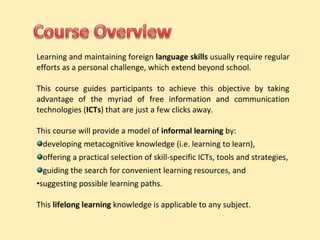
Learning and maintaining foreign language skills usually require regular 
efforts as a personal challenge, which extend beyond school. 
This course guides participants to achieve this objective by taking 
advantage of the myriad of free information and communication 
technologies (ICTs) that are just a few clicks away. 
This course will provide a model of informal learning by: 
developing metacognitive knowledge (i.e. learning to learn), 
offering a practical selection of skill-specific ICTs, tools and strategies, 
guiding the search for convenient learning resources, and 
•suggesting possible learning paths. 
This lifelong learning knowledge is applicable to any subject.
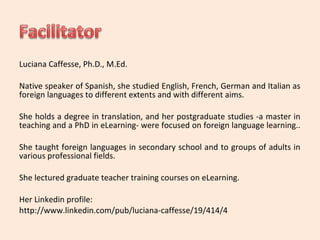
Luciana Caffesse, Ph.D., M.Ed. 
Native speaker of Spanish, she studied English, French, German and Italian as 
foreign languages to different extents and with different aims. 
She holds a degree in translation, and her postgraduate studies -a master in 
teaching and a PhD in eLearning- were focused on foreign language learning.. 
She taught foreign languages in secondary school and to groups of adults in 
various professional fields. 
She lectured graduate teacher training courses on eLearning. 
Her Linkedin profile: 
http://www.linkedin.com/pub/luciana-caffesse/19/414/4
1. Develop foreign language learning-to-learn 
competencies. 
1. Gain practical knowledge of free ICTs that help 
to develop language skills. 
2. Familiarise with autonomous, collaborative 
scenarios.
The total estimated time is 30 hours distributed in nine 
units. 
The course is delivered in asynchronous mode (i.e. not 
communicating at the same time). 
While units are estimated to take 120, 180 and 240 
minutes to complete, additional resources facilitate the 
repetition, extension and expansion of students’ practise. 
It is strongly recommended to log in at least three times 
per week in order to keep up with the content flow and 
interact with the classmates and facilitator.
This course is highly participatory as it stimulates both 
ICT practice and reflection. 
All ICT tools suggested to perform activities are free of 
charge and massively used (e.g. Google Translate). 
The course structure is customisable in terms of time 
allocation, schedule, target level of skills, tools to use, 
topics to review, etc. 
Collaboration and co-operation are key features in the 
form of written and oral exchanges on social networks.
At the completion of the course, participants should be 
able (or better able) to: 
Plan and complete an English language-learning path 
that is aligned with their own learning style and the 
associated strategies. 
Use critical thinking to categorise, assess and select 
learning resources (i.e. tools, content, personal contacts, 
etc.) 
Effectively practice reading, listening, writing, speaking 
and conversation in English.

Using ICTs to Learn Languages Autonomously: Introduction

  • 3.
    Learning and maintainingforeign language skills usually require regular efforts as a personal challenge, which extend beyond school. This course guides participants to achieve this objective by taking advantage of the myriad of free information and communication technologies (ICTs) that are just a few clicks away. This course will provide a model of informal learning by: developing metacognitive knowledge (i.e. learning to learn), offering a practical selection of skill-specific ICTs, tools and strategies, guiding the search for convenient learning resources, and •suggesting possible learning paths. This lifelong learning knowledge is applicable to any subject.
  • 4.
    Luciana Caffesse, Ph.D.,M.Ed. Native speaker of Spanish, she studied English, French, German and Italian as foreign languages to different extents and with different aims. She holds a degree in translation, and her postgraduate studies -a master in teaching and a PhD in eLearning- were focused on foreign language learning.. She taught foreign languages in secondary school and to groups of adults in various professional fields. She lectured graduate teacher training courses on eLearning. Her Linkedin profile: http://www.linkedin.com/pub/luciana-caffesse/19/414/4
  • 5.
    1. Develop foreignlanguage learning-to-learn competencies. 1. Gain practical knowledge of free ICTs that help to develop language skills. 2. Familiarise with autonomous, collaborative scenarios.
  • 6.
    The total estimatedtime is 30 hours distributed in nine units. The course is delivered in asynchronous mode (i.e. not communicating at the same time). While units are estimated to take 120, 180 and 240 minutes to complete, additional resources facilitate the repetition, extension and expansion of students’ practise. It is strongly recommended to log in at least three times per week in order to keep up with the content flow and interact with the classmates and facilitator.
  • 7.
    This course ishighly participatory as it stimulates both ICT practice and reflection. All ICT tools suggested to perform activities are free of charge and massively used (e.g. Google Translate). The course structure is customisable in terms of time allocation, schedule, target level of skills, tools to use, topics to review, etc. Collaboration and co-operation are key features in the form of written and oral exchanges on social networks.
  • 8.
    At the completionof the course, participants should be able (or better able) to: Plan and complete an English language-learning path that is aligned with their own learning style and the associated strategies. Use critical thinking to categorise, assess and select learning resources (i.e. tools, content, personal contacts, etc.) Effectively practice reading, listening, writing, speaking and conversation in English.