
INTRODUCTION TO
ECONOMICS


Dr. Ranjana Agarwal
Learning Objectives

   To analyze the concept of
    economics
   To know how Economics plays a
     role in one’s life
   To understand the scope of
    economics
Economic Terms
    Economic good, Economic activity
   Income and employment
   Economic development
   Choosing between alternative
    choices with limited resources
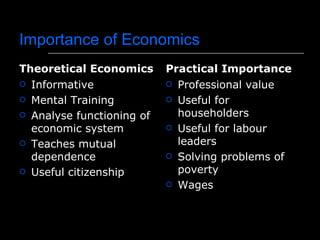
Importance of Economics
Theoretical Economics      Practical Importance
 Informative               Professional value

 Mental Training           Useful for

 Analyse functioning of     householders
  economic system           Useful for labour

 Teaches mutual             leaders
  dependence                Solving problems of

 Useful citizenship         poverty
                            Wages
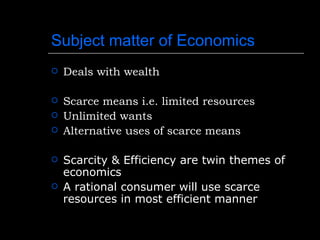
Subject matter of Economics
   Deals with wealth

   Scarce means i.e. limited resources
   Unlimited wants
   Alternative uses of scarce means

   Scarcity & Efficiency are twin themes of
    economics
   A rational consumer will use scarce
    resources in most efficient manner
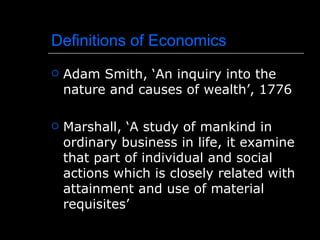
Definitions of Economics
   Adam Smith, ‘An inquiry into the
    nature and causes of wealth’, 1776

   Marshall, ‘A study of mankind in
    ordinary business in life, it examine
    that part of individual and social
    actions which is closely related with
    attainment and use of material
    requisites’
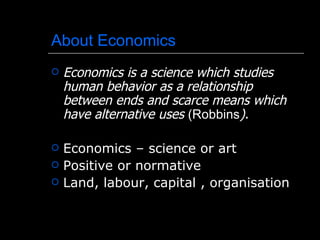
About Economics
   Economics is a science which studies
    human behavior as a relationship
    between ends and scarce means which
    have alternative uses (Robbins).

   Economics – science or art
   Positive or normative
   Land, labour, capital , organisation
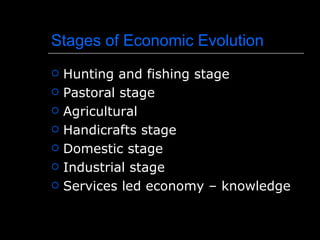
Stages of Economic Evolution
   Hunting and fishing stage
   Pastoral stage
   Agricultural
   Handicrafts stage
   Domestic stage
   Industrial stage
   Services led economy – knowledge
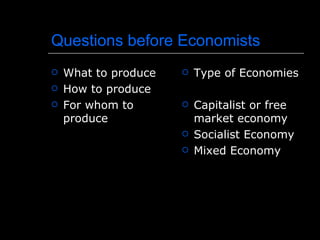
Questions before Economists
   What to produce      Type of Economies
   How to produce
   For whom to          Capitalist or free
    produce               market economy
                         Socialist Economy
                         Mixed Economy
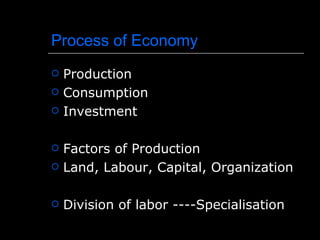
Process of Economy
   Production
   Consumption
   Investment

   Factors of Production
   Land, Labour, Capital, Organization

   Division of labor ----Specialisation
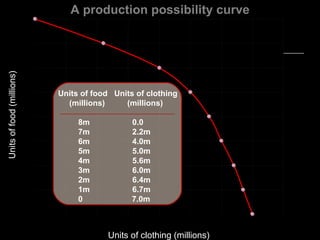
A production possibility curve
                           8


                           7


                           6
Units of food (millions)


                           5       Units of food Units of clothing
                                     (millions)     (millions)
                           4
                                         8m                0.0
                                         7m                2.2m
                           3             6m                4.0m
                                         5m                5.0m
                                         4m                5.6m
                           2
                                         3m                6.0m
                                         2m                6.4m
                           1             1m                6.7m
                                         0                 7.0m
                           0
                               0    1         2        3          4     5        6   7   8
                                                  Units of clothing (millions)
Opportunity Cost
   What is opportunity cost?

   Does IMT education involve any
    opportunity cost?
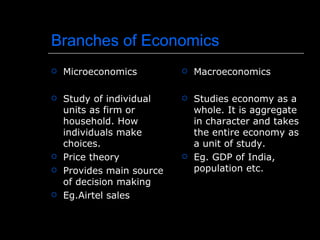
Branches of Economics
   Microeconomics            Macroeconomics

   Study of individual       Studies economy as a
    units as firm or           whole. It is aggregate
    household. How             in character and takes
    individuals make           the entire economy as
    choices.                   a unit of study.
   Price theory              Eg. GDP of India,
   Provides main source       population etc.
    of decision making
   Eg.Airtel sales
Different subjects in Economics
   International economics
   Growth
   Banking
   Economic history
   Agriculture economics
   Applied economics……..
Real Life examples


   Euro Disney

   Multinational product and pricing

   Building a bridge (funding a public project)

   An R & D decision (uncertainty and decision)

   Air fare pricing
   Movies tickets pricing
The Changing Environment of
Economics
   Globalization of Economic Activity
   Spread of IT
   Dismantling of tradition hierarchy
   Information or knowledge Economy

   Technological Change
       Telecommunications Advances
       The Internet and the World Wide Web
Macro Economics – Term 2
   Formulation and execution of
    economic policies
   Income
   Employment
Macroeconomics
   Growth rates, GDP
   Global recession
   Business Cycles, Unemployment
   Exchange rates (Yuan – effect on
    other countries)
   Euro crisis
   Inflation
   Interest rates
Business Environment - term 3
   Purchasing power
   Foreign companies in India
   1991 – before and after, LPG
   CSR
   Corporate governance
   Foreign Universities bill
   IPL and after…….
Term 1 – Microeconomics - ME
   Price theory applied to managerial
    principles
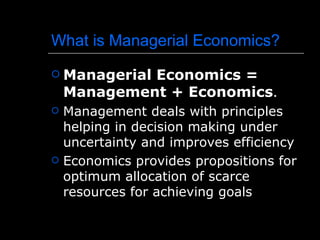
What is Managerial Economics?
   Managerial Economics =
    Management + Economics.
   Management deals with principles
    helping in decision making under
    uncertainty and improves efficiency
   Economics provides propositions for
    optimum allocation of scarce
    resources for achieving goals
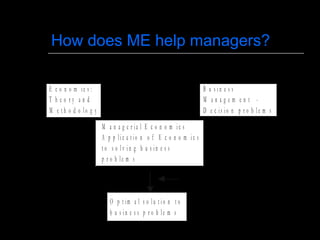
How does ME help managers?

E c o n o m ic s :                                               B u s in e s s
T h eo ry an d                                                   M anagem ent -
M e t h o d o lo g y                                             D e c is io n p r o b le m s
                       M a n a g e r ia l E c o n o m ic s
                       A p p lic a t io n o f E c o n o m ic s
                       t o s o lv in g b u s in e s s
                       p r o b le m s


                          O p t im a l s o lu t io n t o
                          b u s in e s s p r o b le m s
THANK YOU

Introduction

  • 1.
  • 2.
    Learning Objectives  To analyze the concept of economics  To know how Economics plays a role in one’s life  To understand the scope of economics
  • 3.
    Economic Terms  Economic good, Economic activity  Income and employment  Economic development  Choosing between alternative choices with limited resources
  • 4.
    Importance of Economics TheoreticalEconomics Practical Importance  Informative  Professional value  Mental Training  Useful for  Analyse functioning of householders economic system  Useful for labour  Teaches mutual leaders dependence  Solving problems of  Useful citizenship poverty  Wages
  • 5.
    Subject matter ofEconomics  Deals with wealth  Scarce means i.e. limited resources  Unlimited wants  Alternative uses of scarce means  Scarcity & Efficiency are twin themes of economics  A rational consumer will use scarce resources in most efficient manner
  • 6.
    Definitions of Economics  Adam Smith, ‘An inquiry into the nature and causes of wealth’, 1776  Marshall, ‘A study of mankind in ordinary business in life, it examine that part of individual and social actions which is closely related with attainment and use of material requisites’
  • 7.
    About Economics  Economics is a science which studies human behavior as a relationship between ends and scarce means which have alternative uses (Robbins).  Economics – science or art  Positive or normative  Land, labour, capital , organisation
  • 8.
    Stages of EconomicEvolution  Hunting and fishing stage  Pastoral stage  Agricultural  Handicrafts stage  Domestic stage  Industrial stage  Services led economy – knowledge
  • 9.
    Questions before Economists  What to produce  Type of Economies  How to produce  For whom to  Capitalist or free produce market economy  Socialist Economy  Mixed Economy
  • 10.
    Process of Economy  Production  Consumption  Investment  Factors of Production  Land, Labour, Capital, Organization  Division of labor ----Specialisation
  • 11.
    A production possibilitycurve 8 7 6 Units of food (millions) 5 Units of food Units of clothing (millions) (millions) 4 8m 0.0 7m 2.2m 3 6m 4.0m 5m 5.0m 4m 5.6m 2 3m 6.0m 2m 6.4m 1 1m 6.7m 0 7.0m 0 0 1 2 3 4 5 6 7 8 Units of clothing (millions)
  • 12.
    Opportunity Cost  What is opportunity cost?  Does IMT education involve any opportunity cost?
  • 13.
    Branches of Economics  Microeconomics  Macroeconomics  Study of individual  Studies economy as a units as firm or whole. It is aggregate household. How in character and takes individuals make the entire economy as choices. a unit of study.  Price theory  Eg. GDP of India,  Provides main source population etc. of decision making  Eg.Airtel sales
  • 14.
    Different subjects inEconomics  International economics  Growth  Banking  Economic history  Agriculture economics  Applied economics……..
  • 15.
    Real Life examples  Euro Disney  Multinational product and pricing  Building a bridge (funding a public project)  An R & D decision (uncertainty and decision)  Air fare pricing  Movies tickets pricing
  • 16.
    The Changing Environmentof Economics  Globalization of Economic Activity  Spread of IT  Dismantling of tradition hierarchy  Information or knowledge Economy  Technological Change  Telecommunications Advances  The Internet and the World Wide Web
  • 17.
    Macro Economics –Term 2  Formulation and execution of economic policies  Income  Employment
  • 18.
    Macroeconomics  Growth rates, GDP  Global recession  Business Cycles, Unemployment  Exchange rates (Yuan – effect on other countries)  Euro crisis  Inflation  Interest rates
  • 19.
    Business Environment -term 3  Purchasing power  Foreign companies in India  1991 – before and after, LPG  CSR  Corporate governance  Foreign Universities bill  IPL and after…….
  • 20.
    Term 1 –Microeconomics - ME  Price theory applied to managerial principles
  • 21.
    What is ManagerialEconomics?  Managerial Economics = Management + Economics.  Management deals with principles helping in decision making under uncertainty and improves efficiency  Economics provides propositions for optimum allocation of scarce resources for achieving goals
  • 22.
    How does MEhelp managers? E c o n o m ic s : B u s in e s s T h eo ry an d M anagem ent - M e t h o d o lo g y D e c is io n p r o b le m s M a n a g e r ia l E c o n o m ic s A p p lic a t io n o f E c o n o m ic s t o s o lv in g b u s in e s s p r o b le m s O p t im a l s o lu t io n t o b u s in e s s p r o b le m s
  • 23.