C LO U D STAC K

 Clayton Weise cweise@iswest.net
IRC: iswcin #cloudstack on freenode
LICENSING


 This presentation and it’s contents unless otherwise
  noted are released under a Creative Commons
  Attributions, Share-Alike 3.0 unported license.
H I STO RY

   Original company formed - 2008 (VMOps)
   Project open sourced as CloudStack – May 2010
   Acquired by Citrix – July 2011
   Dropped open core – August 2011
   Release of Acton (3.0) – Real soon now
W H AT I S C LO U D STAC K ?

Open Source Infrastructure as a Service platform that
supports multiple hypervisors, complex network, firewall,
load balancer and VPN configurations, high availability, in a
multi-tenant environment.
W H AT D O ES I T R EA L LY D O ?

 Provide separation for the varied tenants
 Allocate compute resources in a deterministic manner
 Expose to the end user the ability to provision various
  computing services in a controlled manner (VLAN
  allocation, firewall rules, load balancer deployment, VM
  creation, etc)
 Manage High Availability
 Massively Scalable
 Permit the placement of resource limits to be applied
 Measuring usage over time
M U LT I P L E H Y P E RV I S O R S U P P O RT

   KVM
   XenServer
   Xen Cloud Platform
   VMware (via vCenter)
   Oracle VM
   Bare Metal
M U LT I - T E N A N T S E PA R AT I O N

 Largely built around abstraction from an end-user POV
    No interaction with hypervisor directly
    No knowledge of underlying storage
 Networking separation
    Every account has at least one dedicated/isolated VLAN
     (Tagged Networking)
    Layer 3 isolation aka Security Groups for untagged
     networking
 Option to use dedicated hardware
N E T WO R K I N G

 CloudStack has a number of network models
 They are generally broken down by:
    Method of isolation (VLAN, Security Groups)
    Physical hardware or virtual
 CloudStack largely manages network infrastructure
N E T WO R K I N G

 Services managed by CloudStack
      DHCP
      VLAN allocation
      Firewall
      NAT/Port forwarding
      Routing
      VPN
      Load Balancing
N E T WO R K I N G

 CloudStack can also manage physical network hardware
  (or the virtualized alternatives)
    F5-Big IP
    NetScaler
    Juniper SRX

 Additionally you can ‘mix and match’ some network
  elements as service offerings.
S EC U R I T Y G RO U P S

 Traditional isolation has been via VLAN
 VLANs isolate well, but have some problems scaling
    Standard has a hard limit of 4096 VLANs
    Hardware that can actually keep up with 4096 VLANs is
     VERY expensive.
    Regardless people tend to not like having arbitrary limits
     on what they can do.
 Amazon and others use layer 3 isolation (Security
  Groups)
S EC U R I T Y G RO U P S

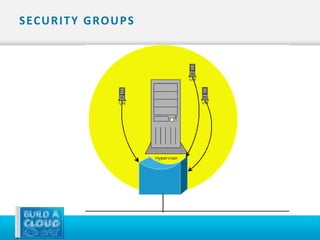
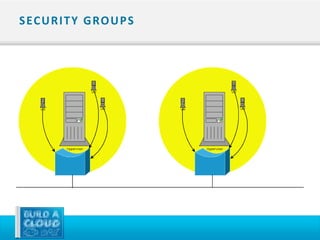
 Assumption of a quasi-trusted Layer 2 network
 Typically will only have hypervisors directly connected to
  that network.
 Filtering/isolation occurs at the bridge device (from a
  Linux perspective – think ebtables)
 Deny by default
S EC U R I T Y G RO U P S
H I G H AVA I L A B I L I T Y

 RFMTTR – but apparently HA looks better in marketing
  slicks and is used that way across the virtualization
  industry.
 CloudStack is not a magical solution for HA – but might
  be a useful tool in the process to increase availability.
 CloudStack will watch for HA-enabled VMs to ensure that
  they are up, and that the hypervisor it’s on is up – and
  will restart on another hypervisor if it goes down.
 Redundant router
A L LO C AT I O N A LG O R I T H M S

 How do you place VMs?, allocate storage, etc.
 CloudStack ships with a number of options:
      First Fit
      Fill first
      Disperse
      Create your own
 Tags
 OS Preference
U SAG E

 Not billing per se – but does give you something to bill
  against.
 Usage stats show VM count, CPU usage, disk allocation
  and usage, network usage; all over time.
 Lots of integration and howto’s - from Excel
  spreadsheets to Ubersmith, Amysta, and Cloud Portal.
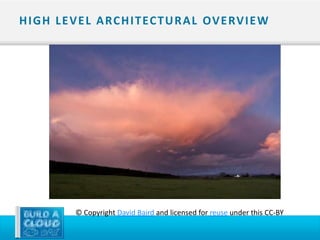
H I G H L E V E L A RC H I T EC T U R A L OV E RV I E W


            © Copyright David Baird and licensed for reuse under this CC-BY
S ECO N DA RY STO R AG E

 Used for storing templates and snapshots
 Historically NFS – just added the option of object storage
    Technically Swift, but Caringo, GlusterFS and others should
     work.
 Managed by Secondary Storage VM – manages moving
  templates and snapshots from/to primary storage, aging
  snapshots out, etc.
P R I M A RY STO R AG E

 In the UI we support NFS, iSCSI, and CLVM.
 We can also make use of local storage
    No HA, no live migration, etc.
 Shared mountpoint
    Anything that all the hypervisors can mount and write to.
R ES O U RC E D I V I S I O N

 We have some somewhat arbitrary divisions of resources
  within CloudStack
    Zones
       • Pods
           – Clusters
ZO N E

 In general practice this is used to designate a specific
  geographic location.
 Shares secondary storage resource across the entire zone
 Single network model for the entire zone
POD

 In general practice – this is used to refer a rack of
  machines or a row of racks.
 Shares guest network
C LU ST E R

 This is typically a max of 8-15 machines per cluster and
  homogenity is enforced:
    Same hypervisor (and same version of the hypervisor)
    Same CPUs
    Same networking (i.e. /dev/eth0 is connected to the same
     network across all machines)
 Primary storage is cluster specific
P L E T H O R A O F N E T WO R KS

 Management Network: Where the hypervisors and
  management server communicate
 Private Network: Default network for system VMs.
  (virtual router, secondary storage VM, Console proxy VM)
 Public Network: The public (often internet-facing
  network)
 Guest Network: The network that VMs are provisioned
  on.
 Link-local network: The RFC 3927 network used for
  communication between hypervisor and system VMs.
M A N AG E M E N T S E RV E R

 UI/API pieces are stateless (state is stored in a MySQL
  database.
 All UI functionality is an API call
API

 RESTful API interface
      Unauthenticated API interace on 8096 (for localhost)
      Authenticated API interface natively on port 8080
      Responses in XML or JSON
      http://demo4.cloudstack.org/client/api?apikey=ZRFLiXIkm
       AHqgRmZzdiXMfaROyK35P_dXxS517WSa9Tmy1Hg&comm
       and=deployVirtualMachine&serviceofferingid=1&template
       id=291&zoneid=1&signature=eXW%2fxfqx%2fhu%2frMreF
       ksVsp3cT4M%3d
UI

 Go play with the UI
Q U EST I O N S

 ASK!
CO N TAC T

   http://cloudstack.org
   Docs: https://cwiki.apache.org/CLOUDSTACK
   IRC: #cloudstack on Freenode
   Twitter/identi.ca: @cloudstack
   Mailing Lists
     https://lists.sourceforge.net/mailman/listinfo/cloudstack-users
     https://lists.sourceforge.net/mailman/listinfo/cloudstack-devel
 Forums

CloudStack Build A Cloud Day (SCaLE 2013)

  • 1.
    C LO UD STAC K Clayton Weise cweise@iswest.net IRC: iswcin #cloudstack on freenode
  • 2.
    LICENSING  This presentationand it’s contents unless otherwise noted are released under a Creative Commons Attributions, Share-Alike 3.0 unported license.
  • 3.
    H I STORY  Original company formed - 2008 (VMOps)  Project open sourced as CloudStack – May 2010  Acquired by Citrix – July 2011  Dropped open core – August 2011  Release of Acton (3.0) – Real soon now
  • 4.
    W H ATI S C LO U D STAC K ? Open Source Infrastructure as a Service platform that supports multiple hypervisors, complex network, firewall, load balancer and VPN configurations, high availability, in a multi-tenant environment.
  • 5.
    W H ATD O ES I T R EA L LY D O ?  Provide separation for the varied tenants  Allocate compute resources in a deterministic manner  Expose to the end user the ability to provision various computing services in a controlled manner (VLAN allocation, firewall rules, load balancer deployment, VM creation, etc)  Manage High Availability  Massively Scalable  Permit the placement of resource limits to be applied  Measuring usage over time
  • 6.
    M U LTI P L E H Y P E RV I S O R S U P P O RT  KVM  XenServer  Xen Cloud Platform  VMware (via vCenter)  Oracle VM  Bare Metal
  • 7.
    M U LTI - T E N A N T S E PA R AT I O N  Largely built around abstraction from an end-user POV  No interaction with hypervisor directly  No knowledge of underlying storage  Networking separation  Every account has at least one dedicated/isolated VLAN (Tagged Networking)  Layer 3 isolation aka Security Groups for untagged networking  Option to use dedicated hardware
  • 8.
    N E TWO R K I N G  CloudStack has a number of network models  They are generally broken down by:  Method of isolation (VLAN, Security Groups)  Physical hardware or virtual  CloudStack largely manages network infrastructure
  • 9.
    N E TWO R K I N G  Services managed by CloudStack  DHCP  VLAN allocation  Firewall  NAT/Port forwarding  Routing  VPN  Load Balancing
  • 10.
    N E TWO R K I N G  CloudStack can also manage physical network hardware (or the virtualized alternatives)  F5-Big IP  NetScaler  Juniper SRX  Additionally you can ‘mix and match’ some network elements as service offerings.
  • 11.
    S EC UR I T Y G RO U P S  Traditional isolation has been via VLAN  VLANs isolate well, but have some problems scaling  Standard has a hard limit of 4096 VLANs  Hardware that can actually keep up with 4096 VLANs is VERY expensive.  Regardless people tend to not like having arbitrary limits on what they can do.  Amazon and others use layer 3 isolation (Security Groups)
  • 12.
    S EC UR I T Y G RO U P S  Assumption of a quasi-trusted Layer 2 network  Typically will only have hypervisors directly connected to that network.  Filtering/isolation occurs at the bridge device (from a Linux perspective – think ebtables)  Deny by default
  • 13.
    S EC UR I T Y G RO U P S
  • 14.
    S EC UR I T Y G RO U P S
  • 15.
    H I GH AVA I L A B I L I T Y  RFMTTR – but apparently HA looks better in marketing slicks and is used that way across the virtualization industry.  CloudStack is not a magical solution for HA – but might be a useful tool in the process to increase availability.  CloudStack will watch for HA-enabled VMs to ensure that they are up, and that the hypervisor it’s on is up – and will restart on another hypervisor if it goes down.  Redundant router
  • 16.
    A L LOC AT I O N A LG O R I T H M S  How do you place VMs?, allocate storage, etc.  CloudStack ships with a number of options:  First Fit  Fill first  Disperse  Create your own  Tags  OS Preference
  • 17.
    U SAG E Not billing per se – but does give you something to bill against.  Usage stats show VM count, CPU usage, disk allocation and usage, network usage; all over time.  Lots of integration and howto’s - from Excel spreadsheets to Ubersmith, Amysta, and Cloud Portal.
  • 18.
    H I GH L E V E L A RC H I T EC T U R A L OV E RV I E W © Copyright David Baird and licensed for reuse under this CC-BY
  • 19.
    S ECO NDA RY STO R AG E  Used for storing templates and snapshots  Historically NFS – just added the option of object storage  Technically Swift, but Caringo, GlusterFS and others should work.  Managed by Secondary Storage VM – manages moving templates and snapshots from/to primary storage, aging snapshots out, etc.
  • 20.
    P R IM A RY STO R AG E  In the UI we support NFS, iSCSI, and CLVM.  We can also make use of local storage  No HA, no live migration, etc.  Shared mountpoint  Anything that all the hypervisors can mount and write to.
  • 21.
    R ES OU RC E D I V I S I O N  We have some somewhat arbitrary divisions of resources within CloudStack  Zones • Pods – Clusters
  • 22.
    ZO N E In general practice this is used to designate a specific geographic location.  Shares secondary storage resource across the entire zone  Single network model for the entire zone
  • 23.
    POD  In generalpractice – this is used to refer a rack of machines or a row of racks.  Shares guest network
  • 24.
    C LU STE R  This is typically a max of 8-15 machines per cluster and homogenity is enforced:  Same hypervisor (and same version of the hypervisor)  Same CPUs  Same networking (i.e. /dev/eth0 is connected to the same network across all machines)  Primary storage is cluster specific
  • 25.
    P L ET H O R A O F N E T WO R KS  Management Network: Where the hypervisors and management server communicate  Private Network: Default network for system VMs. (virtual router, secondary storage VM, Console proxy VM)  Public Network: The public (often internet-facing network)  Guest Network: The network that VMs are provisioned on.  Link-local network: The RFC 3927 network used for communication between hypervisor and system VMs.
  • 26.
    M A NAG E M E N T S E RV E R  UI/API pieces are stateless (state is stored in a MySQL database.  All UI functionality is an API call
  • 27.
    API  RESTful APIinterface  Unauthenticated API interace on 8096 (for localhost)  Authenticated API interface natively on port 8080  Responses in XML or JSON  http://demo4.cloudstack.org/client/api?apikey=ZRFLiXIkm AHqgRmZzdiXMfaROyK35P_dXxS517WSa9Tmy1Hg&comm and=deployVirtualMachine&serviceofferingid=1&template id=291&zoneid=1&signature=eXW%2fxfqx%2fhu%2frMreF ksVsp3cT4M%3d
  • 28.
    UI  Go playwith the UI
  • 29.
    Q U ESTI O N S  ASK!
  • 30.
    CO N TACT  http://cloudstack.org  Docs: https://cwiki.apache.org/CLOUDSTACK  IRC: #cloudstack on Freenode  Twitter/identi.ca: @cloudstack  Mailing Lists  https://lists.sourceforge.net/mailman/listinfo/cloudstack-users  https://lists.sourceforge.net/mailman/listinfo/cloudstack-devel  Forums