An Introduction to
Residencies 2010
Elizabeth Sebranek Evans, Pharm.D., BCPS
November 11, 2010
Evolution of Pharmacist Training and Credentials
• The Doctor of Pharmacy degree became
mandatory for accredited Colleges of Pharmacy
beginning in 1999
• Residency training began steadily increasing as
next level of mandatory minimal training
– American College of Clinical Pharmacy (ACCP) has a
vision of residency as a prerequisite for direct patient
care by 2020
Evolution of Pharmacist Training and Credentials
• After residency training, Board Certification strongly
encouraged by many employers
– Pharmacotherapy Specialist
– Oncology
– Psychiatry
– Nutrition Support
– Geriatrics
– Diabetes Educator
– American Academy of HIV Medicine
What is a Residency?
• An postgraduate training opportunity in a specified
setting that allows pharmacists to:
– Build on their knowledge base
– Improved clinical skills and confidence
– Provide independent and effective patient care
• Opportunity for continued clinical learning with
benefit of being licensed pharmacist
• Most residencies are one year in length
(July 1s -June 30th)
Why Complete a Residency?
• Preferred for many types of positions
– Hospital/health-system pharmacy management
– Clinical pharmacist
– College faculty
• Improved marketability
• Residency = 3 years of practice experience
• Eligibility for board certification
• Exposure to more clinical experiences
• Opportunities to provide patient care in a “protected”
setting within a learning environment
• Career networking!!
What are Future Job Opportunities
After Residency?
• Disease state management in
community pharmacy
• College faculty
• Clinical pharmacist or specialist in hospital or
outpatient clinic
• HMO/Managed Care benefits manager
• Pharmaceutical Industry
• Clinical coordinator
• Hospital pharmacy manager
Classification of Residencies:
PGY-1 vs. PGY-2
• PGY- 1 (post-graduate year #1)
– Designed to be completed first, usually immediately after
completing a Doctor of Pharmacy degree program
– Many PGY-1 residencies offer a broad array of
experiences
• PGY-2 (post-graduate year #2)
– Intended to be completed after PGY-1 year
– Specialized area of focus (pediatrics, critical care, solid
organ transplant, oncology, drug information, etc.)
Types of PGY-1 Residencies
• Community pharmacy-based residencies
– There are programs based in community/retail
pharmacies
– Many also have a college of pharmacy affiliation
– Perform direct patient care with an emphasis on
disease state management (dyslipidemia, diabetes,
hypertension, immunizations, etc.)
• Practice Management
– Learn how to develop and evaluate advanced practice
sites in the community setting
– Learn how to market services and receive financial
compensation!
Types of PGY-1 Residencies
• Pharmacy Practice in a Veterans Affairs hospital
• Pharmacy Practice in a children’s hospital
• Pharmacy Practice through a College
of Pharmacy
• Pharmacy Practice with an ambulatory
care focus
Types of PGY-1 Residencies
• Pharmacy Practice in Indian Health Service
• Pharmacy Practice in a military facility
• Pharmacy Practice with an emphasis in
psychiatric pharmacy
• Pharmacy Practice in home infusion
• Managed care pharmacy-based residencies
Residency Application Timeline
• P3 year early December
– Attend ASHP Midyear Clinical Meeting
• Residency showcase: Open house with most accredited
residency programs
• Personal placement service (PPS): Opportunity for one-on-one
interviews with residency programs directors
• Mid-December
– Submit applications to programs
• Requirements vary but programs may require CV, personal
statements, examples of clinical projects, etc.
• Usually need three letters of recommendation
• Transcripts required
Residency Application Timeline
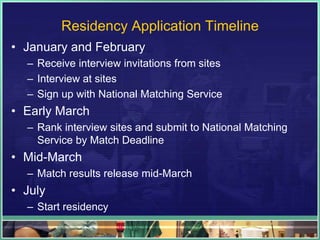
• January and February
– Receive interview invitations from sites
– Interview at sites
– Sign up with National Matching Service
• Early March
– Rank interview sites and submit to National Matching
Service by Match Deadline
• Mid-March
– Match results release mid-March
• July
– Start residency
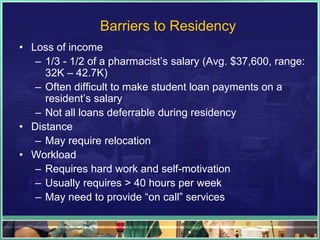
Barriers to Residency
• Loss of income
– 1/3 - 1/2 of a pharmacist’s salary (Avg. $37,600, range:
32K – 42.7K)
– Often difficult to make student loan payments on a
resident’s salary
– Not all loans deferrable during residency
• Distance
– May require relocation
• Workload
– Requires hard work and self-motivation
– Usually requires > 40 hours per week
– May need to provide “on call” services
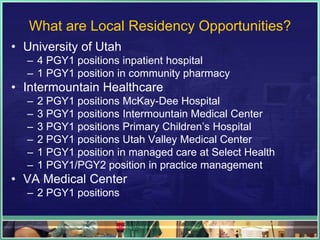
What are Local Residency Opportunities?
• University of Utah
– 4 PGY1 positions inpatient hospital
– 1 PGY1 position in community pharmacy
• Intermountain Healthcare
– 2 PGY1 positions McKay-Dee Hospital
– 3 PGY1 positions Intermountain Medical Center
– 3 PGY1 positions Primary Children’s Hospital
– 2 PGY1 positions Utah Valley Medical Center
– 1 PGY1 position in managed care at Select Health
– 1 PGY1/PGY2 position in practice management
• VA Medical Center
– 2 PGY1 positions
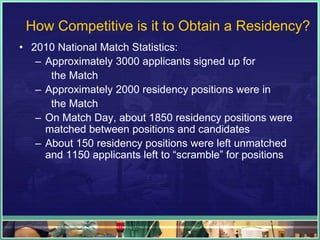
How Competitive is it to Obtain a Residency?
• 2010 National Match Statistics:
– Approximately 3000 applicants signed up for
the Match
– Approximately 2000 residency positions were in
the Match
– On Match Day, about 1850 residency positions were
matched between positions and candidates
– About 150 residency positions were left unmatched
and 1150 applicants left to “scramble” for positions
What if I Wait a Few Years to
Do A Residency?
• Cons
– You may lose valuable sources of information about
residencies after graduations
– It takes a great deal of discipline to transition from
full pharmacist salary to resident salary
– Would need to take time off of work to interview for
residencies
– Delay achieving your long term goals
• Pros
– Pharmacist work experience and time management
skills will make you a stronger resident candidate
What Makes an Excellent
Resident Candidate?
• Excellent work ethic and communication
skills required
• Strong clinical skills
• Going “above and beyond” basic requirements
for graduation
– Leadership
– Community service
– Scholarship
How Can a USN Student Become a More
Competitive Residency Candidate?
• Clinical Skills Opportunities
– ACCP Clinical Challenge (September)
– ASHP Clinical Skills Competition (October)
– APhA Patient Counseling Competition (January?)
• Leadership
– Active participation in student organizations
– Attendance and active participation at local and
national pharmacy organization meetings
– Networking, networking, networking!
• Community service
– Health fairs
– Brown-bag events
How Can a USN Student Become a More
Competitive Residency Candidate?
• APPE rotations
– Select challenging clinical sites
– Consider sites with unique opportunities
– Proactively seek opportunities for journal clubs,
presentations, and quality-improvement projects
• Scholarship
– Formal research opportunities with science or
clinical faculty
– Submit case reports or review articles to peer-reviewed
medical journals for publication
– Present posters at state (USHP, UPhA) or national
meetings (APhA, ACCP, ASHP)
– Develop high-quality patient education materials
More Information
• American Society of Health-Systems
Pharmacists (ASHP)
– www.ashp.org
– Directory of accredited residency programs available
online (search for free)
– “Professional Development: Residencies, the ASHP
midyear clinical meeting, and more” (The “Blue Book”)
• Careful! This hasn’t been updated since 2005
• American College of Clinical Pharmacy (ACCP)
– www.accp.com
– Directory of residencies and fellowships available online
– Free online job and residency position searches
More Information
• American Pharmacists Association (APhA)
– www.aphanet.org
– Only provides information on community residencies but
generous detail available
Faculty Resources
• Dr. Boehme (sboeme@usn.edu)
– Pediatric transplant and pediatric general medicine
residency preceptor at Primary Children’s Hospital
• Dr. Chan (achan@usn.edu)
– Completed PGY1 at Utah Valley Medical Center
– Adult internal medicine residency preceptor (starting
2010-2011) at Intermountain Medical Center
• Dr. Christensen (tchristensen@usn.edu)
– Critical care / cardiology residency preceptor at Utah
Valley Medical Center
Faculty Resources
• Dr. Drake (tdrake@usn.edu)
– Ambulatory care residency preceptor at
McKay-Dee Hospital
– Residency Director at McKay-Dee Hospital
• Dr. Harper (mharper@usn.edu)
– Critical care residency preceptor at McKay-Dee Hospital
• Dr. Healy (rhealy@usn.edu)
– Completed PGY1 residency at Intermountain
Medical Center
– In process of completing PGY2 residency in Oncology /
Teaching through Intermountain Medical Center and USN
Faculty Resources
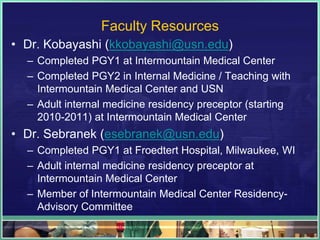
• Dr. Kobayashi (kkobayashi@usn.edu)
– Completed PGY1 at Intermountain Medical Center
– Completed PGY2 in Internal Medicine / Teaching with
Intermountain Medical Center and USN
– Adult internal medicine residency preceptor (starting
2010-2011) at Intermountain Medical Center
• Dr. Sebranek (esebranek@usn.edu)
– Completed PGY1 at Froedtert Hospital, Milwaukee, WI
– Adult internal medicine residency preceptor at
Intermountain Medical Center
– Member of Intermountain Medical Center Residency-
Advisory Committee
Faculty Resources
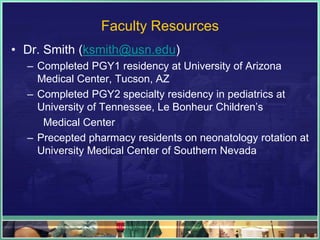
• Dr. Smith (ksmith@usn.edu)
– Completed PGY1 residency at University of Arizona
Medical Center, Tucson, AZ
– Completed PGY2 specialty residency in pediatrics at
University of Tennessee, Le Bonheur Children’s
Medical Center
– Precepted pharmacy residents on neonatology rotation at
University Medical Center of Southern Nevada
Faculty Resources
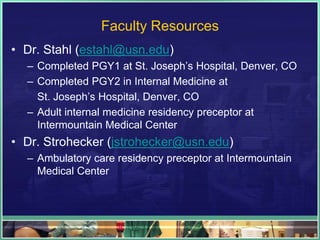
• Dr. Stahl (estahl@usn.edu)
– Completed PGY1 at St. Joseph’s Hospital, Denver, CO
– Completed PGY2 in Internal Medicine at
St. Joseph’s Hospital, Denver, CO
– Adult internal medicine residency preceptor at
Intermountain Medical Center
• Dr. Strohecker (jstrohecker@usn.edu)
– Ambulatory care residency preceptor at Intermountain
Medical Center

Intro to residencies 2010

  • 1.
    An Introduction to Residencies2010 Elizabeth Sebranek Evans, Pharm.D., BCPS November 11, 2010
  • 2.
    Evolution of PharmacistTraining and Credentials • The Doctor of Pharmacy degree became mandatory for accredited Colleges of Pharmacy beginning in 1999 • Residency training began steadily increasing as next level of mandatory minimal training – American College of Clinical Pharmacy (ACCP) has a vision of residency as a prerequisite for direct patient care by 2020
  • 3.
    Evolution of PharmacistTraining and Credentials • After residency training, Board Certification strongly encouraged by many employers – Pharmacotherapy Specialist – Oncology – Psychiatry – Nutrition Support – Geriatrics – Diabetes Educator – American Academy of HIV Medicine
  • 4.
    What is aResidency? • An postgraduate training opportunity in a specified setting that allows pharmacists to: – Build on their knowledge base – Improved clinical skills and confidence – Provide independent and effective patient care • Opportunity for continued clinical learning with benefit of being licensed pharmacist • Most residencies are one year in length (July 1s -June 30th)
  • 5.
    Why Complete aResidency? • Preferred for many types of positions – Hospital/health-system pharmacy management – Clinical pharmacist – College faculty • Improved marketability • Residency = 3 years of practice experience • Eligibility for board certification • Exposure to more clinical experiences • Opportunities to provide patient care in a “protected” setting within a learning environment • Career networking!!
  • 6.
    What are FutureJob Opportunities After Residency? • Disease state management in community pharmacy • College faculty • Clinical pharmacist or specialist in hospital or outpatient clinic • HMO/Managed Care benefits manager • Pharmaceutical Industry • Clinical coordinator • Hospital pharmacy manager
  • 7.
    Classification of Residencies: PGY-1vs. PGY-2 • PGY- 1 (post-graduate year #1) – Designed to be completed first, usually immediately after completing a Doctor of Pharmacy degree program – Many PGY-1 residencies offer a broad array of experiences • PGY-2 (post-graduate year #2) – Intended to be completed after PGY-1 year – Specialized area of focus (pediatrics, critical care, solid organ transplant, oncology, drug information, etc.)
  • 8.
    Types of PGY-1Residencies • Community pharmacy-based residencies – There are programs based in community/retail pharmacies – Many also have a college of pharmacy affiliation – Perform direct patient care with an emphasis on disease state management (dyslipidemia, diabetes, hypertension, immunizations, etc.) • Practice Management – Learn how to develop and evaluate advanced practice sites in the community setting – Learn how to market services and receive financial compensation!
  • 9.
    Types of PGY-1Residencies • Pharmacy Practice in a Veterans Affairs hospital • Pharmacy Practice in a children’s hospital • Pharmacy Practice through a College of Pharmacy • Pharmacy Practice with an ambulatory care focus
  • 10.
    Types of PGY-1Residencies • Pharmacy Practice in Indian Health Service • Pharmacy Practice in a military facility • Pharmacy Practice with an emphasis in psychiatric pharmacy • Pharmacy Practice in home infusion • Managed care pharmacy-based residencies
  • 11.
    Residency Application Timeline •P3 year early December – Attend ASHP Midyear Clinical Meeting • Residency showcase: Open house with most accredited residency programs • Personal placement service (PPS): Opportunity for one-on-one interviews with residency programs directors • Mid-December – Submit applications to programs • Requirements vary but programs may require CV, personal statements, examples of clinical projects, etc. • Usually need three letters of recommendation • Transcripts required
  • 12.
    Residency Application Timeline •January and February – Receive interview invitations from sites – Interview at sites – Sign up with National Matching Service • Early March – Rank interview sites and submit to National Matching Service by Match Deadline • Mid-March – Match results release mid-March • July – Start residency
  • 13.
    Barriers to Residency •Loss of income – 1/3 - 1/2 of a pharmacist’s salary (Avg. $37,600, range: 32K – 42.7K) – Often difficult to make student loan payments on a resident’s salary – Not all loans deferrable during residency • Distance – May require relocation • Workload – Requires hard work and self-motivation – Usually requires > 40 hours per week – May need to provide “on call” services
  • 14.
    What are LocalResidency Opportunities? • University of Utah – 4 PGY1 positions inpatient hospital – 1 PGY1 position in community pharmacy • Intermountain Healthcare – 2 PGY1 positions McKay-Dee Hospital – 3 PGY1 positions Intermountain Medical Center – 3 PGY1 positions Primary Children’s Hospital – 2 PGY1 positions Utah Valley Medical Center – 1 PGY1 position in managed care at Select Health – 1 PGY1/PGY2 position in practice management • VA Medical Center – 2 PGY1 positions
  • 15.
    How Competitive isit to Obtain a Residency? • 2010 National Match Statistics: – Approximately 3000 applicants signed up for the Match – Approximately 2000 residency positions were in the Match – On Match Day, about 1850 residency positions were matched between positions and candidates – About 150 residency positions were left unmatched and 1150 applicants left to “scramble” for positions
  • 16.
    What if IWait a Few Years to Do A Residency? • Cons – You may lose valuable sources of information about residencies after graduations – It takes a great deal of discipline to transition from full pharmacist salary to resident salary – Would need to take time off of work to interview for residencies – Delay achieving your long term goals • Pros – Pharmacist work experience and time management skills will make you a stronger resident candidate
  • 17.
    What Makes anExcellent Resident Candidate? • Excellent work ethic and communication skills required • Strong clinical skills • Going “above and beyond” basic requirements for graduation – Leadership – Community service – Scholarship
  • 18.
    How Can aUSN Student Become a More Competitive Residency Candidate? • Clinical Skills Opportunities – ACCP Clinical Challenge (September) – ASHP Clinical Skills Competition (October) – APhA Patient Counseling Competition (January?) • Leadership – Active participation in student organizations – Attendance and active participation at local and national pharmacy organization meetings – Networking, networking, networking! • Community service – Health fairs – Brown-bag events
  • 19.
    How Can aUSN Student Become a More Competitive Residency Candidate? • APPE rotations – Select challenging clinical sites – Consider sites with unique opportunities – Proactively seek opportunities for journal clubs, presentations, and quality-improvement projects • Scholarship – Formal research opportunities with science or clinical faculty – Submit case reports or review articles to peer-reviewed medical journals for publication – Present posters at state (USHP, UPhA) or national meetings (APhA, ACCP, ASHP) – Develop high-quality patient education materials
  • 20.
    More Information • AmericanSociety of Health-Systems Pharmacists (ASHP) – www.ashp.org – Directory of accredited residency programs available online (search for free) – “Professional Development: Residencies, the ASHP midyear clinical meeting, and more” (The “Blue Book”) • Careful! This hasn’t been updated since 2005 • American College of Clinical Pharmacy (ACCP) – www.accp.com – Directory of residencies and fellowships available online – Free online job and residency position searches
  • 21.
    More Information • AmericanPharmacists Association (APhA) – www.aphanet.org – Only provides information on community residencies but generous detail available
  • 22.
    Faculty Resources • Dr.Boehme (sboeme@usn.edu) – Pediatric transplant and pediatric general medicine residency preceptor at Primary Children’s Hospital • Dr. Chan (achan@usn.edu) – Completed PGY1 at Utah Valley Medical Center – Adult internal medicine residency preceptor (starting 2010-2011) at Intermountain Medical Center • Dr. Christensen (tchristensen@usn.edu) – Critical care / cardiology residency preceptor at Utah Valley Medical Center
  • 23.
    Faculty Resources • Dr.Drake (tdrake@usn.edu) – Ambulatory care residency preceptor at McKay-Dee Hospital – Residency Director at McKay-Dee Hospital • Dr. Harper (mharper@usn.edu) – Critical care residency preceptor at McKay-Dee Hospital • Dr. Healy (rhealy@usn.edu) – Completed PGY1 residency at Intermountain Medical Center – In process of completing PGY2 residency in Oncology / Teaching through Intermountain Medical Center and USN
  • 24.
    Faculty Resources • Dr.Kobayashi (kkobayashi@usn.edu) – Completed PGY1 at Intermountain Medical Center – Completed PGY2 in Internal Medicine / Teaching with Intermountain Medical Center and USN – Adult internal medicine residency preceptor (starting 2010-2011) at Intermountain Medical Center • Dr. Sebranek (esebranek@usn.edu) – Completed PGY1 at Froedtert Hospital, Milwaukee, WI – Adult internal medicine residency preceptor at Intermountain Medical Center – Member of Intermountain Medical Center Residency- Advisory Committee
  • 25.
    Faculty Resources • Dr.Smith (ksmith@usn.edu) – Completed PGY1 residency at University of Arizona Medical Center, Tucson, AZ – Completed PGY2 specialty residency in pediatrics at University of Tennessee, Le Bonheur Children’s Medical Center – Precepted pharmacy residents on neonatology rotation at University Medical Center of Southern Nevada
  • 26.
    Faculty Resources • Dr.Stahl (estahl@usn.edu) – Completed PGY1 at St. Joseph’s Hospital, Denver, CO – Completed PGY2 in Internal Medicine at St. Joseph’s Hospital, Denver, CO – Adult internal medicine residency preceptor at Intermountain Medical Center • Dr. Strohecker (jstrohecker@usn.edu) – Ambulatory care residency preceptor at Intermountain Medical Center