Catholic Social
Teaching
Sunday, March 6, 2016
Father Kevin Queally, TOR
Saint Mary Our Lady of Grace
Saint Petersburg, Florida
Option for the Poor and
Vulnerable
The bread which you do not use is the
bread of the hungry; the garment
hanging in your wardrobe is the
garment of him who is naked; the
shoes that you do not wear are the
shoes of the one who is barefoot; the
money you keep locked away is the
money of the poor; and the acts of
charity that you do not perform are so
many injustices that you commit. –
Saint Basil the Great (c.329 – 379),
Doctor of the Church
Option for the Poor and
Vulnerable
A basic moral test is how our
most vulnerable members are
faring. In a society marred by
deepening divisions between rich
and poor, our tradition recalls the
story of the Last Judgment (Mt
25:31-46) and instructs us to put
the needs of the poor and
vulnerable first.
Option for the Poor and
Vulnerable
Still, when there is question of
defending the rights of individuals, the
poor and badly off have a claim to
especial consideration. The richer class
have many ways of
shielding themselves, and stand less in
need of help from the State; whereas the
mass of the poor have no resources of
their own to fall back upon, and must
chiefly depend upon the assistance of
the State. On the Condition of
Labor (Rerum Novarum), 1891, #37
Option for the Poor and
Vulnerable
The obligation to provide justice for all means
that the poor have the single most urgent
economic claim on the conscience of the
nation. Economic Justice for All, #86
In teaching us charity, the Gospel instructs us
in the preferential respect due to the poor and
the special situation they have in society: the
more fortunate should renounce some of their
rights so as to place their goods more
generously at the service of others. (A Call to
Action, Octogesima Adveniens, 1971), #23,
Pope Paul VI
Option for the Poor and
Vulnerable
Therefore everyone has the right to
possess a sufficient amount of the
earth's goods for themselves
and their family. This has been the
opinion of the Fathers and Doctors of
the church, who taught that people
are bound to come to the aid of the
poor and to do so not merely out of
their superfluous goods. Persons in
extreme necessity are entitled to
take what they need from the riches
of others.
Option for the Poor and
Vulnerable
Faced with a world today where so many
people are suffering from want,
the council asks individuals and
governments to remember the saying of
the Fathers: "Feed the people dying of
hunger, because if you do not feed them
you are killing them," and it urges them
according to their ability to share
and dispose of their goods to help others,
above all by giving them aid which
will enable them to help and develop
themselves. (The Church in the Modern
World, Gaudium et Spes, Vatican II), #69
Option for the Poor and
Vulnerable
Love for others, and in the first
place love for the poor, in whom
the Church sees Christ himself, is
made concrete in the promotion of
justice. (On the Hundredth Year,
Centesimus Annus), St. John Paul
II, 1991, #58
Option for the Poor and
Vulnerable
The obligation to provide
justice for all means that the
poor have the single most
urgent economic claim on the
conscience of the
nation. Economic Justice for
All, #86
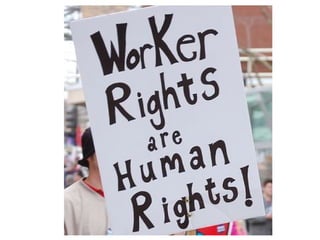
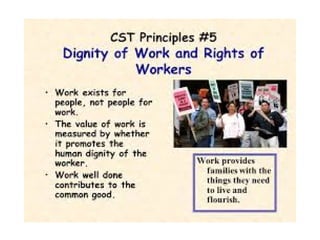
The Dignity of Work and the
Rights of Workers
The economy must serve
people, not the other way
around. Work is more
than a way to make a
living; it is a form of
continuing participation
in Gods creation.
The Dignity of Work and the
Rights of Workers
If the dignity of work is to be
protected, then the basic rights
of workers must be respected--
the right to productive work, to
decent and fair wages, to the
organization and joining of
unions, to private property, and
to economic initiative.
The Dignity of Work and the
Rights of Workers
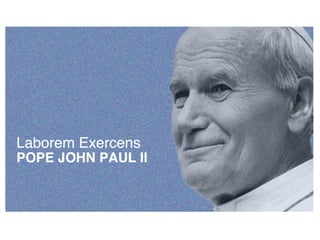
“Work is a good thing for [man] - a
good thing for his humanity - because
through work man not only transforms
nature, adapting it to his own needs,
but he also achieves fulfilment as a
human being and indeed, in a sense,
becomes ‘more a human being.’” On
Human Work (Laborem Exercens),
1984, Saint John Paul II, #9.
The Dignity of Work and the
Rights of Workers
I would like to remind
everyone, especially governments
engaged in boosting the world's
economic and social assets, that the
primary capital to be safeguarded and
valued is man, the human person in his
or her integrity: “Man is the source, the
focus and the aim of all economic and
social life.” Charity in Truth (Caritas in
Veritate), #25, quoting The Church in
the Modern World (Gaudium et Spes),
#63
The Dignity of Work and the
Rights of Workers
The obligation to earn one's bread by
the sweat of one's brow also presumes
the right to do so. A society in which
this right is systematically denied,
in which economic policies do not allow
workers to reach satisfactory levels
of employment, cannot be justified from
an ethical point of view, nor can
that society attain social peace. (The
Hundredth Year, Centesimuc Annus), St.
John Paul II, 1991, #43
The Dignity of Work and the
Rights of Workers
The economic sphere is
neither ethically neutral, or
inherently inhuman or opposed to
society. It is part and parcel of
human activity and precisely
because it is human, it must
be structured and governed in an
ethical manner. (Charity in Truth,
Caritas in Veritate), Pope Benedict
XVI, 2009, #36
Intro to Catholic Social Teaching - Session 3

Intro to Catholic Social Teaching - Session 3

  • 1.
    Catholic Social Teaching Sunday, March6, 2016 Father Kevin Queally, TOR Saint Mary Our Lady of Grace Saint Petersburg, Florida
  • 2.
    Option for thePoor and Vulnerable The bread which you do not use is the bread of the hungry; the garment hanging in your wardrobe is the garment of him who is naked; the shoes that you do not wear are the shoes of the one who is barefoot; the money you keep locked away is the money of the poor; and the acts of charity that you do not perform are so many injustices that you commit. – Saint Basil the Great (c.329 – 379), Doctor of the Church
  • 3.
    Option for thePoor and Vulnerable A basic moral test is how our most vulnerable members are faring. In a society marred by deepening divisions between rich and poor, our tradition recalls the story of the Last Judgment (Mt 25:31-46) and instructs us to put the needs of the poor and vulnerable first.
  • 4.
    Option for thePoor and Vulnerable Still, when there is question of defending the rights of individuals, the poor and badly off have a claim to especial consideration. The richer class have many ways of shielding themselves, and stand less in need of help from the State; whereas the mass of the poor have no resources of their own to fall back upon, and must chiefly depend upon the assistance of the State. On the Condition of Labor (Rerum Novarum), 1891, #37
  • 5.
    Option for thePoor and Vulnerable The obligation to provide justice for all means that the poor have the single most urgent economic claim on the conscience of the nation. Economic Justice for All, #86 In teaching us charity, the Gospel instructs us in the preferential respect due to the poor and the special situation they have in society: the more fortunate should renounce some of their rights so as to place their goods more generously at the service of others. (A Call to Action, Octogesima Adveniens, 1971), #23, Pope Paul VI
  • 6.
    Option for thePoor and Vulnerable Therefore everyone has the right to possess a sufficient amount of the earth's goods for themselves and their family. This has been the opinion of the Fathers and Doctors of the church, who taught that people are bound to come to the aid of the poor and to do so not merely out of their superfluous goods. Persons in extreme necessity are entitled to take what they need from the riches of others.
  • 7.
    Option for thePoor and Vulnerable Faced with a world today where so many people are suffering from want, the council asks individuals and governments to remember the saying of the Fathers: "Feed the people dying of hunger, because if you do not feed them you are killing them," and it urges them according to their ability to share and dispose of their goods to help others, above all by giving them aid which will enable them to help and develop themselves. (The Church in the Modern World, Gaudium et Spes, Vatican II), #69
  • 8.
    Option for thePoor and Vulnerable Love for others, and in the first place love for the poor, in whom the Church sees Christ himself, is made concrete in the promotion of justice. (On the Hundredth Year, Centesimus Annus), St. John Paul II, 1991, #58
  • 9.
    Option for thePoor and Vulnerable The obligation to provide justice for all means that the poor have the single most urgent economic claim on the conscience of the nation. Economic Justice for All, #86
  • 11.
    The Dignity ofWork and the Rights of Workers The economy must serve people, not the other way around. Work is more than a way to make a living; it is a form of continuing participation in Gods creation.
  • 12.
    The Dignity ofWork and the Rights of Workers If the dignity of work is to be protected, then the basic rights of workers must be respected-- the right to productive work, to decent and fair wages, to the organization and joining of unions, to private property, and to economic initiative.
  • 13.
    The Dignity ofWork and the Rights of Workers “Work is a good thing for [man] - a good thing for his humanity - because through work man not only transforms nature, adapting it to his own needs, but he also achieves fulfilment as a human being and indeed, in a sense, becomes ‘more a human being.’” On Human Work (Laborem Exercens), 1984, Saint John Paul II, #9.
  • 15.
    The Dignity ofWork and the Rights of Workers I would like to remind everyone, especially governments engaged in boosting the world's economic and social assets, that the primary capital to be safeguarded and valued is man, the human person in his or her integrity: “Man is the source, the focus and the aim of all economic and social life.” Charity in Truth (Caritas in Veritate), #25, quoting The Church in the Modern World (Gaudium et Spes), #63
  • 16.
    The Dignity ofWork and the Rights of Workers The obligation to earn one's bread by the sweat of one's brow also presumes the right to do so. A society in which this right is systematically denied, in which economic policies do not allow workers to reach satisfactory levels of employment, cannot be justified from an ethical point of view, nor can that society attain social peace. (The Hundredth Year, Centesimuc Annus), St. John Paul II, 1991, #43
  • 17.
    The Dignity ofWork and the Rights of Workers The economic sphere is neither ethically neutral, or inherently inhuman or opposed to society. It is part and parcel of human activity and precisely because it is human, it must be structured and governed in an ethical manner. (Charity in Truth, Caritas in Veritate), Pope Benedict XVI, 2009, #36