IntroductionPrinciples and Practice of management
Koontz : 	ā€œManagement is the art of getting things done through and with the people in formally organized groups.ā€
Henry Fayol: 	To manage is ā€œto forecast and plan, to organize, to command coordinate, and to control.ā€
Multidisciplinary:It draws ideas and concepts from such disciplines as psychology, sociology, anthropology, economics, ecology, statistics, operations research, history etc. Management is dynamic: it is constantly growing processManagement is universal:The basic principles of management are applicable in business as well as in other organizationse.g., university, government, army, family, club, business.Management is goal oriented:objectives sought to be accomplished are those of the organization.Nature of management
Management as Profession: it possesses all the attributes of profession as: 	(a) a systematic corpus of knowledge, 	(b) a code of conduct.Characteristics of profession:Formalized methods of acquired training and experience.The establishment of a representative organization with professionlisation as its goal.Existence of a body of knowledge, techniques, skills and specialized knowledge.The charging of fees based on the nature of service extended. The formation of an ethical code for the guidance of its conduct. Cont…
Body of knowledge: All over the world there is marked growth of an organized systematic body of knowledge about management as a process.Ā Formal methods of teaching: The establishment of professional schools of management in which management as a body of knowledge can be taught is seen everywhere.Ā Fee as remuneration: The number of management consultants is increasing. Even a large number of well reputed firms are establishing their consultancy agencies.Ā Existence of ethical code: There is growing emphasis on the ethical basis of management behavior.Ā Establishment of representative organizations: Both at the national and international levels management associations have been formed with their membership rules, codes of conduct, etcArguments in favour
Management as a Science:Science is by definition a body of knowledge gathered by experimentation and observation, artificially tested and expressed in the form of general principles.Identification of the problem Scientific inquiryChoice of the best available alternativeRigorous control procedureUniversally applicableManagement AS- Science or Art:
Management as an Art: Art refers to the skill to put into action a systematized body of knowledge for the achievement of a given tasks.Personal skillPractical knowledgeResult oriented approachPersonal judgmentContinuous practice
1.Management is a group activity:2.Existence of Objectives: 	An objective or set of objective should exist towards which the organized group activities are directed.3. Management is important organ of society:4. Working with and Through People:5. Decision makingFeatures of management:
Effective Utilisation of resourcesDevelopment of resourcesTo incorporate innovationsIntegrating various interest groupsStability in the societyImportance of management
Evolution of Management Thought
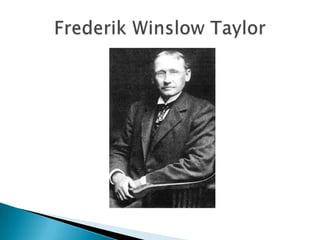
Frederik Winslow Taylor
Management Introduced by Frederik Winslow Taylor in USA ā€œScientific Management is concerned with knowing Exactly What you want men to do and then seeing that they do it in the best and cheapest wayā€. Emphasis is on solving the managerial problem in a scientific way. He carried various experiments about how to increase the efficiency of people. SCIENTIFIC MANAGEMENT
Elements and Tools of scientific Management Principles of Scientific ManagementTaylor’s principles can be described into two parts:
Separation of Planning And DoingHe emphasized on the separation of planning aspect from actual doing of the workPreviously, workers used to plan for the work to be done where put under the supervision of a supervisor.Emphasize that planning should be done by the supervisor and worker should emphasize on operational work only.Elements and tools of scientific management
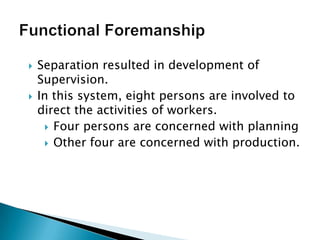
Functional ForemanshipSeparation resulted in development of Supervision.
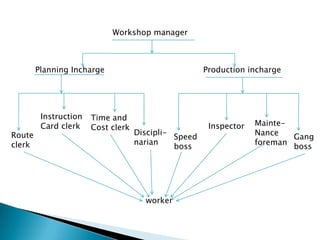
In this system, eight persons are involved to direct the activities of workers.
Four persons are concerned with planning
Other four are concerned with production. Workshop managerPlanning InchargeProduction inchargeInstructionCard clerkTime and Cost clerkMainte-NanceforemanInspectorDiscipli-narianRoute clerkSpeed bossGang bossworker
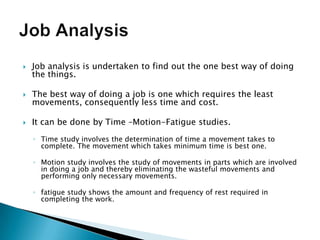
Job analysis is undertaken to find out the one best way of doing the things.The best way of doing a job is one which requires the least movements, consequently less time and cost.It can be done by Time –Motion-Fatigue studies.Time study involves the determination of time a movement takes to complete. The movement which takes minimum time is best one. Motion study involves the study of movements in parts which are involved in doing a job and thereby eliminating the wasteful movements and performing only necessary movements.fatigue study shows the amount and frequency of rest required in completing the work. Job Analysis
Standards should de maintained in respect of instruments and tools, period of work, working condition, cost of production etc. Standardisation
He says that workers should be selected on scientific basic taking into account their education, work experience,
Physical strength etc. Physically and technically sound worker.
Training for workers to make them more efficient and effective. Scientific Selection And Training of Workers
Motivate the workers to put their maximum efforts.He applied the concept of differential piece rate system:- The worker who completes the normal work gets higher rate. one who does not complete the normal work gets the lower rate. He said wages should be based on individual performance and not on the position which he occupies. Financial Incentives
Adequate consideration should be given to Economy and profit. For this technique of cost and control should be adopted:- Making resources more productive as well as by eliminating the wastages. Economy
Mutual co-operation between management and workers. For this mental change in both parties from conflicts to co-operation.Mental revolution
Principles of Scientific Management
He says that , the exactness of various aspects of work like day’s fair work, standardization of work. Differential piece rate etc. is the basic core of scientific management. It is essential that all these are measured precisely and not on mere estimates.Replacing Rule of Thumb With Science
There should be mutual give and take situation and proper understanding so that group as a whole contributes to the maximum.Harmony In Group Action
It is based on mutual confidence, co-operation and goodwill. co-operation between management and workers can be developed through mutual understanding and a change in thinking. Co Operation
It involves continuous increase in production and productivity instead of restricted production either by management or by worker. Maximum Output
Required Scientific selection of workers and providing them training at the work place.Development of Workers
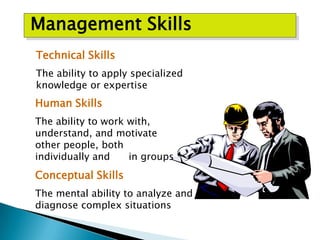
KnowledgeDecisiveness:- A manager must act fast to be decisive.A good Manager should be able to make decision, even when only partial data is available, so that his decision may be based on analytical and intuitional judgment. Ability to handle conflict Emotional stability Characteristics of quality Managers
Fayol’sAdministrative Management :
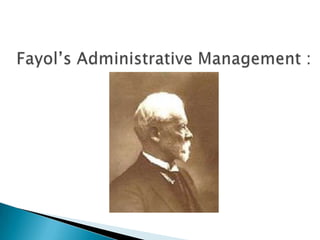
Father of modern operational managementFayol looked at the problems of managing an organisation from top management point of view.His contribution  were first published in book form titled ā€˜Administration Industrielle at Generale’ in French language.Use the term administration instead of management
Division of Work-Produces more and better work with same effort. Various functions like Planning, Organizing, Directing And Controlling cannot be performed by a single person. Henry Fayol’s 14 principles
Management: Getting work done through others. Manager should have the right to give orders and power to get obedience. Authority and Responsibility
It means obedience of authority, rules & regulations. Respect for superiors.
They can be maintained by:-
Good supervisors at all levels.
 Clear & fair agreements b/w both.
 Judicious application. Discipline
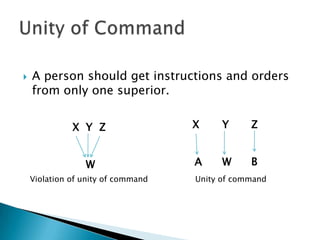
A person should get instructions and orders from only one superior. Unity of CommandXYZXYZBWAWUnity of commandViolation of unity of command
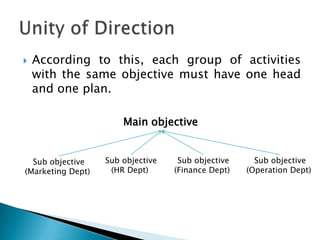
According to this, each group of activities with the same objective must have one head and one plan.Unity of DirectionMain objective Sub objective(HR Dept) Sub objective(Finance Dept) Sub objective(Operation Dept) Sub objective(Marketing Dept)
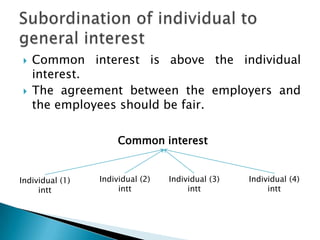
Common interest is above the individual interest. The agreement between the employers and the employees should be fair. Subordination of individual to general interestCommon interest Individual (2)inttIndividual (3)inttIndividual (4)inttIndividual (1)intt
Fair and provide maximum satisfaction to employee.It increases worker’s efficiency and morale and maintain good relationship between them and Management. Remuneration of Personnel
Increase importance of subordinate’s role is decentralization. Reduce its importance is centralization. Decided by management on the basis of nature of circumstances, size of the undertaking etc. Centralization
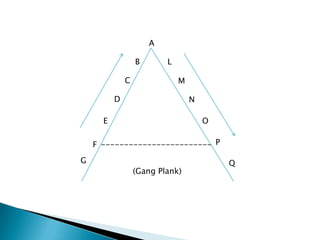
There should be scalar chain of authority and of communication ranging from the highest to the lowest. Communication must follow through each position in the line of authority (upward and downward both). Scalar Chain
ABLCMDNEOPF------------------------GQ(Gang Plank)
Proper place for everything and everything at its proper place. (Material order) Similarly, Right man at the Right place. (social order) Exact knowledge of human requirement and resources and constant balance between them is requiredOrder
Equal Treatment to all. Brings loyalty It requires good sense, experience and manager to be free from personal likes or dislikes. Equity
No employee should be removed within short of time. Job security in order to motivate the workers. Sense of Attachment.Stability of Tenure
Within the limits of authority and discipline, managers should encourage their employees for taking initiative. Initiative
Principle of ā€˜Union is Strength’Extension of Unity of command for establishing team work.Team spirit among the employees. The motto of divide and rule should be avoided. Esprit-de-corps
BUREAUCRACY
In 1910 Max weber made the study of different types of business and govt. organizations and distinguished 3 basic type of administration in them:-Leader oriented:
No delegation of management functions.
Tradition oriented:
Managerial positions are handed down from generation to generation.
ā€˜Who you are’ is more important then ā€˜what you can do’
Bureaucratic Administration:
Delegation of Management responsibilities is based on person’s demonstrated ability to hold the position.
People earn positions because they are presumed to be best capable of filling them. Administrative class:Administrative class responsible for maintaining coordinative activities of the members.
Main features of this class are:
People are paid as whole time employees
They receive salary and other perquisites normally based on their positions.
There tenure in the organization is determined by rules and regulations of the organization.
They are selected on the basis of their competence. Features of Bureaucracy:-
Each lower office is subject to control and supervision by a higher office. Thus no office is left uncontrolled.
 This hierarchy serves as lines of communication & delegation of authority. Hierarchy:
This increases production by improving efficiency and saving time in changing over from one job to another. Work is divided on the basis of specialization. It ensures that each office has a clearly defined area of competence within the organization and each official knows the areas in which he operates.. Division of work
The rules and regulations that are to be followed by employees are well defined to instill(feel) discipline in them and to ensure that they work in a coordinated manner to achieve the goals of the organizationRules & regulations
Relationships among the individuals are governed through the system of official authority and rules. Official positions are free from personal involvement, emotions and sentiments. Impersonal Relationships:
This emphasizes on the maintenance of proper official records. The decision and activities are formally recorded and preserved for future reference Official Record:
HAWTHRONE EXPERIMENT ANDHUMAN RELATIONS :
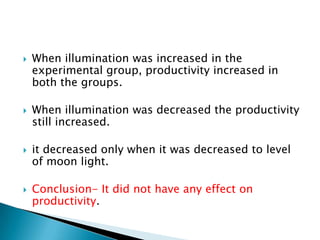
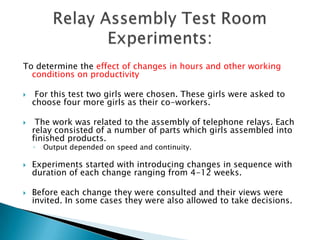
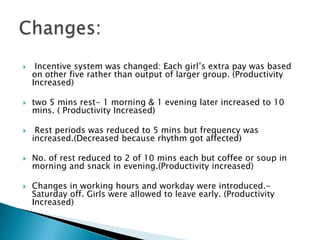
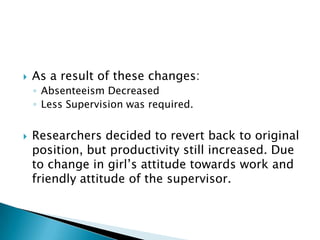
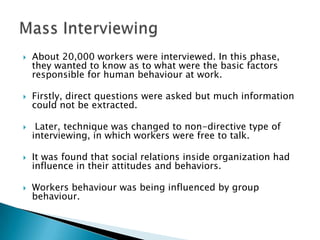
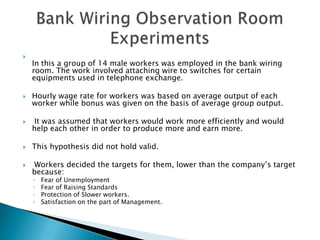
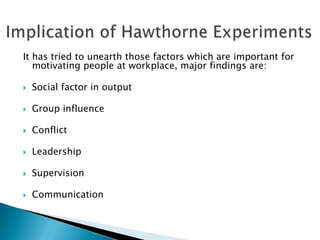
The Hawthrone plant of the General Electric Company was manufacturing Telephone System Bell. Employed about 30,000 employees at time of experiments.In spite of providing various benefits to employees there was dissatisfaction among the workers and productivity was not up to the mark. In order to investigate the real causes, a team was formed to study the relationship between productivity and physical working conditions.They conducted various researches into four phases: HAWTHRONE EXPERIMENT AND HUMAN RELATIONS

Intro ppm

  • 1.
  • 2.
    Koontz : ā€œManagementis the art of getting things done through and with the people in formally organized groups.ā€
  • 3.
    Henry Fayol: Tomanage is ā€œto forecast and plan, to organize, to command coordinate, and to control.ā€
  • 4.
    Multidisciplinary:It draws ideasand concepts from such disciplines as psychology, sociology, anthropology, economics, ecology, statistics, operations research, history etc. Management is dynamic: it is constantly growing processManagement is universal:The basic principles of management are applicable in business as well as in other organizationse.g., university, government, army, family, club, business.Management is goal oriented:objectives sought to be accomplished are those of the organization.Nature of management
  • 5.
    Management as Profession:it possesses all the attributes of profession as: (a) a systematic corpus of knowledge, (b) a code of conduct.Characteristics of profession:Formalized methods of acquired training and experience.The establishment of a representative organization with professionlisation as its goal.Existence of a body of knowledge, techniques, skills and specialized knowledge.The charging of fees based on the nature of service extended. The formation of an ethical code for the guidance of its conduct. Cont…
  • 6.
    Body of knowledge:All over the world there is marked growth of an organized systematic body of knowledge about management as a process.Ā Formal methods of teaching: The establishment of professional schools of management in which management as a body of knowledge can be taught is seen everywhere.Ā Fee as remuneration: The number of management consultants is increasing. Even a large number of well reputed firms are establishing their consultancy agencies.Ā Existence of ethical code: There is growing emphasis on the ethical basis of management behavior.Ā Establishment of representative organizations: Both at the national and international levels management associations have been formed with their membership rules, codes of conduct, etcArguments in favour
  • 7.
    Management as aScience:Science is by definition a body of knowledge gathered by experimentation and observation, artificially tested and expressed in the form of general principles.Identification of the problem Scientific inquiryChoice of the best available alternativeRigorous control procedureUniversally applicableManagement AS- Science or Art:
  • 8.
    Management as anArt: Art refers to the skill to put into action a systematized body of knowledge for the achievement of a given tasks.Personal skillPractical knowledgeResult oriented approachPersonal judgmentContinuous practice
  • 9.
    1.Management is agroup activity:2.Existence of Objectives: An objective or set of objective should exist towards which the organized group activities are directed.3. Management is important organ of society:4. Working with and Through People:5. Decision makingFeatures of management:
  • 10.
    Effective Utilisation ofresourcesDevelopment of resourcesTo incorporate innovationsIntegrating various interest groupsStability in the societyImportance of management
  • 12.
  • 13.
  • 14.
    Management Introduced byFrederik Winslow Taylor in USA ā€œScientific Management is concerned with knowing Exactly What you want men to do and then seeing that they do it in the best and cheapest wayā€. Emphasis is on solving the managerial problem in a scientific way. He carried various experiments about how to increase the efficiency of people. SCIENTIFIC MANAGEMENT
  • 15.
    Elements and Toolsof scientific Management Principles of Scientific ManagementTaylor’s principles can be described into two parts:
  • 16.
    Separation of PlanningAnd DoingHe emphasized on the separation of planning aspect from actual doing of the workPreviously, workers used to plan for the work to be done where put under the supervision of a supervisor.Emphasize that planning should be done by the supervisor and worker should emphasize on operational work only.Elements and tools of scientific management
  • 17.
    Functional ForemanshipSeparation resultedin development of Supervision.
  • 18.
    In this system,eight persons are involved to direct the activities of workers.
  • 19.
    Four persons areconcerned with planning
  • 20.
    Other four areconcerned with production. Workshop managerPlanning InchargeProduction inchargeInstructionCard clerkTime and Cost clerkMainte-NanceforemanInspectorDiscipli-narianRoute clerkSpeed bossGang bossworker
  • 21.
    Job analysis isundertaken to find out the one best way of doing the things.The best way of doing a job is one which requires the least movements, consequently less time and cost.It can be done by Time –Motion-Fatigue studies.Time study involves the determination of time a movement takes to complete. The movement which takes minimum time is best one. Motion study involves the study of movements in parts which are involved in doing a job and thereby eliminating the wasteful movements and performing only necessary movements.fatigue study shows the amount and frequency of rest required in completing the work. Job Analysis
  • 22.
    Standards should demaintained in respect of instruments and tools, period of work, working condition, cost of production etc. Standardisation
  • 23.
    He says thatworkers should be selected on scientific basic taking into account their education, work experience,
  • 24.
    Physical strength etc.Physically and technically sound worker.
  • 25.
    Training for workersto make them more efficient and effective. Scientific Selection And Training of Workers
  • 26.
    Motivate the workersto put their maximum efforts.He applied the concept of differential piece rate system:- The worker who completes the normal work gets higher rate. one who does not complete the normal work gets the lower rate. He said wages should be based on individual performance and not on the position which he occupies. Financial Incentives
  • 27.
    Adequate consideration shouldbe given to Economy and profit. For this technique of cost and control should be adopted:- Making resources more productive as well as by eliminating the wastages. Economy
  • 28.
    Mutual co-operation betweenmanagement and workers. For this mental change in both parties from conflicts to co-operation.Mental revolution
  • 29.
  • 30.
    He says that, the exactness of various aspects of work like day’s fair work, standardization of work. Differential piece rate etc. is the basic core of scientific management. It is essential that all these are measured precisely and not on mere estimates.Replacing Rule of Thumb With Science
  • 31.
    There should bemutual give and take situation and proper understanding so that group as a whole contributes to the maximum.Harmony In Group Action
  • 32.
    It is basedon mutual confidence, co-operation and goodwill. co-operation between management and workers can be developed through mutual understanding and a change in thinking. Co Operation
  • 33.
    It involves continuousincrease in production and productivity instead of restricted production either by management or by worker. Maximum Output
  • 34.
    Required Scientific selectionof workers and providing them training at the work place.Development of Workers
  • 35.
    KnowledgeDecisiveness:- A managermust act fast to be decisive.A good Manager should be able to make decision, even when only partial data is available, so that his decision may be based on analytical and intuitional judgment. Ability to handle conflict Emotional stability Characteristics of quality Managers
  • 36.
  • 37.
    Father of modernoperational managementFayol looked at the problems of managing an organisation from top management point of view.His contribution were first published in book form titled ā€˜Administration Industrielle at Generale’ in French language.Use the term administration instead of management
  • 38.
    Division of Work-Producesmore and better work with same effort. Various functions like Planning, Organizing, Directing And Controlling cannot be performed by a single person. Henry Fayol’s 14 principles
  • 39.
    Management: Getting workdone through others. Manager should have the right to give orders and power to get obedience. Authority and Responsibility
  • 40.
    It means obedienceof authority, rules & regulations. Respect for superiors.
  • 41.
    They can bemaintained by:-
  • 42.
  • 43.
    Clear &fair agreements b/w both.
  • 44.
  • 45.
    A person shouldget instructions and orders from only one superior. Unity of CommandXYZXYZBWAWUnity of commandViolation of unity of command
  • 46.
    According to this,each group of activities with the same objective must have one head and one plan.Unity of DirectionMain objective Sub objective(HR Dept) Sub objective(Finance Dept) Sub objective(Operation Dept) Sub objective(Marketing Dept)
  • 47.
    Common interest isabove the individual interest. The agreement between the employers and the employees should be fair. Subordination of individual to general interestCommon interest Individual (2)inttIndividual (3)inttIndividual (4)inttIndividual (1)intt
  • 48.
    Fair and providemaximum satisfaction to employee.It increases worker’s efficiency and morale and maintain good relationship between them and Management. Remuneration of Personnel
  • 49.
    Increase importance ofsubordinate’s role is decentralization. Reduce its importance is centralization. Decided by management on the basis of nature of circumstances, size of the undertaking etc. Centralization
  • 50.
    There should bescalar chain of authority and of communication ranging from the highest to the lowest. Communication must follow through each position in the line of authority (upward and downward both). Scalar Chain
  • 51.
  • 52.
    Proper place foreverything and everything at its proper place. (Material order) Similarly, Right man at the Right place. (social order) Exact knowledge of human requirement and resources and constant balance between them is requiredOrder
  • 53.
    Equal Treatment toall. Brings loyalty It requires good sense, experience and manager to be free from personal likes or dislikes. Equity
  • 54.
    No employee shouldbe removed within short of time. Job security in order to motivate the workers. Sense of Attachment.Stability of Tenure
  • 55.
    Within the limitsof authority and discipline, managers should encourage their employees for taking initiative. Initiative
  • 56.
    Principle of ā€˜Unionis Strength’Extension of Unity of command for establishing team work.Team spirit among the employees. The motto of divide and rule should be avoided. Esprit-de-corps
  • 57.
  • 58.
    In 1910 Maxweber made the study of different types of business and govt. organizations and distinguished 3 basic type of administration in them:-Leader oriented:
  • 59.
    No delegation ofmanagement functions.
  • 60.
  • 61.
    Managerial positions arehanded down from generation to generation.
  • 62.
    ā€˜Who you are’is more important then ā€˜what you can do’
  • 63.
  • 64.
    Delegation of Managementresponsibilities is based on person’s demonstrated ability to hold the position.
  • 65.
    People earn positionsbecause they are presumed to be best capable of filling them. Administrative class:Administrative class responsible for maintaining coordinative activities of the members.
  • 66.
    Main features ofthis class are:
  • 67.
    People are paidas whole time employees
  • 68.
    They receive salaryand other perquisites normally based on their positions.
  • 69.
    There tenure inthe organization is determined by rules and regulations of the organization.
  • 70.
    They are selectedon the basis of their competence. Features of Bureaucracy:-
  • 71.
    Each lower officeis subject to control and supervision by a higher office. Thus no office is left uncontrolled.
  • 72.
    This hierarchyserves as lines of communication & delegation of authority. Hierarchy:
  • 73.
    This increases productionby improving efficiency and saving time in changing over from one job to another. Work is divided on the basis of specialization. It ensures that each office has a clearly defined area of competence within the organization and each official knows the areas in which he operates.. Division of work
  • 74.
    The rules andregulations that are to be followed by employees are well defined to instill(feel) discipline in them and to ensure that they work in a coordinated manner to achieve the goals of the organizationRules & regulations
  • 75.
    Relationships among theindividuals are governed through the system of official authority and rules. Official positions are free from personal involvement, emotions and sentiments. Impersonal Relationships:
  • 76.
    This emphasizes onthe maintenance of proper official records. The decision and activities are formally recorded and preserved for future reference Official Record:
  • 77.
  • 78.
    The Hawthrone plantof the General Electric Company was manufacturing Telephone System Bell. Employed about 30,000 employees at time of experiments.In spite of providing various benefits to employees there was dissatisfaction among the workers and productivity was not up to the mark. In order to investigate the real causes, a team was formed to study the relationship between productivity and physical working conditions.They conducted various researches into four phases: HAWTHRONE EXPERIMENT AND HUMAN RELATIONS