   Alabama, 1963.

    In Birmingham, anti-segregation demonstrators
    lie on the sidewalk to protect themselves from
    firemen with high PRESSURE water hoses. One
    disgusted fireman said later, "We're supposed
    to fight fires, not people."
seg·re·ga·tion/ˌsegriˌgāSHən/

   Definitions:

   Segregation = The enforced separation of
    different racial groups in a country,
    community, or establishment.
   Anti-segregation Movement = a movement
    against the segregation of black people in the
    USA. Also known as the Civil Rights
    Movement.
   Martin Luther King Jr. goes down in history as
    one of the principal leader of the civil rights
    movement in the United States and a
    prominent advocate of nonviolent protest.
    King's challenges to segregation and racial
    discrimination helped convince many white
    Americans to support the cause of civil rights
    in the United States.
   In 1954 King accepted his first pastorate at the
    Dexter Avenue Baptist Church in Montgomery,
    Alabama. Montgomery's black community had
    long-standing grievances about the
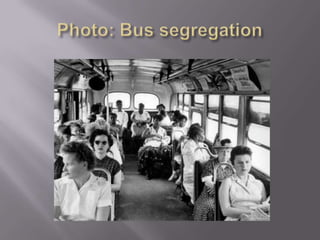
    mistreatment of blacks on city buses. Heading
    the year-long bus-boycott against segregation
    in buses, King soon became a national figure.
   In 1957 King helped found the Southern
    Christian Leadership Conference (SCLC), an
    organization of black churches and ministers
    that aimed to challenge racial segregation. King
    and other SCLC leaders encouraged the use of
    nonviolent marches, demonstrations, and
    boycotts to protest discrimination.
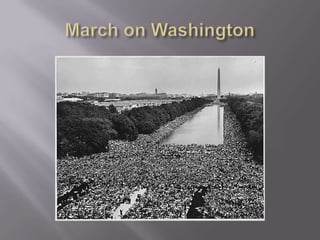
   King and other black leaders organized the 1963
    March on Washington, a massive protest in
    Washington, D.C., for jobs and civil rights. King
    delivered his famous "I Have a Dream" speech to
    an audience of more than 200,000 civil rights
    supporters. The speech and the march created the
    political momentum that resulted in the Civil
    Rights Act of 1964, which prohibited segregation
    in public accommodations and discrimination in
    education and employment. As a result of King's
    effective leadership, he was awarded the 1964
    Nobel Prize for peace.
   Read the text of the “I Have a Dream” speech
    delivered by Martin Luther King as you listen
    to it.

   Link:
   http://www.americanrhetoric.com/speeches/
    mlkihaveadream.htm
   Throughout 1966 and 1967 King increasingly
    turned the focus of his activism to the
    redistribution of the nation's economic wealth
    to overcome entrenched black poverty. In the
    spring of 1968 he went to Memphis, Tennessee,
    to support striking black garbage workers.
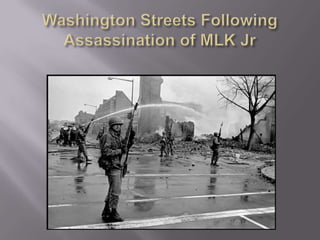
    King was assassinated in Memphis on April 4,
    1968.
   Video of MLK:

   http://www.biography.com/people/martin-
    luther-king-jr-9365086

Intro mlk

  • 2.
    Alabama, 1963. In Birmingham, anti-segregation demonstrators lie on the sidewalk to protect themselves from firemen with high PRESSURE water hoses. One disgusted fireman said later, "We're supposed to fight fires, not people."
  • 3.
    seg·re·ga·tion/ˌsegriˌgāSHən/  Definitions:  Segregation = The enforced separation of different racial groups in a country, community, or establishment.  Anti-segregation Movement = a movement against the segregation of black people in the USA. Also known as the Civil Rights Movement.
  • 4.
    Martin Luther King Jr. goes down in history as one of the principal leader of the civil rights movement in the United States and a prominent advocate of nonviolent protest. King's challenges to segregation and racial discrimination helped convince many white Americans to support the cause of civil rights in the United States.
  • 6.
    In 1954 King accepted his first pastorate at the Dexter Avenue Baptist Church in Montgomery, Alabama. Montgomery's black community had long-standing grievances about the mistreatment of blacks on city buses. Heading the year-long bus-boycott against segregation in buses, King soon became a national figure.
  • 8.
    In 1957 King helped found the Southern Christian Leadership Conference (SCLC), an organization of black churches and ministers that aimed to challenge racial segregation. King and other SCLC leaders encouraged the use of nonviolent marches, demonstrations, and boycotts to protest discrimination.
  • 10.
    King and other black leaders organized the 1963 March on Washington, a massive protest in Washington, D.C., for jobs and civil rights. King delivered his famous "I Have a Dream" speech to an audience of more than 200,000 civil rights supporters. The speech and the march created the political momentum that resulted in the Civil Rights Act of 1964, which prohibited segregation in public accommodations and discrimination in education and employment. As a result of King's effective leadership, he was awarded the 1964 Nobel Prize for peace.
  • 12.
    Read the text of the “I Have a Dream” speech delivered by Martin Luther King as you listen to it.  Link:  http://www.americanrhetoric.com/speeches/ mlkihaveadream.htm
  • 14.
    Throughout 1966 and 1967 King increasingly turned the focus of his activism to the redistribution of the nation's economic wealth to overcome entrenched black poverty. In the spring of 1968 he went to Memphis, Tennessee, to support striking black garbage workers. King was assassinated in Memphis on April 4, 1968.
  • 16.
    Video of MLK:  http://www.biography.com/people/martin- luther-king-jr-9365086