MHBE 2013
BASIC EPIDEMIOLOGY ;
Introduction to
Epidemiology
(2 Hour)
Institut Latihan Kementerian Kesihatan Malaysia (ILKKM)
Prog : Diploma in Medical And Health Science (DPMH)
Year 1 Sem I
Learning outcome (LO) ;
i. Explain what is an
epidemiology.
ii. Describe the purpose
of epidemiology in
public health.
The word epidemiology comes from
the Greek words
• epi, meaning on or upon
• demos, meaning people
• logos, meaning the study of.
In other words, the word
epidemiology has its roots in the
study of what befalls a
population.
Definition ;
Epidemiology is the study of how disease is distributed in
populations and the factors that influence or determine this
distribution.
(Gordis L.,2008)
Definition ;
Epidemiology is the study of the distribution and
determinants of health-related states or events in specified
populations, and the application of this study to the control of
health problems.
(Centers for Disease Control and Prevention (CDC)
, Atlanta USA)
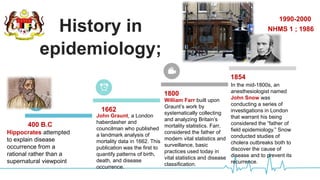
History in
epidemiology;
400 B.C
Hippocrates attempted
to explain disease
occurrence from a
rational rather than a
supernatural viewpoint
1662
1800
1854
1990-2000
John Graunt, a London
haberdasher and
councilman who published
a landmark analysis of
mortality data in 1662. This
publication was the first to
quantify patterns of birth,
death, and disease
occurrence.
William Farr built upon
Graunt’s work by
systematically collecting
and analyzing Britain’s
mortality statistics. Farr,
considered the father of
modern vital statistics and
surveillance, basic
practices used today in
vital statistics and disease
classification.
In the mid-1800s, an
anesthesiologist named
John Snow was
conducting a series of
investigations in London
that warrant his being
considered the “father of
field epidemiology.” Snow
conducted studies of
cholera outbreaks both to
discover the cause of
disease and to prevent its
recurrence.
NHMS 1 ; 1986
History MALAYSIA
epidemiology;
National Health Morbidity Survey (NHMS)
i. NHMS I = 1986
ii. NHMS II = 1996
iii. NHMS III = 2006
iv. NHMS IV = 2016
V. NHMS V = 2026
Rank Disease
Males
Disease
Females
DALYs % DALYs %
1. IHD 164,846 10.0 IHD 113,887 9.2
2. Road Traffic Accidents 133,789 8.2 Cerebrovascular Disease 86,372 7.0
3. CVD 94,059 5.7 Uni-p Major Depression 67,211 5.4
4. Septicaemia 70,232 4.3 Septicaemia 57,483 4.6
5. ALRI 49,649 3.0 Diabetes Mellitus 56,390 4.6
6. Diabetes Mellitus 47,060 2.9 Hearing Loss 38,994 3.1
7. COAD 45,459 2.8 ALRI 37,890 3.1
8. Hearing Loss 44,566 2.7 Asthma 32,815 2.6
9. Unip Major Depression 42,259 2.6 Road Traffic Accidents 28,946 2.3
10. Cirrhosis 37,902 2.3 Osteoarthristis 26,925 2.2
Total (111 diseases) 1,646,896 Total (111 Diseases) 1,240,997
Sejarah Statistik Kesihatan dan Kempen Kesihatandi
Malaysia
1991 – Cintailah jantung anda.
1992 – AIDS Pembunuh.
1993 – Makanan Bersih Keluarga sihat
1994 – Anak sihat tonggak masa depan
negara.
1995 – Maju tanpa kanser.
1996 – Cegah Diabetis
1997 – Makan untuk kesihatan.
1998 – Senaman asas kesihatan
1999 – Cegah Kecederaan
2000 – Kesihatan Mental.
2001- Promosi keluarga sihat.
2002 –Promosi persekitaran sihat
2003-04 – Sihat sepanjang hayat
(setting sekolah)
2005-07 – Sihat sepanjang hayat
( setting tempat kerja)
Sejarah Statistik Kesihatan dan Kempen Kesihatan
di Malaysia
Sejarah Statistik Kesihatan dan Kempen Kesihatan
di Malaysia
1. Hypertension ; NHMS I 14.4% , NHMS II 32.9% , NHMS III 32.3%.
2. Diabetis ; NHMS I 6.3% , NHMS II 8.3% , NHMS III 14.6%.
3. Lima masalah penyakit utama di malaysia sejak 10 tahun adalah dari Non
Communicable Disease. Penyakit Mental juga semakin meningkat di
malaysia.
4. Smoker ; NHMS II 24.8% , NHMS III 22.8%. Ex smoker 18.8% to 28.9%.
5. Alkohol : NHMS II 29.2% , NHMS III 42.8%.
6. Pap smear : NHMS II 26% , NHMS III 43.7%.
The science concerned with the study of the
factors determining and influencing the
frequency and distribution of disease, injury,
and other health-related events and their
causes in a defined human population for the
purpose of establishing programs to prevent and
control their development and spread.
Principles in epid ;
DISTRIBUTION ;
frequency ,
patern
DETERMINAT ; Causes
and other factors that
influence /
what.why,who,how,where?
6 principles in epidemiology ;
STUDY ; Biostatistics
and informatics, with
biologic, economic,
social, and behavioral
sciences.
HEALTH-RELATED
STATES OR
EVENTS ; NCD and
communicable
disease
SPECIFIED
POPULATIONS
APPLICATION ; diagnosis and
prescribe appropriate treatment for a
patient, the clinician combines
medical (scientific) knowledge with
experience, clinical judgment, and
understanding of the patient .
Epidemiology is the study (scientific, systematic,
data-driven) of the distribution (frequency,
pattern) and determinants (causes, risk factors) of
health-related states and events (not just
diseases) in specified populations (patient is
community, individuals viewed collectively), and the
application of (since epidemiology is a discipline
within public health) this study to the control of health
problems.
Current & best definition in
epidemiology ;
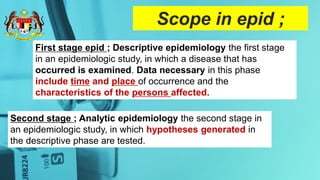
Second stage ; Analytic epidemiology the second stage in
an epidemiologic study, in which hypotheses generated in
the descriptive phase are tested.
Scope in epid ;
First stage epid ; Descriptive epidemiology the first stage
in an epidemiologic study, in which a disease that has
occurred is examined. Data necessary in this phase
include time and place of occurrence and the
characteristics of the persons affected.
Concept of RISK ;
A person expose to potential harmful agent .
Fundamental Concept In The Principle Of
Epidemiology. ;
Concept of CAUSE ;
Is an external agent (microbe,chemical subtance, physical trauma ) which result in
disease to the susceptible individuals.
Concept of DETERMINANT ;
Is an attribute or circumstance thats affects the liability of an individual to be exposed or, when expose
to develop disease. (eg : hereditary predisposition,environmental condition).
Concept of CONFOUNDING ;
Confounding variable factors which it significantly associated with both the occurrence of disease in a
population and with one of its causes or determinants but is not itself a cause.(eg : smoking, there for carcinoma
of bronchus tend to correlate)
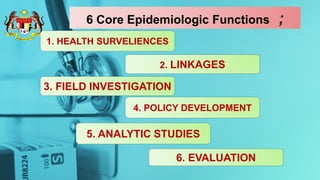
6 Core Epidemiologic Functions ;
1. HEALTH SURVELIENCES
2. LINKAGES
4. POLICY DEVELOPMENT
6. EVALUATION
5. ANALYTIC STUDIES
3. FIELD INVESTIGATION
2 type of epidemiological studies ;
1. Descriptive Epidemiology;
• Descriptive epidemiology
covers time, place, and person.
• The 5W's of descriptive
epidemiology:
i. What = health issue of concern
ii. Who = person
iii. Where = place
iv. When = time
v. Why/how = causes, risk factors,
modes of transmission
2. Analytic Epidemiology;
The characteristic expect associated
with the disease;
i. Demographic factor such as age,
race, or sex;
ii. Constitutional factor such as
blood group or immune status;
iii. Behaviour or act such as
smoking or having eaten salsa;
iv. Circumstance such as living near
a toxic waste site.
1. OBSERVERTIONAL studies
2. EXPERIMENTAL studies
2 type of epidemiological studies ;
EXPERIMENTAL studies ;
The investigator determines through a controlled process the
exposure for each individual (clinical trial) or community
(community trial), and then tracks the individuals or
communities over time to detect the effects of the
exposure.
For example, in a clinical trial of a new vaccine, the investigator may
randomly assign some of the participants to receive the new
vaccine, while others receive a placebo shot.
OBSERVATIONAL studies;
1. Cohort study ;
• Some time we call prospective study or follow up study
or retrospective study.
• In a cohort study the epidemiologist records whether each
study participant is exposed or not, and then tracks the
participants to see if they develop the disease of interest.
• Note that this differs from an experimental study because,
in a cohort study, the investigator observes rather than
determines the participants’ exposure status.
Observational studies ;
2. Case controle study ;
Investigators start by enrolling a group of
people with disease (Case), As a comparison
group, the investigator then enrols a group of
people without disease (Controls).
Observational studies ;
3. Cross Sectional Study ;
• A sample of persons from a population is enrolled and their
exposures and health outcomes are measured simultaneously.
• The cross-sectional study tends to assess the presence
(prevalence) of the health outcome at that point of time without
regard to duration.
• For example, in a cross-sectional study of diabetes, some of the
enrolees with diabetes may have lived with their diabetes for
many years, while others may have been recently diagnosed.
1. To study the cause/clinical
pictures (or etiology) of disease(s),
or conditions, disorders, disabilities,
etc.
– determine the primary agent
responsible or ascertain
causative factors
– determine the characteristics of
the agent or causative factors
– define the mode of transmission
– determine contributing factors
– identify and determine
geographic patterns
Uses of epidemiology ;
2. To determine, describe, and
report on the natural course of
disease, disability, injury, and
death.
3. To aid in the planning and
development of health services
and programs
4. To provide administrative and
planning data
5. Assessing the community’s
health.
6. Making individual decisions.
7. Completing the clinical picture
Ultimate Goal in epid ;
The FINALLY ultimate goal in
epidemiology is to improve the
control of a disease through both
prevention and treatment that will
prevent deaths from the disease
and will enhance the quality of life.
Student reading/ priority references :
Book / Journal / Article
No References
1. Gordis Leon (2013) Epidemiology, 5th edition,Elsevier
Suander,USA.
2. William C. Cockerham (2016) Medical sociology 13th edition,
Routledge,USA
3. Schneider.M.J(2014),Introduction to public health (4th Edition),Jones
& Bartlett Learning,USA
Internet/ e book/ online
No References
1. http://www.moh.gov.my/
2. https://www.who.int/
3. https://books.google.com.my/books?id=AXZz6JIV9ikC&p
rintsec=frontcover#v=onepage&q&f=false
4. https://www.cdc.gov/csels/dsepd/ss1978/lesson1/section
9.html
9
/
1
0
/
2
0
2
0
I
L
K
K
M
;
D
P
M
H
;
M
H
B
E
2
0
1
3
B
a
s
i
c
E
2
6
Recommendation for student Independent Learning (IL) ;
Activities Source
1. Search and download https://www.cdc.gov/csels/dsepd/ss1978/index.ht
ml
2. Reading related topic As above
3. Make short note related
topic
As above
4. Discus and answer
Exercise 1.1, 1.3
https://www.cdc.gov/csels/dsepd/ss1978/lesson1
/section11.html
5. Terminology and
Definitions
Page slide 32 – 33 either one
2
7

Intro epidemiology.pdf

  • 1.
    MHBE 2013 BASIC EPIDEMIOLOGY; Introduction to Epidemiology (2 Hour) Institut Latihan Kementerian Kesihatan Malaysia (ILKKM) Prog : Diploma in Medical And Health Science (DPMH) Year 1 Sem I
  • 2.
    Learning outcome (LO); i. Explain what is an epidemiology. ii. Describe the purpose of epidemiology in public health.
  • 3.
    The word epidemiologycomes from the Greek words • epi, meaning on or upon • demos, meaning people • logos, meaning the study of. In other words, the word epidemiology has its roots in the study of what befalls a population. Definition ;
  • 4.
    Epidemiology is thestudy of how disease is distributed in populations and the factors that influence or determine this distribution. (Gordis L.,2008) Definition ; Epidemiology is the study of the distribution and determinants of health-related states or events in specified populations, and the application of this study to the control of health problems. (Centers for Disease Control and Prevention (CDC) , Atlanta USA)
  • 5.
    History in epidemiology; 400 B.C Hippocratesattempted to explain disease occurrence from a rational rather than a supernatural viewpoint 1662 1800 1854 1990-2000 John Graunt, a London haberdasher and councilman who published a landmark analysis of mortality data in 1662. This publication was the first to quantify patterns of birth, death, and disease occurrence. William Farr built upon Graunt’s work by systematically collecting and analyzing Britain’s mortality statistics. Farr, considered the father of modern vital statistics and surveillance, basic practices used today in vital statistics and disease classification. In the mid-1800s, an anesthesiologist named John Snow was conducting a series of investigations in London that warrant his being considered the “father of field epidemiology.” Snow conducted studies of cholera outbreaks both to discover the cause of disease and to prevent its recurrence. NHMS 1 ; 1986
  • 6.
    History MALAYSIA epidemiology; National HealthMorbidity Survey (NHMS) i. NHMS I = 1986 ii. NHMS II = 1996 iii. NHMS III = 2006 iv. NHMS IV = 2016 V. NHMS V = 2026
  • 7.
    Rank Disease Males Disease Females DALYs %DALYs % 1. IHD 164,846 10.0 IHD 113,887 9.2 2. Road Traffic Accidents 133,789 8.2 Cerebrovascular Disease 86,372 7.0 3. CVD 94,059 5.7 Uni-p Major Depression 67,211 5.4 4. Septicaemia 70,232 4.3 Septicaemia 57,483 4.6 5. ALRI 49,649 3.0 Diabetes Mellitus 56,390 4.6 6. Diabetes Mellitus 47,060 2.9 Hearing Loss 38,994 3.1 7. COAD 45,459 2.8 ALRI 37,890 3.1 8. Hearing Loss 44,566 2.7 Asthma 32,815 2.6 9. Unip Major Depression 42,259 2.6 Road Traffic Accidents 28,946 2.3 10. Cirrhosis 37,902 2.3 Osteoarthristis 26,925 2.2 Total (111 diseases) 1,646,896 Total (111 Diseases) 1,240,997 Sejarah Statistik Kesihatan dan Kempen Kesihatandi Malaysia
  • 8.
    1991 – Cintailahjantung anda. 1992 – AIDS Pembunuh. 1993 – Makanan Bersih Keluarga sihat 1994 – Anak sihat tonggak masa depan negara. 1995 – Maju tanpa kanser. 1996 – Cegah Diabetis 1997 – Makan untuk kesihatan. 1998 – Senaman asas kesihatan 1999 – Cegah Kecederaan 2000 – Kesihatan Mental. 2001- Promosi keluarga sihat. 2002 –Promosi persekitaran sihat 2003-04 – Sihat sepanjang hayat (setting sekolah) 2005-07 – Sihat sepanjang hayat ( setting tempat kerja) Sejarah Statistik Kesihatan dan Kempen Kesihatan di Malaysia
  • 9.
    Sejarah Statistik Kesihatandan Kempen Kesihatan di Malaysia 1. Hypertension ; NHMS I 14.4% , NHMS II 32.9% , NHMS III 32.3%. 2. Diabetis ; NHMS I 6.3% , NHMS II 8.3% , NHMS III 14.6%. 3. Lima masalah penyakit utama di malaysia sejak 10 tahun adalah dari Non Communicable Disease. Penyakit Mental juga semakin meningkat di malaysia. 4. Smoker ; NHMS II 24.8% , NHMS III 22.8%. Ex smoker 18.8% to 28.9%. 5. Alkohol : NHMS II 29.2% , NHMS III 42.8%. 6. Pap smear : NHMS II 26% , NHMS III 43.7%.
  • 10.
    The science concernedwith the study of the factors determining and influencing the frequency and distribution of disease, injury, and other health-related events and their causes in a defined human population for the purpose of establishing programs to prevent and control their development and spread. Principles in epid ;
  • 11.
    DISTRIBUTION ; frequency , patern DETERMINAT; Causes and other factors that influence / what.why,who,how,where? 6 principles in epidemiology ; STUDY ; Biostatistics and informatics, with biologic, economic, social, and behavioral sciences. HEALTH-RELATED STATES OR EVENTS ; NCD and communicable disease SPECIFIED POPULATIONS APPLICATION ; diagnosis and prescribe appropriate treatment for a patient, the clinician combines medical (scientific) knowledge with experience, clinical judgment, and understanding of the patient .
  • 12.
    Epidemiology is thestudy (scientific, systematic, data-driven) of the distribution (frequency, pattern) and determinants (causes, risk factors) of health-related states and events (not just diseases) in specified populations (patient is community, individuals viewed collectively), and the application of (since epidemiology is a discipline within public health) this study to the control of health problems. Current & best definition in epidemiology ;
  • 13.
    Second stage ;Analytic epidemiology the second stage in an epidemiologic study, in which hypotheses generated in the descriptive phase are tested. Scope in epid ; First stage epid ; Descriptive epidemiology the first stage in an epidemiologic study, in which a disease that has occurred is examined. Data necessary in this phase include time and place of occurrence and the characteristics of the persons affected.
  • 14.
    Concept of RISK; A person expose to potential harmful agent . Fundamental Concept In The Principle Of Epidemiology. ; Concept of CAUSE ; Is an external agent (microbe,chemical subtance, physical trauma ) which result in disease to the susceptible individuals. Concept of DETERMINANT ; Is an attribute or circumstance thats affects the liability of an individual to be exposed or, when expose to develop disease. (eg : hereditary predisposition,environmental condition). Concept of CONFOUNDING ; Confounding variable factors which it significantly associated with both the occurrence of disease in a population and with one of its causes or determinants but is not itself a cause.(eg : smoking, there for carcinoma of bronchus tend to correlate)
  • 15.
    6 Core EpidemiologicFunctions ; 1. HEALTH SURVELIENCES 2. LINKAGES 4. POLICY DEVELOPMENT 6. EVALUATION 5. ANALYTIC STUDIES 3. FIELD INVESTIGATION
  • 16.
    2 type ofepidemiological studies ; 1. Descriptive Epidemiology; • Descriptive epidemiology covers time, place, and person. • The 5W's of descriptive epidemiology: i. What = health issue of concern ii. Who = person iii. Where = place iv. When = time v. Why/how = causes, risk factors, modes of transmission 2. Analytic Epidemiology; The characteristic expect associated with the disease; i. Demographic factor such as age, race, or sex; ii. Constitutional factor such as blood group or immune status; iii. Behaviour or act such as smoking or having eaten salsa; iv. Circumstance such as living near a toxic waste site. 1. OBSERVERTIONAL studies 2. EXPERIMENTAL studies
  • 17.
    2 type ofepidemiological studies ;
  • 19.
    EXPERIMENTAL studies ; Theinvestigator determines through a controlled process the exposure for each individual (clinical trial) or community (community trial), and then tracks the individuals or communities over time to detect the effects of the exposure. For example, in a clinical trial of a new vaccine, the investigator may randomly assign some of the participants to receive the new vaccine, while others receive a placebo shot.
  • 20.
    OBSERVATIONAL studies; 1. Cohortstudy ; • Some time we call prospective study or follow up study or retrospective study. • In a cohort study the epidemiologist records whether each study participant is exposed or not, and then tracks the participants to see if they develop the disease of interest. • Note that this differs from an experimental study because, in a cohort study, the investigator observes rather than determines the participants’ exposure status.
  • 21.
    Observational studies ; 2.Case controle study ; Investigators start by enrolling a group of people with disease (Case), As a comparison group, the investigator then enrols a group of people without disease (Controls).
  • 22.
    Observational studies ; 3.Cross Sectional Study ; • A sample of persons from a population is enrolled and their exposures and health outcomes are measured simultaneously. • The cross-sectional study tends to assess the presence (prevalence) of the health outcome at that point of time without regard to duration. • For example, in a cross-sectional study of diabetes, some of the enrolees with diabetes may have lived with their diabetes for many years, while others may have been recently diagnosed.
  • 23.
    1. To studythe cause/clinical pictures (or etiology) of disease(s), or conditions, disorders, disabilities, etc. – determine the primary agent responsible or ascertain causative factors – determine the characteristics of the agent or causative factors – define the mode of transmission – determine contributing factors – identify and determine geographic patterns Uses of epidemiology ; 2. To determine, describe, and report on the natural course of disease, disability, injury, and death. 3. To aid in the planning and development of health services and programs 4. To provide administrative and planning data 5. Assessing the community’s health. 6. Making individual decisions. 7. Completing the clinical picture
  • 24.
    Ultimate Goal inepid ; The FINALLY ultimate goal in epidemiology is to improve the control of a disease through both prevention and treatment that will prevent deaths from the disease and will enhance the quality of life.
  • 25.
    Student reading/ priorityreferences : Book / Journal / Article No References 1. Gordis Leon (2013) Epidemiology, 5th edition,Elsevier Suander,USA. 2. William C. Cockerham (2016) Medical sociology 13th edition, Routledge,USA 3. Schneider.M.J(2014),Introduction to public health (4th Edition),Jones & Bartlett Learning,USA Internet/ e book/ online No References 1. http://www.moh.gov.my/ 2. https://www.who.int/ 3. https://books.google.com.my/books?id=AXZz6JIV9ikC&p rintsec=frontcover#v=onepage&q&f=false 4. https://www.cdc.gov/csels/dsepd/ss1978/lesson1/section 9.html
  • 26.
  • 27.
    Recommendation for studentIndependent Learning (IL) ; Activities Source 1. Search and download https://www.cdc.gov/csels/dsepd/ss1978/index.ht ml 2. Reading related topic As above 3. Make short note related topic As above 4. Discus and answer Exercise 1.1, 1.3 https://www.cdc.gov/csels/dsepd/ss1978/lesson1 /section11.html 5. Terminology and Definitions Page slide 32 – 33 either one 2 7