Intonation of
declarative sentences
Simple sentences
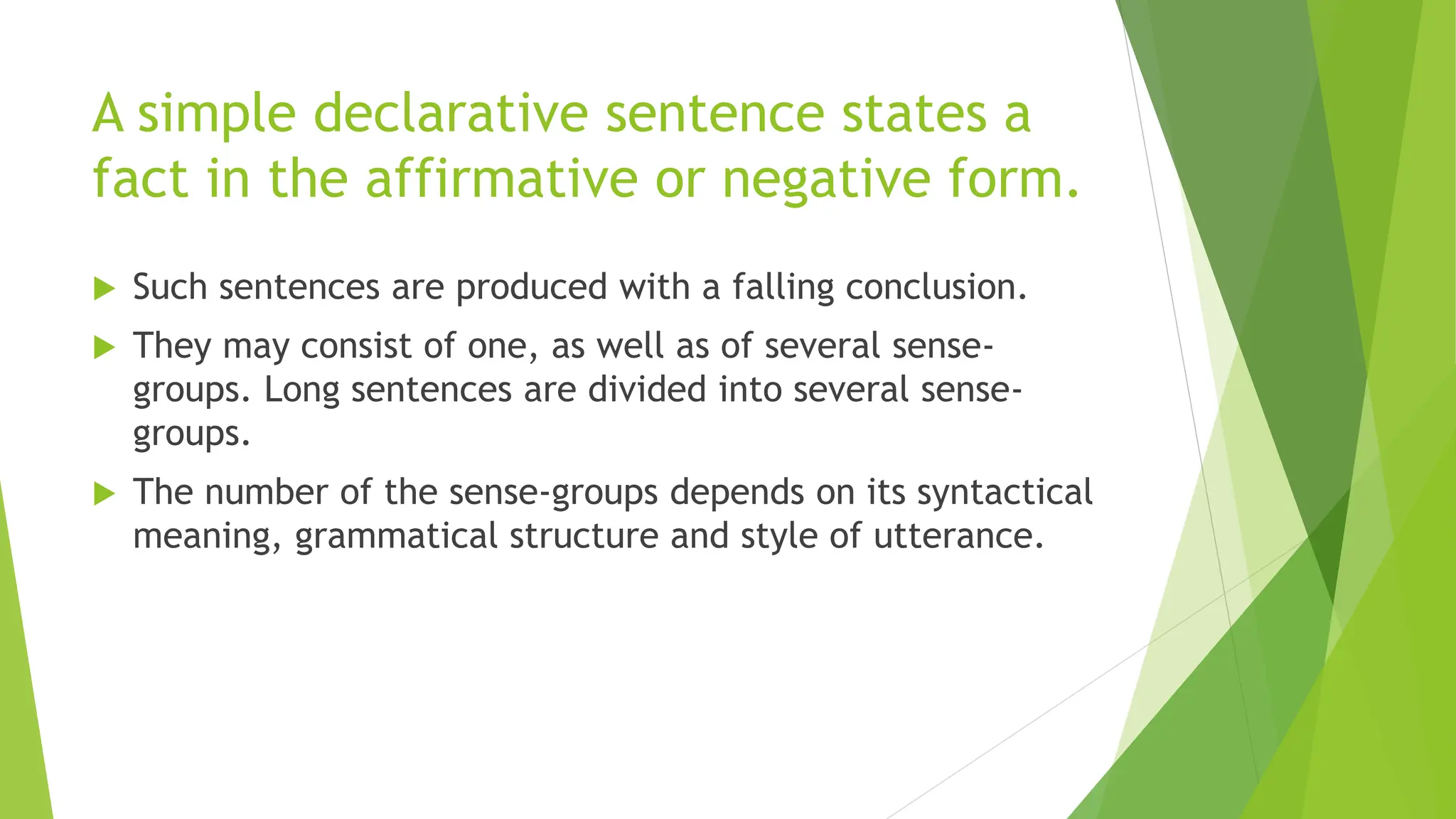
A simple declarative sentence states a
fact in the affirmative or negative form.
 Such sentences are produced with a falling conclusion.
 They may consist of one, as well as of several sense-
groups. Long sentences are divided into several sense-
groups.
 The number of the sense-groups depends on its syntactical
meaning, grammatical structure and style of utterance.
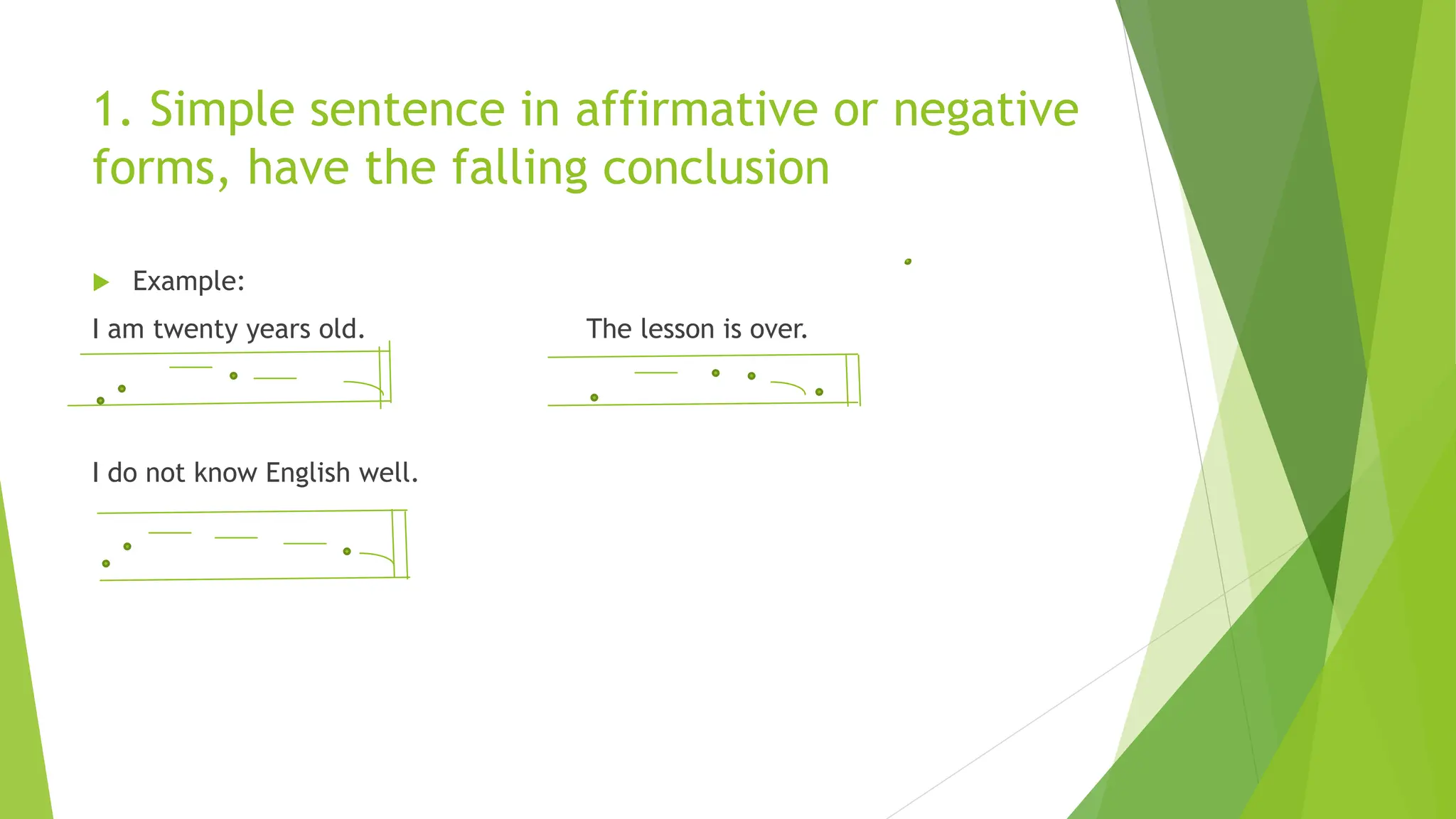
1. Simple sentence in affirmative or negative
forms, have the falling conclusion
 Example:
I am twenty years old. The lesson is over.
I do not know English well.
c
2. Simple sentences containing some attributive subject
groups, adverbial modifier of time and place, some
syntactical phrases and constructions are said in the
following ways:
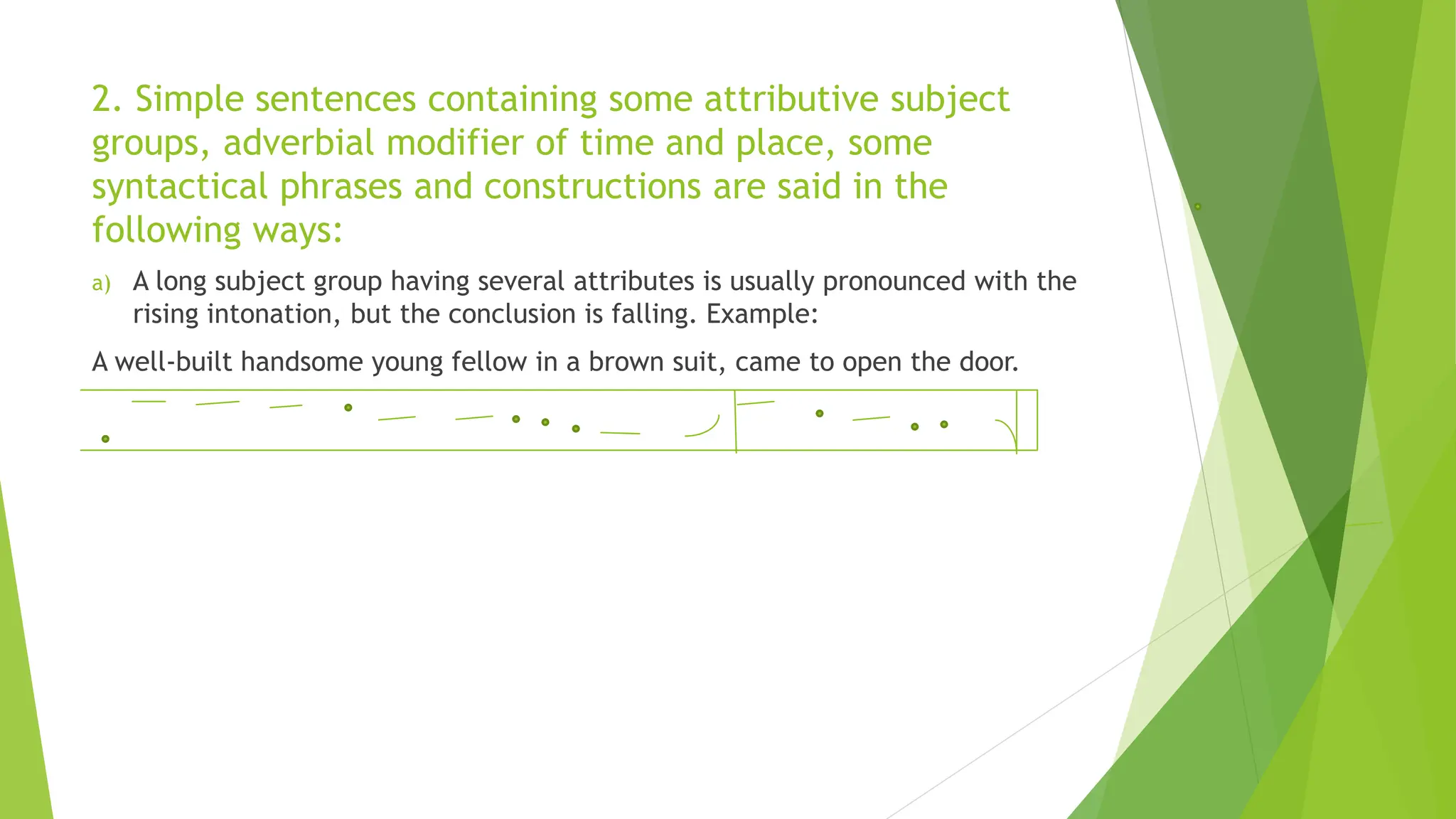
a) A long subject group having several attributes is usually pronounced with the
rising intonation, but the conclusion is falling. Example:
A well-built handsome young fellow in a brown suit, came to open the door.
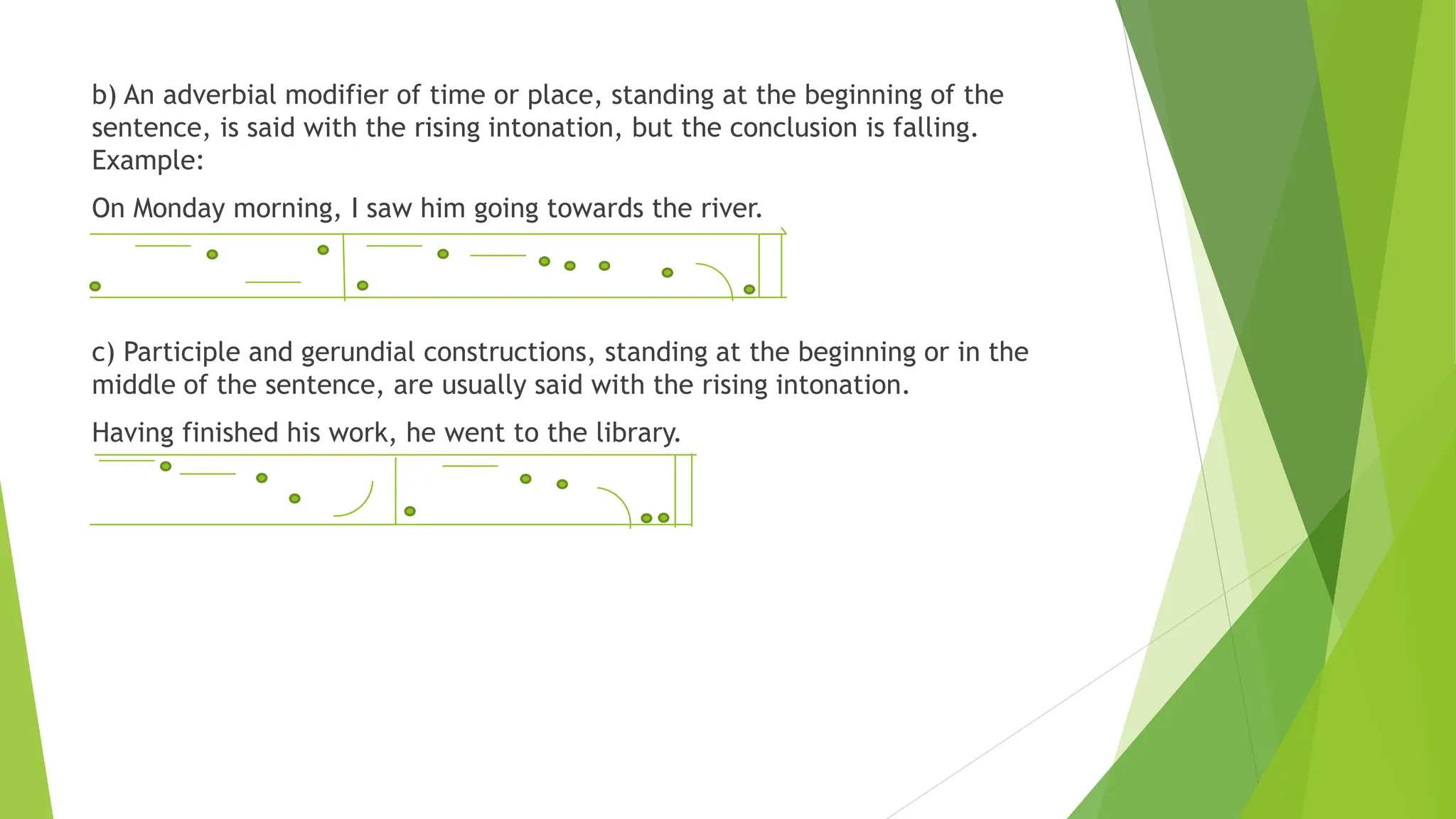
b) An adverbial modifier of time or place, standing at the beginning of the
sentence, is said with the rising intonation, but the conclusion is falling.
Example:
On Monday morning, I saw him going towards the river.
c) Participle and gerundial constructions, standing at the beginning or in the
middle of the sentence, are usually said with the rising intonation.
Having finished his work, he went to the library.
Note:
The part of the main sentence, preceding the participle construction, is also said
with the rising intonation. Example:
The fair-haired young girl, speaking in a trembling voice, was the chairman of a
collective-farm.
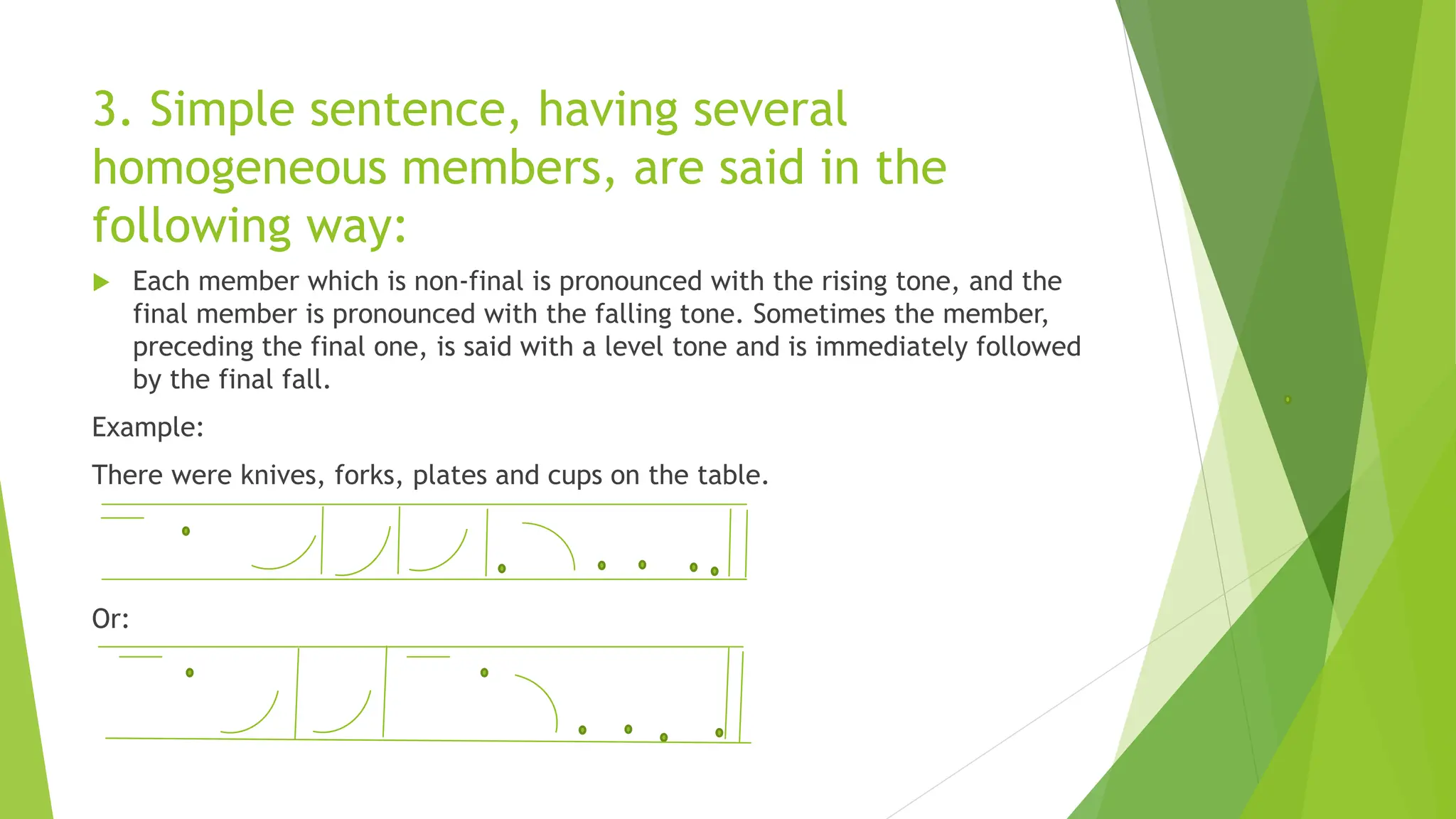
3. Simple sentence, having several
homogeneous members, are said in the
following way:
 Each member which is non-final is pronounced with the rising tone, and the
final member is pronounced with the falling tone. Sometimes the member,
preceding the final one, is said with a level tone and is immediately followed
by the final fall.
Example:
There were knives, forks, plates and cups on the table.
Or:
Note:
In some cases the enumerated parts may be pronounced with the falling tone.
This is usually observed in sentences expressing a special prominence. For
example:
He could imitate other people’s speech, their accent, their mannerisms, their
tones.
4. In sentences containing loose or detached
appositions we can have several equally important
sense groups.
The apposition may stand either in the middle or at the end of the simple
sentence, having its own stress and melody. The apposition standing in the
middle is said with the rising, but at the end- with the falling intonation.
Example:
Dr. Winchcliffe, my predecessor, was a classmate of my father.
This is Mr. Arnold, the dentist.

Intonation of declarative sentenches.pptx

  • 1.
  • 2.
    A simple declarativesentence states a fact in the affirmative or negative form.  Such sentences are produced with a falling conclusion.  They may consist of one, as well as of several sense- groups. Long sentences are divided into several sense- groups.  The number of the sense-groups depends on its syntactical meaning, grammatical structure and style of utterance.
  • 3.
    1. Simple sentencein affirmative or negative forms, have the falling conclusion  Example: I am twenty years old. The lesson is over. I do not know English well. c
  • 4.
    2. Simple sentencescontaining some attributive subject groups, adverbial modifier of time and place, some syntactical phrases and constructions are said in the following ways: a) A long subject group having several attributes is usually pronounced with the rising intonation, but the conclusion is falling. Example: A well-built handsome young fellow in a brown suit, came to open the door.
  • 5.
    b) An adverbialmodifier of time or place, standing at the beginning of the sentence, is said with the rising intonation, but the conclusion is falling. Example: On Monday morning, I saw him going towards the river. c) Participle and gerundial constructions, standing at the beginning or in the middle of the sentence, are usually said with the rising intonation. Having finished his work, he went to the library.
  • 6.
    Note: The part ofthe main sentence, preceding the participle construction, is also said with the rising intonation. Example: The fair-haired young girl, speaking in a trembling voice, was the chairman of a collective-farm.
  • 7.
    3. Simple sentence,having several homogeneous members, are said in the following way:  Each member which is non-final is pronounced with the rising tone, and the final member is pronounced with the falling tone. Sometimes the member, preceding the final one, is said with a level tone and is immediately followed by the final fall. Example: There were knives, forks, plates and cups on the table. Or:
  • 8.
    Note: In some casesthe enumerated parts may be pronounced with the falling tone. This is usually observed in sentences expressing a special prominence. For example: He could imitate other people’s speech, their accent, their mannerisms, their tones.
  • 9.
    4. In sentencescontaining loose or detached appositions we can have several equally important sense groups. The apposition may stand either in the middle or at the end of the simple sentence, having its own stress and melody. The apposition standing in the middle is said with the rising, but at the end- with the falling intonation. Example: Dr. Winchcliffe, my predecessor, was a classmate of my father. This is Mr. Arnold, the dentist.