SELECTION SKILLS

http://groups.yahoo.com/group/hrcommunity
PROGRAMME OBJECTIVES


Create an understanding of Selection tools
and techniques and their appropriateness



Understand competency based selection



Learn interviewing skills



Understand the need for psychometric testing
http://groups.yahoo.com/group/hrcommunity
LEARNING GRID
Unconscious
competence
IV

Conscious competence

Practice

Unlearning/Review

Unconscious
Incompetence
I

III
Learning/Training

Awareness

Conscious
incompetence
II

http://groups.yahoo.com/group/hrcommunity
RECRUITMENT & SELECTION














Manpower Planning
Setting Specs
Advertising/Consultant/Online/Referral
Shortlisting CV’s
Calling candidates
Group Process/Psychometric Testing
Interviews
Offer letter
Joining
Induction
Training
Grooming for productivity

http://groups.yahoo.com/group/hrcommunity
COMMON ERRORS IN RECRUITING
Right person

Wrong Person

A

Selected

Not selected

B

http://groups.yahoo.com/group/hrcommunity
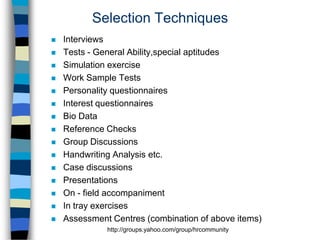
Selection Techniques

















Interviews
Tests - General Ability,special aptitudes
Simulation exercise
Work Sample Tests
Personality questionnaires
Interest questionnaires
Bio Data
Reference Checks
Group Discussions
Handwriting Analysis etc.
Case discussions
Presentations
On - field accompaniment
In tray exercises
Assessment Centres (combination of above items)
http://groups.yahoo.com/group/hrcommunity
Perfect Prediction - Validity
0.7

Assessment Centers (development)

0.6

Work sample Tests

Ability Tests

Assessment Centers (selection)

0.5

Personality Tests

0.4
0.3
0.2

Structured Interviews
Typical Interviews
References

0.1

Astrology/Graphology

0

Chance

Smith, Gregg & Andrews - 1987
http://groups.yahoo.com/group/hrcommunity
RANKING OF SELECTION METHODOLOGIES

1

Patterns of past behaviour

2

TESTS - reported present behaviour

3

Interviews - with many ‘How would you
behave in the future’ questions
http://groups.yahoo.com/group/hrcommunity
WHY DIFFERENT SELECTION TOOLS ?


Any one tool cannot get all the data



Need a set of different tools, which
involve testing different faculties and
behavior of candidates



Each tool is effective for for a specific
set of relevant attributes
http://groups.yahoo.com/group/hrcommunity
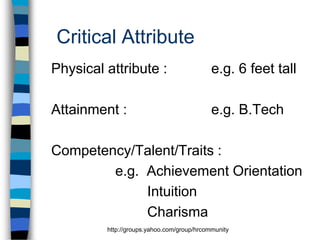
Critical Attribute
Physical attribute :

e.g. 6 feet tall

Attainment :

e.g. B.Tech

Competency/Talent/Traits :
e.g. Achievement Orientation
Intuition
Charisma
http://groups.yahoo.com/group/hrcommunity
Competency
Any quality or characteristic of
a person, which underpins
recurring successful
performance

http://groups.yahoo.com/group/hrcommunity
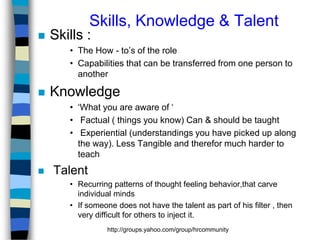
Skills, Knowledge & Talent



Skills :

• The How - to’s of the role
• Capabilities that can be transferred from one person to
another



Knowledge
• ‘What you are aware of ‘
• Factual ( things you know) Can & should be taught
• Experiential (understandings you have picked up along
the way). Less Tangible and therefor much harder to
teach



Talent
• Recurring patterns of thought feeling behavior,that carve
individual minds
• If someone does not have the talent as part of his filter , then
very difficult for others to inject it.
http://groups.yahoo.com/group/hrcommunity
The three levels of competencies are



DISTINGUISHING



THRESHOLD



FUNCTIONAL

http://groups.yahoo.com/group/hrcommunity
A CHECK LIST FOR BEHAVIOURAL
INDICATORS
Each indicator should:








Describe directly observable behavior, or
other specific evidence of an individual’s
competency
Describe just one piece of behavior of
evidence
Not to be duplicated under two or more
competencies
Include a verb phrase i.e. describe action
http://groups.yahoo.com/group/hrcommunity
THE COMPETENCY
PLANNING & ORGANISING
Definition : Level 1 - Junior Manager






Manages own time and personal
activities
Breaks complex activities into
manageable tasks
Identifies possible obstacles to planned
achievements
http://groups.yahoo.com/group/hrcommunity
THE COMPETENCY
PLANNING & ORGANISING
Definition : Level 2 - Middle Manager






Produces contingency plans for possible
future occurrences
Estimates in advance the resources and time
scales needed to meet objectives
Co-ordinates team activities to make the best
use of individual skills and specializations
http://groups.yahoo.com/group/hrcommunity
THE COMPETENCY
PLANNING & ORGANISING
Definition : Level 3 - Senior Manager


Identifies longer term operational
implications of business plans



Effectively plans utilization of all
resources
http://groups.yahoo.com/group/hrcommunity
THE 12 MOST COMMON COMPETENCIES













Communication
Achievement orientation
Customer Focus
Team work
Leadership
Planning and organising
Commercial awareness
Flexibility
Developing others
Problem solving
Analytical thinking
Building relationships

Source: Competency based Recruitment & Selection by Robert Wood and
Tim Payne
http://groups.yahoo.com/group/hrcommunity
Competencies & Trainability
SKILLS
TRAITS
MOTIVES
VALUES
COGNITIVE
CAPBILITIES

Less Conscious
Less Trainable

More conscious
KNOWLEDGE

E.g.: Has contacts
E.g.: Results orientation,planning abilities
http://groups.yahoo.com/group/hrcommunity

More trainable
Critical Attributes for Sales Managers
( Example)









Interpersonal Skills
Influencing Skills
Results orientation
Customer Concern
Technical expertise
Providing direction
Analytical Thinking









Conceptual thinking
Information seeking
Staff development
Team building
Planning
Decision Making

http://groups.yahoo.com/group/hrcommunity
Interview

Entrevoir ( French)
to have a glimpse of

http://groups.yahoo.com/group/hrcommunity
WHAT IS AN INTERVIEW?

A selection procedure designed to predict
future job performance on the basis of
applicants oral responses to oral enquiries
http://groups.yahoo.com/group/hrcommunity
OBJECTIVES OF SELECTION IN INTERVIEW
1

Selecting people for jobs by:

 Informing applicants about the job



2

Gaining unbiased factual information against the
criteria
Influencing suitable candidates to accept

Demonstrating that the company
operates a fair and equitable selection
procedure (Public Relations)
http://groups.yahoo.com/group/hrcommunity
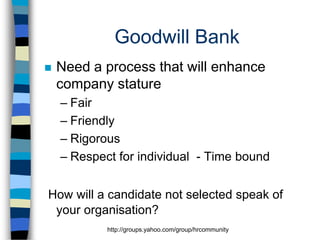
Goodwill Bank


Need a process that will enhance
company stature
– Fair
– Friendly
– Rigorous
– Respect for individual - Time bound

How will a candidate not selected speak of
your organisation?
http://groups.yahoo.com/group/hrcommunity
SELECTION INTERVIEW - EFFECTIVENESS
Bottom line Test - Answering Three key
questions


Can he do the job

(Competence)



Will he do the job



Will he fit in ( Team / Organisation)? ( Match)
http://groups.yahoo.com/group/hrcommunity

( Motivation)
SELECTION INTERVIEW









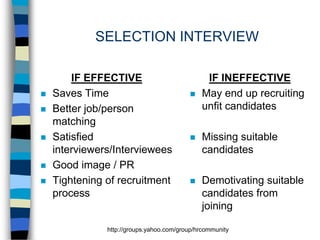
IF EFFECTIVE
Saves Time
Better job/person
matching
Satisfied
interviewers/Interviewees
Good image / PR
Tightening of recruitment
process



IF INEFFECTIVE
May end up recruiting
unfit candidates



Missing suitable
candidates



Demotivating suitable
candidates from
joining

http://groups.yahoo.com/group/hrcommunity
UNDERSTANDING YOUR APPLICANTS
According to research, students have listed the
following Organisational characteristics as important
to them:












Type of work you would do
Type of people you would like to work with
Training & development opportunities
Chances of promotion
Salary
Job security
Working condition
Reputation/image of the organisation
Geographical location
Hours expected at work
Benefits ( Company car, Pension , Loans etc.)
http://groups.yahoo.com/group/hrcommunity
INTERVIEW PROCESS - REQUIREMENTS
Venue
INTERVIEW
PROCESS

CANDIDATE

INTERVIEWER

Expects
•Professionalism
•Realistic picture of job &
company/organisation
•Input on where he
stands (process, time
scale etc.)
•Minimal Wait
•Objectivity

Needs:
• Purpose of I/V
• Agreed Criteria
• Application form
•Time to prepare and judge job
and company knowledge
•Skills to obtain & evaluate
information and make effective
judgements
• Relaxed and open minded
• Right attitude

http://groups.yahoo.com/group/hrcommunity
List the things you would like to
have seen when you last went for
an interview.
What did you expect from the
company ?

http://groups.yahoo.com/group/hrcommunity
SETTING THE ENVIRONMENT









No disturbance
No phone Calls
Seating - Neutral ( Perhaps an L shape )
No distraction in the vicinity
No ‘Power Statements’
Having water available on the table ( for
candidate )
Have stationary ready ( for candidate )
http://groups.yahoo.com/group/hrcommunity
Remember


Note taking - minimal , with permission



Stress Interviews - Try to avoid



Politeness - specially to ‘bad’



Airtime - 80 - 20
http://groups.yahoo.com/group/hrcommunity
INTERVIEW STRUCTURE
1
2

Opening, rapport building
Current & previous roles

3

Aspirations & awareness

4

Education & upbringing

5

Circumstances & interests

6

Closing , wrap up
http://groups.yahoo.com/group/hrcommunity
Interview - An Information Sorting
Model
Opening & Rapport Building

CA 1

Current & Previous Roles

CA2

Aspirations & Awareness

Information
Sorting

Education & Upbringing

Circumstances & Interest

CA3
CA4
CA5

Closing/Wrap up

Assessment
http://groups.yahoo.com/group/hrcommunity
OPENING, RAPPORT BUILDING


Appropriate recognition



Relaxed Approach



Introduce yourself



Share

- Interview purpose
» Recruitment process
» Job Role ( briefly)
» Interview structure & Time



Check Understanding
http://groups.yahoo.com/group/hrcommunity
Things to look out for in a CV


Organisation of events - Priority accordance



Clarity of depiction and succinctness



Unexplained breaks in Service and Education



Extent of customisation to the job applied



Quality of the CV: mode , spelling errors,
verbosity
http://groups.yahoo.com/group/hrcommunity
QUESTIONING SKILLS

http://groups.yahoo.com/group/hrcommunity
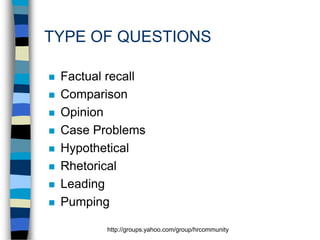
TYPE OF QUESTIONS









Factual recall
Comparison
Opinion
Case Problems
Hypothetical
Rhetorical
Leading
Pumping
http://groups.yahoo.com/group/hrcommunity
PAST BEHAVIOUR is the
single best predictor of
future behaviour

http://groups.yahoo.com/group/hrcommunity
Structure of Questions


Open ended Questions

How - What - When - Where - Who - Why



Close ended Questions

Do you - Did you - Can you - Will you - Could you Would you - Should you


Prompting/ encouraging expressions

Tell me…, Describe …
For example?, For instance?, In what sense?
How come?, In simpler terms...
http://groups.yahoo.com/group/hrcommunity
Questioning Pattern
Broad Open ended
Probe

Narrow

Close
Summarise
http://groups.yahoo.com/group/hrcommunity
Characteristics of Good Questions







Purposeful
Relevant
Clear & concise
Limited to one idea
Neutral in tone & substance

http://groups.yahoo.com/group/hrcommunity
The quality & value of
answer depends on
the quality of the
question
http://groups.yahoo.com/group/hrcommunity
QUESTIONS COVERAGE


WHAT Q’s - Elicit information about knowledge,
facts/data, opinions



WHY Q’s - Analytical skills , reasoning, logic etc.
motivations( what else…How else…, Where else….)



HOW Q’s - Knowledge of functional skills,
process/steps ( also analytical skills)



HOW MUCH/HOW WELL Q’s - validating
achievements
http://groups.yahoo.com/group/hrcommunity
THE INTERVIEW FUNNEL
START WITH AN OPEN ENDED QUESTION
LISTEN
NARROW DOWN TO SPECIFIC AREA

LISTEN
HOW DID THE PERSON GO ABOUT IT
LISTEN
FIND OUT MOTIVATIONS

LISTEN
ACHIEVEMENTS

LISTEN
SUMMARISE
AND SEEK
AGREEMENT
START WITH NEW AREA
http://groups.yahoo.com/group/hrcommunity
INTERVIEW STRUCTURE
1. Opening

-

2. Current & Previous
roles
3. Aspiration /
Awareness
4. Education &
Upbringing
5. Circumstances &
Interest
6. Closing

What, why, How well

Trends, people are not
static

What, why, how realistic
What, why, how well
What, why, how well
implication
-

Causes – relate past to
present

Description
Motivation
Achievement
http://groups.yahoo.com/group/hrcommunity
THE PANEL INTERVIEW
SOME GUIDELINES



Agree roles & structures



Stick to roles



Do not interrupt



Do not help the candidate



Select lead interviewer



The others listen,take notes ( factual) , ask questions
around other key areas and observe non verbal
behavior



Follow up at end of a section
http://groups.yahoo.com/group/hrcommunity
Questioning Technique


Situation



Task



Achievement



Review
http://groups.yahoo.com/group/hrcommunity
Telephonic Interviews








You cannot see the candidate , so you have to trust only two
senses - hearing & intuition
Do not short circuit the interview. The process should be the
same as a face-to-face interview
Follow the interview structure
Use the funnel - what, why, how,how well
Use many encouraging , prompting expressions ,like …
•
•
•
•
•
•




Yes
Tell me more
Describe
I see
For example?
In what sense?

Keep sentences & discussions short
Summarise each section
http://groups.yahoo.com/group/hrcommunity
INTERVIEW TIPS


Interviewers need to be provided with job description
& specification of the requirements of the position to
minimize the influence of stereotypes



Interview questions need to be job related



Avoid making quick decisions about an applicant



Avoid giving too much weight to a few characteristics



Try to put the applicant at ease during the interview



Communicate clearly with the applicant



Maintain consistency in the questions asked
http://groups.yahoo.com/group/hrcommunity
Management Interviewing


Less emphasis on background : more on role and
work



Ask about aspirations before role



Easy for candidate to obscure track record through
jargon and generalities



A ‘look good, talk good’ candidate may land up
interviewing the interviewer - superficial interview

may take place


Hence be specific - focus on Critical attributes
http://groups.yahoo.com/group/hrcommunity
Focus on Roles


Job titles can be misleading



Main areas of job . Principal tasks that you do
personally? Why’? How do you divide your time?



Performance criteria,targets,priorities,performance
ratings,informal reviews



Focus on relationships - up, down , or with
colleagues



Time perspective



Breadth of perception of job relative to entire
organisation



Perceived freedom to act



Ability to influence the organisation
http://groups.yahoo.com/group/hrcommunity
Management skills


How results are achieved and how the candidate
handles the process of management



Setting objectives for self and team



Decision making style - alone or team



Resolving conflicts - how and when



Handling customers - relationship based and task
based



Resolving issues between internal demands and
customer expectations
http://groups.yahoo.com/group/hrcommunity
Management focus


Motivational style - sort of environment in
team. Leading team front or back



Grooming others - spending time for
developing people



Investing in self - learning & growing



Monitoring work of self and team



Handling communication & consultation



Influencing others through meetings and
presentations
http://groups.yahoo.com/group/hrcommunity
TYPES OF INTERVIEWS


Unstructured Interview



Situational Interview



Behaviour Description interview



Comprehensive structured interview



Structured behavioural interview



Oral Interview boards
http://groups.yahoo.com/group/hrcommunity
INTERVIEWING FOR TALENT

http://groups.yahoo.com/group/hrcommunity
TALENT
What is Talent?
A recurring pattern of
thought, feeling or behavior
that can be productively
applied
http://groups.yahoo.com/group/hrcommunity
TALENT
According to Gallup there are 3 kinds of talent:

1. Striving : Why of the person
2. Thinking: How of the person

3. Relating : Who of the person
http://groups.yahoo.com/group/hrcommunity
Talent ( some examples)


Striving
• Achiever ( A drive that is internal, constant &
self imposed )
• Mission ( a drive to put your beliefs into actions)



Thinking
• Responsibility (A need to assume personal
accountability for your work )
• Numerical ( An affinity for numbers )



Relating
• Relator ( a need to build bonds that last )
• Command ( an ability to take charge )
http://groups.yahoo.com/group/hrcommunity
Talent Interview
(Points to remember)


This should stand alone



It should be more structured , more
focussed, less banter , more questions



Ask him about choices he makes



Let him reveal himself to you

http://groups.yahoo.com/group/hrcommunity
Talent Interview
(Listen for specifics)
1. Always listen for a specific example
2. Give credit only to the person’s top of the mind
response
3. Do not probe too much to get response
Clues for talent:
Rapid learning ability
Source of satisfaction
After they have been hired , check back to see if the
people who subsequently performed well answered
your question in a consistent way.This will take time
and focus , but are essential to the art of interviewing
for talent.
http://groups.yahoo.com/group/hrcommunity
PSYCHOMETRIC TESTING
Psychological tests have been devised and are used
primarily for the determination and analysis of
individual differences in general intelligence,specific
aptitudes , educational achievement , vocational
fitness,and non intellectual personality traits.
These tests have been used for a variety of
psychological , educational cultural , sociological and
employment studies of groups and for individuals

http://groups.yahoo.com/group/hrcommunity
TEST - VARIATIONS








Achievement / Attainment
Aptitude
Personality
Interest
Attitude
IQ ( Intelligence quotient)

http://groups.yahoo.com/group/hrcommunity
APPLICATIONS OF PSYCHOMETRIC
TESTING









Placement
Personnel selection
Training & development
Career & Succession Planning
Diagnosis & recommendation of
Performance problems
Vocational education and career
counseling
http://groups.yahoo.com/group/hrcommunity
WHY TESTS


To reduce errors

• Standardized set of questions
• Objective evaluation
http://groups.yahoo.com/group/hrcommunity
SELECTING TESTS


SOURCES



METRICS



INTERPRETATION

http://groups.yahoo.com/group/hrcommunity
ONLINE TESTING








Standardization
Easy to administer across locations
Quick
Automatic Reports
Does not need interpretation expertise
Still requires to be anchored by qualified
persons
http://groups.yahoo.com/group/hrcommunity
REFERENCE CHECKS









Verify claims made by the candidate
Confirm selectors perceptions, sensing and
inferences
Clarify doubts that may have arisen during
the selection process
Add to understanding through input from
referee or any specific area of concern
Hear first hand from referee or anything
significant about the candidate ( positive or
dysfunctional)
http://groups.yahoo.com/group/hrcommunity
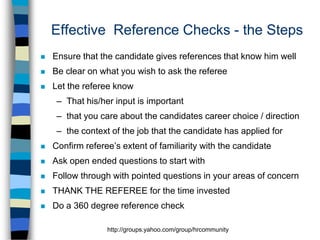
Effective Reference Checks - the Steps


Ensure that the candidate gives references that know him well



Be clear on what you wish to ask the referee



Let the referee know
– That his/her input is important
– that you care about the candidates career choice / direction
– the context of the job that the candidate has applied for



Confirm referee’s extent of familiarity with the candidate



Ask open ended questions to start with



Follow through with pointed questions in your areas of concern



THANK THE REFEREE for the time invested



Do a 360 degree reference check
http://groups.yahoo.com/group/hrcommunity
ASSESSMENT

http://groups.yahoo.com/group/hrcommunity
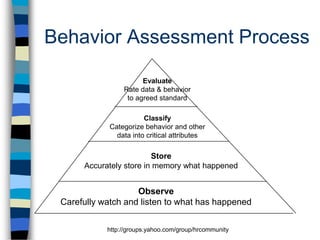
Behavior Assessment Process
Evaluate
Rate data & behavior
to agreed standard
Classify
Categorize behavior and other
data into critical attributes

Store
Accurately store in memory what happened

Observe
Carefully watch and listen to what has happened
http://groups.yahoo.com/group/hrcommunity
ASSESSMENT GUIDELINES


People tend to behave in a consistent way



Understand the context of people’s behavior



Relate information from one source to another

http://groups.yahoo.com/group/hrcommunity
RATINGS


Excellent - 4
Tremendous amount of data across all
sections supporting the indicators. Goes
beyond the indicators. A big strength
area. This is where the candidate
operates from,as a psychological
platform ( will be an adjective for him )
http://groups.yahoo.com/group/hrcommunity
RATINGS


V Good - 3
A lot of data from at least two three
sections, or overwhelmingly in at least
one section supporting the indicators.
This is the way the indicators are
defined. Supports with examples

http://groups.yahoo.com/group/hrcommunity
RATINGS


Acceptable - 2
Evidence from at least one section of
the interview. Supports at least 2/3 of
the indicators. Will do. Exhibits data with
some examples

http://groups.yahoo.com/group/hrcommunity
RATINGS


Not acceptable - 1
Shows definite evidence of lack of the
indicators. Falls short

http://groups.yahoo.com/group/hrcommunity
COMMON FAILINGS IN ASSESSMENT


Leniency



The Halo effect



Mirror image



Contrast



Projection
http://groups.yahoo.com/group/hrcommunity
Happy Interviewing

http://groups.yahoo.com/group/hrcommunity
Dear Colleague,
This is a personal invitation from us to you to join our
hrcommunity. The hrcommunity virtually connects HR
professionals to share current and emerging HR
practices, HR resources & HR related information.
Be in touch with the best brains in the hrcommunity.
To join send a blank e-mail to
hrcommunity-subscribe@yahoogroups.com
Warm regards,Jayesh & Aruna
Moderators – hrcommunity

http://groups.yahoo.com/group/hrcommunity

Interviewing skills

  • 1.
  • 2.
    PROGRAMME OBJECTIVES  Create anunderstanding of Selection tools and techniques and their appropriateness  Understand competency based selection  Learn interviewing skills  Understand the need for psychometric testing http://groups.yahoo.com/group/hrcommunity
  • 3.
  • 4.
    RECRUITMENT & SELECTION             ManpowerPlanning Setting Specs Advertising/Consultant/Online/Referral Shortlisting CV’s Calling candidates Group Process/Psychometric Testing Interviews Offer letter Joining Induction Training Grooming for productivity http://groups.yahoo.com/group/hrcommunity
  • 5.
    COMMON ERRORS INRECRUITING Right person Wrong Person A Selected Not selected B http://groups.yahoo.com/group/hrcommunity
  • 6.
    Selection Techniques                Interviews Tests -General Ability,special aptitudes Simulation exercise Work Sample Tests Personality questionnaires Interest questionnaires Bio Data Reference Checks Group Discussions Handwriting Analysis etc. Case discussions Presentations On - field accompaniment In tray exercises Assessment Centres (combination of above items) http://groups.yahoo.com/group/hrcommunity
  • 7.
    Perfect Prediction -Validity 0.7 Assessment Centers (development) 0.6 Work sample Tests Ability Tests Assessment Centers (selection) 0.5 Personality Tests 0.4 0.3 0.2 Structured Interviews Typical Interviews References 0.1 Astrology/Graphology 0 Chance Smith, Gregg & Andrews - 1987 http://groups.yahoo.com/group/hrcommunity
  • 8.
    RANKING OF SELECTIONMETHODOLOGIES 1 Patterns of past behaviour 2 TESTS - reported present behaviour 3 Interviews - with many ‘How would you behave in the future’ questions http://groups.yahoo.com/group/hrcommunity
  • 9.
    WHY DIFFERENT SELECTIONTOOLS ?  Any one tool cannot get all the data  Need a set of different tools, which involve testing different faculties and behavior of candidates  Each tool is effective for for a specific set of relevant attributes http://groups.yahoo.com/group/hrcommunity
  • 10.
    Critical Attribute Physical attribute: e.g. 6 feet tall Attainment : e.g. B.Tech Competency/Talent/Traits : e.g. Achievement Orientation Intuition Charisma http://groups.yahoo.com/group/hrcommunity
  • 11.
    Competency Any quality orcharacteristic of a person, which underpins recurring successful performance http://groups.yahoo.com/group/hrcommunity
  • 12.
    Skills, Knowledge &Talent  Skills : • The How - to’s of the role • Capabilities that can be transferred from one person to another  Knowledge • ‘What you are aware of ‘ • Factual ( things you know) Can & should be taught • Experiential (understandings you have picked up along the way). Less Tangible and therefor much harder to teach  Talent • Recurring patterns of thought feeling behavior,that carve individual minds • If someone does not have the talent as part of his filter , then very difficult for others to inject it. http://groups.yahoo.com/group/hrcommunity
  • 13.
    The three levelsof competencies are  DISTINGUISHING  THRESHOLD  FUNCTIONAL http://groups.yahoo.com/group/hrcommunity
  • 14.
    A CHECK LISTFOR BEHAVIOURAL INDICATORS Each indicator should:     Describe directly observable behavior, or other specific evidence of an individual’s competency Describe just one piece of behavior of evidence Not to be duplicated under two or more competencies Include a verb phrase i.e. describe action http://groups.yahoo.com/group/hrcommunity
  • 15.
    THE COMPETENCY PLANNING &ORGANISING Definition : Level 1 - Junior Manager    Manages own time and personal activities Breaks complex activities into manageable tasks Identifies possible obstacles to planned achievements http://groups.yahoo.com/group/hrcommunity
  • 16.
    THE COMPETENCY PLANNING &ORGANISING Definition : Level 2 - Middle Manager    Produces contingency plans for possible future occurrences Estimates in advance the resources and time scales needed to meet objectives Co-ordinates team activities to make the best use of individual skills and specializations http://groups.yahoo.com/group/hrcommunity
  • 17.
    THE COMPETENCY PLANNING &ORGANISING Definition : Level 3 - Senior Manager  Identifies longer term operational implications of business plans  Effectively plans utilization of all resources http://groups.yahoo.com/group/hrcommunity
  • 18.
    THE 12 MOSTCOMMON COMPETENCIES             Communication Achievement orientation Customer Focus Team work Leadership Planning and organising Commercial awareness Flexibility Developing others Problem solving Analytical thinking Building relationships Source: Competency based Recruitment & Selection by Robert Wood and Tim Payne http://groups.yahoo.com/group/hrcommunity
  • 19.
    Competencies & Trainability SKILLS TRAITS MOTIVES VALUES COGNITIVE CAPBILITIES LessConscious Less Trainable More conscious KNOWLEDGE E.g.: Has contacts E.g.: Results orientation,planning abilities http://groups.yahoo.com/group/hrcommunity More trainable
  • 20.
    Critical Attributes forSales Managers ( Example)        Interpersonal Skills Influencing Skills Results orientation Customer Concern Technical expertise Providing direction Analytical Thinking       Conceptual thinking Information seeking Staff development Team building Planning Decision Making http://groups.yahoo.com/group/hrcommunity
  • 21.
    Interview Entrevoir ( French) tohave a glimpse of http://groups.yahoo.com/group/hrcommunity
  • 22.
    WHAT IS ANINTERVIEW? A selection procedure designed to predict future job performance on the basis of applicants oral responses to oral enquiries http://groups.yahoo.com/group/hrcommunity
  • 23.
    OBJECTIVES OF SELECTIONIN INTERVIEW 1 Selecting people for jobs by:  Informing applicants about the job   2 Gaining unbiased factual information against the criteria Influencing suitable candidates to accept Demonstrating that the company operates a fair and equitable selection procedure (Public Relations) http://groups.yahoo.com/group/hrcommunity
  • 24.
    Goodwill Bank  Need aprocess that will enhance company stature – Fair – Friendly – Rigorous – Respect for individual - Time bound How will a candidate not selected speak of your organisation? http://groups.yahoo.com/group/hrcommunity
  • 25.
    SELECTION INTERVIEW -EFFECTIVENESS Bottom line Test - Answering Three key questions  Can he do the job (Competence)  Will he do the job  Will he fit in ( Team / Organisation)? ( Match) http://groups.yahoo.com/group/hrcommunity ( Motivation)
  • 26.
    SELECTION INTERVIEW      IF EFFECTIVE SavesTime Better job/person matching Satisfied interviewers/Interviewees Good image / PR Tightening of recruitment process  IF INEFFECTIVE May end up recruiting unfit candidates  Missing suitable candidates  Demotivating suitable candidates from joining http://groups.yahoo.com/group/hrcommunity
  • 27.
    UNDERSTANDING YOUR APPLICANTS Accordingto research, students have listed the following Organisational characteristics as important to them:            Type of work you would do Type of people you would like to work with Training & development opportunities Chances of promotion Salary Job security Working condition Reputation/image of the organisation Geographical location Hours expected at work Benefits ( Company car, Pension , Loans etc.) http://groups.yahoo.com/group/hrcommunity
  • 28.
    INTERVIEW PROCESS -REQUIREMENTS Venue INTERVIEW PROCESS CANDIDATE INTERVIEWER Expects •Professionalism •Realistic picture of job & company/organisation •Input on where he stands (process, time scale etc.) •Minimal Wait •Objectivity Needs: • Purpose of I/V • Agreed Criteria • Application form •Time to prepare and judge job and company knowledge •Skills to obtain & evaluate information and make effective judgements • Relaxed and open minded • Right attitude http://groups.yahoo.com/group/hrcommunity
  • 29.
    List the thingsyou would like to have seen when you last went for an interview. What did you expect from the company ? http://groups.yahoo.com/group/hrcommunity
  • 30.
    SETTING THE ENVIRONMENT        Nodisturbance No phone Calls Seating - Neutral ( Perhaps an L shape ) No distraction in the vicinity No ‘Power Statements’ Having water available on the table ( for candidate ) Have stationary ready ( for candidate ) http://groups.yahoo.com/group/hrcommunity
  • 31.
    Remember  Note taking -minimal , with permission  Stress Interviews - Try to avoid  Politeness - specially to ‘bad’  Airtime - 80 - 20 http://groups.yahoo.com/group/hrcommunity
  • 32.
    INTERVIEW STRUCTURE 1 2 Opening, rapportbuilding Current & previous roles 3 Aspirations & awareness 4 Education & upbringing 5 Circumstances & interests 6 Closing , wrap up http://groups.yahoo.com/group/hrcommunity
  • 33.
    Interview - AnInformation Sorting Model Opening & Rapport Building CA 1 Current & Previous Roles CA2 Aspirations & Awareness Information Sorting Education & Upbringing Circumstances & Interest CA3 CA4 CA5 Closing/Wrap up Assessment http://groups.yahoo.com/group/hrcommunity
  • 34.
    OPENING, RAPPORT BUILDING  Appropriaterecognition  Relaxed Approach  Introduce yourself  Share - Interview purpose » Recruitment process » Job Role ( briefly) » Interview structure & Time  Check Understanding http://groups.yahoo.com/group/hrcommunity
  • 35.
    Things to lookout for in a CV  Organisation of events - Priority accordance  Clarity of depiction and succinctness  Unexplained breaks in Service and Education  Extent of customisation to the job applied  Quality of the CV: mode , spelling errors, verbosity http://groups.yahoo.com/group/hrcommunity
  • 36.
  • 37.
    TYPE OF QUESTIONS         Factualrecall Comparison Opinion Case Problems Hypothetical Rhetorical Leading Pumping http://groups.yahoo.com/group/hrcommunity
  • 38.
    PAST BEHAVIOUR isthe single best predictor of future behaviour http://groups.yahoo.com/group/hrcommunity
  • 39.
    Structure of Questions  Openended Questions How - What - When - Where - Who - Why  Close ended Questions Do you - Did you - Can you - Will you - Could you Would you - Should you  Prompting/ encouraging expressions Tell me…, Describe … For example?, For instance?, In what sense? How come?, In simpler terms... http://groups.yahoo.com/group/hrcommunity
  • 40.
    Questioning Pattern Broad Openended Probe Narrow Close Summarise http://groups.yahoo.com/group/hrcommunity
  • 41.
    Characteristics of GoodQuestions      Purposeful Relevant Clear & concise Limited to one idea Neutral in tone & substance http://groups.yahoo.com/group/hrcommunity
  • 42.
    The quality &value of answer depends on the quality of the question http://groups.yahoo.com/group/hrcommunity
  • 43.
    QUESTIONS COVERAGE  WHAT Q’s- Elicit information about knowledge, facts/data, opinions  WHY Q’s - Analytical skills , reasoning, logic etc. motivations( what else…How else…, Where else….)  HOW Q’s - Knowledge of functional skills, process/steps ( also analytical skills)  HOW MUCH/HOW WELL Q’s - validating achievements http://groups.yahoo.com/group/hrcommunity
  • 44.
    THE INTERVIEW FUNNEL STARTWITH AN OPEN ENDED QUESTION LISTEN NARROW DOWN TO SPECIFIC AREA LISTEN HOW DID THE PERSON GO ABOUT IT LISTEN FIND OUT MOTIVATIONS LISTEN ACHIEVEMENTS LISTEN SUMMARISE AND SEEK AGREEMENT START WITH NEW AREA http://groups.yahoo.com/group/hrcommunity
  • 45.
    INTERVIEW STRUCTURE 1. Opening - 2.Current & Previous roles 3. Aspiration / Awareness 4. Education & Upbringing 5. Circumstances & Interest 6. Closing What, why, How well Trends, people are not static What, why, how realistic What, why, how well What, why, how well implication - Causes – relate past to present Description Motivation Achievement http://groups.yahoo.com/group/hrcommunity
  • 46.
    THE PANEL INTERVIEW SOMEGUIDELINES  Agree roles & structures  Stick to roles  Do not interrupt  Do not help the candidate  Select lead interviewer  The others listen,take notes ( factual) , ask questions around other key areas and observe non verbal behavior  Follow up at end of a section http://groups.yahoo.com/group/hrcommunity
  • 47.
  • 48.
    Telephonic Interviews      You cannotsee the candidate , so you have to trust only two senses - hearing & intuition Do not short circuit the interview. The process should be the same as a face-to-face interview Follow the interview structure Use the funnel - what, why, how,how well Use many encouraging , prompting expressions ,like … • • • • • •   Yes Tell me more Describe I see For example? In what sense? Keep sentences & discussions short Summarise each section http://groups.yahoo.com/group/hrcommunity
  • 49.
    INTERVIEW TIPS  Interviewers needto be provided with job description & specification of the requirements of the position to minimize the influence of stereotypes  Interview questions need to be job related  Avoid making quick decisions about an applicant  Avoid giving too much weight to a few characteristics  Try to put the applicant at ease during the interview  Communicate clearly with the applicant  Maintain consistency in the questions asked http://groups.yahoo.com/group/hrcommunity
  • 50.
    Management Interviewing  Less emphasison background : more on role and work  Ask about aspirations before role  Easy for candidate to obscure track record through jargon and generalities  A ‘look good, talk good’ candidate may land up interviewing the interviewer - superficial interview may take place  Hence be specific - focus on Critical attributes http://groups.yahoo.com/group/hrcommunity
  • 51.
    Focus on Roles  Jobtitles can be misleading  Main areas of job . Principal tasks that you do personally? Why’? How do you divide your time?  Performance criteria,targets,priorities,performance ratings,informal reviews  Focus on relationships - up, down , or with colleagues  Time perspective  Breadth of perception of job relative to entire organisation  Perceived freedom to act  Ability to influence the organisation http://groups.yahoo.com/group/hrcommunity
  • 52.
    Management skills  How resultsare achieved and how the candidate handles the process of management  Setting objectives for self and team  Decision making style - alone or team  Resolving conflicts - how and when  Handling customers - relationship based and task based  Resolving issues between internal demands and customer expectations http://groups.yahoo.com/group/hrcommunity
  • 53.
    Management focus  Motivational style- sort of environment in team. Leading team front or back  Grooming others - spending time for developing people  Investing in self - learning & growing  Monitoring work of self and team  Handling communication & consultation  Influencing others through meetings and presentations http://groups.yahoo.com/group/hrcommunity
  • 54.
    TYPES OF INTERVIEWS  UnstructuredInterview  Situational Interview  Behaviour Description interview  Comprehensive structured interview  Structured behavioural interview  Oral Interview boards http://groups.yahoo.com/group/hrcommunity
  • 55.
  • 56.
    TALENT What is Talent? Arecurring pattern of thought, feeling or behavior that can be productively applied http://groups.yahoo.com/group/hrcommunity
  • 57.
    TALENT According to Gallupthere are 3 kinds of talent: 1. Striving : Why of the person 2. Thinking: How of the person 3. Relating : Who of the person http://groups.yahoo.com/group/hrcommunity
  • 58.
    Talent ( someexamples)  Striving • Achiever ( A drive that is internal, constant & self imposed ) • Mission ( a drive to put your beliefs into actions)  Thinking • Responsibility (A need to assume personal accountability for your work ) • Numerical ( An affinity for numbers )  Relating • Relator ( a need to build bonds that last ) • Command ( an ability to take charge ) http://groups.yahoo.com/group/hrcommunity
  • 59.
    Talent Interview (Points toremember)  This should stand alone  It should be more structured , more focussed, less banter , more questions  Ask him about choices he makes  Let him reveal himself to you http://groups.yahoo.com/group/hrcommunity
  • 60.
    Talent Interview (Listen forspecifics) 1. Always listen for a specific example 2. Give credit only to the person’s top of the mind response 3. Do not probe too much to get response Clues for talent: Rapid learning ability Source of satisfaction After they have been hired , check back to see if the people who subsequently performed well answered your question in a consistent way.This will take time and focus , but are essential to the art of interviewing for talent. http://groups.yahoo.com/group/hrcommunity
  • 61.
    PSYCHOMETRIC TESTING Psychological testshave been devised and are used primarily for the determination and analysis of individual differences in general intelligence,specific aptitudes , educational achievement , vocational fitness,and non intellectual personality traits. These tests have been used for a variety of psychological , educational cultural , sociological and employment studies of groups and for individuals http://groups.yahoo.com/group/hrcommunity
  • 62.
    TEST - VARIATIONS       Achievement/ Attainment Aptitude Personality Interest Attitude IQ ( Intelligence quotient) http://groups.yahoo.com/group/hrcommunity
  • 63.
    APPLICATIONS OF PSYCHOMETRIC TESTING       Placement Personnelselection Training & development Career & Succession Planning Diagnosis & recommendation of Performance problems Vocational education and career counseling http://groups.yahoo.com/group/hrcommunity
  • 64.
    WHY TESTS  To reduceerrors • Standardized set of questions • Objective evaluation http://groups.yahoo.com/group/hrcommunity
  • 65.
  • 66.
    ONLINE TESTING       Standardization Easy toadminister across locations Quick Automatic Reports Does not need interpretation expertise Still requires to be anchored by qualified persons http://groups.yahoo.com/group/hrcommunity
  • 67.
    REFERENCE CHECKS      Verify claimsmade by the candidate Confirm selectors perceptions, sensing and inferences Clarify doubts that may have arisen during the selection process Add to understanding through input from referee or any specific area of concern Hear first hand from referee or anything significant about the candidate ( positive or dysfunctional) http://groups.yahoo.com/group/hrcommunity
  • 68.
    Effective Reference Checks- the Steps  Ensure that the candidate gives references that know him well  Be clear on what you wish to ask the referee  Let the referee know – That his/her input is important – that you care about the candidates career choice / direction – the context of the job that the candidate has applied for  Confirm referee’s extent of familiarity with the candidate  Ask open ended questions to start with  Follow through with pointed questions in your areas of concern  THANK THE REFEREE for the time invested  Do a 360 degree reference check http://groups.yahoo.com/group/hrcommunity
  • 69.
  • 70.
    Behavior Assessment Process Evaluate Ratedata & behavior to agreed standard Classify Categorize behavior and other data into critical attributes Store Accurately store in memory what happened Observe Carefully watch and listen to what has happened http://groups.yahoo.com/group/hrcommunity
  • 71.
    ASSESSMENT GUIDELINES  People tendto behave in a consistent way  Understand the context of people’s behavior  Relate information from one source to another http://groups.yahoo.com/group/hrcommunity
  • 72.
    RATINGS  Excellent - 4 Tremendousamount of data across all sections supporting the indicators. Goes beyond the indicators. A big strength area. This is where the candidate operates from,as a psychological platform ( will be an adjective for him ) http://groups.yahoo.com/group/hrcommunity
  • 73.
    RATINGS  V Good -3 A lot of data from at least two three sections, or overwhelmingly in at least one section supporting the indicators. This is the way the indicators are defined. Supports with examples http://groups.yahoo.com/group/hrcommunity
  • 74.
    RATINGS  Acceptable - 2 Evidencefrom at least one section of the interview. Supports at least 2/3 of the indicators. Will do. Exhibits data with some examples http://groups.yahoo.com/group/hrcommunity
  • 75.
    RATINGS  Not acceptable -1 Shows definite evidence of lack of the indicators. Falls short http://groups.yahoo.com/group/hrcommunity
  • 76.
    COMMON FAILINGS INASSESSMENT  Leniency  The Halo effect  Mirror image  Contrast  Projection http://groups.yahoo.com/group/hrcommunity
  • 77.
  • 78.
    Dear Colleague, This isa personal invitation from us to you to join our hrcommunity. The hrcommunity virtually connects HR professionals to share current and emerging HR practices, HR resources & HR related information. Be in touch with the best brains in the hrcommunity. To join send a blank e-mail to hrcommunity-subscribe@yahoogroups.com Warm regards,Jayesh & Aruna Moderators – hrcommunity http://groups.yahoo.com/group/hrcommunity