














HR Management 
in Practice
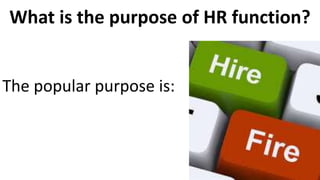
What is the purpose of HR function? 
The popular purpose is:
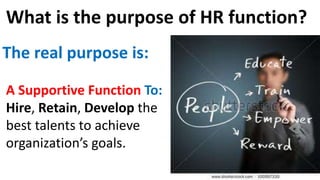
What is the purpose of HR function? 
The real purpose is: 
A Supportive Function To: 
Hire, Retain, Develop the 
best talents to achieve 
organization’s goals.
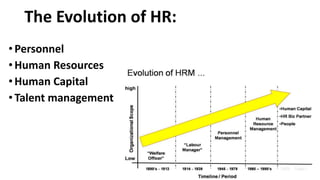
The Evolution of HR: 
• Personnel 
• Human Resources 
• Human Capital 
• Talent management
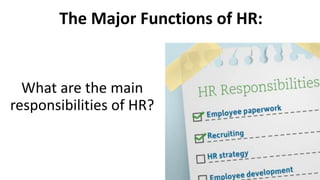
The Major Functions of HR: 
What are the main 
responsibilities of HR?
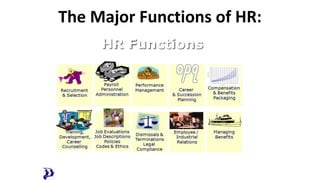
The Major Functions of HR:
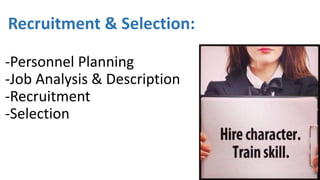
Recruitment & Selection: 
-Personnel Planning 
-Job Analysis & Description 
-Recruitment 
-Selection
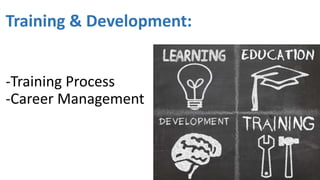
Training & Development: 
-Training Process 
-Career Management
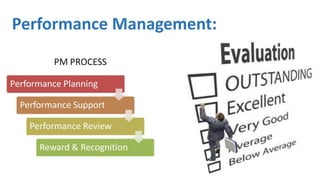
Performance Management:
Compensation & Benefits: 
- Salary survey 
-Job evaluation 
-Grading System 
-Paying Salaries
Personnel & Employee Relations:
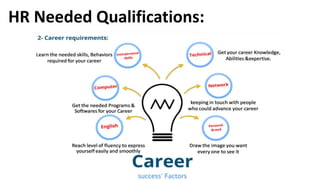
HR Needed Qualifications:
How To Be The Best? 
-Stay Updated. 
-Stay Connected. 
-Stay Focused. 
-Plan Big, Achieve 
More.
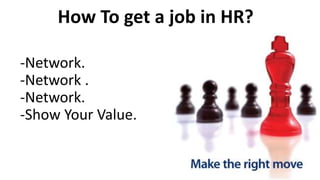
How To get a job in HR? 
-Network. 
-Network . 
-Network. 
-Show Your Value.
Don’t be afraid to Try HR.
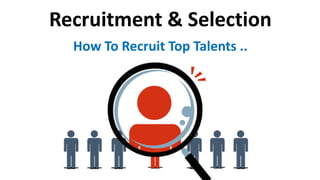
Recruitment & Selection 
How To Recruit Top Talents ..
“Take our 20 best people away 
and I will tell you that 
Microsoft would become an 
unimportant company” 
-Bill Gates
By the end of this module, YOU shall 
be able to: 
Know how to recruit these 20 people 
By the end of this module, YOU shall be able 
to: 
 Define the Recruitment and identify it’s process 
 Define Job Analysis, its elements and uses 
 Identify Methods for gathering Job Analysis Information 
 Identify the types of Recruitment (advantages and disadvantages) 
 Identify the Recruitment channels and process 
 Identify purposes of Interview and the main types of selection interviews 
 List and explain main errors that can undermine an interview’s usefulness 
 Establish hiring criteria and build a competency model 
 Deal with different mentalities 
 Conduct an effective Interview (Prepare – Start – Manage – Close) 
 Finish the Recruitment
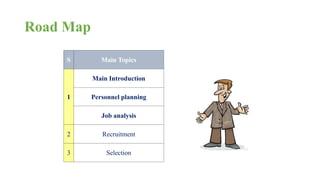
Road Map 
S Main Topics 
1 
Main Introduction 
Personnel planning 
Job analysis 
2 Recruitment 
3 Selection
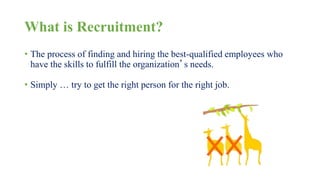
What is Recruitment? 
• The process of finding and hiring the best-qualified employees who 
have the skills to fulfill the organization’s needs. 
• Simply … try to get the right person for the right job.
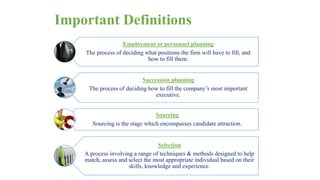
Important Definitions 
Employment or personnel planning 
The process of deciding what positions the firm will have to fill, and 
how to fill them. 
Succession planning 
The process of deciding how to fill the company’s most important 
executive. 
Sourcing 
Sourcing is the stage which encompasses candidate attraction. 
Selection 
A process involving a range of techniques & methods designed to help 
match, assess and select the most appropriate individual based on their 
skills, knowledge and experience.
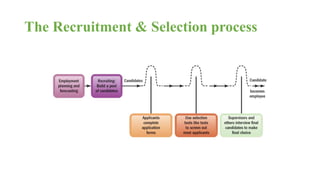
The Recruitment & Selection process
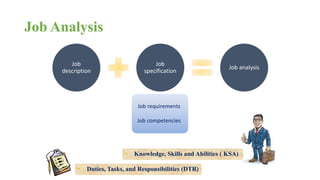
Job Analysis 
Job 
description 
Job 
specification 
Job analysis 
Job requirements 
Job competencies 
• Knowledge, Skills and Abilities ( KSA) 
• Duties, Tasks, and Responsibilities (DTR)
Job analysis 
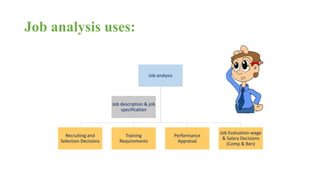
Job analysis uses: 
Recruiting and 
Selection Decisions 
Training 
Requirements 
Performance 
Appraisal 
Job Evaluation-wage 
& Salary Decisions 
(Comp & Ben) 
Job description & job 
specification
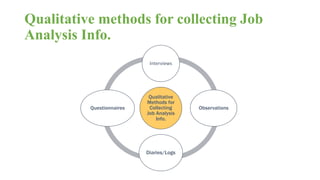
Qualitative methods for collecting Job 
Analysis Info. 
Interviews 
Qualitative 
Methods for 
Collecting 
Job Analysis 
Info. 
Observations 
Diaries/Logs 
Questionnaires
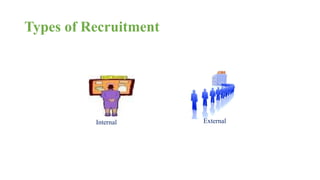
Types of Recruitment 
Internal External
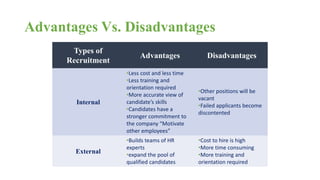
Advantages Vs. Disadvantages 
Types of 
Recruitment 
Advantages Disadvantages 
Internal 
•Less cost and less time 
•Less training and 
orientation required 
•More accurate view of 
candidate’s skills 
•Candidates have a 
stronger commitment to 
the company “Motivate 
other employees” 
•Other positions will be 
vacant 
•Failed applicants become 
discontented 
External 
•Builds teams of HR 
experts 
•expand the pool of 
qualified candidates 
•Cost to hire is high 
•More time consuming 
•More training and 
orientation required
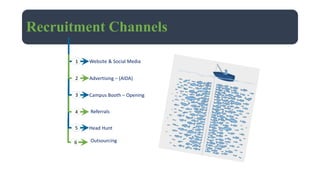
Recruitment Channels 
1 
2 
4 Referrals 
5 
6 
Website & Social Media 
Advertising – (AIDA) 
Campus Booth – Opening 
Head Hunt 
Outsourcing 
3
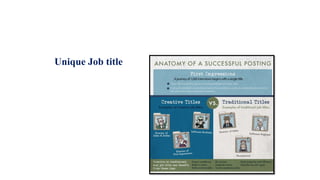
Unique Job title
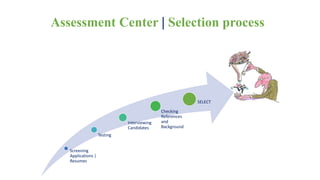
Assessment Center | Selection process 
Screening 
Applications | 
Resumes 
Testing 
Interviewing 
Candidates 
Checking 
References 
and 
Background 
SELECT
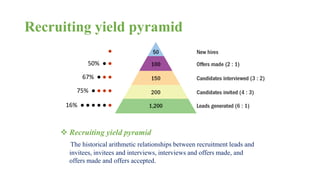
Recruiting yield pyramid 
● 
50% ● ● 
67% ● ● ● 
75% ● ● ● ● 
16% ● ● ● ● ● ● 
 Recruiting yield pyramid 
The historical arithmetic relationships between recruitment leads and 
invitees, invitees and interviews, interviews and offers made, and 
offers made and offers accepted.
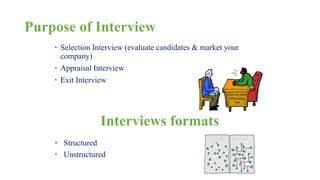
Purpose of Interview 
• Selection Interview (evaluate candidates & market your 
company) 
• Appraisal Interview 
• Exit Interview 
Interviews formats 
• Structured 
• Unstructured
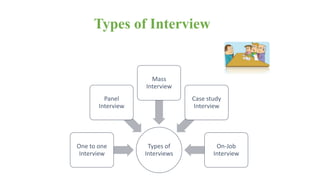
Types of Interview 
Types of 
Interviews 
Panel 
Interview 
One to one 
Interview 
Mass 
Interview 
Case study 
Interview 
On-Job 
Interview
Competency Model 
• Competencies 
Demonstrable characteristics of a person that enable performance 
of a job. 
• Definition 
Choose one definition for every competency.
Types of Competencies 
• General Competencies (core) ……….… Activity 
• Technical Competencies (Functional) … Committee 
• Leadership Competencies ……………... Head of Committee 
STAR technique 
• Situation 
• Task 
• Action 
• Result
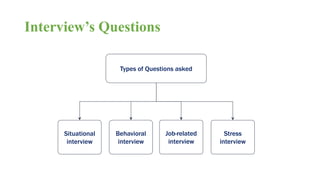
Interview’s Questions 
Situational 
interview 
Types of Questions asked 
Behavioral 
interview 
Job-related 
interview 
Stress 
interview
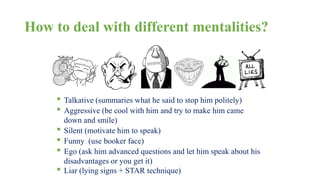
How to deal with different mentalities? 
• Talkative (summaries what he said to stop him politely) 
• Aggressive (be cool with him and try to make him came 
down and smile) 
• Silent (motivate him to speak) 
• Funny (use booker face) 
• Ego (ask him advanced questions and let him speak about his 
disadvantages or you get it) 
• Liar (lying signs + STAR technique)
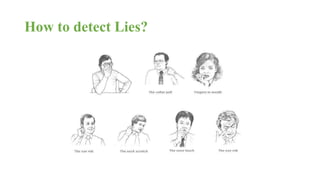
How to detect Lies?
How to tell the applicant about his 
Interview on phone? 
• Say Hi 
• Introduce yourself 
• Tell him, his application is accepted 
• Tell him the time and place of the Interview 
• Ask him to bring a personal photo 
• Ask him if he has any questions 
• Summarize what you said again
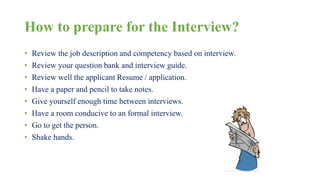
How to prepare for the Interview? 
• Review the job description and competency based on interview. 
• Review your question bank and interview guide. 
• Review well the applicant Resume / application. 
• Have a paper and pencil to take notes. 
• Give yourself enough time between interviews. 
• Have a room conducive to an formal interview. 
• Go to get the person. 
• Shake hands.
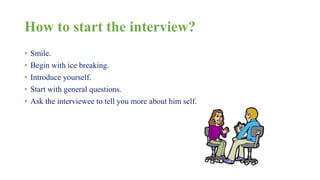
How to start the interview? 
• Smile. 
• Begin with ice breaking. 
• Introduce yourself. 
• Start with general questions. 
• Ask the interviewee to tell you more about him self.
How to manage the interview? 
• Maintain eye contact 
• Take notes about every thing the interviewee says 
• Speak 30% of the interview and let the 70% for interviewee 
• Notice interviewee self confidence. 
• Focus on every word in the application and ask him about it. 
• Ask questions directly and in sequence from what he say. 
• Use STAR technique to evaluate the interviewee’s responses 
and actions. 
• Do not help or motivate. 
• Control the interview and handle different mentalities. 
• Take care of your body language.
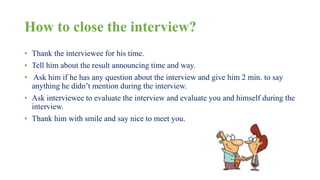
How to close the interview? 
• Thank the interviewee for his time. 
• Tell him about the result announcing time and way. 
• Ask him if he has any question about the interview and give him 2 min. to say 
anything he didn’t mention during the interview. 
• Ask interviewee to evaluate the interview and evaluate you and himself during the 
interview. 
• Thank him with smile and say nice to meet you.
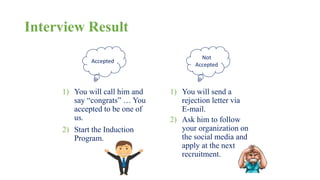
Interview Result 
Accepted 
1) You will call him and 
say “congrats” … You 
accepted to be one of 
us. 
2) Start the Induction 
Program. 
Not 
Accepted 
1) You will send a 
rejection letter via 
E-mail. 
2) Ask him to follow 
your organization on 
the social media and 
apply at the next 
recruitment.
Training & Development 
How to Plan, Design & Implement a full training 
program for your employees.
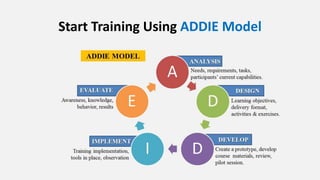
Start Training Using ADDIE Model
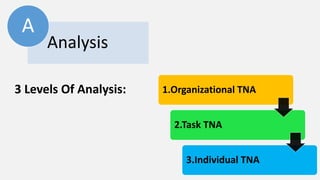
Analysis 
A 
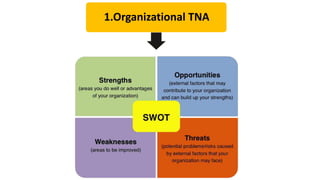
3 Levels Of Analysis: 1.Organizational TNA 
2.Task TNA 
3.Individual TNA
1.Organizational TNA
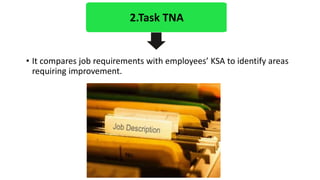
2.Task TNA 
• It compares job requirements with employees’ KSA to identify areas 
requiring improvement.
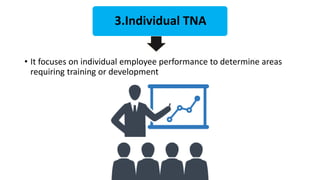
3.Individual TNA 
• It focuses on individual employee performance to determine areas 
requiring training or development
Design 
D 
1-Defining goals 
2- Setting objectives 
3- Defining the target audience 
4- Selecting an instructional designer
Goals
Objectives
Audience
instructional design 
In House Off The Shelf
Development 
D 
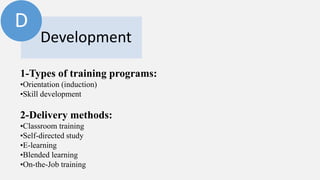
1-Types of training programs: 
•Orientation (induction) 
•Skill development 
2-Delivery methods: 
•Classroom training 
•Self-directed study 
•E-learning 
•Blended learning 
•On-the-Job training
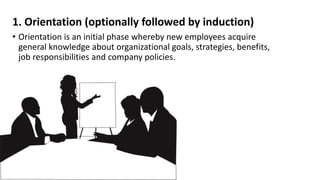
1. Orientation (optionally followed by induction) 
• Orientation is an initial phase whereby new employees acquire 
general knowledge about organizational goals, strategies, benefits, 
job responsibilities and company policies.
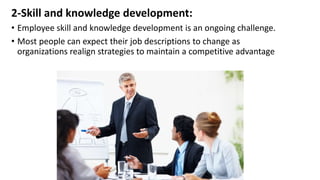
2-Skill and knowledge development: 
• Employee skill and knowledge development is an ongoing challenge. 
• Most people can expect their job descriptions to change as 
organizations realign strategies to maintain a competitive advantage
2-Delivery methods: 
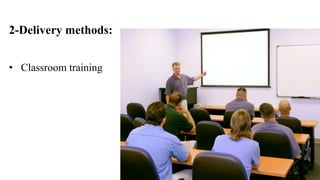
• Classroom training
2-Delivery methods: 
•Self-directed study
2-Delivery methods: 
•E-learning
2-Delivery methods: 
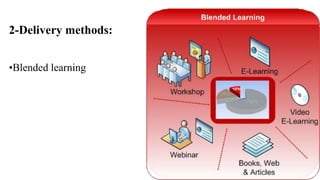
•Blended learning
2-Delivery methods: 
•On-the-Job training
Implementation 
I 
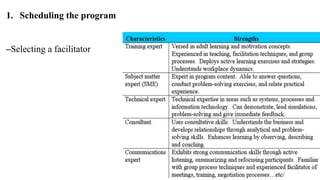
1. Scheduling the program 
–Selecting a facilitator 
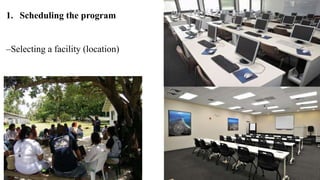
–Selecting a facility (location) 
–Environmental considerations 
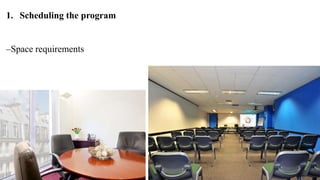
–Space requirements 
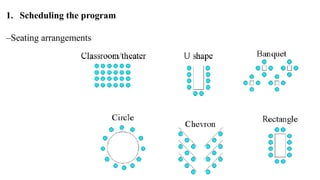
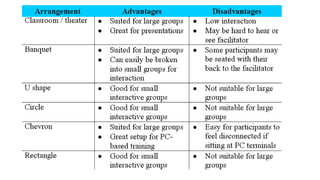
–Seating arrangements 
2. Announcing and implement the program
1. Scheduling the program 
–Selecting a facilitator
1. Scheduling the program 
–Selecting a facility (location)
1. Scheduling the program 
-Environment considerations 
• The effective way to increase interest 
in an upcoming training program is to 
launch an internal marketing 
campaign.
1. Scheduling the program 
–Space requirements
1. Scheduling the program 
–Seating arrangements
3. Announcing and implement the program 
Few considerations for comfortable classrooms are good seating, acoustics, vision site-line, 
room design, lighting, temperature, ventilation and media equipment. 
Breaks should be carefully planned to keep participants refreshed and alert
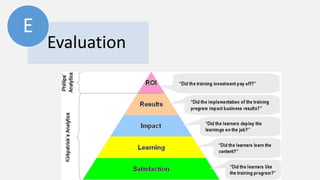
Evaluation 
E
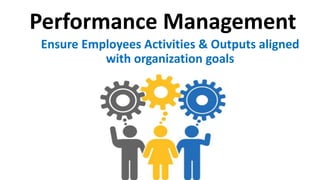
Performance Management 
Ensure Employees Activities & Outputs aligned 
with organization goals
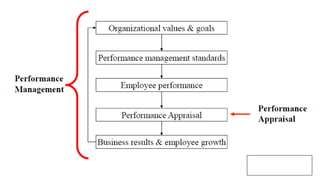
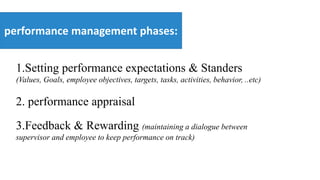
performance management phases: 
1.Setting performance expectations & Standers 
(Values, Goals, employee objectives, targets, tasks, activities, behavior, ..etc) 
2. performance appraisal 
3.Feedback & Rewarding (maintaining a dialogue between 
supervisor and employee to keep performance on track)
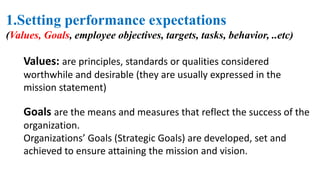
1.Setting performance expectations 
(Values, Goals, employee objectives, targets, tasks, behavior, ..etc) 
Values: are principles, standards or qualities considered 
worthwhile and desirable (they are usually expressed in the 
mission statement) 
Goals are the means and measures that reflect the success of the 
organization. 
Organizations’ Goals (Strategic Goals) are developed, set and 
achieved to ensure attaining the mission and vision.
Values Examples: 
Highly regarded values include : 
•Putting the customer first (internal/external) 
•Treating employees as well as treating customers 
•Conducting business fairly and honestly 
•Utilizing teamwork to achieve goals
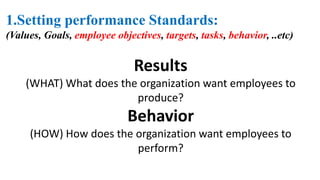
1.Setting performance Standards: 
(Values, Goals, employee objectives, targets, tasks, behavior, ..etc) 
Results 
(WHAT) What does the organization want employees to 
produce? 
Behavior 
(HOW) How does the organization want employees to 
perform?
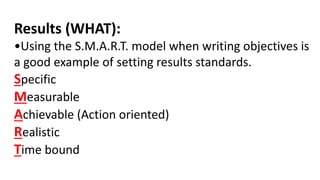
Results (WHAT): 
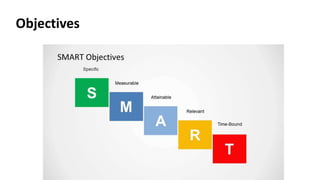
•Using the S.M.A.R.T. model when writing objectives is 
a good example of setting results standards. 
Specific 
Measurable 
Achievable (Action oriented) 
Realistic 
Time bound
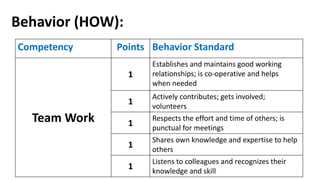
Competency Points Behavior Standard 
TeamWork 
1 
Establishes and maintains good working 
relationships; is co-operative and helps 
when needed 
1 
Actively contributes; gets involved; 
volunteers 
1 
Respects the effort and time of others; is 
punctual for meetings 
1 
Shares own knowledge and expertise to help 
others 
1 
Listens to colleagues and recognizes their 
knowledge and skill 
Behavior (HOW):
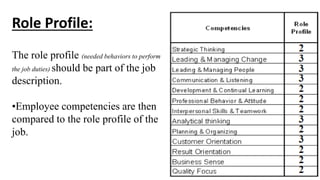
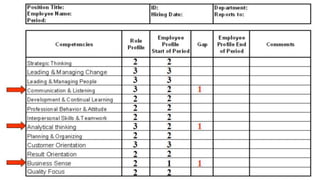
Role Profile: 
The role profile (needed behaviors to perform 
the job duties) should be part of the job 
description. 
•Employee competencies are then 
compared to the role profile of the 
job.
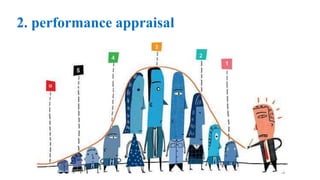
2. performance appraisal
Performance appraisals accomplish three purposes: 
1.Provide feedback and counseling 
2.Help in allocating rewards & opportunities 
3.Help in determining employees’ aspirations and planning 
development needs.
3.Feedback & Rewarding
Hope this presentation Was 
Beneficial to All of You 
خيركم من تعلم العلم وعلمه 
اللهم انفعنا بما علمتنا وزدنا علم ا

Hr lifemaker

  • 1.
  • 2.
    What is thepurpose of HR function? The popular purpose is:
  • 3.
    What is thepurpose of HR function? The real purpose is: A Supportive Function To: Hire, Retain, Develop the best talents to achieve organization’s goals.
  • 4.
    The Evolution ofHR: • Personnel • Human Resources • Human Capital • Talent management
  • 5.
    The Major Functionsof HR: What are the main responsibilities of HR?
  • 6.
  • 7.
    Recruitment & Selection: -Personnel Planning -Job Analysis & Description -Recruitment -Selection
  • 8.
    Training & Development: -Training Process -Career Management
  • 9.
  • 10.
    Compensation & Benefits: - Salary survey -Job evaluation -Grading System -Paying Salaries
  • 11.
  • 12.
  • 13.
    How To BeThe Best? -Stay Updated. -Stay Connected. -Stay Focused. -Plan Big, Achieve More.
  • 14.
    How To geta job in HR? -Network. -Network . -Network. -Show Your Value.
  • 15.
  • 16.
    Recruitment & Selection How To Recruit Top Talents ..
  • 17.
    “Take our 20best people away and I will tell you that Microsoft would become an unimportant company” -Bill Gates
  • 18.
    By the endof this module, YOU shall be able to: Know how to recruit these 20 people 
  • 19.
    By the endof this module, YOU shall be able to:  Define the Recruitment and identify it’s process  Define Job Analysis, its elements and uses  Identify Methods for gathering Job Analysis Information  Identify the types of Recruitment (advantages and disadvantages)  Identify the Recruitment channels and process  Identify purposes of Interview and the main types of selection interviews  List and explain main errors that can undermine an interview’s usefulness  Establish hiring criteria and build a competency model  Deal with different mentalities  Conduct an effective Interview (Prepare – Start – Manage – Close)  Finish the Recruitment
  • 20.
    Road Map SMain Topics 1 Main Introduction Personnel planning Job analysis 2 Recruitment 3 Selection
  • 21.
    What is Recruitment? • The process of finding and hiring the best-qualified employees who have the skills to fulfill the organization’s needs. • Simply … try to get the right person for the right job.
  • 22.
    Important Definitions Employmentor personnel planning The process of deciding what positions the firm will have to fill, and how to fill them. Succession planning The process of deciding how to fill the company’s most important executive. Sourcing Sourcing is the stage which encompasses candidate attraction. Selection A process involving a range of techniques & methods designed to help match, assess and select the most appropriate individual based on their skills, knowledge and experience.
  • 23.
    The Recruitment &Selection process
  • 24.
    Job Analysis Job description Job specification Job analysis Job requirements Job competencies • Knowledge, Skills and Abilities ( KSA) • Duties, Tasks, and Responsibilities (DTR)
  • 25.
    Job analysis Jobanalysis uses: Recruiting and Selection Decisions Training Requirements Performance Appraisal Job Evaluation-wage & Salary Decisions (Comp & Ben) Job description & job specification
  • 26.
    Qualitative methods forcollecting Job Analysis Info. Interviews Qualitative Methods for Collecting Job Analysis Info. Observations Diaries/Logs Questionnaires
  • 27.
    Types of Recruitment Internal External
  • 28.
    Advantages Vs. Disadvantages Types of Recruitment Advantages Disadvantages Internal •Less cost and less time •Less training and orientation required •More accurate view of candidate’s skills •Candidates have a stronger commitment to the company “Motivate other employees” •Other positions will be vacant •Failed applicants become discontented External •Builds teams of HR experts •expand the pool of qualified candidates •Cost to hire is high •More time consuming •More training and orientation required
  • 29.
    Recruitment Channels 1 2 4 Referrals 5 6 Website & Social Media Advertising – (AIDA) Campus Booth – Opening Head Hunt Outsourcing 3
  • 30.
  • 31.
    Assessment Center |Selection process Screening Applications | Resumes Testing Interviewing Candidates Checking References and Background SELECT
  • 32.
    Recruiting yield pyramid ● 50% ● ● 67% ● ● ● 75% ● ● ● ● 16% ● ● ● ● ● ●  Recruiting yield pyramid The historical arithmetic relationships between recruitment leads and invitees, invitees and interviews, interviews and offers made, and offers made and offers accepted.
  • 33.
    Purpose of Interview • Selection Interview (evaluate candidates & market your company) • Appraisal Interview • Exit Interview Interviews formats • Structured • Unstructured
  • 34.
    Types of Interview Types of Interviews Panel Interview One to one Interview Mass Interview Case study Interview On-Job Interview
  • 35.
    Competency Model •Competencies Demonstrable characteristics of a person that enable performance of a job. • Definition Choose one definition for every competency.
  • 36.
    Types of Competencies • General Competencies (core) ……….… Activity • Technical Competencies (Functional) … Committee • Leadership Competencies ……………... Head of Committee STAR technique • Situation • Task • Action • Result
  • 37.
    Interview’s Questions Situational interview Types of Questions asked Behavioral interview Job-related interview Stress interview
  • 38.
    How to dealwith different mentalities? • Talkative (summaries what he said to stop him politely) • Aggressive (be cool with him and try to make him came down and smile) • Silent (motivate him to speak) • Funny (use booker face) • Ego (ask him advanced questions and let him speak about his disadvantages or you get it) • Liar (lying signs + STAR technique)
  • 39.
  • 40.
    How to tellthe applicant about his Interview on phone? • Say Hi • Introduce yourself • Tell him, his application is accepted • Tell him the time and place of the Interview • Ask him to bring a personal photo • Ask him if he has any questions • Summarize what you said again
  • 41.
    How to preparefor the Interview? • Review the job description and competency based on interview. • Review your question bank and interview guide. • Review well the applicant Resume / application. • Have a paper and pencil to take notes. • Give yourself enough time between interviews. • Have a room conducive to an formal interview. • Go to get the person. • Shake hands.
  • 42.
    How to startthe interview? • Smile. • Begin with ice breaking. • Introduce yourself. • Start with general questions. • Ask the interviewee to tell you more about him self.
  • 43.
    How to managethe interview? • Maintain eye contact • Take notes about every thing the interviewee says • Speak 30% of the interview and let the 70% for interviewee • Notice interviewee self confidence. • Focus on every word in the application and ask him about it. • Ask questions directly and in sequence from what he say. • Use STAR technique to evaluate the interviewee’s responses and actions. • Do not help or motivate. • Control the interview and handle different mentalities. • Take care of your body language.
  • 44.
    How to closethe interview? • Thank the interviewee for his time. • Tell him about the result announcing time and way. • Ask him if he has any question about the interview and give him 2 min. to say anything he didn’t mention during the interview. • Ask interviewee to evaluate the interview and evaluate you and himself during the interview. • Thank him with smile and say nice to meet you.
  • 45.
    Interview Result Accepted 1) You will call him and say “congrats” … You accepted to be one of us. 2) Start the Induction Program. Not Accepted 1) You will send a rejection letter via E-mail. 2) Ask him to follow your organization on the social media and apply at the next recruitment.
  • 46.
    Training & Development How to Plan, Design & Implement a full training program for your employees.
  • 47.
  • 48.
    Analysis A 3Levels Of Analysis: 1.Organizational TNA 2.Task TNA 3.Individual TNA
  • 49.
  • 50.
    2.Task TNA •It compares job requirements with employees’ KSA to identify areas requiring improvement.
  • 51.
    3.Individual TNA •It focuses on individual employee performance to determine areas requiring training or development
  • 52.
    Design D 1-Defininggoals 2- Setting objectives 3- Defining the target audience 4- Selecting an instructional designer
  • 53.
  • 54.
  • 55.
  • 56.
    instructional design InHouse Off The Shelf
  • 57.
    Development D 1-Typesof training programs: •Orientation (induction) •Skill development 2-Delivery methods: •Classroom training •Self-directed study •E-learning •Blended learning •On-the-Job training
  • 58.
    1. Orientation (optionallyfollowed by induction) • Orientation is an initial phase whereby new employees acquire general knowledge about organizational goals, strategies, benefits, job responsibilities and company policies.
  • 59.
    2-Skill and knowledgedevelopment: • Employee skill and knowledge development is an ongoing challenge. • Most people can expect their job descriptions to change as organizations realign strategies to maintain a competitive advantage
  • 60.
    2-Delivery methods: •Classroom training
  • 61.
  • 62.
  • 63.
  • 64.
  • 65.
    Implementation I 1.Scheduling the program –Selecting a facilitator –Selecting a facility (location) –Environmental considerations –Space requirements –Seating arrangements 2. Announcing and implement the program
  • 66.
    1. Scheduling theprogram –Selecting a facilitator
  • 67.
    1. Scheduling theprogram –Selecting a facility (location)
  • 68.
    1. Scheduling theprogram -Environment considerations • The effective way to increase interest in an upcoming training program is to launch an internal marketing campaign.
  • 69.
    1. Scheduling theprogram –Space requirements
  • 70.
    1. Scheduling theprogram –Seating arrangements
  • 72.
    3. Announcing andimplement the program Few considerations for comfortable classrooms are good seating, acoustics, vision site-line, room design, lighting, temperature, ventilation and media equipment. Breaks should be carefully planned to keep participants refreshed and alert
  • 74.
  • 75.
    Performance Management EnsureEmployees Activities & Outputs aligned with organization goals
  • 77.
    performance management phases: 1.Setting performance expectations & Standers (Values, Goals, employee objectives, targets, tasks, activities, behavior, ..etc) 2. performance appraisal 3.Feedback & Rewarding (maintaining a dialogue between supervisor and employee to keep performance on track)
  • 78.
    1.Setting performance expectations (Values, Goals, employee objectives, targets, tasks, behavior, ..etc) Values: are principles, standards or qualities considered worthwhile and desirable (they are usually expressed in the mission statement) Goals are the means and measures that reflect the success of the organization. Organizations’ Goals (Strategic Goals) are developed, set and achieved to ensure attaining the mission and vision.
  • 79.
    Values Examples: Highlyregarded values include : •Putting the customer first (internal/external) •Treating employees as well as treating customers •Conducting business fairly and honestly •Utilizing teamwork to achieve goals
  • 80.
    1.Setting performance Standards: (Values, Goals, employee objectives, targets, tasks, behavior, ..etc) Results (WHAT) What does the organization want employees to produce? Behavior (HOW) How does the organization want employees to perform?
  • 81.
    Results (WHAT): •Usingthe S.M.A.R.T. model when writing objectives is a good example of setting results standards. Specific Measurable Achievable (Action oriented) Realistic Time bound
  • 82.
    Competency Points BehaviorStandard TeamWork 1 Establishes and maintains good working relationships; is co-operative and helps when needed 1 Actively contributes; gets involved; volunteers 1 Respects the effort and time of others; is punctual for meetings 1 Shares own knowledge and expertise to help others 1 Listens to colleagues and recognizes their knowledge and skill Behavior (HOW):
  • 83.
    Role Profile: Therole profile (needed behaviors to perform the job duties) should be part of the job description. •Employee competencies are then compared to the role profile of the job.
  • 84.
  • 86.
    Performance appraisals accomplishthree purposes: 1.Provide feedback and counseling 2.Help in allocating rewards & opportunities 3.Help in determining employees’ aspirations and planning development needs.
  • 87.
  • 88.
    Hope this presentationWas Beneficial to All of You خيركم من تعلم العلم وعلمه اللهم انفعنا بما علمتنا وزدنا علم ا