Obsessions of the ad men Planning & Creative Briefs
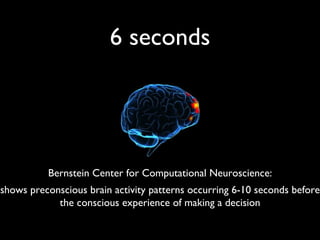
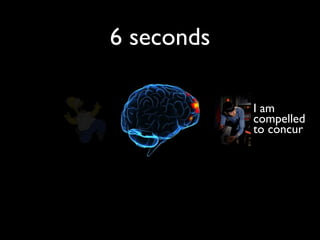
6 seconds Bernstein Center for Computational Neuroscience: shows preconscious brain activity patterns occurring 6-10 seconds before the conscious experience of making a decision
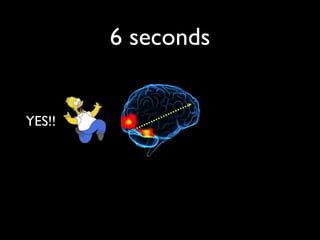
6 seconds YES!!
6 seconds I am compelled to concur
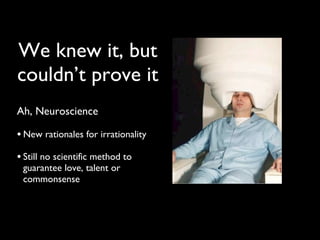
Ah, Neuroscience New rationales for irrationality Still no scientific method to guarantee love, talent or commonsense We knew it, but couldn’t prove it
It does help us fight back, though
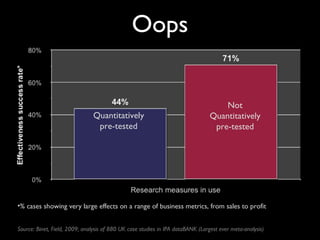
Oops % cases showing very large effects on a range of business metrics, from sales to profit Source: Binet, Field, 2009; analysis of 880 UK case studies in IPA dataBANK (Largest ever meta-analysis) Quantitatively pre-tested Not Quantitatively pre-tested
“ Too many people use research as a drunk uses a lamp-post – for support, rather than illumination” - David Ogilvy Why?  1) Snake Oil for the Gutless
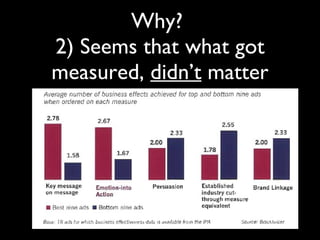
Why?  2) Seems that what got measured,  didn’t  matter
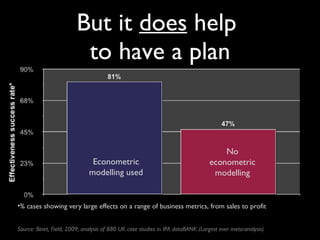
But it  does  help  to have a plan Econometric modelling used No econometric modelling % cases showing very large effects on a range of business metrics, from sales to profit Source: Binet, Field, 2009; analysis of 880 UK case studies in IPA dataBANK (Largest ever meta-analysis)
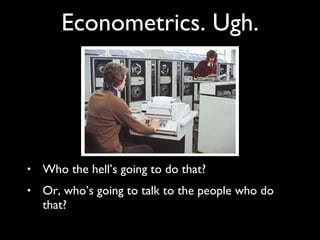
Who the hell’s going to do that? Or, who’s going to talk to the people who do that? Econometrics. Ugh.
Creative agency solution to 80s research depts On creativity’s side, who could speak research Researcher’s job: spot problems, reduce risk Planner’s: spot opportunities, defend originality Championing, proving effectiveness of ‘Relevant Distinctiveness’ vs. USP-formula advertising Planning history
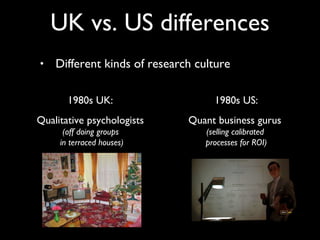
Different kinds of research culture UK vs. US differences 1980s UK:  Qualitative psychologists  (off doing groups  in terraced houses) 1980s US: Quant business gurus  (selling calibrated  processes for ROI)
The opiate of the businesspeople Today’s biggest enemy: the delusion of control
In agencies of smartass yuppy graduates In clients who’d forgotten how to be confused and uninterested Get us to fall in love with the consumer/user Then:  Voice of the Consumer
Not a trendspotter (leveraging fads) Responsibility  to  cultures Earning participation in  their  mediums Finding & earning a brand’s place in its culture Karma as business-sense: give, to get Now:  Voice of the Culture
Includes consumer empathy & insight Overlaps with media & technology Broader implications of UGC Participants enforce tribal rules Brand can set the tone - or nudge it Now:  Voice of the Culture
Detective Ambassador Story police Basic roles
Fragmentation, lateral leaps & tangents make it even harder to stay on story Story MUST be King
Strength, confidence, speed to adjust “ No military strategy ever survives first contact with the enemy” Miles Vorkosigan Flexibility is decisiveness
Job 1 – find the most interesting right answer Job 2 – be an idea’s truest friend  Hard to sell to  Then fight to the death for it As should we all Summing up so far
Not the same Advertising Briefs  & Briefings
Let’s all sit down and read my tax return together
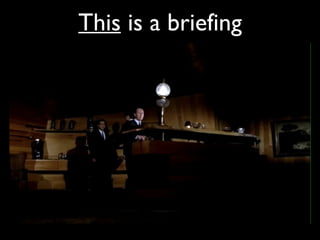
This  is a briefing
“ As a creative, I’m more like an assassin:  point me at the right target, give me what I need and let me go” Advertising ECD  Movies do it better
Why are briefs boring?
They try to do too much
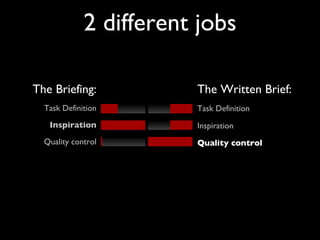
The Briefing: Task Definition Inspiration Quality control 2 different jobs The Written Brief: Task Definition Inspiration Quality control
Even if it’s not an advertising brief, it should be both creative and brief: Objective:  inspire them to dig Strategy:  make it memorable - an earworm The brief is your ad  to the team
“ No one remembers the brief. But often people recall the briefing.” Alan Cooper, How to Plan Advertising 1 Don’t phone it in
“ The best briefings are so good that you can’t wait for the planner to leave your office so you can get started.” Your Goal
“By the time I’ve got the written brief approved, there’s no time to stage a briefing” Clients don’t care about the briefing Clients  do  care about the brief Too much, sometimes Why so hard?
Cruel & painful After a long, clever process Demands decision-making Research can do that later! It’s not the ‘studio suits’ forcing you to cut Every choice you make could be wrong Takes real skill in client relationships Editing is murder
Handy as startpoints & story guides Beware of painting by numbers Draft roughly, go away, come back with an axe Read Hemingway (or Gaiman) just beforehand Cut words until the sentence doesn’t make sense Use forms, but don’t fill them in
Pick some strong executions Quickly bash out reverse briefs for them Objective Target (mindset, occasion... who it’s  not  aimed at) Message (or intended creative expression etc) Tone & Personality (the 80% that’s body language) Surprisingly easy to write good, pithy ones Use later to compare with bloated bags of jargon Tip: practice with clients
Write  the quick-start sheet:  super-easy to do the basic job right Present  like a stirring movie general... Instruct  - Inspire - Check
Here’s the big picture and the ground ahead… Which means our heroes’ job is …. Watching out for traps here, here, and here…. And using these special tools… You’ll know you’ve made it when this happens… And then it’s home for beers all round Instruct  - Inspire - Check
Again, make it easy: to solve, to picture Work on the right nugget Concrete is easier than abstract/conceptual ‘ red & dangerous’,  vs. ‘for kids who know their way around’ Find the bit people love – where’s the heat? Instruct -  Inspire  - Check
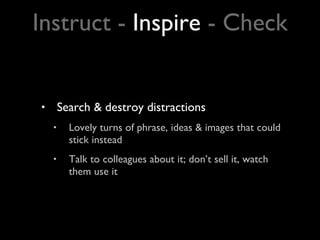
Search & destroy distractions Lovely turns of phrase, ideas & images that could stick instead  Talk to colleagues about it; don’t sell it, watch them use it Instruct -  Inspire  - Check
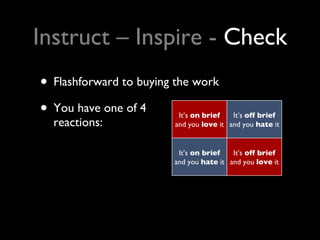
Flashforward to buying the work You have one of 4  reactions: Instruct – Inspire -  Check It’s  on   brief  and you  love  it It’s  off brief  and you  hate  it It’s  on brief  and you  hate  it It’s  off brief  and you  love  it
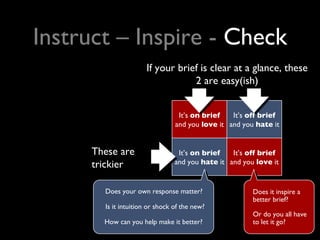
Instruct – Inspire -  Check Does your own response matter?  Is it intuition or shock of the new?  How can you help make it better?  If your brief is clear at a glance, these 2 are easy(ish) These are trickier  Does it inspire a better brief? Or do you all have to let it go? It’s  on   brief  and you  love  it It’s  off brief  and you  hate  it It’s  on brief  and you  hate  it It’s  off brief  and you  love  it
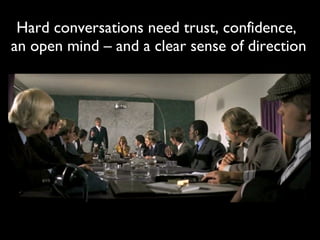
Hard conversations need trust, confidence,  an open mind – and a clear sense of direction
Thank you very much

Planning & briefing talk 2

  • 1.
    Obsessions of thead men Planning & Creative Briefs
  • 2.
    6 seconds BernsteinCenter for Computational Neuroscience: shows preconscious brain activity patterns occurring 6-10 seconds before the conscious experience of making a decision
  • 3.
  • 4.
    6 seconds Iam compelled to concur
  • 5.
    Ah, Neuroscience Newrationales for irrationality Still no scientific method to guarantee love, talent or commonsense We knew it, but couldn’t prove it
  • 6.
    It does helpus fight back, though
  • 7.
    Oops % casesshowing very large effects on a range of business metrics, from sales to profit Source: Binet, Field, 2009; analysis of 880 UK case studies in IPA dataBANK (Largest ever meta-analysis) Quantitatively pre-tested Not Quantitatively pre-tested
  • 8.
    “ Too manypeople use research as a drunk uses a lamp-post – for support, rather than illumination” - David Ogilvy Why? 1) Snake Oil for the Gutless
  • 9.
    Why? 2)Seems that what got measured, didn’t matter
  • 10.
    But it does help to have a plan Econometric modelling used No econometric modelling % cases showing very large effects on a range of business metrics, from sales to profit Source: Binet, Field, 2009; analysis of 880 UK case studies in IPA dataBANK (Largest ever meta-analysis)
  • 11.
    Who the hell’sgoing to do that? Or, who’s going to talk to the people who do that? Econometrics. Ugh.
  • 12.
    Creative agency solutionto 80s research depts On creativity’s side, who could speak research Researcher’s job: spot problems, reduce risk Planner’s: spot opportunities, defend originality Championing, proving effectiveness of ‘Relevant Distinctiveness’ vs. USP-formula advertising Planning history
  • 13.
    Different kinds ofresearch culture UK vs. US differences 1980s UK: Qualitative psychologists (off doing groups in terraced houses) 1980s US: Quant business gurus (selling calibrated processes for ROI)
  • 14.
    The opiate ofthe businesspeople Today’s biggest enemy: the delusion of control
  • 15.
    In agencies ofsmartass yuppy graduates In clients who’d forgotten how to be confused and uninterested Get us to fall in love with the consumer/user Then: Voice of the Consumer
  • 16.
    Not a trendspotter(leveraging fads) Responsibility to cultures Earning participation in their mediums Finding & earning a brand’s place in its culture Karma as business-sense: give, to get Now: Voice of the Culture
  • 17.
    Includes consumer empathy& insight Overlaps with media & technology Broader implications of UGC Participants enforce tribal rules Brand can set the tone - or nudge it Now: Voice of the Culture
  • 18.
    Detective Ambassador Storypolice Basic roles
  • 19.
    Fragmentation, lateral leaps& tangents make it even harder to stay on story Story MUST be King
  • 20.
    Strength, confidence, speedto adjust “ No military strategy ever survives first contact with the enemy” Miles Vorkosigan Flexibility is decisiveness
  • 21.
    Job 1 –find the most interesting right answer Job 2 – be an idea’s truest friend Hard to sell to Then fight to the death for it As should we all Summing up so far
  • 22.
    Not the sameAdvertising Briefs & Briefings
  • 23.
    Let’s all sitdown and read my tax return together
  • 24.
    This isa briefing
  • 25.
    “ As acreative, I’m more like an assassin: point me at the right target, give me what I need and let me go” Advertising ECD Movies do it better
  • 26.
  • 27.
    They try todo too much
  • 28.
    The Briefing: TaskDefinition Inspiration Quality control 2 different jobs The Written Brief: Task Definition Inspiration Quality control
  • 29.
    Even if it’snot an advertising brief, it should be both creative and brief: Objective: inspire them to dig Strategy: make it memorable - an earworm The brief is your ad to the team
  • 30.
    “ No oneremembers the brief. But often people recall the briefing.” Alan Cooper, How to Plan Advertising 1 Don’t phone it in
  • 31.
    “ The bestbriefings are so good that you can’t wait for the planner to leave your office so you can get started.” Your Goal
  • 32.
    “By the timeI’ve got the written brief approved, there’s no time to stage a briefing” Clients don’t care about the briefing Clients do care about the brief Too much, sometimes Why so hard?
  • 33.
    Cruel & painfulAfter a long, clever process Demands decision-making Research can do that later! It’s not the ‘studio suits’ forcing you to cut Every choice you make could be wrong Takes real skill in client relationships Editing is murder
  • 34.
    Handy as startpoints& story guides Beware of painting by numbers Draft roughly, go away, come back with an axe Read Hemingway (or Gaiman) just beforehand Cut words until the sentence doesn’t make sense Use forms, but don’t fill them in
  • 35.
    Pick some strongexecutions Quickly bash out reverse briefs for them Objective Target (mindset, occasion... who it’s not aimed at) Message (or intended creative expression etc) Tone & Personality (the 80% that’s body language) Surprisingly easy to write good, pithy ones Use later to compare with bloated bags of jargon Tip: practice with clients
  • 36.
    Write thequick-start sheet: super-easy to do the basic job right Present like a stirring movie general... Instruct - Inspire - Check
  • 37.
    Here’s the bigpicture and the ground ahead… Which means our heroes’ job is …. Watching out for traps here, here, and here…. And using these special tools… You’ll know you’ve made it when this happens… And then it’s home for beers all round Instruct - Inspire - Check
  • 38.
    Again, make iteasy: to solve, to picture Work on the right nugget Concrete is easier than abstract/conceptual ‘ red & dangerous’, vs. ‘for kids who know their way around’ Find the bit people love – where’s the heat? Instruct - Inspire - Check
  • 39.
    Search & destroydistractions Lovely turns of phrase, ideas & images that could stick instead Talk to colleagues about it; don’t sell it, watch them use it Instruct - Inspire - Check
  • 40.
    Flashforward to buyingthe work You have one of 4 reactions: Instruct – Inspire - Check It’s on brief and you love it It’s off brief and you hate it It’s on brief and you hate it It’s off brief and you love it
  • 41.
    Instruct – Inspire- Check Does your own response matter? Is it intuition or shock of the new? How can you help make it better? If your brief is clear at a glance, these 2 are easy(ish) These are trickier Does it inspire a better brief? Or do you all have to let it go? It’s on brief and you love it It’s off brief and you hate it It’s on brief and you hate it It’s off brief and you love it
  • 42.
    Hard conversations needtrust, confidence, an open mind – and a clear sense of direction
  • 43.

Editor's Notes

  • #3 The results support the notion that unconscious brain activity comes first and conscious experience follows as a result, says Patrick Haggard of University College London, who was not involved with the study. “We all think that we have a conscious free will,” he says. “ However, this study shows that actions come from preconscious brain activity patterns and not from the person consciously thinking about what they are going to do.”