Interviewer Handbook


                andre david&associates, inc.©2012
Interviewer Handbook


                        D Magazine Partners, recognized as one of America’s
                         “Best City magazines”, can only maintain its premier sta-
                         tus by producing high value publications. This is accom-
                         plished by employing the “best and the brightest” in the
                        field of journalism and publishing.


Successful and profitable business entities are only as good as the employees
that are hired and retained. The significance of the selection process cannot
be understated or emphasized enough. Decisions on who will likely succeed,
contribute, and add value to the D Magazine Partners’ team are difficult under
normal circumstances.


What are the skills and traits that serve as the foundation of success for the
company? What are the common threads and the consistent behaviors that
can be identified? Why are these traits and behaviors important for success in
the company? Can these be learned or must they be inherent in candidates for
positions?


These questions need answers and require you, as hiring executives, to be as-
sured that you are making sound hiring decisions.


The Success Factors Analysis and Interviewing Process are designed to provide
you with guidelines for interviewing and selecting talent for your department
and your company. It is not a stand-alone process. When combined with
feedback from peers, skilled interviewing techniques, and in depth referencing,
your decision-making capabilities around candidate selection are greatly im-
proved.


                                                                                  2
What’s inside?

•   Alphabetical listing of Success Factors with brief definitions and/or descrip-
    tions


•   Worksheets for pre-interview preparation and post-interview assignment of
    success factors


•   Worksheets for comparing, contrasting, and prioritizing multiple candi-
    dates for open positions


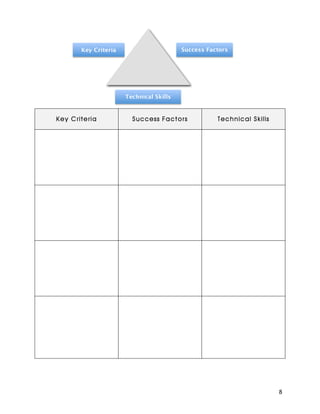
•   Key criteria – technical skills assessment – success factors model


•   Interviewer guidelines


                                                                                3
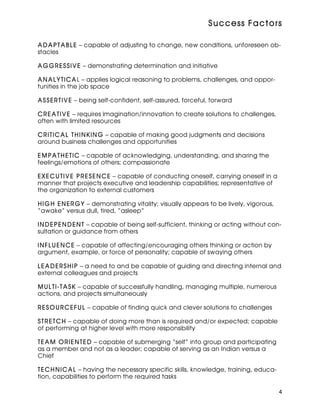
Success Factors

ADAPTABLE – capable of adjusting to change, new conditions, unforeseen ob-
stacles

AGGRESSIVE – demonstrating determination and initiative

ANALYTICAL – applies logical reasoning to problems, challenges, and oppor-
tunities in the job space

ASSERTIVE – being self-confident, self-assured, forceful, forward

CREATIVE – requires imagination/innovation to create solutions to challenges,
often with limited resources

CRITICAL THINKING – capable of making good judgments and decisions
around business challenges and opportunities

EMPATHETIC – capable of acknowledging, understanding, and sharing the
feelings/emotions of others; compassionate

EXECUTIVE PRESENCE – capable of conducting oneself, carrying oneself in a
manner that projects executive and leadership capabilities; representative of
the organization to external customers

HIGH ENERGY – demonstrating vitality; visually appears to be lively, vigorous,
“awake” versus dull, tired, “asleep”

INDEPENDENT – capable of being self-sufficient, thinking or acting without con-
sultation or guidance from others

INFLUENCE – capable of affecting/encouraging others thinking or action by
argument, example, or force of personality; capable of swaying others

LEADERSHIP – a need to and be capable of guiding and directing internal and
external colleagues and projects

MULTI-TASK – capable of successfully handling, managing multiple, numerous
actions, and projects simultaneously

RESOURCEFUL – capable of finding quick and clever solutions to challenges

STRETCH – capable of doing more than is required and/or expected; capable
of performing at higher level with more responsibility

TEAM ORIENTED – capable of submerging “self” into group and participating
as a member and not as a leader; capable of serving as an Indian versus a
Chief

TECHNICAL – having the necessary specific skills, knowledge, training, educa-
tion, capabilities to perform the required tasks

                                                                                 4
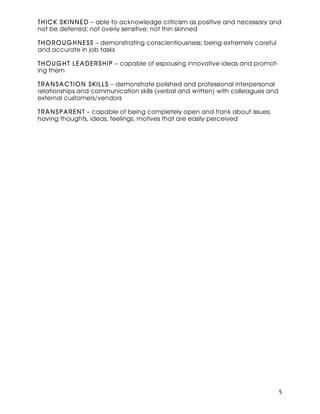
THICK SKINNED – able to acknowledge criticism as positive and necessary and
not be deterred; not overly sensitive; not thin skinned

THOROUGHNESS – demonstrating conscientiousness; being extremely careful
and accurate in job tasks

THOUGHT LEADERSHIP – capable of espousing innovative ideas and promot-
ing them

TRANSACTION SKILLS – demonstrate polished and professional interpersonal
relationships and communication skills (verbal and written) with colleagues and
external customers/vendors

TRANSPARENT – capable of being completely open and frank about issues;
having thoughts, ideas, feelings, motives that are easily perceived


                                                                                  5
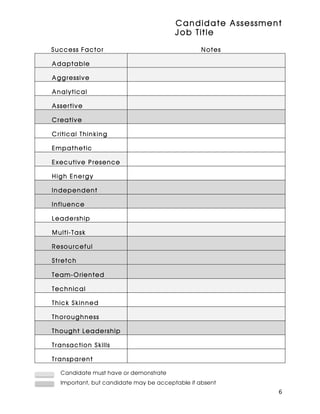
Candidate Assessment
                                        Job Title

Success Factor                                  Notes

Adaptable

Aggressive

Analytical

Assertive

Creative

Critical Thinking

Empathetic

Executive Presence

High Energy

Independent

Influence

Leadership

Multi-Task

Resourceful

Stretch

Team-Oriented

Technical

Thick Skinned

Thoroughness

Thought Leadership

Transaction Skills

Transparent

  Candidate must have or demonstrate
  Important, but candidate may be acceptable if absent
                                                           6
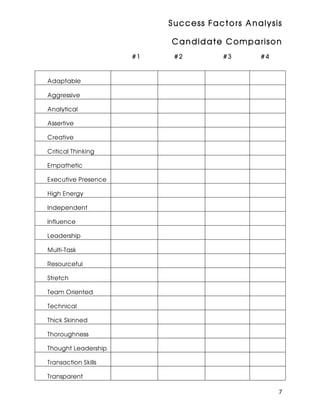
Success Factors Analysis

                          Candidate Comparison
                     #1    #2        #3      #4


Adaptable

Aggressive

Analytical

Assertive

Creative

Critical Thinking

Empathetic

Executive Presence

High Energy

Independent

Influence

Leadership

Multi-Task

Resourceful

Stretch

Team Oriented

Technical

Thick Skinned

Thoroughness

Thought Leadership

Transaction Skills

Transparent

                                                  7
Key Criteria                      Success Factors


                      Technical Skills


Key Criteria            Success Factors             Technical Skills


                                                                       8
Interviewer Guidelines

                               The interview process can be taxing and challenging for
                               both the interviewee and interviewer. For the interview-
                               er, the process can be effectively managed allowing
                               both parties to accomplish the ultimate goal...to deter-
                               mine if there is a mutual agreement on acceptability
(success factors), capabilities (technical skills), and requirements (key criteria).
The interview process can be modeled after a simple business letter with a salu-
tation, body, and a closing. Just as you have to prepare mentally when crafting
a business letter, you must have a certain level of preparation for your interview:


Clear Your Calendar...No interruptions
•   Read the resume thoroughly
•   Look for...
•   Inconsistencies
•   Discrepancies
•   Breaks in employment


Interview’s Salutation
•   Avoid being distracted when greeting your candidate
•   Strive to lower candidate’s anxiety (acceptable humor or possible common
    ground issue(s)
•   Outline the process that will unfold


Interview’s Body
•   Inherently probe for presence of success factors using behavioral questioning
    techniques (“give me an example when you...)
•   Strive for clarity in your questioning and candidate responses
•   Probe...probe...probe (the “why” is very powerful)
•   Listen...listen...listen
•   Conscientiously extend the dialogue by asking for elaboration on responses
•   Allow for “pregnant pauses/silent gaps”


                                                                                          9
Interview’s Closing
•   Sell position and company regardless of go/no decision (every candidate is
    a client or customer)
•   Encourage questions around positions and D Magazine


                                                                             10

Interviewer Handbook

  • 1.
    Interviewer Handbook andre david&associates, inc.©2012
  • 2.
    Interviewer Handbook D Magazine Partners, recognized as one of America’s “Best City magazines”, can only maintain its premier sta- tus by producing high value publications. This is accom- plished by employing the “best and the brightest” in the field of journalism and publishing. Successful and profitable business entities are only as good as the employees that are hired and retained. The significance of the selection process cannot be understated or emphasized enough. Decisions on who will likely succeed, contribute, and add value to the D Magazine Partners’ team are difficult under normal circumstances. What are the skills and traits that serve as the foundation of success for the company? What are the common threads and the consistent behaviors that can be identified? Why are these traits and behaviors important for success in the company? Can these be learned or must they be inherent in candidates for positions? These questions need answers and require you, as hiring executives, to be as- sured that you are making sound hiring decisions. The Success Factors Analysis and Interviewing Process are designed to provide you with guidelines for interviewing and selecting talent for your department and your company. It is not a stand-alone process. When combined with feedback from peers, skilled interviewing techniques, and in depth referencing, your decision-making capabilities around candidate selection are greatly im- proved. 2
  • 3.
    What’s inside? • Alphabetical listing of Success Factors with brief definitions and/or descrip- tions • Worksheets for pre-interview preparation and post-interview assignment of success factors • Worksheets for comparing, contrasting, and prioritizing multiple candi- dates for open positions • Key criteria – technical skills assessment – success factors model • Interviewer guidelines 3
  • 4.
    Success Factors ADAPTABLE –capable of adjusting to change, new conditions, unforeseen ob- stacles AGGRESSIVE – demonstrating determination and initiative ANALYTICAL – applies logical reasoning to problems, challenges, and oppor- tunities in the job space ASSERTIVE – being self-confident, self-assured, forceful, forward CREATIVE – requires imagination/innovation to create solutions to challenges, often with limited resources CRITICAL THINKING – capable of making good judgments and decisions around business challenges and opportunities EMPATHETIC – capable of acknowledging, understanding, and sharing the feelings/emotions of others; compassionate EXECUTIVE PRESENCE – capable of conducting oneself, carrying oneself in a manner that projects executive and leadership capabilities; representative of the organization to external customers HIGH ENERGY – demonstrating vitality; visually appears to be lively, vigorous, “awake” versus dull, tired, “asleep” INDEPENDENT – capable of being self-sufficient, thinking or acting without con- sultation or guidance from others INFLUENCE – capable of affecting/encouraging others thinking or action by argument, example, or force of personality; capable of swaying others LEADERSHIP – a need to and be capable of guiding and directing internal and external colleagues and projects MULTI-TASK – capable of successfully handling, managing multiple, numerous actions, and projects simultaneously RESOURCEFUL – capable of finding quick and clever solutions to challenges STRETCH – capable of doing more than is required and/or expected; capable of performing at higher level with more responsibility TEAM ORIENTED – capable of submerging “self” into group and participating as a member and not as a leader; capable of serving as an Indian versus a Chief TECHNICAL – having the necessary specific skills, knowledge, training, educa- tion, capabilities to perform the required tasks 4
  • 5.
    THICK SKINNED –able to acknowledge criticism as positive and necessary and not be deterred; not overly sensitive; not thin skinned THOROUGHNESS – demonstrating conscientiousness; being extremely careful and accurate in job tasks THOUGHT LEADERSHIP – capable of espousing innovative ideas and promot- ing them TRANSACTION SKILLS – demonstrate polished and professional interpersonal relationships and communication skills (verbal and written) with colleagues and external customers/vendors TRANSPARENT – capable of being completely open and frank about issues; having thoughts, ideas, feelings, motives that are easily perceived 5
  • 6.
    Candidate Assessment Job Title Success Factor Notes Adaptable Aggressive Analytical Assertive Creative Critical Thinking Empathetic Executive Presence High Energy Independent Influence Leadership Multi-Task Resourceful Stretch Team-Oriented Technical Thick Skinned Thoroughness Thought Leadership Transaction Skills Transparent Candidate must have or demonstrate Important, but candidate may be acceptable if absent 6
  • 7.
    Success Factors Analysis Candidate Comparison #1 #2 #3 #4 Adaptable Aggressive Analytical Assertive Creative Critical Thinking Empathetic Executive Presence High Energy Independent Influence Leadership Multi-Task Resourceful Stretch Team Oriented Technical Thick Skinned Thoroughness Thought Leadership Transaction Skills Transparent 7
  • 8.
    Key Criteria Success Factors Technical Skills Key Criteria Success Factors Technical Skills 8
  • 9.
    Interviewer Guidelines The interview process can be taxing and challenging for both the interviewee and interviewer. For the interview- er, the process can be effectively managed allowing both parties to accomplish the ultimate goal...to deter- mine if there is a mutual agreement on acceptability (success factors), capabilities (technical skills), and requirements (key criteria). The interview process can be modeled after a simple business letter with a salu- tation, body, and a closing. Just as you have to prepare mentally when crafting a business letter, you must have a certain level of preparation for your interview: Clear Your Calendar...No interruptions • Read the resume thoroughly • Look for... • Inconsistencies • Discrepancies • Breaks in employment Interview’s Salutation • Avoid being distracted when greeting your candidate • Strive to lower candidate’s anxiety (acceptable humor or possible common ground issue(s) • Outline the process that will unfold Interview’s Body • Inherently probe for presence of success factors using behavioral questioning techniques (“give me an example when you...) • Strive for clarity in your questioning and candidate responses • Probe...probe...probe (the “why” is very powerful) • Listen...listen...listen • Conscientiously extend the dialogue by asking for elaboration on responses • Allow for “pregnant pauses/silent gaps” 9
  • 10.
    Interview’s Closing • Sell position and company regardless of go/no decision (every candidate is a client or customer) • Encourage questions around positions and D Magazine 10