Interviewee Feedback Form
Professors Norman Lomow, Moira McDonald, and Catrina
McBrideIndividual Interview Feedback
Student Interviewed: Saiaf Bareem
Human Resources Student Interviewer: Rhett Mcrae
All interviewees are required to complete and email this file to
Moira McDonald [email protected] and their course professor
within 24 hours of the interview. Please highlight any areas in
the second column that were not completed satisfactorily or as
planned and enter any comments in the last column.
Section
Highlight any areas below that were not completed
satisfactorily or as planned
Comments
Invitation to interviewee to interview
· Telephoned or emailed you minimum of one week before
interview with day, time, and location
· Explained interview in a professional, informative, and clear
manner
· Professional management of your questions
The interviewer did very well in all aspects. He dealt with the
interview professionally. The interviewer emailed me a head of
time, arranged the time with me, and booked the room. He also
explained the interview in a professional and informative
manner.
Welcome interviewee to interview
· Began interview on time as scheduled
· Greeted you in a welcoming and professional manner
The interviewer was waiting me in the room ahead of time
before I came. We both were there on time. He greeted and
welcomed me in a professional way.
Explain format of interview
· Clear and concise
· Explained role of interviewer
· Explained interview process
The interviewer explained the job to me and clarified that this is
not a real-job but only for practice matter. He explained that
there will be some questions related to the job I need to answer.
Interview questions
· Clear and concise
· Respectful and professional management of your responses
and questions
There were 10 questions. All questions were clear expect one. I
asked the interviewer to clarify the question and he did. Some
question were situational where I am put into a situation and
want to know how I would react.
Closing of interview
· Clear and concise
· Explanation of decision process and next steps
The interview lasted about 15-20 minutes. At the end of the
interview I was asked if I had anything that I would say. We
shook hands and finished the interview.
Interpersonal skills
· Empathetic
· Articulate
· Maintained eye contact
· Professional
The interviewer did very well. He dealt with the situation as if
it was a real-interview for a real-job. The way he talks and the
way he managed eye-contact was very professional. I believe he
would be a good interviewer.
Professionalism
· Familiarity with content
· Limited reading
· Industry appropriate word selection and behaviour at all times
during interview
The interview was professional. Everything went well. It did not
last too long, the interviewer mentioned in the beginning that
the interview will take from 15-20 minutes and that was true, it
did not last more than that. The words the interviewer selected
and used were appropriate for the case we are doing. He was
taking notes while I was answering the questions. Simply, he
acted professionally.
I have read, understood, and am aware that the School of
Business Procedures apply this assessment and course
I understand my resume with shared with the human resources
student interviewer and these two course professors
I understand this feedback will the shared with the human
resources student interviewer and these two course professors
Signed: Saiaf Bareem
Date: Nov27/2015
Project Planning –Unit IV Case Study
Unit IV Case Study
Read the “Nightingale Project— A” case on page 333 of your
textbook.
After reading the case, answer the following questions:
Will the project as planned meet the October 25th deadline?
Why, or why not? What schedule compression techniques would
you use?
What activities lie on the critical path?
How sensitive is this network?
You will need to identify your own thoughts and cite specific
passages from the case study to support your point of view.
Your response should be a minimum of one page in length in
standard essay form following APA style guidelines.
Project Planning
–
Unit
IV Case Study
Unit IV Case Study
Read the “Nightingale Project
—
A” case on page 333 of your textbook.
After reading the case, answer the following questions:
·
Will the project as pl
anned meet the October 25th deadline? Why, or why not? What
schedule
compression techniques would you use?
·
What activities lie on the critical path?
·
How sensitive is this network?
You will need to identify your own thoughts and cite specific
passages f
rom the case study to
support your point of view. Your response should be a minimum
of one page in length in
standard essay form following APA style guidelines.
Project Planning –Unit IV Case Study
Unit IV Case Study
Read the “Nightingale Project— A” case on page 333 of your
textbook.
After reading the case, answer the following questions:
Why, or why not? What schedule
compression techniques would you use?
You will need to identify your own thoughts and cite specific
passages from the case study to
support your point of view. Your response should be a minimum
of one page in length in
standard essay form following APA style guidelines.
Generic SOW Template
Statement of Work (SOW) Template
The Statement of Work (SOW) template is only meant to be a
guide for you to demonstrate your understanding of how
important it is to outline the project needs in detail. Contents
should be tailored to the requirement.
Background
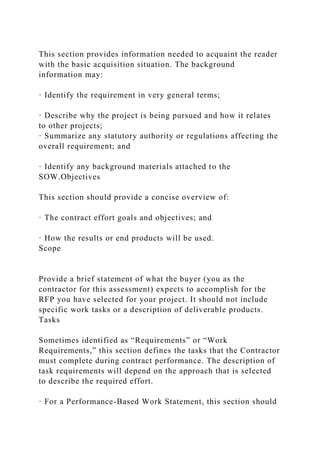
This section provides information needed to acquaint the reader
with the basic acquisition situation. The background
information may:
· Identify the requirement in very general terms;
· Describe why the project is being pursued and how it relates
to other projects;
· Summarize any statutory authority or regulations affecting the
overall requirement; and
· Identify any background materials attached to the
SOW.Objectives
This section should provide a concise overview of:
· The contract effort goals and objectives; and
· How the results or end products will be used.
Scope
Provide a brief statement of what the buyer (you as the
contractor for this assessment) expects to accomplish for the
RFP you have selected for your project. It should not include
specific work tasks or a description of deliverable products.
Tasks
Sometimes identified as “Requirements” or “Work
Requirements,” this section defines the tasks that the Contractor
must complete during contract performance. The description of
task requirements will depend on the approach that is selected
to describe the required effort.
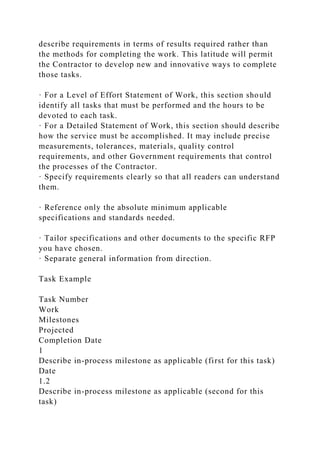
· For a Performance-Based Work Statement, this section should
describe requirements in terms of results required rather than
the methods for completing the work. This latitude will permit
the Contractor to develop new and innovative ways to complete
those tasks.
· For a Level of Effort Statement of Work, this section should
identify all tasks that must be performed and the hours to be
devoted to each task.
· For a Detailed Statement of Work, this section should describe
how the service must be accomplished. It may include precise
measurements, tolerances, materials, quality control
requirements, and other Government requirements that control
the processes of the Contractor.
· Specify requirements clearly so that all readers can understand
them.
· Reference only the absolute minimum applicable
specifications and standards needed.
· Tailor specifications and other documents to the specific RFP
you have chosen.
· Separate general information from direction.
Task Example
Task Number
Work
Milestones
Projected
Completion Date
1
Describe in-process milestone as applicable (first for this task)
Date
1.2
Describe in-process milestone as applicable (second for this
task)
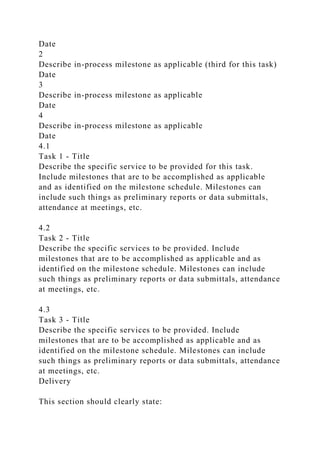
Date
2
Describe in-process milestone as applicable (third for this task)
Date
3
Describe in-process milestone as applicable
Date
4
Describe in-process milestone as applicable
Date
4.1
Task 1 - Title
Describe the specific service to be provided for this task.
Include milestones that are to be accomplished as applicable
and as identified on the milestone schedule. Milestones can
include such things as preliminary reports or data submittals,
attendance at meetings, etc.
4.2
Task 2 - Title
Describe the specific services to be provided. Include
milestones that are to be accomplished as applicable and as
identified on the milestone schedule. Milestones can include
such things as preliminary reports or data submittals, attendance
at meetings, etc.
4.3
Task 3 - Title
Describe the specific services to be provided. Include
milestones that are to be accomplished as applicable and as
identified on the milestone schedule. Milestones can include
such things as preliminary reports or data submittals, attendance
at meetings, etc.
Delivery
This section should clearly state:
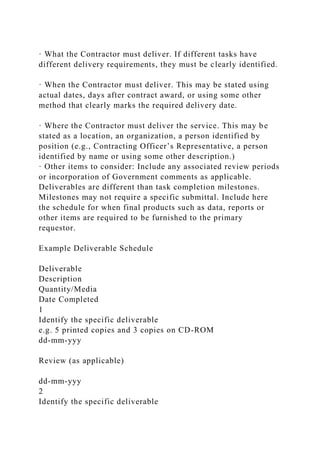
· What the Contractor must deliver. If different tasks have
different delivery requirements, they must be clearly identified.
· When the Contractor must deliver. This may be stated using
actual dates, days after contract award, or using some other
method that clearly marks the required delivery date.
· Where the Contractor must deliver the service. This may be
stated as a location, an organization, a person identified by
position (e.g., Contracting Officer’s Representative, a person
identified by name or using some other description.)
· Other items to consider: Include any associated review periods
or incorporation of Government comments as applicable.
Deliverables are different than task completion milestones.
Milestones may not require a specific submittal. Include here
the schedule for when final products such as data, reports or
other items are required to be furnished to the primary
requestor.
Example Deliverable Schedule
Deliverable
Description
Quantity/Media
Date Completed
1
Identify the specific deliverable
e.g. 5 printed copies and 3 copies on CD-ROM
dd-mm-yyy
Review (as applicable)
dd-mm-yyy
2
Identify the specific deliverable
As applicable
dd-mm-yyy
3
Identify the specific deliverable
As applicable
dd-mm-yyySecurity
This section should identify any unique security requirements
associated with contract performance (when applicable). These
requirements may include, but are not limited to, such items as:
· Special pass or identification requirements (this is usually
required of software upgrades or installations);
· Special security clearance requirements; or
· Special escort requirements. Travel
Describe any travel requirements that are to be encountered in
the performance of the service(s).
Special Material Requirements
Describe requirements for any special materials that are to be
encountered in the performance of the service(s).Other Unique
Requirements
Discuss any other unique requirements or considerations, e.g. -
Unique Item Identification (UID) and Radio Frequency
Identification (RFID).
SOW Language Tips:
A variety of people with different perspectives and life
experiences will read your SOW. Readers can typically include
Government and industry contracting personnel, managers,
technical experts, accountants and lawyers. All these readers
need to understand the SOW in a clear and concise manner;
therefore, language selection is very important.
Below are tips that you should consider when reviewing the
SOW:
· Use simple words, phrases, and sentences whenever practical.
· Be concise, precise, and consistent. Keep sentences short and
to the point. Normally the longer the sentence, the harder it is to
understand.
· Use verbs in the active voice. A verb is in the active voice
when it expresses an action performed by its subject. For
example, “The Contractor shall report contract progress
quarterly.” Conversely, avoid using verbs in the passive voice.
A verb is in the passive voice when it expresses an action
performed upon its subject or when the subject is the result of
the action. For example, “Contract progress shall be reported
quarterly by the Contractor.”
· Use “shall” or “must” when writing a requirement binding on
the Contractor. Avoid “should” or “may” because they leave the
decision on appropriate action up to the Contractor.
· Be consistent when using terminology. Use the same word to
mean the same thing throughout your SOW. Avoid using
different words to indicate the same type of action.
· Avoid redundancy. At best, requiring the Contractor to do the
same thing in different parts of the SOW will add needless
words to the SOW. At worst, there may be subtle differences in
the requirements that may lead to a dispute during contract
performance.
· Avoid vague or inexact phrases and generalizations.
· Avoid catchall and open-ended phrases, such as, “is common
practice in the industry,” “as directed,” or “subject to
approval.” If you want to give the Contractor an opportunity to
use their standard commercial practices, require each offeror to
identify its commercial practices in a proposal and then include
that proposal as part of the order/contract.
· Define technical terms.
· Only use “any,” “either,” “and/or,” “etc.” when allowing the
Contractor to select an alternative.
· Identify the date or version of any document referenced in
your SOW.
· Advise readers from industry where they can obtain referenced
documents.
1
PAGE
4
Procurement & Contract Mgmt –Unit IV Mini Project
Unit IV Mini Project
Statement of Work
Click here to retrieve the Statement of Work Template. Working
with the RFP you have selected and this template create a
statement of work for your project.
This template must be tailored to your specific project and
presented as if you are giving this to your client and your
leadership; this means uniform font, color, graphics and a
professional look.
Remove all traces of the guidance verbiage that is included in
the template.
The tips in the guidance are there to help you fill out the
Statement of Work appropriately for your selected RFP.
Procurement & Contract Mgmt
–
Unit
IV Min
i
Project
Unit IV Mini Project
Statement of Work
Click here to retrieve the Statement of Work Template. Working
with the RFP you have selected
and this template create a statement of work for your project.
This template must be tailored to your specific project and
presented as if you are giving this to
your client and your leadership; this means uniform font, color,
graphics and a professional look.
·
Remove all traces of
the guidance verbiage that is included in the template.
·
The tips in the guidance are there to help you fill out the
Statement of Work appropriately for
your selected RFP.
Procurement & Contract Mgmt –Unit IV Mini Project
Unit IV Mini Project
Statement of Work
Click here to retrieve the Statement of Work Template. Working
with the RFP you have selected
and this template create a statement of work for your project.
This template must be tailored to your specific project and
presented as if you are giving this to
your client and your leadership; this means uniform font, color,
graphics and a professional look.
f the guidance verbiage that is included in
the template.
Statement of Work appropriately for
your selected RFP.
Procurement & Contract Mgmt –Unit IV Assessment
Unit IV Assessment
Q1.
Using the RFP you have selected at the beginning of the
course, answer the two questions below in detail. Submit this
assignment as one comprehensive document of no less than 200
words.
1. Review the contract types discussed in Chapter 8. There is
a table that summarizes them all on pages 128-131 of the course
textbook. Discuss which type(s) of contract(s) are appropriate
for the RFP you have selected for your project and why.
2. How will you advertise and market your needs to different
sellers to bring the most competitive ones to the table?
Procurement & Contract Mgmt
–
Unit
IV Assessment
Unit IV Assessment
Q1.
Using the RFP you have selected at the beginning of the course,
answer the two questions below
in detail. Submit this assignment as one comprehensive
document of no less than 200 words.
1.
Review the contract types discussed in Chapter 8. There is a
table that summarizes them all
on pages 128
-
131 of the course textbook. Discuss which type(s) of contract(s)
are appropriate for
the RFP you have selected for your project and why.
2.
How will you advertise and market your needs to different
sellers to
bring the most
competitive ones to the table?
Procurement & Contract Mgmt –Unit IV Assessment
Unit IV Assessment
Q1.
Using the RFP you have selected at the beginning of the
course, answer the two questions below
in detail. Submit this assignment as one comprehensive
document of no less than 200 words.
1. Review the contract types discussed in Chapter 8. There is
a table that summarizes them all
on pages 128-131 of the course textbook. Discuss which type(s)
of contract(s) are appropriate for
the RFP you have selected for your project and why.
2. How will you advertise and market your needs to different
sellers to bring the most
competitive ones to the table?
Mock Job Interview Assignment – MGT4303 (15%)
This assignment will help you prepare yourself for your next
job hunt by developing and applying interview skills. In
particular, you will get used to being assessed by a panel of
interviewers (an increasingly common approach!). You will also
have a chance to observe others’ interviews and learn from their
strengths and weaknesses. A description of the job you are
applying for has been posted on Blackboard in the Assignments
section. You will be graded using the rubric on page 2 of this
document.
Directions:
You will sign up for an interview team on the Interview Wiki on
Blackboard.
Each team will have five members and will have a timeslot in
Weeks 12 or 13.
Everyone should dress in professional interview attire.
In each team, every member will be interviewed once by a panel
of the other members.
The interviewers will start by asking the interviewee to tell
them a bit about him/herself. The interviewee will then
introduce him or herself using the positioning pitch developed
in the Beyond a Resume Worksheet.
The panel will then ask the following three questions
a. What special aspects of your education or training have
prepared you for this job?
b. Tell me about a time when you solved a difficult problem.
c. Tell me about one or two of your most important
accomplishments.
They will also ask two other questions from the Interviewing
Chapter Reading (p. 394-396), which will be chosen by the
professor at the time of the interview.
The interviews will take about 5 minutes each.
There will be a short debrief at the end of each interview. Be
prepared to tell each interviewee one thing they did well and
one thing they could improve.
MOCK INTERVIEW SCORING RUBRIC
Name_________________________________________ Score
/20
Competency
Needs Work 1pt
Better 3pts
You’re Hired 5pts
Notes/Score
Impression and Attitude
Shows up for the interview late, does not shake hands, and/or
chews gum; is not dressed professionally at all.
Lack of interest and enthusiasm passive and indifferent; or
overly enthusiastic
Shows up for the interview on time with an attempt at
professional attire. Shakes hands, not optimal posture
Seems interested but could be better prepared or informed on
certain topics
Shows up for the interview on time in professional attire.
Shakes hands, smiles, composed body language
Interested and enthusiastic about the interview
Non-verbal Interview Skills/ Techniques
Looks at the floor or ceiling when speaking. Grammar and
language are not appropriate. Says “um” or “uhh” too many
times. Speak too fast or too slow, too loudly or softly
Adequate eye contact with your interviewers. Language and
grammar are adequate. Says “um” or “uhh”, but not enough to
disrupt the interview. Speak a little too fast or too slow, loudly
or softly
Excellent eye contact with interviewers without staring.
Language and grammar is appropriate. Few to no instances of
“um” or “uhh”. Speak at the right speed and volume
Positioning Pitch and Question Responses
Answers questions in generalities with no reference to personal
strengths, skills and abilities or position
Answers a few questions with some reference to personal
strengths, skills and abilities, and position
Answers questions with reference to strengths, skills and
abilities and how these will contribute to the position.
Question Responses: Stories/Examples
Fails to elaborate or explain using examples or stories, sounds
unprepared
Gives well-constructed responses, but sounds rehearsed or
unsure, or does not provide specific stories and examples
Gives well-constructed, confident responses that are genuine
and gives specific examples and stories.
OVERALL possible 20 pts
1
Last Blog Entry - Student name: Saiaf Bareem
Job interview
Hello, today I will be discussing an interesting topic that almost
important to everyone; the topic I am going to talk about today
is job interview. After that, I am going to tell you about the
interview I had last week, and give my feedback on the
interviewer.
To begin with, job interview is an essential key for an applicant
to join a team work or to get accepted to work in a company. An
interview in general is a type of communication and questioning
between two people or more such as hirer and an applicant in
order to get accepted to hire a position in a company. There are
several different questions will be asked and many topics will
be discussed in any interview between the hirer and the
applicant or the candidate. Those questions or topics are related
to the position that would be hired or about the applicant
experience.
However, I was interviewed by a graduated Human Resources
Management’s student last week to hire a data analyst position.
The interview went very well; it was easy and did not take too
long. To be honest, I was nervous and afraid that I will not be
able to answer most of the questions very well. As a second
language speaker of English, sometimes I think that I do not
speak English very good when talking to people who I do not
know. But when I just saw the interviewer in front of the
meeting room, she was smiling to me and shook my hand, as a
result, this made me feeling comfortable and relaxed during the
meeting. The interviewer and I dressed suits and were well-
prepared for the interview. Then, the interviewer began the
interview by asking me about myself. Afterward, I was asked
about some skills that I have mentioned in my CV; those skills
are some computer software that has a relation to the job
position such as Microsoft Office Database, Microsoft Office
Suite, Excel, and SAP. In addition, the interviewer gave me
some examples of problems that could happen in working
environment and asked me how I would handle those problems.
In conclusion, I was very happy at the end of the interview
because I was satisfied with my answers. In my opinion, the
student who interviewed is a professional and did a very good
job and I really liked her behaviour.
Tags: interview, job, data_analyst, analysis, data, blog,
Interviewees
Categories: interview, jobs, career, position, assignment
Pic:http://oneday.wpengine.netdna-cdn.com/wp-
content/uploads/6829381157_aa24bd171b_o.jpg
Good work on your final blog, but it was supposed to cover both
interview assignments. You also need a link, and there were
some English errors 2.4/3
Job Description for Practice and Mock Interview
AssignmentsSummer Student- Supply Chain Support
Company:
Loblaw
Location:
Mississauga, ON
Source:
JobPostings.ca
The candidate will be responsible for supporting the discovery,
development and delivery of ongoing engineering solutions that
continue to improve the competitive advantage of Loblaw
Companies Limited through continuous business process
improvements.
· Effectively communicate customer needs and priorities for
project planning, development, implementation, maintenance
and support.
· Support projects or processes and/or regulates, controls and
integrate activities and resources used in executing projects.
· Use initiative and critical thinking to deal with
concerns/issues/roadblocks within projects.
· Maintains accountability and is focused on results.
· Develops and manages relationships with internal customer
where contact involves probing and interpretation in dealing
with complex or sensitive issues and/or gaining cooperation,
with accountability for reaching agreement.
· Focuses on opportunities to improve and streamline processes
methodologies.
· Apply multiple, moderately complex methodologies for data
collection and process improvement initiatives.
· Obtain and provide complex, technical information around
data collection and standards providing additional clarification
to customers or team, as required.
· Ensure in-depth analyses of business issues and project results
are presented in a clear and concise format.
· Continuously reviews progress and accuracy of work to ensure
quality and high standards are delivered.
· Analyze, clarify and present the technical components of
business issues/needs in a clear and concise format and in a
professional, diplomatic and timely fashion.Job Qualifications
Exceptional PC Windows skills, including Microsoft Word,
Microsoft Access, Microsoft Excel spreadsheets, database and
graphics, with the ability to manipulate data, construct
graphical reports, flowcharts and statistics etc. Ability to think
through a problem and determine the appropriate solution based
upon Supply Chain principles, logic and common sense Ability
to work in a fast paced environment Be able to handle multiple
tasks at the same time and be able to re-prioritize effectively
Must be able to work independently as well as in a team
environment

Interviewee Feedback FormProfessors Norman Lomow, Moira McDonald, .docx

  • 1.
    Interviewee Feedback Form ProfessorsNorman Lomow, Moira McDonald, and Catrina McBrideIndividual Interview Feedback Student Interviewed: Saiaf Bareem Human Resources Student Interviewer: Rhett Mcrae All interviewees are required to complete and email this file to Moira McDonald [email protected] and their course professor within 24 hours of the interview. Please highlight any areas in the second column that were not completed satisfactorily or as planned and enter any comments in the last column. Section Highlight any areas below that were not completed satisfactorily or as planned Comments Invitation to interviewee to interview · Telephoned or emailed you minimum of one week before interview with day, time, and location · Explained interview in a professional, informative, and clear manner · Professional management of your questions The interviewer did very well in all aspects. He dealt with the interview professionally. The interviewer emailed me a head of time, arranged the time with me, and booked the room. He also explained the interview in a professional and informative manner. Welcome interviewee to interview · Began interview on time as scheduled · Greeted you in a welcoming and professional manner The interviewer was waiting me in the room ahead of time before I came. We both were there on time. He greeted and welcomed me in a professional way. Explain format of interview
  • 2.
    · Clear andconcise · Explained role of interviewer · Explained interview process The interviewer explained the job to me and clarified that this is not a real-job but only for practice matter. He explained that there will be some questions related to the job I need to answer. Interview questions · Clear and concise · Respectful and professional management of your responses and questions There were 10 questions. All questions were clear expect one. I asked the interviewer to clarify the question and he did. Some question were situational where I am put into a situation and want to know how I would react. Closing of interview · Clear and concise · Explanation of decision process and next steps The interview lasted about 15-20 minutes. At the end of the interview I was asked if I had anything that I would say. We shook hands and finished the interview. Interpersonal skills · Empathetic · Articulate · Maintained eye contact · Professional The interviewer did very well. He dealt with the situation as if it was a real-interview for a real-job. The way he talks and the way he managed eye-contact was very professional. I believe he
  • 3.
    would be agood interviewer. Professionalism · Familiarity with content · Limited reading · Industry appropriate word selection and behaviour at all times during interview The interview was professional. Everything went well. It did not last too long, the interviewer mentioned in the beginning that the interview will take from 15-20 minutes and that was true, it did not last more than that. The words the interviewer selected and used were appropriate for the case we are doing. He was taking notes while I was answering the questions. Simply, he acted professionally. I have read, understood, and am aware that the School of Business Procedures apply this assessment and course I understand my resume with shared with the human resources student interviewer and these two course professors I understand this feedback will the shared with the human resources student interviewer and these two course professors Signed: Saiaf Bareem Date: Nov27/2015 Project Planning –Unit IV Case Study Unit IV Case Study Read the “Nightingale Project— A” case on page 333 of your textbook. After reading the case, answer the following questions: Will the project as planned meet the October 25th deadline? Why, or why not? What schedule compression techniques would you use? What activities lie on the critical path? How sensitive is this network?
  • 4.
    You will needto identify your own thoughts and cite specific passages from the case study to support your point of view. Your response should be a minimum of one page in length in standard essay form following APA style guidelines. Project Planning – Unit IV Case Study Unit IV Case Study Read the “Nightingale Project — A” case on page 333 of your textbook. After reading the case, answer the following questions: · Will the project as pl anned meet the October 25th deadline? Why, or why not? What schedule compression techniques would you use? · What activities lie on the critical path? · How sensitive is this network?
  • 5.
    You will needto identify your own thoughts and cite specific passages f rom the case study to support your point of view. Your response should be a minimum of one page in length in standard essay form following APA style guidelines. Project Planning –Unit IV Case Study Unit IV Case Study Read the “Nightingale Project— A” case on page 333 of your textbook. After reading the case, answer the following questions: Why, or why not? What schedule compression techniques would you use? You will need to identify your own thoughts and cite specific passages from the case study to support your point of view. Your response should be a minimum of one page in length in standard essay form following APA style guidelines. Generic SOW Template Statement of Work (SOW) Template The Statement of Work (SOW) template is only meant to be a guide for you to demonstrate your understanding of how important it is to outline the project needs in detail. Contents should be tailored to the requirement. Background
  • 6.
    This section providesinformation needed to acquaint the reader with the basic acquisition situation. The background information may: · Identify the requirement in very general terms; · Describe why the project is being pursued and how it relates to other projects; · Summarize any statutory authority or regulations affecting the overall requirement; and · Identify any background materials attached to the SOW.Objectives This section should provide a concise overview of: · The contract effort goals and objectives; and · How the results or end products will be used. Scope Provide a brief statement of what the buyer (you as the contractor for this assessment) expects to accomplish for the RFP you have selected for your project. It should not include specific work tasks or a description of deliverable products. Tasks Sometimes identified as “Requirements” or “Work Requirements,” this section defines the tasks that the Contractor must complete during contract performance. The description of task requirements will depend on the approach that is selected to describe the required effort. · For a Performance-Based Work Statement, this section should
  • 7.
    describe requirements interms of results required rather than the methods for completing the work. This latitude will permit the Contractor to develop new and innovative ways to complete those tasks. · For a Level of Effort Statement of Work, this section should identify all tasks that must be performed and the hours to be devoted to each task. · For a Detailed Statement of Work, this section should describe how the service must be accomplished. It may include precise measurements, tolerances, materials, quality control requirements, and other Government requirements that control the processes of the Contractor. · Specify requirements clearly so that all readers can understand them. · Reference only the absolute minimum applicable specifications and standards needed. · Tailor specifications and other documents to the specific RFP you have chosen. · Separate general information from direction. Task Example Task Number Work Milestones Projected Completion Date 1 Describe in-process milestone as applicable (first for this task) Date 1.2 Describe in-process milestone as applicable (second for this task)
  • 8.
    Date 2 Describe in-process milestoneas applicable (third for this task) Date 3 Describe in-process milestone as applicable Date 4 Describe in-process milestone as applicable Date 4.1 Task 1 - Title Describe the specific service to be provided for this task. Include milestones that are to be accomplished as applicable and as identified on the milestone schedule. Milestones can include such things as preliminary reports or data submittals, attendance at meetings, etc. 4.2 Task 2 - Title Describe the specific services to be provided. Include milestones that are to be accomplished as applicable and as identified on the milestone schedule. Milestones can include such things as preliminary reports or data submittals, attendance at meetings, etc. 4.3 Task 3 - Title Describe the specific services to be provided. Include milestones that are to be accomplished as applicable and as identified on the milestone schedule. Milestones can include such things as preliminary reports or data submittals, attendance at meetings, etc. Delivery This section should clearly state:
  • 9.
    · What theContractor must deliver. If different tasks have different delivery requirements, they must be clearly identified. · When the Contractor must deliver. This may be stated using actual dates, days after contract award, or using some other method that clearly marks the required delivery date. · Where the Contractor must deliver the service. This may be stated as a location, an organization, a person identified by position (e.g., Contracting Officer’s Representative, a person identified by name or using some other description.) · Other items to consider: Include any associated review periods or incorporation of Government comments as applicable. Deliverables are different than task completion milestones. Milestones may not require a specific submittal. Include here the schedule for when final products such as data, reports or other items are required to be furnished to the primary requestor. Example Deliverable Schedule Deliverable Description Quantity/Media Date Completed 1 Identify the specific deliverable e.g. 5 printed copies and 3 copies on CD-ROM dd-mm-yyy Review (as applicable) dd-mm-yyy 2 Identify the specific deliverable
  • 10.
    As applicable dd-mm-yyy 3 Identify thespecific deliverable As applicable dd-mm-yyySecurity This section should identify any unique security requirements associated with contract performance (when applicable). These requirements may include, but are not limited to, such items as: · Special pass or identification requirements (this is usually required of software upgrades or installations); · Special security clearance requirements; or · Special escort requirements. Travel Describe any travel requirements that are to be encountered in the performance of the service(s). Special Material Requirements Describe requirements for any special materials that are to be encountered in the performance of the service(s).Other Unique Requirements Discuss any other unique requirements or considerations, e.g. - Unique Item Identification (UID) and Radio Frequency Identification (RFID). SOW Language Tips: A variety of people with different perspectives and life experiences will read your SOW. Readers can typically include Government and industry contracting personnel, managers, technical experts, accountants and lawyers. All these readers need to understand the SOW in a clear and concise manner; therefore, language selection is very important. Below are tips that you should consider when reviewing the
  • 11.
    SOW: · Use simplewords, phrases, and sentences whenever practical. · Be concise, precise, and consistent. Keep sentences short and to the point. Normally the longer the sentence, the harder it is to understand. · Use verbs in the active voice. A verb is in the active voice when it expresses an action performed by its subject. For example, “The Contractor shall report contract progress quarterly.” Conversely, avoid using verbs in the passive voice. A verb is in the passive voice when it expresses an action performed upon its subject or when the subject is the result of the action. For example, “Contract progress shall be reported quarterly by the Contractor.” · Use “shall” or “must” when writing a requirement binding on the Contractor. Avoid “should” or “may” because they leave the decision on appropriate action up to the Contractor. · Be consistent when using terminology. Use the same word to mean the same thing throughout your SOW. Avoid using different words to indicate the same type of action. · Avoid redundancy. At best, requiring the Contractor to do the same thing in different parts of the SOW will add needless words to the SOW. At worst, there may be subtle differences in the requirements that may lead to a dispute during contract performance. · Avoid vague or inexact phrases and generalizations. · Avoid catchall and open-ended phrases, such as, “is common practice in the industry,” “as directed,” or “subject to approval.” If you want to give the Contractor an opportunity to use their standard commercial practices, require each offeror to identify its commercial practices in a proposal and then include that proposal as part of the order/contract.
  • 12.
    · Define technicalterms. · Only use “any,” “either,” “and/or,” “etc.” when allowing the Contractor to select an alternative. · Identify the date or version of any document referenced in your SOW. · Advise readers from industry where they can obtain referenced documents. 1 PAGE 4 Procurement & Contract Mgmt –Unit IV Mini Project Unit IV Mini Project Statement of Work Click here to retrieve the Statement of Work Template. Working with the RFP you have selected and this template create a statement of work for your project. This template must be tailored to your specific project and presented as if you are giving this to your client and your leadership; this means uniform font, color, graphics and a professional look. Remove all traces of the guidance verbiage that is included in the template. The tips in the guidance are there to help you fill out the Statement of Work appropriately for your selected RFP. Procurement & Contract Mgmt – Unit
  • 13.
    IV Min i Project Unit IVMini Project Statement of Work Click here to retrieve the Statement of Work Template. Working with the RFP you have selected and this template create a statement of work for your project. This template must be tailored to your specific project and presented as if you are giving this to your client and your leadership; this means uniform font, color, graphics and a professional look. · Remove all traces of the guidance verbiage that is included in the template. · The tips in the guidance are there to help you fill out the Statement of Work appropriately for your selected RFP. Procurement & Contract Mgmt –Unit IV Mini Project
  • 14.
    Unit IV MiniProject Statement of Work Click here to retrieve the Statement of Work Template. Working with the RFP you have selected and this template create a statement of work for your project. This template must be tailored to your specific project and presented as if you are giving this to your client and your leadership; this means uniform font, color, graphics and a professional look. f the guidance verbiage that is included in the template. Statement of Work appropriately for your selected RFP. Procurement & Contract Mgmt –Unit IV Assessment Unit IV Assessment Q1. Using the RFP you have selected at the beginning of the course, answer the two questions below in detail. Submit this assignment as one comprehensive document of no less than 200 words. 1. Review the contract types discussed in Chapter 8. There is a table that summarizes them all on pages 128-131 of the course textbook. Discuss which type(s) of contract(s) are appropriate for the RFP you have selected for your project and why. 2. How will you advertise and market your needs to different sellers to bring the most competitive ones to the table?
  • 15.
    Procurement & ContractMgmt – Unit IV Assessment Unit IV Assessment Q1. Using the RFP you have selected at the beginning of the course, answer the two questions below in detail. Submit this assignment as one comprehensive document of no less than 200 words. 1. Review the contract types discussed in Chapter 8. There is a table that summarizes them all on pages 128 - 131 of the course textbook. Discuss which type(s) of contract(s) are appropriate for the RFP you have selected for your project and why. 2. How will you advertise and market your needs to different sellers to
  • 16.
    bring the most competitiveones to the table? Procurement & Contract Mgmt –Unit IV Assessment Unit IV Assessment Q1. Using the RFP you have selected at the beginning of the course, answer the two questions below in detail. Submit this assignment as one comprehensive document of no less than 200 words. 1. Review the contract types discussed in Chapter 8. There is a table that summarizes them all on pages 128-131 of the course textbook. Discuss which type(s) of contract(s) are appropriate for the RFP you have selected for your project and why. 2. How will you advertise and market your needs to different sellers to bring the most competitive ones to the table? Mock Job Interview Assignment – MGT4303 (15%) This assignment will help you prepare yourself for your next job hunt by developing and applying interview skills. In particular, you will get used to being assessed by a panel of interviewers (an increasingly common approach!). You will also have a chance to observe others’ interviews and learn from their strengths and weaknesses. A description of the job you are applying for has been posted on Blackboard in the Assignments section. You will be graded using the rubric on page 2 of this document.
  • 17.
    Directions: You will signup for an interview team on the Interview Wiki on Blackboard. Each team will have five members and will have a timeslot in Weeks 12 or 13. Everyone should dress in professional interview attire. In each team, every member will be interviewed once by a panel of the other members. The interviewers will start by asking the interviewee to tell them a bit about him/herself. The interviewee will then introduce him or herself using the positioning pitch developed in the Beyond a Resume Worksheet. The panel will then ask the following three questions a. What special aspects of your education or training have prepared you for this job? b. Tell me about a time when you solved a difficult problem. c. Tell me about one or two of your most important accomplishments. They will also ask two other questions from the Interviewing Chapter Reading (p. 394-396), which will be chosen by the professor at the time of the interview. The interviews will take about 5 minutes each. There will be a short debrief at the end of each interview. Be prepared to tell each interviewee one thing they did well and one thing they could improve. MOCK INTERVIEW SCORING RUBRIC Name_________________________________________ Score /20 Competency Needs Work 1pt Better 3pts You’re Hired 5pts Notes/Score Impression and Attitude
  • 18.
    Shows up forthe interview late, does not shake hands, and/or chews gum; is not dressed professionally at all. Lack of interest and enthusiasm passive and indifferent; or overly enthusiastic Shows up for the interview on time with an attempt at professional attire. Shakes hands, not optimal posture Seems interested but could be better prepared or informed on certain topics Shows up for the interview on time in professional attire. Shakes hands, smiles, composed body language Interested and enthusiastic about the interview Non-verbal Interview Skills/ Techniques Looks at the floor or ceiling when speaking. Grammar and language are not appropriate. Says “um” or “uhh” too many times. Speak too fast or too slow, too loudly or softly Adequate eye contact with your interviewers. Language and grammar are adequate. Says “um” or “uhh”, but not enough to disrupt the interview. Speak a little too fast or too slow, loudly or softly Excellent eye contact with interviewers without staring. Language and grammar is appropriate. Few to no instances of “um” or “uhh”. Speak at the right speed and volume Positioning Pitch and Question Responses Answers questions in generalities with no reference to personal strengths, skills and abilities or position Answers a few questions with some reference to personal strengths, skills and abilities, and position Answers questions with reference to strengths, skills and abilities and how these will contribute to the position. Question Responses: Stories/Examples Fails to elaborate or explain using examples or stories, sounds
  • 19.
    unprepared Gives well-constructed responses,but sounds rehearsed or unsure, or does not provide specific stories and examples Gives well-constructed, confident responses that are genuine and gives specific examples and stories. OVERALL possible 20 pts 1 Last Blog Entry - Student name: Saiaf Bareem Job interview Hello, today I will be discussing an interesting topic that almost important to everyone; the topic I am going to talk about today is job interview. After that, I am going to tell you about the interview I had last week, and give my feedback on the interviewer. To begin with, job interview is an essential key for an applicant to join a team work or to get accepted to work in a company. An interview in general is a type of communication and questioning between two people or more such as hirer and an applicant in order to get accepted to hire a position in a company. There are several different questions will be asked and many topics will be discussed in any interview between the hirer and the
  • 20.
    applicant or thecandidate. Those questions or topics are related to the position that would be hired or about the applicant experience. However, I was interviewed by a graduated Human Resources Management’s student last week to hire a data analyst position. The interview went very well; it was easy and did not take too long. To be honest, I was nervous and afraid that I will not be able to answer most of the questions very well. As a second language speaker of English, sometimes I think that I do not speak English very good when talking to people who I do not know. But when I just saw the interviewer in front of the meeting room, she was smiling to me and shook my hand, as a result, this made me feeling comfortable and relaxed during the meeting. The interviewer and I dressed suits and were well- prepared for the interview. Then, the interviewer began the interview by asking me about myself. Afterward, I was asked about some skills that I have mentioned in my CV; those skills are some computer software that has a relation to the job position such as Microsoft Office Database, Microsoft Office Suite, Excel, and SAP. In addition, the interviewer gave me some examples of problems that could happen in working environment and asked me how I would handle those problems. In conclusion, I was very happy at the end of the interview because I was satisfied with my answers. In my opinion, the student who interviewed is a professional and did a very good job and I really liked her behaviour. Tags: interview, job, data_analyst, analysis, data, blog, Interviewees Categories: interview, jobs, career, position, assignment Pic:http://oneday.wpengine.netdna-cdn.com/wp- content/uploads/6829381157_aa24bd171b_o.jpg Good work on your final blog, but it was supposed to cover both
  • 21.
    interview assignments. Youalso need a link, and there were some English errors 2.4/3 Job Description for Practice and Mock Interview AssignmentsSummer Student- Supply Chain Support Company: Loblaw Location: Mississauga, ON Source: JobPostings.ca The candidate will be responsible for supporting the discovery, development and delivery of ongoing engineering solutions that continue to improve the competitive advantage of Loblaw Companies Limited through continuous business process improvements. · Effectively communicate customer needs and priorities for project planning, development, implementation, maintenance and support. · Support projects or processes and/or regulates, controls and integrate activities and resources used in executing projects. · Use initiative and critical thinking to deal with concerns/issues/roadblocks within projects. · Maintains accountability and is focused on results. · Develops and manages relationships with internal customer where contact involves probing and interpretation in dealing with complex or sensitive issues and/or gaining cooperation, with accountability for reaching agreement. · Focuses on opportunities to improve and streamline processes methodologies. · Apply multiple, moderately complex methodologies for data collection and process improvement initiatives. · Obtain and provide complex, technical information around data collection and standards providing additional clarification to customers or team, as required. · Ensure in-depth analyses of business issues and project results
  • 22.
    are presented ina clear and concise format. · Continuously reviews progress and accuracy of work to ensure quality and high standards are delivered. · Analyze, clarify and present the technical components of business issues/needs in a clear and concise format and in a professional, diplomatic and timely fashion.Job Qualifications Exceptional PC Windows skills, including Microsoft Word, Microsoft Access, Microsoft Excel spreadsheets, database and graphics, with the ability to manipulate data, construct graphical reports, flowcharts and statistics etc. Ability to think through a problem and determine the appropriate solution based upon Supply Chain principles, logic and common sense Ability to work in a fast paced environment Be able to handle multiple tasks at the same time and be able to re-prioritize effectively Must be able to work independently as well as in a team environment