IP Subnet Design Project- ONLY QUALITY ASSIGNMENTS
AND 0% PLAGIARISM
1 | P a g e
IP Subnet Design Project
Overview
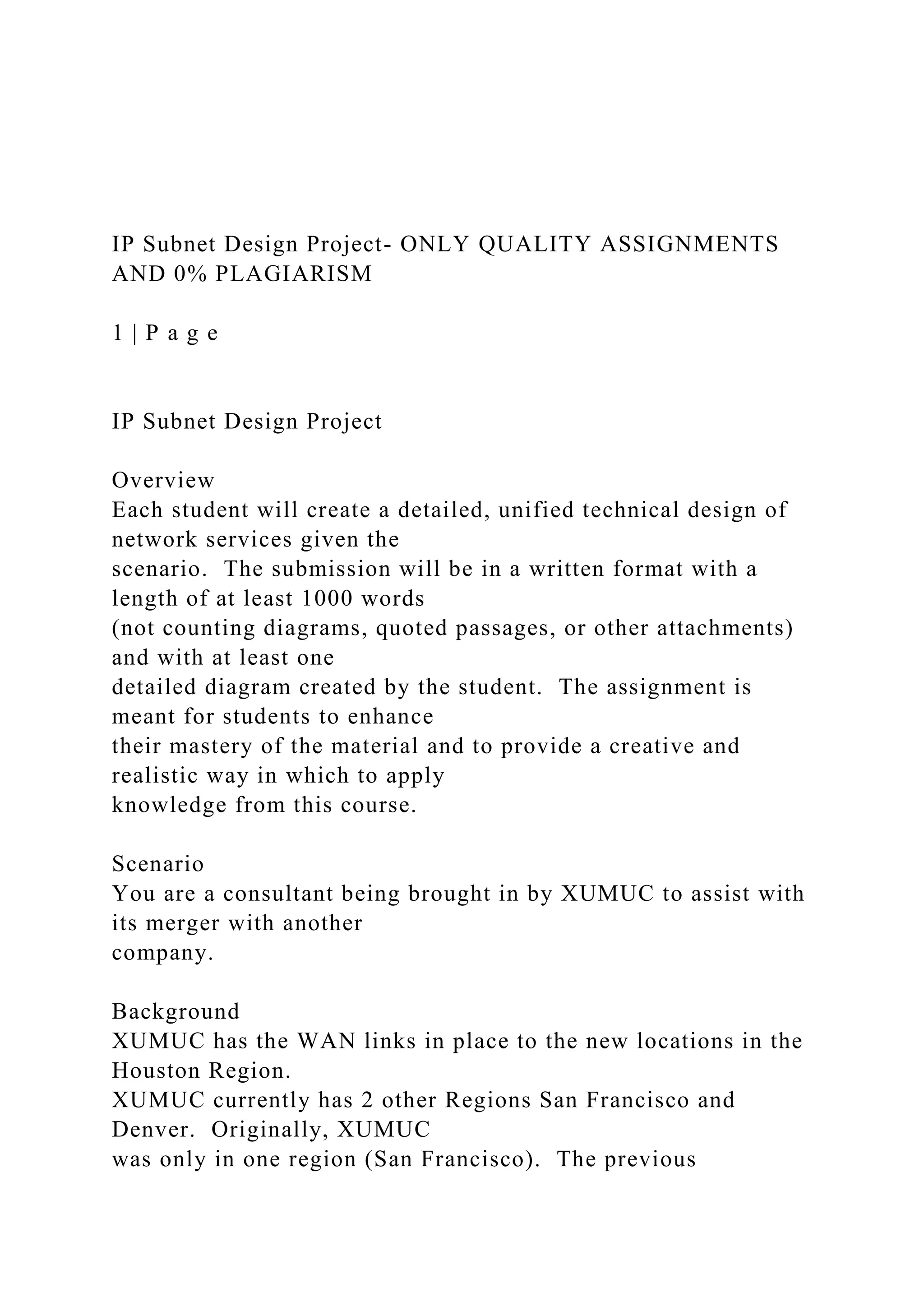
Each student will create a detailed, unified technical design of
network services given the
scenario. The submission will be in a written format with a
length of at least 1000 words
(not counting diagrams, quoted passages, or other attachments)
and with at least one
detailed diagram created by the student. The assignment is
meant for students to enhance
their mastery of the material and to provide a creative and
realistic way in which to apply
knowledge from this course.
Scenario
You are a consultant being brought in by XUMUC to assist with
its merger with another
company.
Background
XUMUC has the WAN links in place to the new locations in the
Houston Region.
XUMUC currently has 2 other Regions San Francisco and
Denver. Originally, XUMUC
was only in one region (San Francisco). The previous
consultant did a poor job with the
integration resulting in a poor IP address scheme as a result
routing tables at the
summarization points and at the San Francisco Campus are very
large.
In addition, no VLAN structure was developed to isolate
broadcast traffic. There are 4
main departments in XUMC: sales, finance, human resources,
and research and
development. Also, there has been some concern that the WAN
transport was not able to
accommodate the network traffic. Finally, all addresses in the
network are statically
assigned resulting in high administration overhead when
changes are made. XUMC
would like this changed to lower administrative overhead.
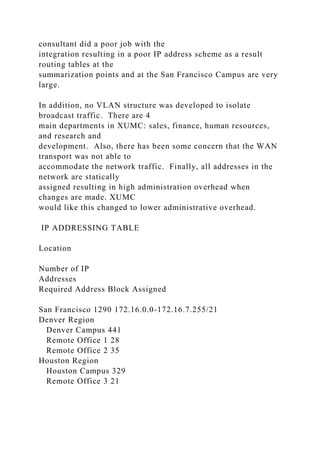
IP ADDRESSING TABLE
Location
Number of IP
Addresses
Required Address Block Assigned
San Francisco 1290 172.16.0.0-172.16.7.255/21
Denver Region
Denver Campus 441
Remote Office 1 28
Remote Office 2 35
Houston Region
Houston Campus 329
Remote Office 3 21
IP Subnet Design Project.
2 | P a g e
Deliverables
There are a number of requirements for this project.
• The document should contain:
o Title page
o Table of Content page
o Executive summary
o Technical details (including any assumptions)
le (including summarized routes
for
the Denver and Houston regions),
o Conclusion
o Reference page
Formatting and Length:
• The paper must be at least 1000 words in length. Word count
does not include
words in diagrams, tables, large quotations from sources, or
other attachments.
The length should not exceed 15 pages; recommended length is
8-9 double-
spaced pages.
• Use 1" margins. The font should be 12-point, Arial. Include
page numbers in your
document, as well as your name and date somewhere in the
document (e.g., on a
title page).
XMUMC Network Diagram
IP Subnet Design Project.
3 | P a g e
IP Subnet Design Project
4 | P a g e
Grading Rubric for Term Papers (Courtesy of Noah Lilian)
Qualities & Criteria Poor (0-80) Good (80-90) Excellent (90-
100)
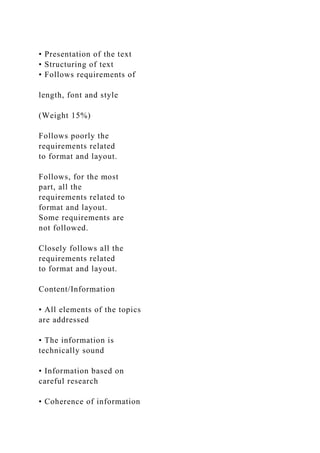
Format/Layout
• Presentation of the text
• Structuring of text
• Follows requirements of
length, font and style
(Weight 15%)
Follows poorly the
requirements related
to format and layout.
Follows, for the most
part, all the
requirements related to
format and layout.
Some requirements are
not followed.
Closely follows all the
requirements related
to format and layout.
Content/Information
• All elements of the topics
are addressed
• The information is
technically sound
• Information based on
careful research
• Coherence of information
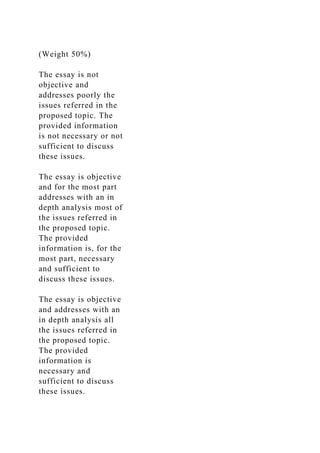
(Weight 50%)
The essay is not
objective and
addresses poorly the
issues referred in the
proposed topic. The
provided information
is not necessary or not
sufficient to discuss
these issues.
The essay is objective
and for the most part
addresses with an in
depth analysis most of
the issues referred in
the proposed topic.
The provided
information is, for the
most part, necessary
and sufficient to
discuss these issues.
The essay is objective
and addresses with an
in depth analysis all
the issues referred in
the proposed topic.
The provided
information is
necessary and
sufficient to discuss
these issues.
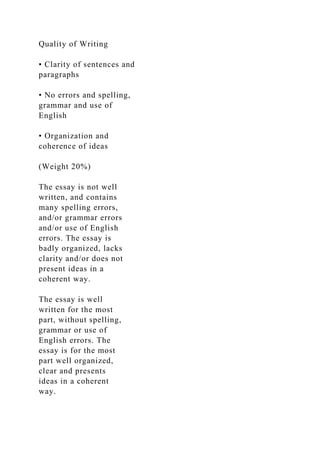
Quality of Writing
• Clarity of sentences and
paragraphs
• No errors and spelling,
grammar and use of
English
• Organization and
coherence of ideas
(Weight 20%)
The essay is not well
written, and contains
many spelling errors,
and/or grammar errors
and/or use of English
errors. The essay is
badly organized, lacks
clarity and/or does not
present ideas in a
coherent way.
The essay is well
written for the most
part, without spelling,
grammar or use of
English errors. The
essay is for the most
part well organized,
clear and presents
ideas in a coherent
way.
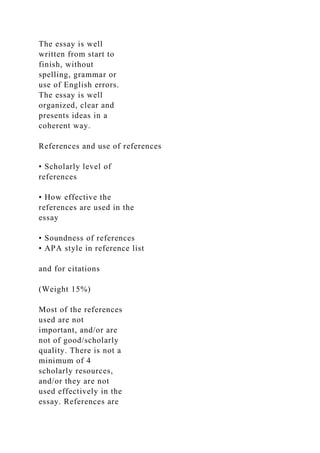
The essay is well
written from start to
finish, without
spelling, grammar or
use of English errors.
The essay is well
organized, clear and
presents ideas in a
coherent way.
References and use of references
• Scholarly level of
references
• How effective the
references are used in the
essay
• Soundness of references
• APA style in reference list
and for citations
(Weight 15%)
Most of the references
used are not
important, and/or are
not of good/scholarly
quality. There is not a
minimum of 4
scholarly resources,
and/or they are not
used effectively in the
essay. References are
not effectively used,
and/or correctly cited
and/or correctly listed
in the reference list
according to APA
style.
Most of the references
used are important,
and are of
good/scholarly quality.
There is a minimum of
4 scholarly resources
that are for the most
part used effectively in
the essay. Most of the
references are
effectively used,
correctly cited and
correctly listed in the
reference list
according to APA
style.
All the references
used are important,
and are of
good/scholarly
quality. There is a
minimum of 4
scholarly resources
that are used
effectively in the
essay. All the
references are
effectively used,
correctly cited and
correctly listed in the
reference list
according to APA
style.
IP Subnet Design Project
5 | P a g e
Overriding criterion: Originality and authenticity. If the essay is
identified as not being original, and/or
not done by the student, the instructor has the right to grade the
paper as an F.
“Gideon’s Trumpet” by Anthony Lewis
“Gideon’s Trumpet” by Anthony Lewis provides a detailed
overview of a long and difficult struggle of Clarence Earl
Gideon for justice and freedom. The depicted years showed no
need in defense lawyer, meaning that the due process might
come without an appointed attorney and the accused should
defend them. Thus, the key goal of the book is to present a long
road of the main hero to gain his civil rights for counseling.
Lewis is very effective and persuasive in depicting an appealing
process to the Supreme Court. The author has done a great job
of combing all the court cases into one book that was released
in 1964. The book is a quest of a person for justice as Gideon
claimed the sentence was wrong and court’s decision should be
revised. Gideon’s strong belief in justice has changed the world
and has given a hope for many accused in similar situations.
(Lewis 1989)
Lewis starts with discussing biographical peculiarities of
Clarence Earl Gideon, stating that he spent much time in prison.
In particular, Gideon’s life was divided into two parts: in prison
and out of prison. Despite being unable to lead a normal life,
Gideon wasn’t viewed as either professional criminal or severe
recidivist. Lewis writes about Gideon: “Those who had known
him, even the men who had arrested him and those who were
now his jailers, considered Gideon a perfectly harmless human
being, rather like able, but one tossed aside by life. Anyone
meeting him for the first time would be likely to regard him as
the most wretched of men”. (Lewis 1989) Nevertheless, Gideon
hasn’t
become a legislative citizen.
Gideon claimed that Florida’s law had treated him unfairly and,
thus, he felt responsible to seek for justice. He was willing to
gain fair freedom. In particular, his arrest dated to 1961 in
Panama City. When the trial started the due process, Gideon
refused to continue it, stating he had no appointed lawyer.
Lewis mentions with interest that “the defendant answered the
court’s question, but spoken in such low tones that it was not
audible”. (Lewis 1989) Gideon decently repeated his claim:
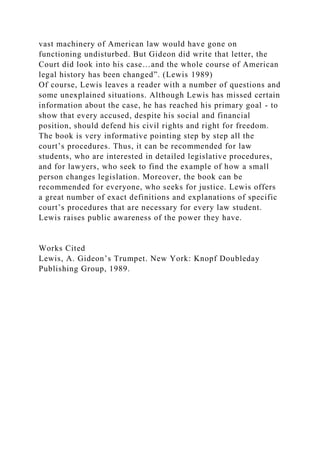
“You Honour: I request this Court to appoint counsel to
represent me in this trial”. (Lewis 1989) The court denied his
request, underlying that capital offence is the only ground for
appointing the lawyer to an accused. As a result, Gideon’s claim
was denied, but he strongly claimed his imprisonment was
illegal. That claim appeared to be revolutionary, stimulating a
number of future changes in legislative procedures.
Lewis effectively presents Gideon’s feelings and emotions, his
resentment. Gideon underlined he was a poor man and, thus, the
Court had to appoint an attorney for him. The positive moment
is that Gideon decided to struggle for his rights and prepared all
the case requirements for the Supreme Court. The preliminary
trial was set for ninety days. Further, Gideon sent copies of his
application to the lower Florida court, stressing that his rights
were violated –as appointed lawyer hasn’t represented his
interests in the Supreme Court. Gideon’s application to the
Supreme Court was a document of over five pages with a central
claim to move his case to the Supreme Court. Gideon succeeded
in finding the only existing hole between the state court and the
federal court. In particular, the decision of the state court can’t
be revised by the Supreme Court, but the hole shows that in
case the state court deals with federal issues, the Supreme Court
can revise the decisions of the state court.
Finally, the court noticed Gideon’s petition and Gideon
accomplished his goal. Lewis argues that proving a
constitutional right for counselling was a real victory and the
most important change. The year of 1963 appeared to be the
year of great change as the indigent defendants were provided
with
a lawyer during the due process. Clarence Earl Gideon
considered it the first victory as every civil society couldn’t
deprive a person his civil rights. A new trial was granted to
Gideon. He was excited about getting the first victory over the
Supreme Court, and during the new trial process his interests
were represented by the appointed lawyer. Gideon as acquitted
in his re-trial thanks to his attorney – the justice was set.
Lewis shows that seeking for justice and the ability of the
accused to reach justice are vitally important for every civil
society and for the accused as well. Evidence shows a number
of illegally and wrongly accused people. Lewis presents
“Gideon’s Trumpet” as the story of unexpected triumph of a
person over the court system. He shows that even the poorest
person is able to defend his position and his civil rights in the
Supreme Court. It seems unusual that a “little man” has dared to
struggle with legislative system and to win: “If an obscure
Florida convict named Clarence Earl Gideon had not sat down
in his prison cell to write a letter to the supreme Court…the
vast machinery of American law would have gone on
functioning undisturbed. But Gideon did write that letter, the
Court did look into his case…and the whole course of American
legal history has been changed”. (Lewis 1989)
Of course, Lewis leaves a reader with a number of questions and
some unexplained situations. Although Lewis has missed certain
information about the case, he has reached his primary goal - to
show that every accused, despite his social and financial
position, should defend his civil rights and right for freedom.
The book is very informative pointing step by step all the
court’s procedures. Thus, it can be recommended for law
students, who are interested in detailed legislative procedures,
and for lawyers, who seek to find the example of how a small
person changes legislation. Moreover, the book can be
recommended for everyone, who seeks for justice. Lewis offers
a great number of exact definitions and explanations of specific
court’s procedures that are necessary for every law student.
Lewis raises public awareness of the power they have.
Works Cited
Lewis, A. Gideon’s Trumpet. New York: Knopf Doubleday
Publishing Group, 1989.
“Gideon’s Trumpet” by Anthony Lewis
“Gideon’s Trumpet” by Anthony Lewis provides a detailed
overview of a long and difficult
struggle of Clarence Earl Gideon for justice and freedom.
The depicted years showed no need in
defense lawyer, meaning that the due process might come
without an appointed attorney and the
accused should defend them. Thus, the key goal of the book is
to present a long road of the main hero
to gain his civil rights for counseling. Lewis is very effective
and persuasive in depicting an appealing
process to the Supreme Court. The author has done a great job
of combing all the court cases into one
book that was released in 1964. The book is a quest of a person
for justice as Gideon claimed the
sentence was wrong and court’s decision should be
revised. Gideon’s strong belief in justice has
changed the world and has given a hope for many accused in
similar situations. (Lewis 1989)
Lewis starts with discussing biographical peculiarities of
Clarence Earl Gideon, stating that he
spent much time in prison. In particular, Gideon’s life was
divided into two parts: in prison and out of
prison. Despite being unable to lead a normal life, Gideon
wasn’t viewed as either professional
criminal or severe recidivist. Lewis writes about Gideon:
“Those who had known him, even the men
who had arrested him and those who were now his jailers,
considered Gideon a perfectly harmless
human being, rather like able, but one tossed aside by life.
Anyone meeting him for the first time would
be likely to regard him as the most wretched of men”. (Lewis
1989) Nevertheless, Gideon hasn’t
become a legislative citizen.
Gideon claimed that Florida’s law had treated him unfairly and,
thus, he felt responsible to seek
for justice. He was willing to gain fair freedom. In particular,
his arrest dated to 1961 in Panama City.
When the trial started the due process, Gideon refused to
continue it, stating he had no appointed
lawyer. Lewis mentions with interest that “the defendant
answered the court’s question, but spoken in
such low tones that it was not audible”. (Lewis 1989)
Gideon decently repeated his claim: “You
IP Subnet Design Project- ONLY QUALITY ASSIGNMENTS AND 0 PLAG.docx

IP Subnet Design Project- ONLY QUALITY ASSIGNMENTS AND 0 PLAG.docx

  • 1.
    IP Subnet DesignProject- ONLY QUALITY ASSIGNMENTS AND 0% PLAGIARISM 1 | P a g e IP Subnet Design Project Overview Each student will create a detailed, unified technical design of network services given the scenario. The submission will be in a written format with a length of at least 1000 words (not counting diagrams, quoted passages, or other attachments) and with at least one detailed diagram created by the student. The assignment is meant for students to enhance their mastery of the material and to provide a creative and realistic way in which to apply knowledge from this course. Scenario You are a consultant being brought in by XUMUC to assist with its merger with another company. Background XUMUC has the WAN links in place to the new locations in the Houston Region. XUMUC currently has 2 other Regions San Francisco and Denver. Originally, XUMUC was only in one region (San Francisco). The previous
  • 2.
    consultant did apoor job with the integration resulting in a poor IP address scheme as a result routing tables at the summarization points and at the San Francisco Campus are very large. In addition, no VLAN structure was developed to isolate broadcast traffic. There are 4 main departments in XUMC: sales, finance, human resources, and research and development. Also, there has been some concern that the WAN transport was not able to accommodate the network traffic. Finally, all addresses in the network are statically assigned resulting in high administration overhead when changes are made. XUMC would like this changed to lower administrative overhead. IP ADDRESSING TABLE Location Number of IP Addresses Required Address Block Assigned San Francisco 1290 172.16.0.0-172.16.7.255/21 Denver Region Denver Campus 441 Remote Office 1 28 Remote Office 2 35 Houston Region Houston Campus 329 Remote Office 3 21
  • 3.
    IP Subnet DesignProject. 2 | P a g e Deliverables There are a number of requirements for this project. • The document should contain: o Title page o Table of Content page o Executive summary o Technical details (including any assumptions) le (including summarized routes for the Denver and Houston regions), o Conclusion o Reference page Formatting and Length: • The paper must be at least 1000 words in length. Word count does not include words in diagrams, tables, large quotations from sources, or other attachments. The length should not exceed 15 pages; recommended length is 8-9 double-
  • 4.
    spaced pages. • Use1" margins. The font should be 12-point, Arial. Include page numbers in your document, as well as your name and date somewhere in the document (e.g., on a title page). XMUMC Network Diagram IP Subnet Design Project. 3 | P a g e IP Subnet Design Project 4 | P a g e Grading Rubric for Term Papers (Courtesy of Noah Lilian) Qualities & Criteria Poor (0-80) Good (80-90) Excellent (90- 100) Format/Layout
  • 5.
    • Presentation ofthe text • Structuring of text • Follows requirements of length, font and style (Weight 15%) Follows poorly the requirements related to format and layout. Follows, for the most part, all the requirements related to format and layout. Some requirements are not followed. Closely follows all the requirements related to format and layout. Content/Information • All elements of the topics are addressed • The information is technically sound • Information based on careful research • Coherence of information
  • 6.
    (Weight 50%) The essayis not objective and addresses poorly the issues referred in the proposed topic. The provided information is not necessary or not sufficient to discuss these issues. The essay is objective and for the most part addresses with an in depth analysis most of the issues referred in the proposed topic. The provided information is, for the most part, necessary and sufficient to discuss these issues. The essay is objective and addresses with an in depth analysis all the issues referred in the proposed topic. The provided information is necessary and sufficient to discuss these issues.
  • 7.
    Quality of Writing •Clarity of sentences and paragraphs • No errors and spelling, grammar and use of English • Organization and coherence of ideas (Weight 20%) The essay is not well written, and contains many spelling errors, and/or grammar errors and/or use of English errors. The essay is badly organized, lacks clarity and/or does not present ideas in a coherent way. The essay is well written for the most part, without spelling, grammar or use of English errors. The essay is for the most part well organized, clear and presents ideas in a coherent way.
  • 8.
    The essay iswell written from start to finish, without spelling, grammar or use of English errors. The essay is well organized, clear and presents ideas in a coherent way. References and use of references • Scholarly level of references • How effective the references are used in the essay • Soundness of references • APA style in reference list and for citations (Weight 15%) Most of the references used are not important, and/or are not of good/scholarly quality. There is not a minimum of 4 scholarly resources, and/or they are not used effectively in the essay. References are
  • 9.
    not effectively used, and/orcorrectly cited and/or correctly listed in the reference list according to APA style. Most of the references used are important, and are of good/scholarly quality. There is a minimum of 4 scholarly resources that are for the most part used effectively in the essay. Most of the references are effectively used, correctly cited and correctly listed in the reference list according to APA style. All the references used are important, and are of good/scholarly quality. There is a minimum of 4 scholarly resources that are used effectively in the essay. All the references are effectively used,
  • 10.
    correctly cited and correctlylisted in the reference list according to APA style. IP Subnet Design Project 5 | P a g e Overriding criterion: Originality and authenticity. If the essay is identified as not being original, and/or not done by the student, the instructor has the right to grade the paper as an F. “Gideon’s Trumpet” by Anthony Lewis “Gideon’s Trumpet” by Anthony Lewis provides a detailed overview of a long and difficult struggle of Clarence Earl Gideon for justice and freedom. The depicted years showed no need in defense lawyer, meaning that the due process might come without an appointed attorney and the accused should defend them. Thus, the key goal of the book is to present a long road of the main hero to gain his civil rights for counseling. Lewis is very effective and persuasive in depicting an appealing process to the Supreme Court. The author has done a great job of combing all the court cases into one book that was released in 1964. The book is a quest of a person for justice as Gideon claimed the sentence was wrong and court’s decision should be revised. Gideon’s strong belief in justice has changed the world
  • 11.
    and has givena hope for many accused in similar situations. (Lewis 1989) Lewis starts with discussing biographical peculiarities of Clarence Earl Gideon, stating that he spent much time in prison. In particular, Gideon’s life was divided into two parts: in prison and out of prison. Despite being unable to lead a normal life, Gideon wasn’t viewed as either professional criminal or severe recidivist. Lewis writes about Gideon: “Those who had known him, even the men who had arrested him and those who were now his jailers, considered Gideon a perfectly harmless human being, rather like able, but one tossed aside by life. Anyone meeting him for the first time would be likely to regard him as the most wretched of men”. (Lewis 1989) Nevertheless, Gideon hasn’t become a legislative citizen. Gideon claimed that Florida’s law had treated him unfairly and, thus, he felt responsible to seek for justice. He was willing to gain fair freedom. In particular, his arrest dated to 1961 in Panama City. When the trial started the due process, Gideon refused to continue it, stating he had no appointed lawyer. Lewis mentions with interest that “the defendant answered the court’s question, but spoken in such low tones that it was not audible”. (Lewis 1989) Gideon decently repeated his claim: “You Honour: I request this Court to appoint counsel to represent me in this trial”. (Lewis 1989) The court denied his request, underlying that capital offence is the only ground for appointing the lawyer to an accused. As a result, Gideon’s claim was denied, but he strongly claimed his imprisonment was illegal. That claim appeared to be revolutionary, stimulating a number of future changes in legislative procedures. Lewis effectively presents Gideon’s feelings and emotions, his resentment. Gideon underlined he was a poor man and, thus, the Court had to appoint an attorney for him. The positive moment is that Gideon decided to struggle for his rights and prepared all the case requirements for the Supreme Court. The preliminary
  • 12.
    trial was setfor ninety days. Further, Gideon sent copies of his application to the lower Florida court, stressing that his rights were violated –as appointed lawyer hasn’t represented his interests in the Supreme Court. Gideon’s application to the Supreme Court was a document of over five pages with a central claim to move his case to the Supreme Court. Gideon succeeded in finding the only existing hole between the state court and the federal court. In particular, the decision of the state court can’t be revised by the Supreme Court, but the hole shows that in case the state court deals with federal issues, the Supreme Court can revise the decisions of the state court. Finally, the court noticed Gideon’s petition and Gideon accomplished his goal. Lewis argues that proving a constitutional right for counselling was a real victory and the most important change. The year of 1963 appeared to be the year of great change as the indigent defendants were provided with a lawyer during the due process. Clarence Earl Gideon considered it the first victory as every civil society couldn’t deprive a person his civil rights. A new trial was granted to Gideon. He was excited about getting the first victory over the Supreme Court, and during the new trial process his interests were represented by the appointed lawyer. Gideon as acquitted in his re-trial thanks to his attorney – the justice was set. Lewis shows that seeking for justice and the ability of the accused to reach justice are vitally important for every civil society and for the accused as well. Evidence shows a number of illegally and wrongly accused people. Lewis presents “Gideon’s Trumpet” as the story of unexpected triumph of a person over the court system. He shows that even the poorest person is able to defend his position and his civil rights in the Supreme Court. It seems unusual that a “little man” has dared to struggle with legislative system and to win: “If an obscure Florida convict named Clarence Earl Gideon had not sat down in his prison cell to write a letter to the supreme Court…the
  • 13.
    vast machinery ofAmerican law would have gone on functioning undisturbed. But Gideon did write that letter, the Court did look into his case…and the whole course of American legal history has been changed”. (Lewis 1989) Of course, Lewis leaves a reader with a number of questions and some unexplained situations. Although Lewis has missed certain information about the case, he has reached his primary goal - to show that every accused, despite his social and financial position, should defend his civil rights and right for freedom. The book is very informative pointing step by step all the court’s procedures. Thus, it can be recommended for law students, who are interested in detailed legislative procedures, and for lawyers, who seek to find the example of how a small person changes legislation. Moreover, the book can be recommended for everyone, who seeks for justice. Lewis offers a great number of exact definitions and explanations of specific court’s procedures that are necessary for every law student. Lewis raises public awareness of the power they have. Works Cited Lewis, A. Gideon’s Trumpet. New York: Knopf Doubleday Publishing Group, 1989.
  • 14.
    “Gideon’s Trumpet” byAnthony Lewis “Gideon’s Trumpet” by Anthony Lewis provides a detailed overview of a long and difficult struggle of Clarence Earl Gideon for justice and freedom. The depicted years showed no need in defense lawyer, meaning that the due process might come without an appointed attorney and the accused should defend them. Thus, the key goal of the book is to present a long road of the main hero to gain his civil rights for counseling. Lewis is very effective and persuasive in depicting an appealing process to the Supreme Court. The author has done a great job of combing all the court cases into one book that was released in 1964. The book is a quest of a person for justice as Gideon claimed the sentence was wrong and court’s decision should be revised. Gideon’s strong belief in justice has changed the world and has given a hope for many accused in similar situations. (Lewis 1989) Lewis starts with discussing biographical peculiarities of Clarence Earl Gideon, stating that he spent much time in prison. In particular, Gideon’s life was divided into two parts: in prison and out of prison. Despite being unable to lead a normal life, Gideon
  • 15.
    wasn’t viewed aseither professional criminal or severe recidivist. Lewis writes about Gideon: “Those who had known him, even the men who had arrested him and those who were now his jailers, considered Gideon a perfectly harmless human being, rather like able, but one tossed aside by life. Anyone meeting him for the first time would be likely to regard him as the most wretched of men”. (Lewis 1989) Nevertheless, Gideon hasn’t become a legislative citizen. Gideon claimed that Florida’s law had treated him unfairly and, thus, he felt responsible to seek for justice. He was willing to gain fair freedom. In particular, his arrest dated to 1961 in Panama City. When the trial started the due process, Gideon refused to continue it, stating he had no appointed lawyer. Lewis mentions with interest that “the defendant answered the court’s question, but spoken in such low tones that it was not audible”. (Lewis 1989) Gideon decently repeated his claim: “You