in conversation with Arun Khanna
interview
PEOPLE &
PERSONS
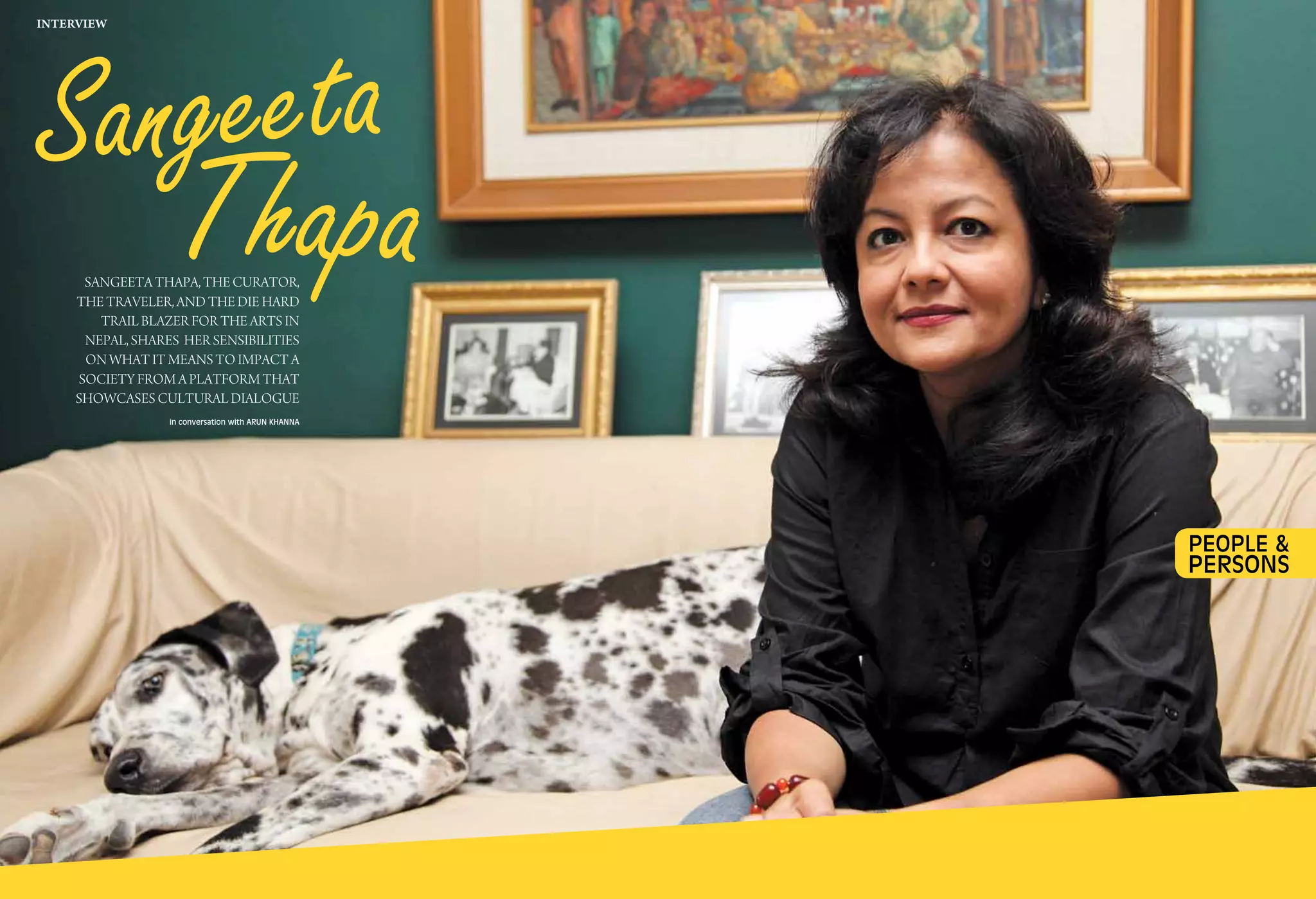
ThapaSangeeta Thapa, the curator,
the traveler, and the die hard
trail blazer for the Arts in
Nepal, shares her sensibilities
on what it means to impact a
society from a platform that
showcases cultural dialogue
Sangeeta
in contemporary art
has brought new
aspects in arts and
its curating?
Definitely, we need to be
cognizant of the global trends
in the arts and move ahead
instead of being stuck in a
time warp. However there
is no point in aping these
trends without understanding
the philosophies that have
galvanized such movements  
At an international
level, how much of
Nepalese art are you
able to take abroad
for exhibitions?
I have only managed to take
shows to India and Pakistan –
on a private level. We have no
funding or support from the
government or any cultural
foundations to take Nepalese
art abroad. The costs involved
arehighforaprivateinstitution
like Siddhartha Art Gallery. 
As a curator in a
country like Nepal,
what have been
your professional
constraints?
The Siddhartha Art Gallery is
totally dependent on the sale
of art works – the sales have
been abysmal in comparison
to say ten years ago.
Why?
Duetothepoliticaluncertainty
in the country which has
directly impacted business
– there is no confidence in
a robust market emerging
even in the near future and
this has hampered sales.  Art
is the very last priority on
the corporate list. The lack
of finances have inhibited us
from growing and moving on
to projects that could embrace
the entire nation. 
Who is your role
model as a curator?
Closer to home Pooja Sood
from Khoj in India , she is
everywhere- she knows how
to garner global interest for
her art projects in India and to
fundraise at an international
level …she is all over the
place giving talks on art and
everyone appreciates the
incredible  work she is doing
with the local communities .
In a time of social
networking, blogs,
and hundreds of
visual outlets on the
net, how do you see
the physical spaces
of an art gallery
as a platform for
exhibitions?
This is the new reality if you
are not out there in cyber
space-facebook, blogging,
tweeting you may just get left
behind – also more and more
virtual galleries, and virtual
museums will emerge defying
the conventional space of the
physical gallery  
What challenges you
most as a person?
The bigger the challenge the
greater the seduction – I’m a
sucker for pain. My motto  -
no pain , no gain   
What are the
new projects you
are working on
currently?
The Second Kathmandu
InternationalArtsfestivalwhich
willbeheldinNovember2012.
Do you think enough
is done to educate
and propagate young
people on the rich
heritage of arts in
Nepal?
Not at all – our elementary
text books need to be
rewritten giving emphasis to
our culture. More schools
need to visit  museums as
museums are the repository
of our culture. Local schools,
local communities and clubs
need to feel an ownership of
their heritage and culture. The
museum must also project
itself as a community space
for learning about our history
and culture, with dance,
theater, music, literature and
art workshops. Electronic and
digital media too needs to
be utilized  to educate young
people about their heritage.
How much has
travelling inspired
you towards the arts?
Travel is the greatest teacher.
I have learnt more from my
travels, visiting museums and
galleries, talking to people
from different   communities
than I have learnt in schools
and universities.  
With its
multiculturalism,
how would you
define the breakup of
targeted audiences
of Art Galleries and
the Arts?
Multiculturalism is creating
an equal space for diverse
cultures. Today   museums
and galleries have to be aware
of the evolving demographics-
new programs need to be
designedwhicharesensitiveto
these changes –if we think  the
target audience is   fixed, we
will stagnate – museums and
galleries  need to design new
programs constantly taking
into mind what is happening
in the country.  
With what objective
did you start your
career as a curator?
I started my career as a
curator in 1987, this was
when we established the
Siddhartha Art Gallery with
the objective of showcasing
contemporary Nepali art and
servingasaplatformforcultural
dialogue between national and
international artists.
How do you see the
development of the
arts in Nepal since
you started curating
in this country?
I think the contemporary art
scene was in a state of limbo in
the1980’s-noMFAprograms,
a diploma in Fine Arts which
restricted our artists from
moving forward…however
despite all the limitations
the artists and galleries
really struggled to give
shape & definition to the art
movement…today there is an
undeclared revolution in the
field of art, music, literature
and the media. Each feeds off
the other, we have a vibrant
art scene now. However a
lot still needs to be done at
the governmental level and
by private stakeholders  to
nurture and develop it further.
How do you decide
the artistic field of
the exhibitions that
happen in Siddhartha
Art Gallery?
Variety,qualityandinnovative
expressions at a national and
international level
Do you have any
specific fields of
interest for your
curatorial practice?
I have always been intrigued
by projects that bring the
community together ...where art
reflects  important socio-political
issues. Art for peace, the status of
women, climate change, new age
slavery ....Ithinkartholdsamirror
tosocietyandcanimpactchange 
Do you think the new
and digital media used
I think art holds a mirror
to society and can
impact change.
By priority, defining the artist’s building
blocks; Inspiration, talent, industriousness,
networking, trainings, fundings? 
Is there a point
of convergence
that you look for
between the Nepalese
and international
practices of
preserving and
exhibiting art?
Or should the
approaches be
culture specific?
The intersections and point of
convergence between Nepali
and international practices
of preserving and exhibiting
art...boils down to education
and economics...Today
Nepali art managers and
museum curators are invited
all over the world to see how
Museums and Galleries curate
and preserve their shows, we
know how things should be
done but we don’t have the
resources to back us up.  
Your most endearing
experience as a
promoter of the
Arts?
Though the work I have been
doing for the arts has not
been acknowledged by the
government of Nepal, I feel
proud that international arts
bodies have been taking note
of what I have been doing.
I am  now invited to attend
various summits, seminars
and conferences  across the
world. 
One thing that
you would change
about the business
of curating on
immediate basis?
Register the gallery as a
Cultural Foundation
interview
‘Talent, Inspiration, trainings,industriousness, networking, fundings’

Interview sangeeta thapa vivacity 6

  • 1.
    in conversation withArun Khanna interview PEOPLE & PERSONS ThapaSangeeta Thapa, the curator, the traveler, and the die hard trail blazer for the Arts in Nepal, shares her sensibilities on what it means to impact a society from a platform that showcases cultural dialogue Sangeeta
  • 2.
    in contemporary art hasbrought new aspects in arts and its curating? Definitely, we need to be cognizant of the global trends in the arts and move ahead instead of being stuck in a time warp. However there is no point in aping these trends without understanding the philosophies that have galvanized such movements   At an international level, how much of Nepalese art are you able to take abroad for exhibitions? I have only managed to take shows to India and Pakistan – on a private level. We have no funding or support from the government or any cultural foundations to take Nepalese art abroad. The costs involved arehighforaprivateinstitution like Siddhartha Art Gallery.  As a curator in a country like Nepal, what have been your professional constraints? The Siddhartha Art Gallery is totally dependent on the sale of art works – the sales have been abysmal in comparison to say ten years ago. Why? Duetothepoliticaluncertainty in the country which has directly impacted business – there is no confidence in a robust market emerging even in the near future and this has hampered sales.  Art is the very last priority on the corporate list. The lack of finances have inhibited us from growing and moving on to projects that could embrace the entire nation.  Who is your role model as a curator? Closer to home Pooja Sood from Khoj in India , she is everywhere- she knows how to garner global interest for her art projects in India and to fundraise at an international level …she is all over the place giving talks on art and everyone appreciates the incredible  work she is doing with the local communities . In a time of social networking, blogs, and hundreds of visual outlets on the net, how do you see the physical spaces of an art gallery as a platform for exhibitions? This is the new reality if you are not out there in cyber space-facebook, blogging, tweeting you may just get left behind – also more and more virtual galleries, and virtual museums will emerge defying the conventional space of the physical gallery   What challenges you most as a person? The bigger the challenge the greater the seduction – I’m a sucker for pain. My motto  - no pain , no gain    What are the new projects you are working on currently? The Second Kathmandu InternationalArtsfestivalwhich willbeheldinNovember2012. Do you think enough is done to educate and propagate young people on the rich heritage of arts in Nepal? Not at all – our elementary text books need to be rewritten giving emphasis to our culture. More schools need to visit  museums as museums are the repository of our culture. Local schools, local communities and clubs need to feel an ownership of their heritage and culture. The museum must also project itself as a community space for learning about our history and culture, with dance, theater, music, literature and art workshops. Electronic and digital media too needs to be utilized  to educate young people about their heritage. How much has travelling inspired you towards the arts? Travel is the greatest teacher. I have learnt more from my travels, visiting museums and galleries, talking to people from different   communities than I have learnt in schools and universities.   With its multiculturalism, how would you define the breakup of targeted audiences of Art Galleries and the Arts? Multiculturalism is creating an equal space for diverse cultures. Today   museums and galleries have to be aware of the evolving demographics- new programs need to be designedwhicharesensitiveto these changes –if we think  the target audience is   fixed, we will stagnate – museums and galleries  need to design new programs constantly taking into mind what is happening in the country.   With what objective did you start your career as a curator? I started my career as a curator in 1987, this was when we established the Siddhartha Art Gallery with the objective of showcasing contemporary Nepali art and servingasaplatformforcultural dialogue between national and international artists. How do you see the development of the arts in Nepal since you started curating in this country? I think the contemporary art scene was in a state of limbo in the1980’s-noMFAprograms, a diploma in Fine Arts which restricted our artists from moving forward…however despite all the limitations the artists and galleries really struggled to give shape & definition to the art movement…today there is an undeclared revolution in the field of art, music, literature and the media. Each feeds off the other, we have a vibrant art scene now. However a lot still needs to be done at the governmental level and by private stakeholders  to nurture and develop it further. How do you decide the artistic field of the exhibitions that happen in Siddhartha Art Gallery? Variety,qualityandinnovative expressions at a national and international level Do you have any specific fields of interest for your curatorial practice? I have always been intrigued by projects that bring the community together ...where art reflects  important socio-political issues. Art for peace, the status of women, climate change, new age slavery ....Ithinkartholdsamirror tosocietyandcanimpactchange  Do you think the new and digital media used I think art holds a mirror to society and can impact change. By priority, defining the artist’s building blocks; Inspiration, talent, industriousness, networking, trainings, fundings?  Is there a point of convergence that you look for between the Nepalese and international practices of preserving and exhibiting art? Or should the approaches be culture specific? The intersections and point of convergence between Nepali and international practices of preserving and exhibiting art...boils down to education and economics...Today Nepali art managers and museum curators are invited all over the world to see how Museums and Galleries curate and preserve their shows, we know how things should be done but we don’t have the resources to back us up.   Your most endearing experience as a promoter of the Arts? Though the work I have been doing for the arts has not been acknowledged by the government of Nepal, I feel proud that international arts bodies have been taking note of what I have been doing. I am  now invited to attend various summits, seminars and conferences  across the world.  One thing that you would change about the business of curating on immediate basis? Register the gallery as a Cultural Foundation interview ‘Talent, Inspiration, trainings,industriousness, networking, fundings’