29
• Are ourHR practices too
bureaucratic?
• What do they focus on most?
• Could they support our
business goals better?
• Do they help employees
understand how to drive
results?
• Would replacing rules with
common sense work here?
• How would things change if
we made recruiting stars the
top priority for our managers?
For Discussion
29.
30
Learn More
Harvard BusinessReview Magazine
and Web Articles
How Netflix Reinvented HR
Patty McCord
Reinventing Performance Management
Marcus Buckingham and Ashley Goodall
Talent Management for the Twenty-First Century
Peter Cappelli
Building a Game-Changing Talent Strategy
Douglas A. Ready, Linda Hill, and Robert J. Thomas
Harvard Business Review Press Books
The Alliance: Managing Talent in the Networked Age
Reid Hoffman, Ben Casnocha, and Chris Yeh
It’s Not the How or the What but the Who: Succeed
by Surrounding Yourself with the Best
Claudio Fernández-Aráoz
HBR’s 10 Must Reads on Managing People
Editor's Notes
#2 Recently, Netflix has gotten a lot of attention for its pioneering HR practices.
Today we’ll take a look at the company’s approach and how it evolved, drawing on an article that former chief talent officer Patty McCord wrote for Harvard Business Review.
The full article is available here:
http://hbr.org/2014/01/how-netflix-reinvented-hr
#3 Why should we care about how Netflix handles HR?
Because the company has been incredibly successful on many fronts, including subscriber growth, stock performance, and even Emmy awards.
Netflix attributes a lot of that success to its culture and the unique way it attracts, retains, and manages stellar employees.
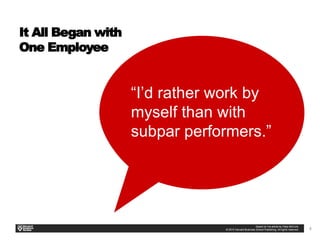
#4 How did Netflix arrive at its approach to HR?
It all began with something one employee told McCord.
After the dot-com bubble burst, Netflix had to lay off a third of its staff. But that Christmas its DVD business unexpectedly exploded.
John, an engineer, had lost three of his people and was working long hours. McCord told him she hoped to get him help soon.
His response? “Don’t rush.” It turned out the laid-off engineers hadn’t been all that great. John was always riding them and fixing their mistakes.
He said he’d rather work alone than with subpar colleagues.
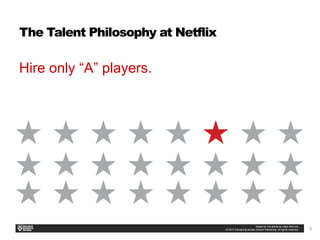
#5 John’s comment inspired this key insight about talent:
The best thing you can do for your people—a perk better than foosball or free sushi—is to hire only “A” players to work with them.
Excellent colleagues trump everything else.
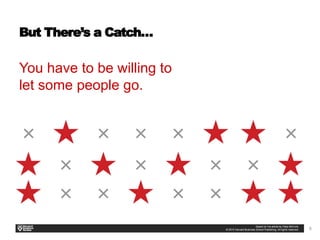
#6 But there’s a catch to hiring only “A” players: You have to be willing to let go of people whose skills no longer fit—even people you really like.
#7 Out of fairness to people who have done their best but still don’t measure up, Netflix learned to offer rich severance packages.
Here’s how McCord handled the situation of Laura, a hardworking bookkeeper who had played an important role in the firm’s early days.
When Netflix went public, it needed experienced CPAs, and Laura had only an associate’s degree. She no longer had the right skills.
To McCord’s surprise, Laura took it well. She was sad to leave but realized that her severance would help her retrain for a new career.
#8 Those ideas about which people to hire and which to let go have shaped five HR tenets at Netflix:
Let’s explore each of them.
#9 First, Netflix believes that if you’re careful about hiring the right people—meaning people who put the company’s interests first and strive for high performance—97% of your employees will do the right thing when asked to use their common sense.
Most companies spend a lot of time and money writing and enforcing policies to deal with problems caused by a small minority.
But Netflix just tries really hard not to hire those people—and if it does, it lets them go.
#10 Having faith in the power of common sense has changed the company’s approach to time off.
Netflix started with a standard policy. It was an honor system: Employees kept track of their own days.
When the company went public, its auditors wanted the firm to formally track time off.
But because there was no legal requirement to give time off, Netflix decided to go in the opposite direction. It gave employees even more freedom by removing the caps.
#11 Under the new guidelines, salaried employees may take whatever time they feel is appropriate, as long as they work it out with their bosses and one another.
Hourly call-center workers have a more structured policy, however, and workers in accounting are asked not to be out during the beginning or end of a quarter. And people who want a whole month off have to meet with HR.
But otherwise, employees just use their judgment and coordinate with others.
To make employees comfortable about taking time off, senior leaders are urged to take vacations and let people know about them.
#12 Netflix also got rid of its formal travel-and-expense policy.
Its new policy is five words long: Act in Netflix’s best interests.
The company asks employees to be frugal, as if they were spending their own money.
This move has eliminated expense account police and shifted responsibility to frontline managers.
It has also cut costs. Employees book their own trips online, for instance, which is cheaper than using a travel agency.
McCord did have to talk periodically with employees who spent a little too freely.
But overall she found that if you create a clear expectation of responsible behavior, most employees will comply.
#13 The company’s second HR tenet is to tell the truth about performance.
Netflix decided that “performance improvement plans” were fundamentally dishonest—and got rid of them.
They’re rarely used to improve performance, even though that’s what the name implies.
Companies use them mainly as a paper trail—to justify firing people later—and to avoid lawsuits.
#14 McCord was once asked to create a performance improvement plan for a quality assurance engineer we’ll call Maria.
Maria’s performance began to slip when QA systems were automated, because she wasn’t good with the technology.
McCord didn’t want to put her on a plan.
“We know how this will play out,” she told Maria’s manager. “You’ll write up objectives that she can’t achieve, because she lacks the skills. You’ll meet weekly to discuss her shortcomings, and it will be awful. This will go on for months, and then we’ll fire her.”
So they just told Maria the truth. And they gave her a great severance package.
#15 In fact, Netflix did away with formal reviews altogether.
The elaborate annual ritual did little to improve performance—it was too infrequent and too bureaucratic.
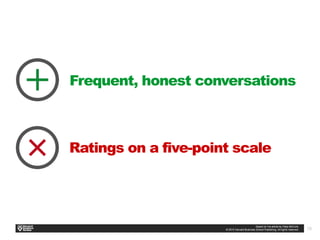
Instead, Netflix employees have regular informal discussions about performance with their managers.
In many jobs—like sales, engineering, and product development—it’s fairly obvious how people are doing, especially if their work is being tracked with analytics.
If you talk simply and honestly about performance on a regular basis, McCord points out, you will get better results than a company that grades everyone on a five-point scale.
#16 To support those frequent and frank conversations, Netflix has replaced formal annual reviews with informal 360s.
The format is simple: People are asked to identify things colleagues should stop, start, and continue.
At first the feedback was anonymous, but over time the company shifted to signed feedback, and many teams now do their reviews face-to-face.
#17 Donald Rumsfeld famously said that you go to war with the army you have, not the one you wish you had.
But Netflix takes the opposite tack.
It rates managers on how well they recruit strong people—not their skill at coaching “the army they have.”
That’s what this third tenet is about: Managers are expected to own the responsibility of creating great teams.
#18 When McCord talks to managers about creating great teams, she tells them, “Imagine a documentary about your team six months from now. What results do you see the team producing? How is its work different from the current work?”
Next she asks, “What skills are needed to make that vision a reality? Does the current team have them?”
#19 If you’re in a fast-moving business, she says, chances are you’ll see mismatches. If so, you’ll need to recruit people to fill the gaps—and have honest conversations with other team members about finding a place where they fit better.
Netflix went through this process when it shifted from DVDs by mail to streaming service.
It suddenly had to bring in people with deep experience in operating cloud services on a giant scale.
#20 To meet the need for new talent, Netflix had to hire people away from Facebook, Amazon, and Google.
That wasn’t easy, but its approach to compensation helped.
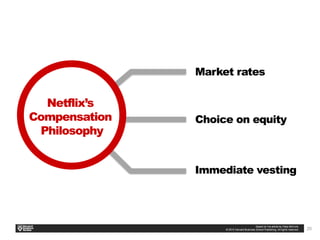
The company believes deeply in market-based pay. It will actually tell employees to interview with competitors to get a sense of their worth in the market.
It also lets people decide how much compensation they’ll receive in equity—believing they’re sophisticated enough to understand the trade-offs and decide what’s best for them.
And while most companies have a four-year vesting schedule, Netflix has no such “golden handcuffs”; options can be cashed immediately. If you have a better opportunity elsewhere, Netflix won’t hold you hostage.
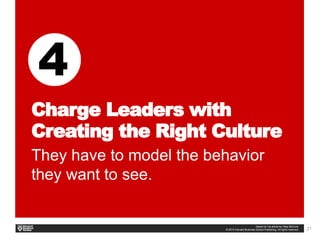
#21 This brings us to the fourth tenet: Leaders should own the job of creating the company’s culture.
That means living up to the values they articulate by modeling the right behavior.
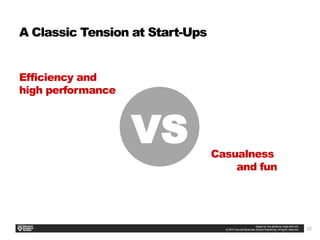
#22 Sometimes there’s a disconnect between a company’s stated values and the behaviors that its leaders demonstrate and encourage.
For instance, a start-up might say that efficiency and high performance are its most important values but then create a fun, casual atmosphere where it’s OK to be late to a meeting because you’re finishing a pool game.
It’s a waste of time to articulate values but then fail to encourage behavior that aligns with them.
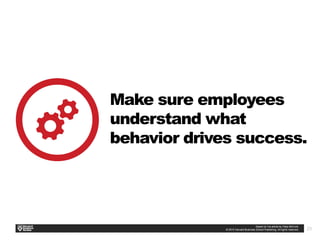
#23 Leaders also need to clearly communicate to workers what behaviors drive the company’s success.
Even in a business with a creative focus, employees need to understand how the company makes money.
At Netflix, for instance, employees used to focus too heavily on subscriber growth.
They weren’t aware that the company often spent huge amounts buying DVDs, setting up distribution, and ordering programming before it collected even one cent from a new subscriber.
It had to teach employees that managing expenses really mattered.
#24 Another thing leaders must pay attention to is “the split personality syndrome”: Subcultures inside a company may need to be managed differently.
At tech companies, for instance, there’s often a divide between the engineers and the sales team.
At Netflix, there were big differences between the salaried staff at headquarters and the hourly workers in the call centers.
One small example: When finance wanted to put everyone on direct-deposit paychecks, McCord had to point out that some hourly workers didn’t have bank accounts.
#25 The fifth tenet of HR at Netflix has to do with the mind-set within the HR department itself.
Too many HR executives focus on initiatives to improve morale or on perks that will get their companies onto lists of “best places to work.”
You can throw all the parties you want, but they won’t matter if your stock price is dropping and your products aren’t successful.
According to McCord, good talent managers think like businesspeople and innovators first and like HR people last.
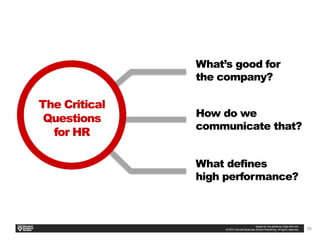
#26 Instead of handing out T-shirts, HR people should ask what’s good for
the business and then figure out how to communicate that—clearly—
to employees.
HR’s most critical job is to make sure that every worker understands what “high performance” means at the company.
#27 When McCord started at Netflix, it was a pioneering company that was changing the way people consumed entertainment.
But the expectation was that she’d take the same old approach to HR that everyone else did.
As we’ve seen, she firmly rejected that idea.
Her work clearly shows that HR people can innovate, too. And when they do it successfully, they can have a big impact on the business.
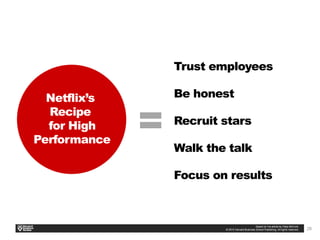
#28 And that’s how the HR team has helped Netflix create a successful culture:
by giving employees freedom and responsibility, being honest about performance, recruiting stars, modeling the right culture, and thinking like businesspeople.
#30 Slide links are live in slideshow view only.
Presenter’s note: Netflix has put together another slide deck, which delves deeper into the values behind the principles discussed here. You can access the original Netflix deck here: http://www.slideshare.net/reed2001/culture-1798664