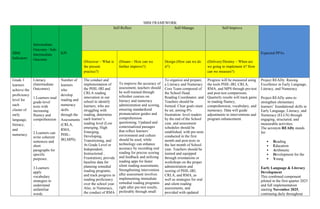
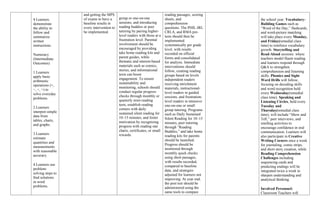
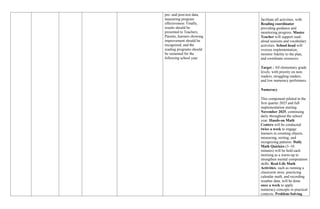
SBM FRAMEWORK
SBM
Indicators
Intermediate
Outcome /Sub-
Intermediate
Outcome
KPI
Self-Reflect Self-Manage Self-Improve
Expected PPAs
(Discover – What is
the present
practice?)
(Dream – How can we
further improve?)
Design (How can we do
it?)
(Delivery/Destiny – When are
we going to implement it? How
can we measure?)
Grade 3
learners
achieve the
proficiency
level for
each
cluster of
early
language,
literacy,
and
numeracy.
Literacy
(Intermediate
Outcomes)
1.Learners read
grade-level
texts with
increasing
fluency and
comprehension
.
2.Learners can
write coherent
sentences and
short
paragraphs for
specific
purposes.
3.Learners
apply
vocabulary
strategies to
understand
unfamiliar
words.
Number of
learners
who
develop
reading and
numeracy
skills
through the
Assessments
(CRLA,
RMA,
PHIL-
IRI,MPS)
The conduct and
implementation of
the PHIL-IRI and
CRLA reading
innovation in our
school to identify
learners, who are
struggling with
reading, determine
each learner’s
reading level (Low
emerging, High
Emerging,
Developing,
Transitioning, and
At Grade Level or
Independent,
Instructional ,
Frustration), provide
baseline data for
planning remedial
reading programs,
and track progress in
reading proficiency
over the school year.
Also, in Numeracy,
the conduct of RMA
To improve the accuracy of
assessment, teachers should
be well-trained through
refresher courses on
literacy and numeracy
administration and scoring,
ensuring standardized
pronunciation guides and
comprehension
questioning. Updated and
contextualized passages
that reflect learners’
environment and culture
should be used, while
technology can enhance
accuracy by recording oral
reading for precise scoring
and feedback and utilizing
reading apps for faster
silent reading assessments.
Strengthening intervention
after assessment involves
implementing immediate
remedial reading programs
right after pre-test results,
preferably through small
To organize and prepare,
a Literacy and Numeracy
Core Team composed of
the School Head,
Reading Coordinator, and
Teachers should be
formed. Clear goals must
be set, aiming 0%
frustration- level readers
by the end of the School
year, and assessment
schedules should be
established, with pre-tests
conducted in the first
month and post-tests in
the last month of School
year. Teachers should be
trained and equipped
through orientations or
workshops on the proper
administration and
scoring of PHIL-IRI,
CRLA, and RMA, as
well as strategies for oral
and silent reading
assessments, and
provided with updated
Progress will be measured using
the tools PHIL-IRI, CRLA,
RMA, and MPS through pre-test
and post-test comparisons.
Quarterly results will track gains
in reading fluency,
comprehension, vocabulary, and
numeracy. Data will guide
adjustments to interventions and
program enhancement.
Project READy: Raising
Excellence in Early Language,
Literacy, and Numeracy
Project READy aims to
strengthen elementary
learners’ foundational skills in
Early Language, Literacy, and
Numeracy (ELLN) through
engaging, structured, and
measurable activities.
The acronym READy stands
for:
Reading
Education
Arithmetic
Development for the
Young
Early Language & Literacy
Development
This combined component
piloted in the first quarter 2025
and full implementation
starting November 2025,
continuing daily throughout
2.
4.Learners
demonstrate
the ability to
followand
summarize
written
instructions.
Numeracy
(Intermediate
Outcomes)
1.Learners
apply basic
arithmetic
operations (+,
−, ×, ÷) to
solve everyday
problems.
2.Learners
interpret simple
data from
tables, charts,
and graphs.
3.Learners
estimate
quantities and
measurements
with reasonable
accuracy.
4.Learners use
problem-
solving steps to
find solutions
in word
problems.
and getting the MPS
of exams to have a
baseline results in
every intervention to
be implemented.
group or one-on-one
sessions, and introducing
reading buddies or peer
tutoring by pairing higher-
level readers with those at a
frustration level. Parental
involvement should be
encouraged by providing
take home reading kits and
parent guides, while
thematic and interest-based
materials such as comics,
stories, and informational
texts can boost
engagement. To ensure
sustainability and
monitoring, schools should
conduct regular progress
checks through monthly or
quarterly mini-reading
tests, establish reading
corners with daily
sustained silent reading for
10–15 minutes, and foster
motivation by recognizing
progress with reading star
charts, certificates, or small
rewards.
reading passages, scoring
sheets, and
comprehension
questions. The PHIL-IRI,
CRLA, and RMA pre-
tests should then be
implemented
systematically per grade
level, with results
recorded on official
forms and consolidated
for analysis. Immediate
interventions should
follow, creating reading
groups based on levels
independent readers
receiving enrichment
materials, instructional-
level readers in guided
sessions, and frustration-
level readers in intensive
one-on-one or small
group tutoring. Programs
such as Daily Sustained
Silent Reading for 10–15
minutes, peer tutoring
through “Reading
Buddies,” and take home
reading kits for parents
should be launched.
Progress should be
monitored through
monthly quick checks
using short passages,
with results recorded,
compared to baseline
data, and strategies
adjusted for learners not
improving. At year end,
the post test should be
administered using the
same tools to compare
the school year. Vocabulary-
Building Games such as
“Word of the Day,” flashcards,
and word-picture matching
will take place every Monday,
and Friday(remedial class
time) to reinforce vocabulary
growth. Storytelling and
Read-Aloud sessions where
teachers model fluent reading
and learners respond through
Q&A to strengthen
comprehension and listening
skills. Phonics and Sight
Word Drills will follow,
focusing on decoding skills
and word recognition held
every Wednesday(remedial
class time). Speaking and
Listening Circles, held every
Tuesday and
Thursday(remedial class
time), will include “Show and
Tell,” peer interviews, and
retelling activities to
encourage confidence in oral
communication. Learners will
also participate in Creative
Writing Corners once a week
for journaling, comic strips,
and short story creation, while
Reading Comprehension
Challenges including
sequencing cards and
predicting endings will be
integrated twice a week to
sharpen understanding and
analytical thinking.
Involved Personnel:
Classroom Teachers will
3.
pre- and post-testdata,
measuring program
effectiveness. Finally,
results should be
presented to Teachers,
Parents, learners showing
improvement should be
recognized, and the
reading programs should
be sustained for the
following school year.
facilitate all activities, with
Reading coordinator
providing guidance and
monitoring progress. Master
Teacher will support read-
aloud sessions and vocabulary
activities. School head will
oversee implementation,
monitor fidelity to the plan,
and coordinate resources.
Target : All elementary grade
levels, with priority on non-
readers, struggling readers,
and low numeracy performers.
Numeracy
This component piloted in the
first quarter 2025 and full
implementation starting
November 2025, continuing
daily throughout the school
year. Hands-on Math
Centers will be conducted
twice a week to engage
learners in counting objects,
measuring, sorting, and
recognizing patterns. Daily
Math Quickies (5–10
minutes) will be held each
morning as a warm-up to
strengthen mental computation
skills. Real-Life Math
Activities, such as running a
classroom store, practicing
calendar math, and recording
weather data, will be done
once a week to apply
numeracy concepts in practical
contexts. Problem-Solving
4.
Stories, involving word
problemslinked to students’
daily experiences, will be
integrated twice a week into
math lessons to promote
analytical thinking and
application.
Involved Personnel:
Classroom teachers will lead
all numeracy activities, while
math Coordinator will
provide technical guidance and
help design problem-solving
exercises. Master Teacher
may assist with Real-Life
Math Activities, particularly
the classroom store and data
recording.
School head will oversee the
implementation, ensuring
consistency and alignment
with the project goals.