Greedy Algorithms
a. Unweighted Interval Scheduling
Time
0 1 2 3 4 5 6 7 8 9 10 11
f
g
h
e
a
b
c
d
Interval Scheduling: Problem Definition
• Interval scheduling.
• Job j starts at sj and finishes at fj.
• Two jobs compatible if they don't overlap.
• Goal: find maximum subset of mutually compatible jobs.
Interval Scheduling: Greedy Attempts
• Greedy template: Consider jobs in some natural order.
Take each job provided it's compatible with the ones
already taken.
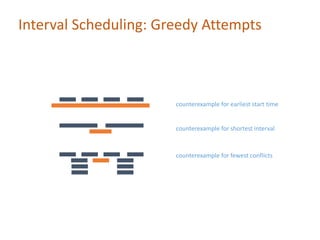
• [Earliest start time] Consider jobs in ascending order of sj.
• [Earliest finish time] Consider jobs in ascending order of fj.
• [Shortest interval] Consider jobs in ascending order of fj - sj.
• [Fewest conflicts] For each job j, count the number of
conflicting jobs cj. Schedule in ascending order of cj.
counterexample for earliest start time
counterexample for shortest interval
counterexample for fewest conflicts
Interval Scheduling: Greedy Attempts
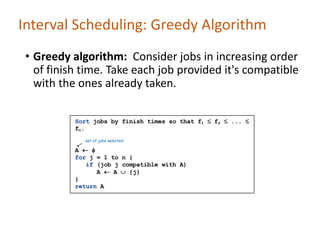
• Greedy algorithm: Consider jobs in increasing order
of finish time. Take each job provided it's compatible
with the ones already taken.
Sort jobs by finish times so that f1 £ f2 £ ... £
fn.
A ¬ f
for j = 1 to n {
if (job j compatible with A)
A ¬ A È {j}
}
return A
set of jobs selected
Interval Scheduling: Greedy Algorithm
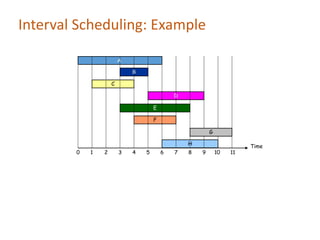
Time
0
A
B
D
C
E
H
F
1 2 3 4 5 6 7 8 9 10 11
G
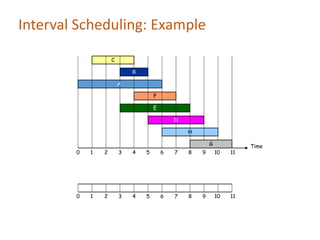
Interval Scheduling: Example
Time
0
A
B
D
C
E
H
F
1 2 3 4 5 6 7 8 9 10 11
G
0 1 2 3 4 5 6 7 8 9 10 11
Interval Scheduling: Example
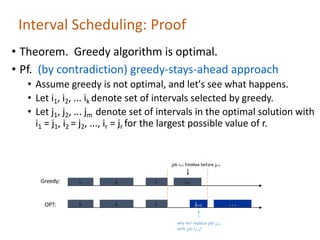
• Theorem. Greedy algorithm is optimal.
• Pf. (by contradiction) greedy-stays-ahead approach
• Assume greedy is not optimal, and let's see what happens.
• Let i1, i2, ... ik denote set of intervals selected by greedy.
• Let j1, j2, ... jm denote set of intervals in the optimal solution with
i1 = j1, i2 = j2, ..., ir = jr for the largest possible value of r.
j1 j2 jr
i1 i2 ir ir+1
. . .
Greedy:
OPT: jr+1
why not replace job jr+1
with job ir+1?
job ir+1 finishes before jr+1
Interval Scheduling: Proof
• Finding the next earliest finishing time of
remaining intervals via linear search:
• O(n2).
• Sorting
• Sort all the requests by finishing time — O(n log n)
• Iterate through the sorted array taking the next legal
request — O(n)
• O(nlogn)
Interval Scheduling: Implementation
• Scheduling problems are often amenable to greedy
approach
• But there may be many greedy choices and it is
important to select the right one
• Main Takeaway: Greedy-stays-ahead is a useful
proof approach
Summary

Interval Scheduling application and problem.pdf

  • 1.
  • 2.
    Time 0 1 23 4 5 6 7 8 9 10 11 f g h e a b c d Interval Scheduling: Problem Definition • Interval scheduling. • Job j starts at sj and finishes at fj. • Two jobs compatible if they don't overlap. • Goal: find maximum subset of mutually compatible jobs.
  • 3.
    Interval Scheduling: GreedyAttempts • Greedy template: Consider jobs in some natural order. Take each job provided it's compatible with the ones already taken. • [Earliest start time] Consider jobs in ascending order of sj. • [Earliest finish time] Consider jobs in ascending order of fj. • [Shortest interval] Consider jobs in ascending order of fj - sj. • [Fewest conflicts] For each job j, count the number of conflicting jobs cj. Schedule in ascending order of cj.
  • 4.
    counterexample for earlieststart time counterexample for shortest interval counterexample for fewest conflicts Interval Scheduling: Greedy Attempts
  • 5.
    • Greedy algorithm:Consider jobs in increasing order of finish time. Take each job provided it's compatible with the ones already taken. Sort jobs by finish times so that f1 £ f2 £ ... £ fn. A ¬ f for j = 1 to n { if (job j compatible with A) A ¬ A È {j} } return A set of jobs selected Interval Scheduling: Greedy Algorithm
  • 6.
    Time 0 A B D C E H F 1 2 34 5 6 7 8 9 10 11 G Interval Scheduling: Example
  • 7.
    Time 0 A B D C E H F 1 2 34 5 6 7 8 9 10 11 G 0 1 2 3 4 5 6 7 8 9 10 11 Interval Scheduling: Example
  • 8.
    • Theorem. Greedyalgorithm is optimal. • Pf. (by contradiction) greedy-stays-ahead approach • Assume greedy is not optimal, and let's see what happens. • Let i1, i2, ... ik denote set of intervals selected by greedy. • Let j1, j2, ... jm denote set of intervals in the optimal solution with i1 = j1, i2 = j2, ..., ir = jr for the largest possible value of r. j1 j2 jr i1 i2 ir ir+1 . . . Greedy: OPT: jr+1 why not replace job jr+1 with job ir+1? job ir+1 finishes before jr+1 Interval Scheduling: Proof
  • 9.
    • Finding thenext earliest finishing time of remaining intervals via linear search: • O(n2). • Sorting • Sort all the requests by finishing time — O(n log n) • Iterate through the sorted array taking the next legal request — O(n) • O(nlogn) Interval Scheduling: Implementation
  • 10.
    • Scheduling problemsare often amenable to greedy approach • But there may be many greedy choices and it is important to select the right one • Main Takeaway: Greedy-stays-ahead is a useful proof approach Summary