INTERSECTIONALITY
KMVILLAFLOR
MA HUMS – WS
11 MARCH 2023
POINTSOF
DISCUSSION:
 What is intersectionality?
 History
 Intersectional Feminism
 Important points
 What can we do?
2
SINOKA?
WHOAREU?
Choose TWO CATEGORIES where you
are “oppressed” and are “privileged”?
Please share to the group your
experienc
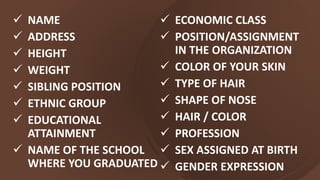
 NAME
 ADDRESS
 HEIGHT
 WEIGHT
 SIBLING POSITION
 ETHNIC GROUP
 EDUCATIONAL
ATTAINMENT
 NAME OF THE SCHOOL
WHERE YOU GRADUATED
 ECONOMIC CLASS
 POSITION/ASSIGNMENT
IN THE ORGANIZATION
 COLOR OF YOUR SKIN
 TYPE OF HAIR
 SHAPE OF NOSE
 HAIR / COLOR
 PROFESSION
 SEX ASSIGNED AT BIRTH
 GENDER EXPRESSION
5
Intersectionality is the
acknowledgement
that everyone has their own
unique experiences of
discrimination and
oppression and we must
consider everything and
anything that can marginalise
people – gender, race, class,
sexual orientation, physical
ability, etc.
https://www.womankind.org.uk/intersectionality-101-what-is-it-and-why-is-it-important/
6
“the interconnected nature
of social categorisations
such as race, class, and
gender, regarded as
creating overlapping and
interdependent systems of
discrimination or
disadvantage”
https://www.womankind.org.uk/intersectionality-101-what-is-it-and-why-is-it-important/
7
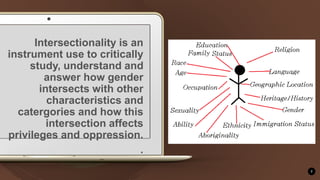
Intersectionality is an
instrument use to critically
study, understand and
answer how gender
intersects with other
characteristics and
catergories and how this
intersection affects
privileges and oppression.
.
• During the 1970s, black feminist scholar-activists, a
number of whom were also LGBTQ, developed theoretical
frameworks to serve as a model for other women of color,
to broaden feminism’s definition and scope. Throughout
the final decades of the 20th and the first decade of the
21st centuries, women of color published many
groundbreaking works that highlighted these dynamics. In
doing so, they exposed the interlocking systems that define
women’s lives.
• The theory of those systems became known as
intersectionality, a term popularized by law professor
Kimberlé Crenshaw. In her 1991 article “Mapping the
Margins,” she explained how people who are “both
women and people of color” are marginalized by
“discourses that are shaped to respond to one [identity] or
the other,” rather than both.
• “All of us live complex lives that require a great deal of
juggling for survival,” Carty and Mohanty said in an email.
“What that means is that we are actually living at the
intersections of overlapping systems of privilege and
oppression.” https://time.com/5560575/intersectionality-theory/
LOOKINGBACK
8
Intersectional feminism
centers the voices of those
experiencing overlapping,
concurrent forms of
oppression in order to
understand the depths of the
inequalities and the
relationships among them in
any given context.
9
• to reveal multiple identities, exposing the different types of
discrimination and disadvantage that occur as a
consequence of the combination of identities
• the aim is not to show that one group is more victimized or
privileged than another, but to reveal meaningful
distinctions and similarities in order to overcome
discriminations and put the conditions in place for all
people to fully enjoy their human rights.
AIMOFINTERSECTIONALITY
10
• Most gender analysis
frameworks used by
development actors
focus solely on gender
relations.
11
Why
Intersectionality?
women are not a
homogenous
group !
MOVING FROM ME
POLITICS TO “ALL OF
US TOGETHER
POLITICS”
HOW?
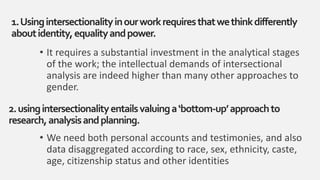
2.usingintersectionalityentailsvaluinga‘bottom-up’approachto
research,analysisandplanning.
• We need both personal accounts and testimonies, and also
data disaggregated according to race, sex, ethnicity, caste,
age, citizenship status and other identities
1.Usingintersectionalityinourworkrequiresthatwethinkdifferently
aboutidentity,equalityandpower.
• It requires a substantial investment in the analytical stages
of the work; the intellectual demands of intersectional
analysis are indeed higher than many other approaches to
gender.
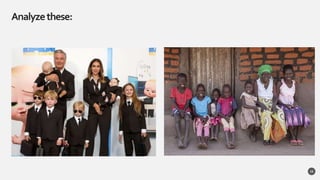
Analyzethese:
15
COMMENTS?
Meet Lorna Eluna, Zamboanga del Norte’s
female ‘kargador’
https://www.rappler.com
16
WHATCANWEDO? Check your privilege
Listen & learn
Make space
Watch your language
17
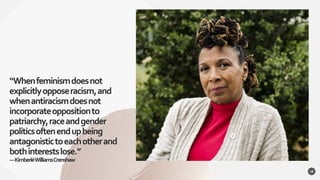
“Whenfeminismdoesnot
explicitlyopposeracism,and
whenantiracismdoesnot
incorporateoppositionto
patriarchy,raceandgender
politicsoftenendupbeing
antagonistictoeachotherand
bothinterestslose.”
—KimberléWilliamsCrenshaw
18
19
THANKYOU
Kaye Michelle B. Villaflor
09212375340
kmbvillaflor@ssc.edu.ph
20

INTERSECTIONALITY.pptx

  • 1.
  • 2.
    POINTSOF DISCUSSION:  What isintersectionality?  History  Intersectional Feminism  Important points  What can we do? 2
  • 3.
    SINOKA? WHOAREU? Choose TWO CATEGORIESwhere you are “oppressed” and are “privileged”? Please share to the group your experienc
  • 4.
     NAME  ADDRESS HEIGHT  WEIGHT  SIBLING POSITION  ETHNIC GROUP  EDUCATIONAL ATTAINMENT  NAME OF THE SCHOOL WHERE YOU GRADUATED  ECONOMIC CLASS  POSITION/ASSIGNMENT IN THE ORGANIZATION  COLOR OF YOUR SKIN  TYPE OF HAIR  SHAPE OF NOSE  HAIR / COLOR  PROFESSION  SEX ASSIGNED AT BIRTH  GENDER EXPRESSION
  • 5.
    5 Intersectionality is the acknowledgement thateveryone has their own unique experiences of discrimination and oppression and we must consider everything and anything that can marginalise people – gender, race, class, sexual orientation, physical ability, etc. https://www.womankind.org.uk/intersectionality-101-what-is-it-and-why-is-it-important/
  • 6.
    6 “the interconnected nature ofsocial categorisations such as race, class, and gender, regarded as creating overlapping and interdependent systems of discrimination or disadvantage” https://www.womankind.org.uk/intersectionality-101-what-is-it-and-why-is-it-important/
  • 7.
    7 Intersectionality is an instrumentuse to critically study, understand and answer how gender intersects with other characteristics and catergories and how this intersection affects privileges and oppression. .
  • 8.
    • During the1970s, black feminist scholar-activists, a number of whom were also LGBTQ, developed theoretical frameworks to serve as a model for other women of color, to broaden feminism’s definition and scope. Throughout the final decades of the 20th and the first decade of the 21st centuries, women of color published many groundbreaking works that highlighted these dynamics. In doing so, they exposed the interlocking systems that define women’s lives. • The theory of those systems became known as intersectionality, a term popularized by law professor Kimberlé Crenshaw. In her 1991 article “Mapping the Margins,” she explained how people who are “both women and people of color” are marginalized by “discourses that are shaped to respond to one [identity] or the other,” rather than both. • “All of us live complex lives that require a great deal of juggling for survival,” Carty and Mohanty said in an email. “What that means is that we are actually living at the intersections of overlapping systems of privilege and oppression.” https://time.com/5560575/intersectionality-theory/ LOOKINGBACK 8
  • 9.
    Intersectional feminism centers thevoices of those experiencing overlapping, concurrent forms of oppression in order to understand the depths of the inequalities and the relationships among them in any given context. 9
  • 10.
    • to revealmultiple identities, exposing the different types of discrimination and disadvantage that occur as a consequence of the combination of identities • the aim is not to show that one group is more victimized or privileged than another, but to reveal meaningful distinctions and similarities in order to overcome discriminations and put the conditions in place for all people to fully enjoy their human rights. AIMOFINTERSECTIONALITY 10
  • 11.
    • Most genderanalysis frameworks used by development actors focus solely on gender relations. 11 Why Intersectionality? women are not a homogenous group !
  • 12.
    MOVING FROM ME POLITICSTO “ALL OF US TOGETHER POLITICS”
  • 13.
  • 14.
    2.usingintersectionalityentailsvaluinga‘bottom-up’approachto research,analysisandplanning. • We needboth personal accounts and testimonies, and also data disaggregated according to race, sex, ethnicity, caste, age, citizenship status and other identities 1.Usingintersectionalityinourworkrequiresthatwethinkdifferently aboutidentity,equalityandpower. • It requires a substantial investment in the analytical stages of the work; the intellectual demands of intersectional analysis are indeed higher than many other approaches to gender.
  • 15.
  • 16.
    COMMENTS? Meet Lorna Eluna,Zamboanga del Norte’s female ‘kargador’ https://www.rappler.com 16
  • 17.
    WHATCANWEDO? Check yourprivilege Listen & learn Make space Watch your language 17
  • 18.
  • 19.
  • 20.
    THANKYOU Kaye Michelle B.Villaflor 09212375340 kmbvillaflor@ssc.edu.ph 20

Editor's Notes

  • #16  "If you look at Africa from the perspective of poverty, I think it's hard to find hope there," he said. "I try to present an alternative, new perspective about Africa and African people. In my photos, African people are smiling and their innocent smiles are captured. Instead of malnourished children drinking unsanitary water or fighting for their lives after being infected with AIDS or other untreatable diseases, I captured children and adults with healthy smiles. Photographer Cho Jang-sok
  • #17 Glorified ang pagiging kargador nya dahil still the way she expresses herself is very feminine.
  • #18 Check your privilege: And look beyond just skin colour. Middle class? University level education? Able-bodied? Cis-gender? All your social identities play into your ‘privilege’, even if you didn’t ask for it. Reflect on these and consider how this impacts the discriminations you do and don’t experience. Listen and learn: At its very core, intersectionality is about learning and understanding views from other women. Listen to, include and meaningfully collaborate with diverse groups of women. Hear and honour their words. But remember it’s not the responsibility of marginalised groups to do all the work in educating people on their experiences. This often takes up lots of emotional labour and should never be taken for granted so be prepared to help undertake some of the labour by doing your own research. Make space: Ask yourself if you’re the right person to take up space or speak on certain issues. Centre stories and actions on those with the lived experiences. Don’t speak for them, don’t speak over them. Watch your language: So many of the words we use every day are ableist, exclusionary and downright offensive to marginalised communities. When was the last time you said “ah, that’s so lame!” when you were annoyed about something? Consider how someone with a physical impairment might hear this. Recognise and correct your use of such terms. Accept criticism and call others out. As we become more intersectional and better at understanding differences, our language evolve to simply reflecting experiences from people of a singular identity.