Interpersonal Communication
in the Workplace
Learning Objectives
In this chapter, readers will explore interpersonal
communication in business and professional
settings. By the end of this chapter, readers will be able to
• Identify workplace communication behaviors
• Explain how interpersonal communication can enhance
professional success
• Understand the different types of formal and informal
workplace relationships
• Describe how new and emerging technologies continue to
change workplace
communication
• Apply suggestions for successful interpersonal business
and professional communication to
interactions
6
Jupiterimages/Goodshoot/Thinkstock
Introduction Chapter 6
Introduction
To illustrate the intricacy of communication in a business and
professional setting, consider the
following scenario that takes place between two coworkers,
Patrick and Megan, and their boss,
Suzanne:
Patrick and Megan work as lawyers in a mid-sized law firm in
Memphis, Tennessee. Neither
of them is from the area, so once they were hired, they
immediately forged a close friendship.
They found that they both had common interests, such as
watching football, baking, and
talking about their partners and kids. Because Patrick and
Megan do not practice the same
type of law, they do not work together very frequently;
however, they attend many of the same
meetings and are both sometimes a part of cases that their firm
takes on. Though they do not
collaborate at work very often, they do frequently talk about
their coworkers, the policies at
the firm, and their boss, Suzanne.
Suzanne is actually a frequent topic of conversation between
Patrick and Megan. Sometimes,
they do not understand her managerial style, and they find
themselves commiserating with
each other about decisions that she has made or policies that she
has introduced. They feel
that talking to each other is better than complaining to Suzanne
because, overall, they do
enjoy their jobs. Patrick and Megan are also careful to rarely
have these conversations at
work; instead, they will e-mail, text, instant message, or chat on
the phone about Suzanne.
Suzanne, however, has picked up on the fact that Patrick and
Megan are very close and
believes that their friendship is actually a detriment to the
organization. She sees their close-
ness as reducing overall employee morale, such as when she
(and other employees) notice
them rolling their eyes at each other during meetings, or when
she finds them frequently
talking in each other’s offices with their doors closed. Because
of this, Suzanne has cautioned
newer attorneys in the firm from getting too close to Patrick and
Megan, because she does
not want them to engage in the types of behaviors that they do.
Think about this situation from both sides. Patrick and Megan
see their friendship as harmless. It
does not directly affect their work, and it offers them something
to look forward to when they go
to work each day. They enjoy having someone else at work who
understands and can empathize
when things get stressful or overwhelming. But from Suzanne’s
perspective, Patrick and Megan’s
friendship is a threat to her and to the organization. She views
them as talking about her behind
her back and as undermining her leadership. Who is right? How
can this issue be best resolved?
Should Suzanne talk about this issue with Patrick and Megan?
In this situation, we see the importance of a number of business
and professional communica-
tion concepts, including formal and informal communication,
conflict management, relationship
maintenance, and expressing negative emotion. We will touch
on each of these specific aspects of
business and professional communication, and many more, in
this chapter.
In this text, you will have the opportunity to examine
interpersonal communication in a range of
contexts, including everyday conversations, friendships, family
interactions, romantic relation-
ships, and mediated settings. In Chapter 6, we focus specifically
on interpersonal communication
in business and professional settings such as in the workplace
and in the classroom. We examine
the requirements for effective communication in this
environment, consider the types of formal
and informal relationships that we can have, and we explore
how communication in such envi-
ronments differs from interactions in your personal life. This
chapter will end with a discussion
about suggestions for successful interpersonal business and
professional communication.
Business and Professional Communication Chapter 6
6.1 Business and Professional Communication
Almost everyone will be employed at some sort of job during
his or her lifetime. It may be a
part-time summer job between school semesters, a volunteer
position with a charity or nonprofit
organization, or a full-time career. Consider the various types of
jobs available to you, how would
you respond if someone asked you, “Why do you work?” Many
people would say, “I work because
I have to,” or, “I work to pay the bills.” Although these are our
primary reasons for working, and
are certainly important, most of us derive additional, important
benefits from our work. The non-
monetary rewards from our jobs fall into two main categories:
self-fulfillment—the feelings of
competence, recognition, and personal reward from knowing a
job and doing it well—and social
interaction—the feeling of being part of a team and the social
relationships with coworkers. We
maintain these business relationships through communication,
which we also use to seek and
share information, make decisions, coordinate and complete
tasks, and influence and motivate
others in business and professional contexts (Myers, Seibold, &
Park, 2011).
Business and professional communication (BPC) is a
broad communication context that
includes all of the different forms of messages exchanged in the
workplace or in a professional
setting. This definition can include written and oral
communication, both verbal and nonverbal,
and can also take place in digital or mediated contexts. BPC
also encompasses the gathering and
dissemination of information that is relevant to that particular
business setting, as well as the
promotion of a specific product, service, or organization.
Advertising, public relations, market-
ing, crisis and reputation management, human resources, event
planning, and corporate com-
munications are all areas of BPC, and BPC in all of these
specific areas involves how coworkers or
members of a professional organization interpersonally relate to
one another.
Communication in these professional settings is not solely about
the work that we do. We also
communicate with our colleagues at work because we like them.
We build interpersonal rela-
tionships with them that we wish to maintain, and we want to
give and receive social support
from them. In fact, the interpersonal component of our business
and professional relationships
is vital. For example, a study examining the demands of work
found that support from peers in
the workplace buffered employees from the negative health
effects of job stress and strain, which
then reduced employee mortality (Shirom, Toker, Alkaly,
Jacobson, & Balicer, 2011). Arie Shirom
and colleagues also found that this colleague support, which
involved immediate coworkers
being friendly and helpful with solving problems, reduced
symptoms of depression and anxiety
(Shirom et al., 2011). Our interpersonal relationships in the
workplace thus can positively impact
our health in multiple, important ways, and this chapter will
focus on this and other interper-
sonal aspects of BPC.
The Importance of Interpersonal Communication in the
Workplace
According to the Bureau of Labor Statistics (2013), Americans
age 25–54 who have children
spend an average of 8.8 hours working during a typical
workday. This significant time devoted
to working drives home the importance of competent
communication in business and profes-
sional settings. Interpersonal and written communication skills
are some of the most important
skills you can develop to help you achieve your academic and
professional goals. In business,
government, and other professional fields, people communicate
to share information, to per-
suade others, to reach goals and obtain results, and to form
positive relationships with clients
and customers (Picardi, 2001). A number of career and
employer organizations conduct surveys
of employers to determine which skills are particularly
important for employers and find that
various forms of communication are consistently rated as
important. For example, each year,
Business and Professional Communication Chapter 6
the National Association of Colleges and Employers (NACE)
surveys its employer members to
project the job market for new college graduates. Each year
employers rate the most in-demand
bachelor’s degrees. The 2013 survey indicates that
communication degrees, as a broad category,
are the fifth most in-demand degree, with almost 33% of
employers surveyed indicating that they
would hire individuals who majored in communication (NACE,
2012).
In addition, NACE employers are asked to rate the importance
of 10 skills and qualities on a scale
of 1 through 5, with 1 representing “not important” and 5
representing “extremely important.” The
top two skills are verbal interpersonal skills and teamwork
skills, both abilities that are directly
related to interpersonal communication (NACE, 2012). The
skills of obtaining and processing
information, writing reports, and selling or influencing others
are also an integral part of inter-
personal communications with others in the workplace. Time
and again employers also report
that they value listening, leadership, management of others, and
multicultural awareness and
sensitivity (Hansen & Hansen, n.d.). A similar employer survey
asked business executives about
the top 10 soft skills, or the intangible interpersonal qualities
and personal attributes that job
seekers need, in addition to the hard skills, or the technical
knowledge and expertise, required
for a particular job (Robles, 2012). Three of these 10 most
important soft skills directly involve
interpersonal communication skills: communication (ranked
second), interpersonal skills (fifth),
and teamwork skills (ninth) (Robles, 2012).
Though employers consistently rate com-
munication as an important skill, job seek-
ers, especially Millennials (between the ages
of 19 and 26), may not be doing an effective
job presenting such skills to prospective
employers. A recent survey conducted by an
online career network, Beyond.com (2013),
polled 6,000 job seekers and veteran human
resource (HR) professionals, finding a sub-
stantial difference between how members of
the Millennial generation view themselves
as employee prospects and how HR pro-
fessionals perceive such prospective candi-
dates. Though 66% of the Millennials rated
themselves as team players, only 22% of HR
people agreed that the Millennials would
work well in a team (Beyond.com, 2013).
In addition, 65% of the Millennials felt that
their interpersonal communication skills were strong, but only
14% of the HR professionals agreed
with this assessment. These perceptual differences may be
discouraging for job seekers, but one
way to overcome such hurdles is to learn more about
interpersonal communication, which can give
job seekers an important advantage because they will know how
to better communicate who they
are and what skills they can offer employers. The simple fact is
that employers need and want peo-
ple who have good communication skills and are competent
communicators in a variety of ways.
Workplace Communication Behaviors
BPC research aims to identify and understand the types of
communication that occur in the
workplace. A recent study (Keyton et al., 2013) helped pinpoint
four routine forms of work-
place communication that can help evaluate employee
effectiveness. The researchers sought to
Goodshoot/Thinkstock
▲▲ Employers need and want employees who have good
communications skills in a range of interpersonal and group
situations.
Business and Professional Communication Chapter 6
determine which communication behaviors individuals use
frequently in the workplace and how
these messages are evaluated by coworkers (Keyton et al.,
2013). This study defined workplace
communication behaviors as social behaviors that employees
engage in with coworkers, which
then create connections between the individual employees and
the larger organization. There are
a few key purposes of such behaviors. Workplace
communication behaviors
• Serve important functions
• Are undertaken to accomplish goals
• Are interactive because they involve other individuals
• Are learnable
• Are observable
Joann Keyton and her colleagues (2013) argued that it is
important to identify these behaviors
because they are relevant to how organizations evaluate
employee performance, competence,
and skill.
To identify these behaviors in the workplace, Keyton and
colleagues (2013) conducted two stud-
ies. The first study helped researchers generate a list of
workplace behaviors that were commu-
nicative in nature. The second study then allowed researchers to
organize the list of behaviors
into broader categories and examine each category in relation to
effectiveness—an employee’s
perceived ability in that particular area—and communication
competence. Four broad workplace
communication behavior categories emerged from Keyton and
colleagues’ analysis:
• Information sharing: task-related behaviors such as
explaining, solving problems, giving
feedback and advice, and asking and answering questions
• Relational maintenance: interpersonal relationship-
focused actions such as creating rela-
tionships, engaging in small talk, and being humorous
• Expressing negative emotion: complaints or
frustrations about work or the workplace
frustration
• Organizing: administrative-type behaviors such as
scheduling and planning, personnel
management, and problem solving
There are elements of each of these four behavior categories in
the scenario that was described
at the beginning of the chapter. Patrick and Megan each share
information about the policies of
the firm where they work, and each also expresses negative
emotions about their boss, Suzanne.
Suzanne is organizing as she attempts to understand the
friendship between her two employees
and its possible influence on their coworkers and the
organization. Throughout the scenario,
Patrick, Megan, and Suzanne are also independently attempting
to maintain workplace relation-
ships by trying to work through the situation (though it might be
more constructive if they com-
municated and worked through concerns as a team). Of these
four workplace communication
behavior categories, information sharing, relational
maintenance, and organizing were associated
with increased self-reported communication competence,
whereas expressing negative emotion
was unrelated to self-reported competence (Keyton et al., 2013).
In other words, engaging in
information sharing, maintaining relationships, and organizing
were perceived by participants
as appropriate and effective workplace communication
behaviors. Further, though information
sharing and maintaining relationships are often viewed by
researchers as important factors in
workplace communication processes, organization behaviors
and the expression of negative emo-
tion are important additional behaviors that help communication
scholars understand how indi-
viduals in business and professional settings communicate.
Everyday Communication Challenges
elaborates on expressing feelings in the work environment.
How Interpersonal Communication Can Enhance Professional
Success Chapter 6
6.2 How Interpersonal Communication Can Enhance
Professional Success
Though BPC tends to focus on how colleagues communicate
with one another about business
and professional matters, interpersonal messages and
relationships among colleagues are also
integral to workplace success. As we have seen, social support
from our colleagues helps buf-
fer against negative health effects that stem from work, and
employers recognize and seek out
the value of interpersonal communication when hiring new
employees. In addition, maintaining
relationships with colleagues is also an important aspect of
BPC. The next sections will explore
additional ways that interpersonal communication can enhance
your success at work and your
career advancement.
E V E R Y D A Y C O M M U N I C A T I O N C H A L L E N
G E S
Expressing Feelings in the Workplace
Every day you are surrounded by people who interact in ways
that are different from yours. You col-
laborate with them and share informal and formal messages with
them. Have you ever been frus-
trated by something a coworker said? Has your boss not paid
attention to you when you thought
he or she should? Has a client made your life a little more
difficult? As you just read, workplace
communication behaviors that express negative emotions by
complaining or venting frustration are
unrelated to communication competence. This means that
consistently expressing feelings that are
negative does not contribute to how effective and appropriate
you are in your business and profes-
sional communication.
Most people do want to build and maintain good relationships
with their coworkers, so a well-
thought-out conversation about your experiences may make the
workplace more pleasant for
everyone. First, be sure not to respond too hastily. The best way
to deal with a strong emotional
response is to let that emotion die down so you can approach
the topic rationally. Second, try to
figure out why you felt that emotion in the first place. Was it
because you didn’t feel respected?
Was it because you felt frustrated because you had to say or do
the same thing over and over
again? Was it because you felt like no one listened to you?
Identifying the source of the emotion
can help you figure out what to do to alleviate it. Third, jot
down a list of things you might want
to say, and then reread it after a short break, imagining that you
were on the other side, hearing
those things about yourself. Does your list make sense? Does
your list make you mad? Does your list
say what you really want to say and assist you in doing so in a
competent manner? Finally, ask the
person involved for a good time to discuss your feelings. It’s
never helpful to spring a difficult con-
versation on someone, particularly when he or she is busy doing
something else. If you follow these
rules and keep your complaining and venting to a minimum,
everyone will hopefully be happier in
the long run.
Critical Thinking Questions
1. Do you think that expressing negative emotions is an
essential form of informal communication
in the workplace? What potential functions might this form of
communication serve?
2. Have you had a similar experience in a business or
professional setting? If so, how did you handle
it? What information from this chapter may have altered how
you responded?
3. How might you consider the situation and approach the
person involved differently if this was a
situation that occurred in a mediated setting (i.e., over e-mail or
during a videoconference)?
How Interpersonal Communication Can Enhance Professional
Success Chapter 6
Professionalism
The term professional is applied to occupations or activities
related to work or career that require
certain skills, competence, or character. The related concept of
professionalism refers to the
principles of behavior and communication that are appropriate
and effective in these more formal
settings. Professionalism is an important soft skill in the
workplace (Robles, 2012). The Center for
Professional Excellence (CPE), which conducts an annual
survey on professionalism in the work-
place, reported in 2012 that HR professionals and managers
designate a number of components
of professionalism, including interpersonal skills,
communication skills, appearance, time man-
agement, knowledge, confidence, ethics, and productivity. Many
of these components are directly
related to verbal and nonverbal communication skills necessary
to communicate with others in
business and professional settings.
The communication skills discussed thus far in this text apply to
professional settings just as
much as they do to other environments. However, the context of
a professional environment,
such as the college classroom or the workplace, imposes some
specific requirements on the ways
that individuals communicate. Some of the most important
requirements for conveying profes-
sionalism to others are outlined in the following sections. Many
of the elements are central in
business and professional settings but are important in our
personal lives as well.
Formal Language
Formal language is more careful, articulate, and mannered than
everyday speech. It is used to
express serious thought and is clear, accurate, and not overly
emotional. Formal language is
the standard speech of the academic world and the appropriate
language in most professional
workplaces, with clients or customers, in professional writing,
and in public speaking situa-
tions. Formal language avoids colloquial-
isms, slang, verbal fillers such as “like,” and
biased language. In these ways, using for-
mal language conveys professionalism.
If we have established a familiar relation-
ship with someone, we often use slang
expressions in our conversations, e-mails,
and text messages, and we worry less about
using correct punctuation, grammar, and
sentence structure. It can be argued that
everyday conversations, social network
posts, text messages, and personal e-mails
have conditioned us to respond quickly and
briefly to messages via both mediated and
face-to-face channels. Specifically, Larry
Rosen and his colleagues (Rosen, Chang,
Erwin, Carrier, & Cheever, 2010) found that
individuals with no or some college educa-
tion who used more brief language in their
electronic interactions created formal writing that was of lower
quality. This was also the case for
individuals who had some college education and who also sent
more text and instant messages.
As a result, when we must deliver an oral presentation at work
or send a well-written letter or
e-mail to a customer, we may be unsure how best to proceed.
Failing to recognize the necessity of
a more formal communication style in a professional setting is a
significant mistake that people
James Woodson/Photodisc/Thinkstock
▲▲ We often use informal language when we have a familiar
relationship with someone, but formal language should be
used in academic and professional settings.
How Interpersonal Communication Can Enhance Professional
Success Chapter 6
make in the classroom and the workplace. However, formal
communication matters: Poor verbal
skills during an interview, including incorrect grammar, often
have negative consequences for
job candidates (Center for Professional Excellence, 2012).
Integrity
Plagiarizing, providing false or incomplete information to
others (either in writing or orally),
lying, and cheating are behaviors that demonstrate a lack of
integrity. So are missing deadlines
and not doing what you say you will do. Crucial for both
personal and professional success, integ-
rity involves behaving and communicating honestly and
ethically, being true to your word, and
honoring your commitments. Business executives ranked
integrity as the most important soft
skill in the workplace (Robles, 2012). Lack of integrity affects
your reputation and undermines
others’ trust in you, and thus negatively affects your
professionalism. It is extremely difficult to
restore trust in a relationship once it is broken.
Respect for Others
Respect for others is also imperative for success in your
personal and professional life. Be con-
siderate of others by using respectful language, being polite,
and being encouraging. Someone
who is respectful also appreciates diversity, values differences
among coworkers, avoids biased
language and attitudes, and calls people by the terms and names
that they prefer to be called.
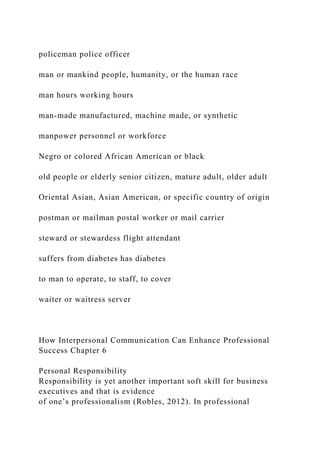
Over the past few decades, for example, language in
professional settings has evolved to replace
sexist and other biased terms with more inclusive language (see
examples of alternative terms
outlined in Table 6.1). Using more inclusive language
demonstrates respect for others, which in
turn reflects professionalism.
Table 6.1: Replacing sexist or biased language with inclusive
terms
Sexist or Biased Term Inclusive Term
businessman business owner, business executive, or business
person
cancer victim; AIDS victim cancer patient; person with AIDS
chairman chairperson or chair
confined to a wheelchair uses a wheelchair
congressman congressperson
Eskimo Inuit or Aleut
fireman firefighters
freshman first-year student
Indian (when referring to U.S. indigenous peoples) Native
American or specific tribe
policeman police officer
man or mankind people, humanity, or the human race
man hours working hours
man-made manufactured, machine made, or synthetic
manpower personnel or workforce
Negro or colored African American or black
old people or elderly senior citizen, mature adult, older adult
Oriental Asian, Asian American, or specific country of origin
postman or mailman postal worker or mail carrier
steward or stewardess flight attendant
suffers from diabetes has diabetes
to man to operate, to staff, to cover
waiter or waitress server
How Interpersonal Communication Can Enhance Professional
Success Chapter 6
Personal Responsibility
Responsibility is yet another important soft skill for business
executives and that is evidence
of one’s professionalism (Robles, 2012). In professional
settings, you alone are responsible for
motivating yourself, for getting your work done effectively and
efficiently, for making sure that
you meet your obligations and deadlines, and for avoiding
distractions or wasting time. To say
that someone is professional implies that the person is highly
skilled, competent, works indepen-
dently, and gets the job done on time.
Collaboration
People in professional environments often work together to
achieve goals, and in the previous
section the importance of teamwork in the workplace was
verified in multiple surveys of impor-
tant job skills (e.g., NACE, 2013; Robles, 2012). To be
successful in these team efforts requires
good interpersonal communication skills, and the ability to
collaborate, or to work cooperatively
with others to accomplish goals. It is common in classrooms and
in the workplace to form work
groups, project teams, task forces, committees, and other groups
to accomplish tasks. The suc-
cessful outcome of the effort often depends on each person
performing his or her specific tasks
well. Thus being collaborative is a final integral component of
professionalism.
Professional Reputation
The verbal and nonverbal messages that you use in the
workplace or the classroom can affect your
reputation. Emily Bennington and Skip Lineberg (2010), authors
of Effective Immediately: How
to Fit In, Stand Out, and Move Up at Your First Real Job, state
that in many instances, people’s
professional reputations are not destroyed by one or two major
errors. Instead, their reputations
are chipped away over time by continual communication
mistakes. Some of the specific mistakes
that can negatively impact your professional reputation, or
how much professionalism that you
are perceived to have by your clients and colleagues, are
discussed in the following sections.
E-Mail Errors
Although e-mails are often used in the workplace as a substitute
for letters or memos, they are
also used in professional settings in place of face-to-face or
telephone conversations. Professional
reputations are frequently harmed by the errors people make
with e-mail messages. Everyone
makes an occasional mistake, but consistent errors in
punctuation, grammar, spelling, and sen-
tence structure create negative impressions among people who
read your e-mail. Sending per-
sonal messages such as jokes or chain letters, using biased or
offensive language, and including
abbreviations that may not be understood by others are other
common e-mail problems that can
affect an employee’s professional reputation. Sending
inappropriate messages on work computers
can be harmful to your career as well; they are usually a
violation of organizational policies.
Misunderstandings are also frequent in e-mail communication
because the tone of the commu-
nication is often difficult to determine. The short, informal style
of many e-mail messages can be
interpreted by a recipient as terse or rude. It is best to carefully
proofread each e-mail that you send
to your professional recipients and ensure that the e-mail’s
content is clear and easily understood.
Communication in Meetings
When you communicate in workplace meetings, you must be
sensitive to the organizational
culture, or how an organization’s mission, values, and attitudes
are translated into communica-
tion policies and practices (Eisenberg & Riley, 2001), know
when it is prudent to speak up or to
remain silent, and know how much information to share. When
the meeting leader asks, “That’s
about it; any questions?” it might be an invitation to ask about
anything you did not understand.
However, it might also be a ritual to end the meeting, and no
response is expected or appreciated.
How Interpersonal Communication Can Enhance Professional
Success Chapter 6
New employees are often ambitious or eager to make an
impression and may think that they will
be judged negatively if they sit through a meeting without
saying anything. To be useful, how-
ever, contributions in meetings need to be thoughtful and
relevant and have a strong foundation
(Wolgemuth, 2010). When you are in a meeting, be attentive
and ask questions when critical
issues need clarification, but be wary of interjecting unless you
have something important to add.
In a new work environment, analyze the responses of others to
determine the type of response
that is effective and appropriate in each situation. Some
organizations encourage open and hon-
est dialogue about issues; others do not. Knowing the
expectations of your workplace will help
you assess how to behave in meetings.
Interrupting others, embarrassing them, or focusing on issues
that are relevant just to you in
a meeting can also negatively affect your professional
reputation in the workplace. It is crucial
to support your boss and coworkers when you are in public
settings. Make sure your loyalty is
thoughtful and deliberate, however, not just blind allegiance
(Wolgemuth, 2010). (The Web Field
Trip feature offers tips for learning workplace communication.)
Job Satisfaction
Our professional success not only depends on how professional
we are to others, but also on how
we feel about our jobs. One way to assess your perception of
your job is via job satisfaction,
which is defined as the emotional response one has regarding
multiple aspects of his or her pro-
fessional environment (Wheeless, Wheeless, & Howard, 1984).
In other words, job satisfaction is
your personal evaluation or appraisal of how much you enjoy
and are content with your employ-
ment situation. Any number of factors can contribute to how
satisfied you are with your job,
including the number of hours that you work, the amount of
money that you make, and the num-
ber and type of job responsibilities that you have. In addition,
research has found that a major
component of job satisfaction is the business and professional
communication in which you take
W E B F I E L D T R I P
Leadership Skills and Communication
Observing others can help you understand what language and
which behaviors are appropriate
and effective in different interactions. For example, you can
observe the communication of business
leaders and other professionals as they interact. If you would
like to learn how to be an effective
and professional public speaker, consider attending a meeting of
Toastmasters International, which
is an international organization with local chapters all over the
world. Founded in 1924, it is a non-
profit group dedicated to helping people improve their speaking
and leadership skills. You can find
meeting locations, learn more about Toastmasters, and find free
resources and speaking tips and
techniques on the website (www.toastmasters.org). Under the
Video Resources tab, click “view gal-
lery 2” found under the heading “Toastmasters Time-tested
Communication Tips on Video.” Locate
and view the Gestures and Body Language video, which
provides specific communication tips, and
consider the following questions.
Critical Thinking Questions
1. What are the main suggestions provided in the video? How
can you apply this to improve your
workplace interactions?
2. How does the presenter in the video use nonverbal
communication to convey his message? Do
you think his gestures are appropriate and useful?
How Interpersonal Communication Can Enhance Professional
Success Chapter 6
part, including both verbal and nonverbal messages. We explore
how some of these messages are
related to job satisfaction in the next sections.
Verbal Messages
What is said in business and professional settings can increase
or decrease an employee’s job sat-
isfaction. In general, organizations that stress open
communication and that are willing to share
information have more satisfied employees. In addition,
communication between superiors and
subordinates is one major verbal communication contributor to
subordinates’ job satisfactions.
For example, when supervisors used positive or prosocial
messages—such as being friendly and
showing that they like their subordinates—to convey their
power, subordinates were more satis-
fied than when antisocial power messages, such as those that
control or punish the subordinate,
were employed (Teven, 2007). Further, satisfaction with one’s
supervisor was the only one of six
components of job satisfaction that was negatively related to
oral communication apprehension
(Gibbs, Rosenfeld, & Javidi, 1994).
Conflict is also an influential element in the workplace (De
Dreu, van Dierendonck, & Dijkstra,
2004). For example, unresolved conflict is a major reason that
employees leave their jobs (Chen,
Zhao, Liu, & Wu, 2012). How we engage in conflict with our
colleagues at work is also associated
with job satisfaction. The following items reveal specific
research findings about employees’ job
satisfactions:
• Job satisfaction was higher in companies that encouraged
their employees to cooperate and
collaborate with one another in conflict situations (Choi, 2013).
• Job satisfaction was lower in businesses where conflict
was dealt with via active confronta-
tion (Choi, 2013).
• Compromising when in conflict is positively related to job
satisfaction (Chen et al., 2012).
• Constructive conflict cultures may reduce employee
burnout, making the employees more
satisfied with their jobs (Choi, 2013).
• Employees are less satisfied with their jobs in destructive
conflict cultures, which may then
increase employee burnout (Choi, 2013).
Nonverbal Messages
In addition to verbal communication, a variety of nonverbal
mes-
sages have been associated with job satisfaction in business and
pro-
fessional communication research. Nonverbal immediacy
involves
a collection of specific nonverbal messages such as eye contact
and
smiling that together increase your feelings of closeness with
another
person. We tend to be drawn to those who use nonverbal
immediacy,
and this can contribute to job satisfaction. For example, when
supe-
riors communicated higher nonverbal immediacy to their
subordi-
nates, the job satisfaction of subordinates increased (Teven,
2007).
Time, or chronemics, is another nonverbal message that is
related
to job satisfaction. Dawna Ballard and David Seibold (2006)
found
that multiple elements of time predicted employee job
satisfaction.
Specifically, individuals with more of a future time focus,
where
future developments and long-term goals were emphasized, and
▶▲Nonverbal immediacy and chronemics are two specific non-
verbal communication concepts related to job satisfaction.
Maria Teijeiro/Digital Vision/Thinkstock
Types of Workplace Relationships Chapter 6
employees with higher punctuality experienced greater job
satisfaction. In contrast, employees
who were expected to keep a faster pace were less satisfied with
their jobs. Together, time orienta-
tions combine to help employees feel as if they are capable of
meeting the demands of their jobs,
thus contributing to their job satisfaction (Ballard & Seibold,
2006).
6.3 Types of Workplace Relationships
One person can serve any number of the roles that are possible
in business and professional
contexts. We have bosses, and we may also supervise other
employees. We work in teams with
other individuals. We assist the clients that the company serves
and collaborate with individuals
at other organizations. We represent our workplace or
organization to individuals, groups, and
the community at large. In addition, we have friendships and
even romantic relationships with
those with whom we work. Americans work an average of 35 to
40 hours per week, so forming
personal relationships with work colleagues is inevitable; in
turn, these workplace friendships
can contribute to an organization’s effectiveness. We examine
different categories of workplace
relationships in this section.
Formal Relationships
The primary relationship in business and professional settings is
the formal relationship, which
involves the many associations and networks that are designed
and dictated by the business or
organization. The formal relationships in a business setting
should be clear to every employee,
whether there are 3 employees or 300,000. Formal relationships
allow employees to know who
they need to communicate with in order to accomplish a
particular task, and who is responsible
for which other employees. These relationships are defined by
each employee’s job title or posi-
tion and can be depicted visually in an organizational flowchart.
The interactions that occur in
formal relationships are what keep a business or organization
going; they could be considered the
lifeblood of an organization.
These formal relationships can be further broken down
according to the power differentials
between each employee, or whether the work-related
communication is vertical (downward and
upward) or horizontal in nature. In a business or professional
context, vertical formal com-
munication occurs between individuals of different power
differentials. When a business’s CEO
sends an e-mail to all of her employees about a new company
policy or when a professor talks
to a student about a grade, these are both examples of vertical
communication. Vertical formal
communication can be broken down further based on who
initiates the interaction. When a
superior begins an interaction with a subordinate (someone
lower in the company hierarchy), it
is an example of vertical downward communication. This type
of communication could occur
in the scenario at the beginning of the chapter if Suzanne, their
superior, initiated a conversation
with Patrick and Megan about their workplace friendship.
Conversely, when a subordinate starts
communicating with a superior, they engage in a vertical
upward communication interaction.
In the scenario, for example, Patrick and Megan could
communicate their concerns directly to
Suzanne.
Horizontal formal communication, in contrast, takes
place between employees who are at
identical or similar levels of hierarchy in a business or
professional context. Two students who
talk to each other about a class assignment or a group of
salespeople who discuss their monthly
quotas are each examples of horizontal formal communication.
Work interactions between
Patrick and Megan also constitute horizontal communication
because they are both lawyers at
Types of Workplace Relationships Chapter 6
the same firm. Whether there is a power differential that is
dictated by the organizational struc-
ture determines whether formal communication is vertical or
horizontal. Both types of formal
communication can also occur simultaneously, such as in a
classroom setting or a meeting where
superiors and subordinates are both present.
Employees need to seek and share information. Thus formal
communications in business and
professional settings helps employees accomplish the
professional tasks that a business needs
to exist and thrive. The importance of formal BPC also goes
beyond such tasks. In one study,
employees’ satisfaction with how much they interacted with
their superior strongly predicted
their commitment to the organization (Postmes, Tanis, & de
Wit, 2001). In other words, vertical,
formal relationships, such as those between superiors and
subordinates, strongly contributed to
how much the subordinates identified with, felt involved in, and
were emotionally attached to
their organization. In addition, verbal formal communication
was a better predictor of employ-
ees’ organizational commitment than horizontal, informal
workplace interactions (Postmes et
al., 2001). Thus, formal relationships are not only important for
accomplishing the tasks that
comprise one’s job description, but they also influence
employees’ attachment and involvement
with the organization.
Informal Relationships
As opposed to the formal relationships that are defined by a
company or organization, infor-
mal relationships are relationships based on shared interests,
mutual regard, and friendship.
Informal relationships occur between employees in a business
and professional setting, but such
interactions have little to do with the company. Nonetheless,
informal communication between
colleagues is important. Forging interpersonal relations and
being familiar with other employees
in the workplace helps coworkers feel comfortable, allows them
to feel they have the social and
emotional support of others, and creates a general sense of
community (Myers et al., 2011). It is
for these reasons that Patrick and Megan enjoy a close informal
friendship with each other.
These informal relationships are enjoyable for those involved
and can also benefit the company
in a number of ways. For example, informal relationships can
increase employees’ enjoyment of
work and solidify their place in the organization, reducing the
likelihood of employee turnover
(Myers et al., 2011). Further, employees who feel more familiar
with one another are more will-
ing to engage in communication related to the company,
including problem solving, discussions,
and decision making (Myers & Oetzel, 2003). Despite these
benefits some communication issues
can arise that make these informal relationships problematic; a
few of these are described below.
Inappropriate Topics
Many of us spend as much time at work as we do with our
families or loved ones. We often
become so comfortable with coworkers that we sometimes
forget we must maintain profession-
alism in our interactions with them. Personal disputes in the
workplace can make it difficult for
people to work together to achieve organizational goals. To
keep these disputes to a minimum, it
is best to avoid discussing topics that deal with personal and
moral values. The top three topics
to steer clear of are sex, politics, and religion.
Charles Purdy, senior editor of job site Monster.com and author
of the book Urban Etiquette
(2004), states that “if you make gender differences an issue at
work, or if you let water-cooler
discussion head toward a sex-related topic, you do so at great
peril” (p. 84). Some people may be
comfortable discussing topics of a sexual nature; however,
many people are not. Discussing such
topics may offend some people, cause them to be
uncomfortable, or create an environment that
Types of Workplace Relationships Chapter 6
they feel is offensive or hostile. Your comments might also be
considered sexual harassment,
which is a behavior that is against the law.
Politics and religion are also emotional issues for most people.
A survey by the American
Management Association (AMA) revealed that only 39% of
senior executives, managers, and
employees said they were comfortable discussing their political
views with their colleagues
(AMA, 2008). Likewise, off-color jokes have no place at work;
not only can they be offensive to
many people, but they can also violate company policies and
create a hostile work environment,
which can have legal ramifications for you and for your
company. Laughing and telling elaborate
stories about your weekend escapades, bodily functions, and
other personal issues also detracts
from your professional image and reputation. The safest course,
suggests Purdy (2004), is to keep
your conversations positive. Resist the temptation to spread
negative rumors, to complain about
your job, and to speak negatively about anything or anyone.
Workplace Networks
It is a mistake to ignore your manager’s or supervisor’s point of
view on an issue, but it is also a
mistake to continually agree with him or her. Always siding
with the boss can cause trouble for
you with your coworkers. You were hired to be a contributor to
a team effort, and your success
depends as much on your associations with your coworkers as it
does on your relationship with
your boss. Roy Cohen, executive coach and author of the book
The Wall Street Professional’s
Survival Guide, reminds us of the importance of good working
relations with coworkers. It is
important, he states, not to be a lone ranger. Make sure to be an
integral part of the team and to
socialize with your colleagues at office functions (Cohen,
2010).
As we have discussed throughout this chapter, it is also
important in professional settings to pay
attention to the informal communication networks that exist in
every organization. The grape-
vine is one of these informal networks; the term refers to the
way information is passed from per-
son to person in an organization through casual conversations
rather than via formal channels.
The grapevine is an important way to find out what is happening
throughout the organization,
and you should ensure that you are a part of that conversation
pathway. But not everything you
hear via the grapevine is true. Gossip, which is not necessarily
accurate or appropriate informa-
tion, is often transmitted via the grapevine. However, this
informal network can still serve as an
early warning system about possible changes or issues and give
you an opportunity to check the
information to determine if it is accurate.
Other informal networks might be the Friday night happy hour,
the company softball team, the
annual company picnic, and similar voluntary events or leisure
activities that encourage employ-
ees to come together and interact outside of the office. A great
deal of information and relation-
ship building occurs during these events, and it is important to
participate in these opportunities
and to socialize with people throughout your organization, when
possible.
Why Relationships Are Central to Job Satisfaction
Informal relationships and networks are not only important for
your own career advancement
and ambitions, but they also contribute to your job satisfaction.
Research on informal, interper-
sonal relationships in business and professional settings has
found that a number of factors are
associated with job satisfaction. One variable is the biological
sex of the employee. For example,
for males, but not females, there was a strong, positive
relationship between having strong friend-
ships in the workplace and job satisfaction, as well as cohesion
with colleagues (Morrison, 2009).
Females, on the other hand, were less likely to leave their jobs
when they had formed strong work-
place friendships, a study finding that did not exist for males
(Morrison, 2009).
Types of Workplace Relationships Chapter 6
How we maintain our workplace friendships is a second
concept that is related to job satisfaction. Relationship
maintenance, which we will also discuss in more detail
in Chapter 8, is accomplished in workplace friend-
ships via a number of specific communication strate-
gies, including these seven: being positive or upbeat,
sharing tasks, managing conflict competently, sharing
social networks, being open, giving advice, and assur-
ing coworkers about the friendship (Madlock & Booth-
Butterfield, 2012). Over 80% of employees in one study
reported that they used positivity, conflict manage-
ment, and sharing tasks strategies (Madlock & Booth-
Butterfield, 2012). Further, each of the above seven
relationship maintenance strategies was positively
related to job satisfaction in this study, with conflict
management and positivity being the best predictors
of job satisfaction.
A third way to assess the relationship between infor-
mal workplace relationships and job satisfaction is by
considering the centrality of an employee in a work-
place friendship network. Network centrality focuses
on how much an employee participates in and is connected with
other individuals in a friendship
network (Raile et al., 2008). This concept can be further broken
down into three related factors:
• Degree, or the extent to which a coworker is connected to
other individuals in the network
• Closeness, or the extent to which a coworker can be in
contact or communicate with all
other members of the network
• Betweenness, or the extent to which a coworker mediates
or becomes involved in interac-
tions between two other network members (Raile et al., 2008)
The coworker who organizes happy hours and birthday
celebrations for the colleagues that she
spends time with socially would be considered fairly central to
that friendship network. Of the
three aspects of network centrality, Amber Raile and her
colleagues (2008) found that only close-
ness was positively related to employee job satisfaction at a
Korean organization, possibly because
closeness reflects an employee’s ability to access organizational
resources efficiently. Similarly,
behaving in ways that benefit one’s colleagues, such as helping
someone who has a particularly
heavy workload, is positively related to network centrality in an
international Taiwanese bank
(Liu & Ipe, 2010).
Challenges of Romantic Workplace Relationships
As we discussed, we often form friendships at work and can
forge lasting bonds with people
through our professional associations. Because work consumes a
great deal of our life, we spend a
vast amount of time with coworkers on the job. It is also likely
that you will become romantically
attracted to the people at work with whom you interact most
frequently. From this attraction,
a workplace romance might blossom. Workplace romances
occur “between two members of an
organization where sexual attraction is present, affection is
communicated, and both members
recognize the relationship to be something more than just
professional and platonic” (Horan &
Chory, 2011, p. 565).
Stockbyte/Thinkstock
▲▲ A coworker who organizes happy hours and
birthday celebrations for colleagues is central in
the office’s friendship network.
The Influence of New and Emerging Technology Chapter 6
Unlike non-workplace romantic relationships, workplace
romances often involve two employees
who must continue to interact with each other and perhaps even
depend on each other to com-
plete job tasks even after their romance has ended (Pierce,
Byrne, & Aguinis, 1996). These types
of relationships are quite common: A survey by
Careerbuilder.com found that 40% of workers
had dated someone they worked with during their career, and
30% reported that they went on to
marry someone they met in the office (“Nearly one-in-five
workers,” 2011).
Workplace romances may be common, but they can also be
complicated and problematic. They
can affect not only the relationship participants but those
around them in the work environment.
At the minimum, the romantic relationship may be a source of
gossip among coworkers. It can
also have a negative effect on coworker morale and
productivity. Further, workplace romance
can negatively impact the credibility of the individuals
involved. For example, participants in
one study reported that they would perceive individuals who are
dating a superior at work more
negatively than colleagues who are dating a peer; specifically,
there is less trust, solidarity, and
caring, and less accurate and honest self-disclosure when
interacting with someone who is dating
a superior (Horan & Chory, 2009, 2011). Another study found
that those dating superiors at work
were viewed as being more likely to receive unfair advantages
than those dating a peer, a subor-
dinate, or an outsider (Malachowski, Chory, & Claus, 2012).
Women, in particular, were viewed
as less credible by their coworkers if they dated someone above
them in the company hierarchy
(Horan & Chory, 2011).
Another important issue to consider before you get involved in
a workplace romance is that many
businesses and organizations have rules or policies that
discourage, prohibit, or restrict their
employees from having a romance with someone who works in
the same organization or the
same unit. In a 2013 poll conducted by the Society for Human
Resource Management (SHRM),
405 human resource professionals and 5,004 employees
responded to questions concerning
whether their company has such policies (SHRM, 2013). Results
from the survey indicate that
58% of the people polled reported that their organizations did
not permit or discouraged work-
place romances, a decrease from 79% in 2005 (SHRM, 2006).
Be sure to check your company’s
policies and consider your colleagues’ perceptions of you and
your potential partner before enter-
ing into a relationship with someone where you work.
6.4 The Influence of New and Emerging Technology on
Interpersonal Communication in the Workplace
Thirty years ago, people came to work in the morning, checked
their telephone answering machine
to retrieve voicemail messages, and read the letters, memos, and
notes stacked in the physical “In”
boxes on their desks. Most of these voice and printed messages
have been replaced by text mes-
sages and e-mails. In the office of yesteryear, interpersonal
communication took place from 8 to 5
when you met your coworkers at the water cooler, in the break
room, or over lunch. While you still
see people at work today, you can also form long-lasting
relationships online with colleagues you
have never physically met and know only through telephone
conversations or online interactions.
Mediated communication has dramatically changed almost every
aspect of our culture, includ-
ing how we interact in business settings. It has changed the way
in which we communicate with
friends, families, colleagues, and customers. Mediated
communication allows people to com-
municate over distances and time spans that are not possible in
face-to-face communication.
Smartphones, for example, allow people to be highly mobile, to
work without being physically
present in the office, and to be connected to others 24/7 through
different media such as e-mail,
The Influence of New and Emerging Technology Chapter 6
telephone, and instant messaging. Mediated communication
often interrupts face-to-face com-
munications, however, and forces you to make choices, such as
engaging in a face-to-face con-
versation with someone or answering a ringing cell phone. It
can also affect your interpersonal
relationships and require you to increase your awareness of
communication contexts and modify
your communication behavior for personal and professional
success.
Many of the elements of interpersonal communication in the
workplace that we have discussed
in this chapter apply to mediated business and professional
communication as well. Like face-to-
face communication, mediated communication at work may be
formal or informal, and feedback,
which may be immediate or delayed, is a crucial element in the
communication process.
Gregory Berry (2006) reviewed 25 years of research that has
compared face-to-face and medi-
ated business and professional communication. The study notes
that mediated communication
is beneficial because it affords multiple individuals with the
opportunity to interact with one
another, at any time and across great physical distance.
Mediated communication also alleviates
issues that are typical with face-to-face interactions, including
managing large groups, assisting
in leveling the playing field for employees of different statuses,
reducing geographic and time
difference difficulties, and inaccuracies in group recollections
of information. Mediated interac-
tions, such as via e-mail, also may embolden employees who are
shy about speaking up in group
situations, and the lack of visual cues when communicating via
e-mail could assist employees
in being more focused on their task rather than on the
interaction’s personal or social compo-
nents. Finally, mediated interactions offer the option to take
time and reflect on what is said
(Berry, 2006).
Unlike face-to-face communication, however, mediated
communication is often permanent.
Voicemails and e-mails can be saved and retrieved later; they
become a permanent record of your
communication. Therefore, in professional situations, it is
important to change a short, informal,
and grammatically incorrect personal e-mail style to a more
formal writing style that uses com-
plete sentences, proper capitalization, and correct grammar and
punctuation. A good guideline
for workplace communication is do not put anything in an e-
mail that you would not want your
boss to read.
Telecommuting
Technology has dramatically changed the way people interact.
In business and professional set-
tings, technology offers employers and employees the option to
telecommute. Technology makes
the virtual office and telecommuting, or telework, possible by
allowing people to do their jobs
from home, in an airport, or across the globe. Telework is a
“work arrangement in which employ-
ees perform their regular work at a site other than the ordinary
workplace, supported by techno-
logical connections” (Fitzer, 1997, p. 65). Telecommuting, in
which an employee works remotely
one or more days a week, grew 73% from 2005 to 2011 and now
includes 20 to 30 million U.S.
workers (Global Workplace Analytics, 2012).
Although working from home, avoiding a daily commute,
making your own hours, and being
able to do your job in your pajamas might seem desirable, the
importance of the interactions
and relationships you have with your coworkers should not be
underestimated. Across research
studies, the most frequent concern about telecommuting or
working from home is feeling
socially isolated from coworkers (e.g., Marshall, Michaels, &
Mulki, 2007). People missed the
spontaneous interactions and discussions they had with others at
work, the opportunities to get
together with friends and coworkers for lunch, and the ability to
keep tabs on what was going on
in the organization. Interpersonal communication is an
important element of our working lives.
The Influence of New and Emerging Technology Chapter 6
Indeed, one main reason that Yahoo CEO
Marissa Mayer put an end to the company’s
telecommuting program in February 2013,
prompting much outcry from employees
and the general public, was to increase
interaction among her employees. In her
keynote speech at the Great Place to Work
Conference in Los Angeles in April 2013,
Mayer defended her decision, saying that
employees “are more collaborative and
innovative when they’re together. Some of
the best ideas come from pulling two differ-
ent ideas together” (Tkaczyk, 2013, para. 6).
However, despite these perspectives,
research has also revealed that there are
many benefits to telecommuting and that
this arrangement does not always lead to a
deterioration of informal work relationships. Here are some
findings related to the organization
and individual benefits of telecommuting:
• Telecommuters reported that the more they liked their
coworkers and engaged in infor-
mal conversations with their coworkers, the higher their
commitment to the organization
(Fay & Kline, 2011).
• Coworker liking was positively linked to telecommuters’
job satisfaction (Fay & Kline,
2011).
• Those who telecommute experienced greater job
satisfaction than those who work in a
traditional office environment, in part because telecommuters
experienced less work–life
conflict and exchanged information with colleagues less
frequently (Fonner & Roloff, 2010).
• Telecommuters experienced less stress related to meetings
and engaged in less office poli-
tics behavior than office-based employees (Fonner & Roloff,
2010).
Such results indicate that telework is a credible form of work
that can alleviate distractions and
stress and can be positively related to job satisfaction (Fonner
& Roloff, 2010; Fay & Kline, 2011).
Crafting a Professional Online Reputation
The first impressions people form of you are often created by
your online self, before they even
meet you face-to-face. These impressions can affect your ability
to get or keep a job. Many employ-
ers search the Internet for information about job applicants,
either before or immediately after
interviews, and what they find in the search results can
influence their hiring decisions (Weisser,
2011). Today, many employers are also visiting job applicants’
Facebook pages and reading their
posts on Twitter, Tumblr, or Instagram to learn more about the
personalities, attitudes, interests,
and characters of the employee candidates. The website
CareerBuilder.com reports that, in 2013,
43% of employers who used social networking sites to research
job candidates found information
that caused them not to hire a candidate, an increase of 9% from
2012 (“More employers find-
ing reasons,” 2013). This information included provocative or
inappropriate photos, information
about the candidate using drugs or drinking, bad-mouthing of a
former employer, lying about
their qualifications, making discriminatory comments, or
showing evidence of poor communica-
tion skills. A study by Microsoft (2010) found that 70% of
employers chose not to hire job certain
Mike Watson Images/moodboard/Thinkstock
▲▲ Although telecommuting may offer more work and sched-
ule flexibility, some telecommuters miss the spontaneous
interactions and discussions that can occur at the office.
The Influence of New and Emerging Technology Chapter 6
candidates based on information that they found about them
online. However, 85% of these
employers were also positively influenced by candidates’ online
reputation, or their “publicly
held social evaluation of a person based on his or her behavior,
what he or she posts, and what
others (such as individuals, groups, and Web services) share
about the person on the Internet”
(Microsoft, 2010, p. 3). This information emphasizes that there
is a balance between creating an
online reputation and ensuring your online reputation is
appropriate and professional.
Whenever you put information online, it becomes public and
can be used by other people in ways
you might never imagine. When you post your activities online
in real time, anyone who has
access to your posts can discover personal information about
you. Information you share online
might even come back to haunt you years later. Words you have
written or photographs you have
shared that you think are humorous now might not be so funny 5
or 10 years from now when
they can be embarrassing or professionally damaging. Once
information is posted online, even if
it is later removed, it can be recovered or others may have saved
it before you removed it. So you
should consider all Internet postings to be permanent
correspondence, and think carefully about
what you disclose and how you communicate online.
Websites such as Twitter, Facebook, and Instagram are often
highly valued social networking sites
where you can interact with friends near and far and build
online personal relationships. These
sites and business and professional networking sites such as
LinkedIn can be useful avenues for
building career relationships as well. You can use such social
media sites to enhance your profes-
sional image. One way is to create a positive online persona.
You can generate digital content that
emphasizes your work experience, marketable skills, and
community volunteer efforts and post
that information on social networking sites. Of course, it is
imperative that the information you
post be true and accurate. Your goal is to highlight positive
aspects of yourself as you would in a
resume and to enhance your image, not to fabricate it.
Maintaining a well-written blog, writing
articles, or posting well-reasoned responses to forums on
serious topics can also enhance your
image as a potential employee. Many employers today even
expect those with established careers
to have an online presence. Sites for professionals such as the
website LinkedIn provide an oppor-
tunity for exposure and have networking and recruiting benefits
for both the employee and the
company. IPC in the Digital Age offers some tips for preparing
your online reputation before a
job search.
I P C I N T H E D I G I T A L A G E
Cleaning Up Your Online Self before an Interview
Sites like Facebook, MySpace, and Twitter allow you to share
information in new ways. People can
see your photos, read your recent thoughts, and see what others
say about you. Many companies
have hired individuals to specifically spend the bulk of the
hiring season looking through social
media sites, “friending” or following potential employees, and
finding out about their fit with the
company through online searches. To that end, when you are
looking for a job, it’s a good idea to
filter through your online self. The following are some useful
steps to accomplish that:
1. First, create a LinkedIn account and use it to showcase your
professional qualifications and to
connect with potential business contacts, including current and
former professors and colleagues
and friends and family.
2. Conduct an Internet search of yourself to ensure that there is
no inaccurate or compromising
information about you online.
(continued)
Strategies for Successful Communication at Work Chapter 6
6.5 Strategies for Successful Communication at Work
Throughout this chapter, we have discussed important aspects of
business and professional com-
munication. The final section offers a number of strategies that
you can use to improve your com-
munication competence in business and professional settings.
Be Aware of Your Professional Communication Behaviors
One of the most important steps to becoming a better
communicator in business and professional
settings is to increase your awareness of your formal and
informal communication behaviors. Pay
attention to the online and face-to-face messages you send in
the workplace. For example, don’t
send e-mails complaining about or disparaging your boss or
your company using your work
e-mail account; these accounts are often monitored. In addition,
never make comments or jokes
of a sexual nature to your fellow employees, as these could be
perceived as harassment. It is also
a good idea to be mindful of how you present yourself (and are
presented by others) online, as
someone from your organization, or a company that you want to
work for might consider cer-
tain details inappropriate. Remember that how you maintain
your formal and informal profes-
sional relationships can be just as important as being competent
at task-related behaviors such as
information sharing and organizing. Also, similar to your
workplace, the academic classroom is
a professional setting, so be sure that your contributions, both
online and offline, represent who
you are in the most positive and professional manner.
3. Set all your Facebook photos (except your current profile
picture) to private. Delete or untag
yourself from any online photos that show you engaging in
unprofessional behaviors. Remove
online references to smoking because some companies screen
out smokers due to health
plan costs.
4. Set all your Facebook status updates to private, and then go
through all your status updates,
removing controversial content. Remember, things can be taken
out of context and potentially
offensive or insensitive statements can cause problems.
5. If someone that you do not know sends you a friend request
on Facebook or starts to follow you
on Twitter or Instagram, conduct an online search of that person
to see if he or she is affiliated
with a company where you have applied for a job.
6. Finally, monitor your Twitter and Instagram feeds, and think
carefully about what you are saying
or posting during the hiring process. Some individuals have
separate professional and personal
social media accounts, with their personal accounts set to the
most stringent privacy settings.
This may be an option you want to pursue.
These are all useful tips for your professional life in general, so
don’t be too quick to return to old
online behaviors after you get hired!
Critical Thinking Questions
1. Have you had difficulty keeping your personal and
professional selves separate online? Why or
why not?
2. Can you identify any additional suggestions that would help
create a more professional online
persona?
3. Have you changed your opinion of a professional colleague
based on what you saw about their
online behaviors?
Summary and Resources Chapter 6
Create and Maintain a Professional Reputation
In the workplace, make sure that you present and maintain a
professional image with your writ-
ten, oral, and mediated communication. Switch from informal to
more formal language when
you write and speak professionally, and use the strategies
outlined earlier in this chapter for
participating appropriately in meetings and building a positive
reputation in the workplace. You
have all the skills you need for success. Keep working to hone
these skills and to enhance your
professional image.
Build and Maintain Informal Relationships with Your
Colleagues
Throughout this chapter, we have discussed the importance of
having positive informal, as well
as formal, interactions with coworkers. Maintaining these
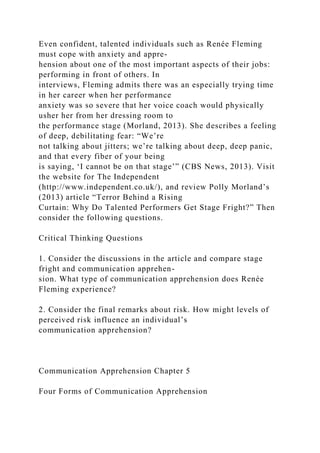
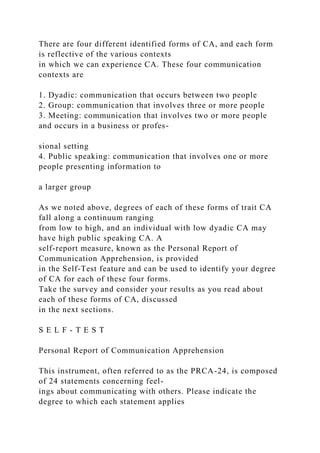
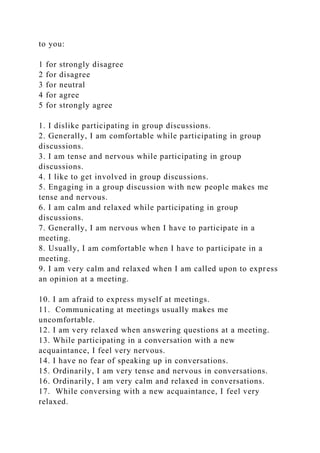
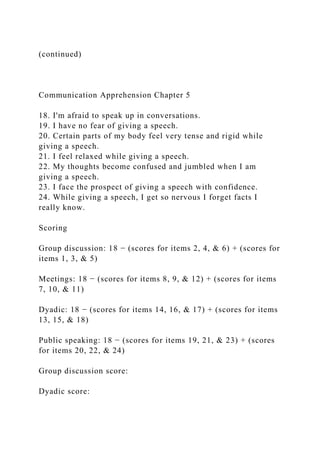
relationships benefits your health,
increases your commitment to the organization and your job
satisfaction, and is associated with
higher communication competence. Informal coworker
relationships are even important for
those who telecommute. Thus try to frequently engage in
interpersonal communication behav-
iors that will help maintain these relationships, such as sharing
tasks, managing conflict con-
structively, and being positive.
Consider Your Online Reputation and Communication
Just as you work to craft a professional reputation in the
workplace, you must also monitor who you
are online. As we saw, many employers are turning to the
Internet to learn about and vet prospect
job candidates. A quick search of your name could be enough to
put you out of the running for a
job if you post or share inappropriate, overly personal, or biased
or derogatory information online.
In addition, the Center for Professional Excellence (CPE)
survey (2012) found that one major
way to damage your professional reputation is to abuse the
Internet and emerging technologies
at work, including excessively tweeting or visiting social media
sites, texting at inappropriate
times, and using your work cell phone for personal phone calls.
In this survey, the percentage of
HR professionals and managers reporting these abuses by their
employees markedly increased
between 2011 and 2012: from 67.3% to 82.5% (CPE, 2012).
Abusing technology is also a frequent
reason that employees are fired (CPE, 2012). Thus be aware of
how you are using computer-
mediated communication in professional contexts, and limit
your usage to work-related tasks
whenever possible.
Summary and Resources
One of the most important benefits of working is the network of
social interactions and rela-
tionships you form with colleagues. Some of these workplace
relationships may last a lifetime.
Communication is an important characteristic of professional
settings, but the professional envi-
ronment also has specific requirements for behavior and
communication.
First, it is important to recognize that professional settings
require the use of more formal lan-
guage. When you communicate in the workplace or the
classroom, you must remember to mod-
ify your communication to this more formal style. Second,
communicating with others honestly
and ethically, in both oral and written communication, is
essential to your personal and profes-
sional integrity. Plagiarizing, providing false information to
others, lying, cheating, and avoiding
Summary and Resources Chapter 6
deadlines all demonstrate a lack of integrity. They negatively
impact your professional reputation
and can cause others to distrust you. Respect for others and
personal responsibility are also
crucial requirements for both professional and personal
interactions. Respect is demonstrated
by using respectful language, by being polite, and by
encouraging others. It also involves appre-
ciating diversity; valuing differences in race, ethnicity, gender,
age, and physical ability; avoiding
biased language and attitudes; and calling people by terms or
names that they prefer to be called.
To be a professional, you must have job skills, perform your job
well, be able to work indepen-
dently, and get the job done on time. People in professional
environments must also be able to
work as members of a team and to collaborate well with others
to meet organizational goals. It is
also important to understand and adhere to the policies and
norms of an organization concern-
ing workplace relationships.
Good communication skills are highly valued by employers, and
your professional reputation is
built and maintained through your communication. Mistakes in
interpersonal and online com-
munication can erode your reputation over time and affect your
career progression. Sending
inappropriate e-mail messages and other e-mail errors, having
inappropriate communication in
meetings, discussing inappropriate topics at work, and ignoring
workplace social and communi-
cation networks such as the grapevine and company activities
and events have contributed to the
demise of many careers.
Technology has dramatically changed the ways in which we
communicate with others. Mediated
communication is similar to face-to-face communication in
many ways. However, it has several
important differences as well. Mediated communication changes
the communication process by
introducing technology as the communication channel. The
features and capabilities of this tech-
nology must be taken into consideration; the technology can
introduce additional types of noise
into the communication process, and the communicators are
operating in different communica-
tion contexts. The absence of the nonverbal cues of face-to-face
communication is one of the most
important ways mediation changes the communication
environment. There are also different norms
concerning what is proper and improper in mediated
communication situations. Mediated com-
munication requires you to make the same decisions regarding
the appropriate degree of formality;
however, mediated communication is often more permanent than
face-to-face oral communication.
Mediated communication also provides an opportunity to remain
anonymous, to conceal or
disguise identity, and to disclose information that others can use
against you. For these reasons,
mediated communication can have implications for your safety.
Be sure to think carefully about
what personal information you disclose online, and take the
precautions suggested in this chap-
ter to protect yourself from people who might use the
information you post online for malicious
purposes. While you can remain anonymous when you
communicate online, you can also use
mediated communication channels to enhance your personal and
professional image and to cre-
ate a favorable online impression. Many employers search
online and visit social networking sites
and other websites to learn more about people they might
consider hiring. Your online image can
be an important aspect of your professional success.
Key Terms
betweenness A factor of network centrality that emphasizes
the extent to which a coworker
mediates or becomes involved in interactions between two other
network members.
business and professional communication (BPC) A
broad communication context that
includes all of the different forms of messages exchanged in the
workplace or in a professional
setting.
Summary and Resources Chapter 6
closeness A factor of network centrality that emphasizes the
extent to which a coworker can
be in contact or communicate with all other members of the
network.
collaborate To work cooperatively with others to
accomplish goals.
colleague support Connections with immediate coworkers
who are friendly and helpful with
solving problems.
degree A factor of network centrality that emphasizes
the extent to which a coworker is con-
nected to other individuals in the network.
downwardcommunication A type of vertical formal
communication that occurs when a
superior begins an interaction with a subordinate.
expressing negative emotion Workplace communication
behavior that involves complaints
about work or workplace frustrations.
formal relationship The primary relationship in business
and professional settings, which
involves the many associations and networks that are designed
and dictated by the business
organization.
grapevine An informal communication network among
employees in the workplace that car-
ries messages, including gossip, throughout an organization.
hard skills Technical knowledge or expertise required for a
particular job.
horizontal formal communication Communication in a
business and professional context
that occurs between individuals who are at identical or similar
levels of hierarchy.
informal relationships The relationships in business and
professional settings that are based
on shared interests, mutual regards, and friendship.
information sharing Workplace task-related behaviors
such as explaining, solving problems,
giving feedback and advice, and asking and answering
questions.
integrity A term applied to someone who practices honest and
ethical behaviors and
communications.
job satisfaction An individual’s personal appraisal of how
much he or she enjoys and is con-
tent with an employment situation.
network centrality The extent to which an employee
participates in and is connected with
other individuals in a friendship network.
nonverbal immediacy A collection of specific nonverbal
messages such as eye contact and
smiling that increase one’s feelings of closeness with another
person.
online reputation The social evaluation of a person’s
character and behavior as presented in
online settings.
organizational culture The way that an organization’s
mission, values, and attitudes are
translated into communication policies and practices.
organizing Workplace communication administrative-type
behaviors such as scheduling and
planning, personnel management, and problem solving.
Summary and Resources Chapter 6
professionalism Principles of behavior and communication
that are appropriate and effective
in business and professional settings.
professional reputation The amount of professionalism that
one is perceived to have by one’s
clients and colleagues.
relational maintenance Workplace interpersonal relationship-
focused behaviors such as cre-
ating relationships, engaging in small talk, and being humorous.
soft skills Intangible interpersonal qualities and personal
attributes that employers consider
when hiring employees.
telework An arrangement in a business and professional
context that allows employees to per-
form their regular work, via mediated technology, at an offsite
location.
upward communication A type of vertical formal
communication that occurs when a subor-
dinate begins an interaction with a superior.
vertical formal communication Communication in a
business and professional context that
occurs between individuals of different power differentials.
workplacecommunication behaviors The social behaviors that
employees engage in with
coworkers, which then create connections between the
individual employees and the larger
organization.
Critical Thinking and Discussion Questions
1. Consider your own employment experiences. What behaviors
and messages contribute to
your professional reputation at work and online? How do you
work to craft your professional
reputation?
2. According to the information presented in the chapter, which
communication messages and
relationships at work are most important for your job
satisfaction? Do your own experiences
mirror such assessments?
3. Review the relationship maintenance behaviors identified in
the chapter that are specific to
business and professional settings. Which behaviors do you use
and which are most beneficial
for your interpersonal relationships at work? Do such behaviors
work well in certain situations
but not in others?
4. As you read, technology makes telecommuting a more
accessible option for companies and
employees. If you have worked as a telecommuting employee,
what aspects of this option
worked well? What aspects were more challenging? Based on
what you have read in this chap-
ter, do you think telecommuting is helpful or harmful for a
company? If you were a company
CEO, what would your policy on telecommuting be?
5. Revisit the section of this chapter that discusses workplace
relationships. If you have ever been
involved in a workplace romance, do you think it made a
difference in terms of your cred-
ibility at work and your professional reputation? Why or why
not? Now consider how you
might respond if you knew two of your colleagues were in a
romantic relationship. Would this
relationship alter your assessment of their professional
reputations? Would it influence your
workplace interactions with them?
4 PAGES
APA
5 SOURCES
1,000-1,250-word essay describing the differing approaches of
nursing leaders and managers to issues in practice. To complete
this assignment, do the following:
1. write on the issue of nursing shortage and nurse turn-over.
2. Compare and contrast how you would expect nursing leaders
and managers to approach your selected issue. Support your
rationale by using the theories, principles, skills, and roles of
the leader versus manager described in your readings.
3. Identify the approach that best fits your personal and
professional philosophy of nursing and explain why the
approach is suited to your personal leadership style.
Developing Confidence:
Coping with Insecurities about
Interpersonal Communication
Learning Objectives
In this chapter, readers will explore the fear and anxiety that
some communicators experience
during communication situations. By the end of this chapter,
readers will be able to
• Define the concept of communication apprehension and
identify the various types of com-
munication apprehension
• Explain how communication apprehension is related to a
number of personality factors
and interpersonal consequences
• Describe both broad and specific interpersonal effects of
communication apprehension
• Use strategies to reduce communication apprehension in
interpersonal interactions
5
Sigrid Olsson/The Image Bank/Getty Images
Communication Apprehension Chapter 5
Introduction
Michael, a 25-year-old man, has a great deal of trouble
communicating in certain situations.
When he is talking with his friends, his family members, and his
girlfriend Jane, he is perfectly
comfortable: He seeks out interactions with those he is close to
and fully engages in and partici-
pates in conversations with them. But he quickly becomes
overwhelmed when he is in situations
where he is meeting new people or participating in a group
situation with those he does not know
very well, which happens frequently for him at school and at his
job as a marketing assistant. He
gets nervous; he starts to sweat, and his hands become clammy,
which makes him even more
uncomfortable with introductory handshakes; he avoids talking
unless he absolutely has to, and
he stumbles over his words and sounds unsure and tentative
when he does have to speak. Overall,
he is generally not himself in such situations. As a result he
routinely avoids certain communica-
tion situations because he does not want to experience such
discomfort.
Michael’s trouble communicating in these new interactions has
been detrimental to him: He
has had job interviews where he did not get hired because of his
difficulty communicating con-
fidently, he has not impressed his classmates or coworkers
because he shuts down in group situ-
ations, and he is too afraid to ask his boss for a raise or to speak
with his professor about a grade
that he thinks is incorrect. Michael doesn’t think that he is shy,
because once he gets to know
people, he is very eager to interact with them and does so
competently. In fact, what Michael has
is communication apprehension, and as we will see in this
chapter, this is a common communica-
tion challenge that can make you a less confident or competent
communicator.
Like Michael, you likely experience some insecurity in at least
one aspect of your communication
with others. Maybe you get nervous when speaking with
someone who has a great deal of power
and influence, experience apprehension when talking with your
romantic partner about a diffi-
cult issue, or get jitters while speaking in public or performing
on stage. A major goal of this text
is to help you understand and improve your interpersonal
communication. Identifying specific
communication challenges and insecurities, and then addressing
these issues, is the main hur-
dle in this process. Throughout the book we have discussed
communication competence as an
important and easy-to-implement strategy for improving
communication. Chapter 5 thus exam-
ines a number of challenges that can arise in interpersonal
communication situations, introduces
and describes the concept of communication apprehension, and
examines how communication
apprehension is related to a number of personality factors and
interpersonal consequences. We
will also discuss several strategies for reducing communication
apprehension in interpersonal
interactions.
5.1 Communication Apprehension
Communication apprehension is one of the most frequently
researched concepts in the com-
munication discipline and, on a more specific level, is
commonly studied in relation to interper-
sonal communication (Daly, 2011; Levine & McCroskey, 1990).
Communication scholar James
McCroskey first identified communication apprehension in 1968
when he proposed it as a broad
concept that encompasses the fear and stress associated with
any form of communication, includ-
ing stage fright and reticence. Communicationapprehension
(CA) specifically occurs when an
individual experiences “fear or anxiety associated with either
real or anticipated communication
with another person or persons” (McCroskey, 1977, p. 78). In
other words, CA can occur during
an interaction or when you expect to take part in an interaction
in the near future. In fact, CA
can compel you to avoid certain interactions altogether.
Communication Apprehension Chapter 5
An individual who experiences CA might
avoid or reduce her participation in com-
munication situations in an attempt to
prevent feeling upset and experiencing
anxiety. In this way, someone with high CA
views communication as a punishment that
should be avoided, whereas people with low
CA will seek opportunities to engage in the
same interaction and find it to be enjoyable
(Daly, 2011). We will use the words high,
moderate, and low to describe CA levels
throughout this chapter because these des-
ignations reflect the categorizations that
researchers often use for their study partic-
ipants in order to make statistical compari-
sons among the three groups. Keep in mind
that CA is a continuum that ranges from
low to high levels, and that there is also a
continuum for each of the different types and forms of CA that
we will discuss below. Everyone’s
CA levels will differ according to the specific type or form of
CA that is relevant, and everyone
will experience some type of CA at different points. For
example, an individual may feel very
comfortable talking with others but become nervous in formal
meeting situations, particularly
when the meeting is a job interview.
McCroskey (1977) describes three propositions regarding
individuals with high communication
apprehension:
1. Those with high levels of CA will avoid and withdraw from
communication whenever they can.
2. Avoidance and withdrawal will lead others to view the high
CA individual less positively than
those with low to no CA.
3. The combination of communication avoidance and less
positive perceptions by others will
cause the high CA individual to experience greater difficulty in
social, academic, financial, and
professional situations.
Individuals can experience communication apprehension as
either an enduring personality trait
or in response to a particular state. We discuss these two
concepts and the different forms of
CA next.
Two Types of Communication Apprehension
It is not unusual for people to experience apprehension in a
specific communication scenario.
Indeed, McCroskey (2009) notes that 70% of Americans
experience CA in anticipation of giving
a speech. This type of CA is known as state communication
apprehension, or an apprehensive
reaction to a specific communication context or situation. If you
have high state CA, you fear or
feel anxious in one communication context but do not feel that
way in others (McCroskey, 2009).
The stage fright that singers and actors describe experiencing,
such as Renée Fleming’s perfor-
mance anxiety described in the Web Field Trip at the end of this
section, is an example of state
CA because they only feel that fear and anxiety in performance
situations. State CA thus occurs
less often, and only when in the midst of the single
communication environment, and it is typi-
cally experienced at only mild or moderate levels. McCroskey
(1977) stresses that experiencing
Michael Blann/Iconica/Getty Images
▲▲ For an individual with communication apprehension, com-
munication situations cause feelings of fear and anxiety.
Communication Apprehension Chapter 5
state CA from time to time is normal for most people, and it is a
logical response to an interaction
that could be perceived as intimidating or intense, such as
giving a speech to hundreds of people
or going into an important job interview.
On the other hand, communication apprehension can also be
something that you are to some extent
born with, and it can affect your life and your relationships.
This trait communication apprehen-
sion is experienced as a broad, consistent personal attribute that
can have multiple implications
and must be dealt with almost daily. It is viewed as a general
pattern along a continuum such that
one can have low, moderate, or high fear or anxiety orientation
across communication contexts
(McCroskey, 2009). For example, someone with high trait CA
may be less assertive, free, and clear
when communicating, and may also feel less powerful,
confident, and brave during interactions
(Hopf & Colby, 1992; Jung, 2013). In contrast, low trait CA
people will communicate in a more
assertive, clear, and free manner and feel confident and in
control when interacting with others.
Consistent effects of high CA can prevent you from achieving
certain personal goals, particularly
ones that involve interacting with others. In addition, the higher
one’s trait communication appre-
hension, the more he or she experiences a self-identity gap,
which is the difference between one’s
present self-concept and his or her perception of how others
view the self (Jung, 2013).
An estimated 15–20% of college and public school students,
adults, and senior citizens have high
trait CA (McCroskey, 2009; McCroskey & Richmond, 1982).
Trait CA is experienced in a variety
of different communication situations, from interpersonal to
organizational to public speaking,
and such interactions can be either real or imagined threats. As
a result, the vast majority of com-
munication apprehension research has focused on trait CA. For
the remainder of this chapter,
when we refer to CA, we are describing trait CA, unless
otherwise noted.
W E B F I E L D T R I P
Stage Fright
In 2008, Renée Fleming, a now internationally famous opera
singer, became the first female to
solo headline an opening night gala at the Metropolitan Opera
House in New York City, roughly 13
years after she had a breakthrough career performance at the
same venue (Metropolitan Opera,
2013a, 2013b). Despite years of professional training and
immense vocal talent, there was a point
in her career when the anxiety of performance could have
prevented her from taking those fateful
steps toward center stage.
Even confident, talented individuals such as Renée Fleming
must cope with anxiety and appre-
hension about one of the most important aspects of their jobs:
performing in front of others. In
interviews, Fleming admits there was an especially trying time
in her career when her performance
anxiety was so severe that her voice coach would physically
usher her from her dressing room to
the performance stage (Morland, 2013). She describes a feeling
of deep, debilitating fear: “We’re
not talking about jitters; we’re talking about deep, deep panic,
and that every fiber of your being
is saying, ‘I cannot be on that stage’” (CBS News, 2013). Visit
the website for The Independent
(http://www.independent.co.uk/), and review Polly Morland’s
(2013) article “Terror Behind a Rising
Curtain: Why Do Talented Performers Get Stage Fright?” Then
consider the following questions.
Critical Thinking Questions
1. Consider the discussions in the article and compare stage
fright and communication apprehen-
sion. What type of communication apprehension does Renée
Fleming experience?
2. Consider the final remarks about risk. How might levels of
perceived risk influence an individual’s
communication apprehension?
Communication Apprehension Chapter 5
Four Forms of Communication Apprehension
There are four different identified forms of CA, and each form
is reflective of the various contexts
in which we can experience CA. These four communication
contexts are
1. Dyadic: communication that occurs between two people
2. Group: communication that involves three or more people
3. Meeting: communication that involves two or more people
and occurs in a business or profes-
sional setting
4. Public speaking: communication that involves one or more
people presenting information to
a larger group
As we noted above, degrees of each of these forms of trait CA
fall along a continuum ranging
from low to high, and an individual with low dyadic CA may
have high public speaking CA. A
self-report measure, known as the Personal Report of
Communication Apprehension, is provided
in the Self-Test feature and can be used to identify your degree
of CA for each of these four forms.
Take the survey and consider your results as you read about
each of these forms of CA, discussed
in the next sections.
S E L F - T E S T
Personal Report of Communication Apprehension
This instrument, often referred to as the PRCA-24, is composed
of 24 statements concerning feel-
ings about communicating with others. Please indicate the
degree to which each statement applies
to you:
1 for strongly disagree
2 for disagree
3 for neutral
4 for agree
5 for strongly agree
1. I dislike participating in group discussions.
2. Generally, I am comfortable while participating in group
discussions.
3. I am tense and nervous while participating in group
discussions.
4. I like to get involved in group discussions.
5. Engaging in a group discussion with new people makes me
tense and nervous.
6. I am calm and relaxed while participating in group
discussions.
7. Generally, I am nervous when I have to participate in a
meeting.
8. Usually, I am comfortable when I have to participate in a
meeting.
9. I am very calm and relaxed when I am called upon to express
an opinion at a meeting.
10. I am afraid to express myself at meetings.
11. Communicating at meetings usually makes me
uncomfortable.
12. I am very relaxed when answering questions at a meeting.
13. While participating in a conversation with a new
acquaintance, I feel very nervous.
14. I have no fear of speaking up in conversations.
15. Ordinarily, I am very tense and nervous in conversations.
16. Ordinarily, I am very calm and relaxed in conversations.
17. While conversing with a new acquaintance, I feel very
relaxed.
(continued)
Communication Apprehension Chapter 5
18. I'm afraid to speak up in conversations.
19. I have no fear of giving a speech.
20. Certain parts of my body feel very tense and rigid while
giving a speech.
21. I feel relaxed while giving a speech.
22. My thoughts become confused and jumbled when I am
giving a speech.
23. I face the prospect of giving a speech with confidence.
24. While giving a speech, I get so nervous I forget facts I
really know.
Scoring
Group discussion: 18 − (scores for items 2, 4, & 6) + (scores for
items 1, 3, & 5)
Meetings: 18 − (scores for items 8, 9, & 12) + (scores for items
7, 10, & 11)
Dyadic: 18 − (scores for items 14, 16, & 17) + (scores for items
13, 15, & 18)
Public speaking: 18 − (scores for items 19, 21, & 23) + (scores
for items 20, 22, & 24)
Group discussion score:
Dyadic score:
Meetings score:
Public speaking score:
To obtain your total score for the PRCA, simply add your
subscores together:
Scores can range from 24–120. Scores below 51 represent
people who have very low CA. Scores
between 51–80 represent people with average CA. Scores above
80 represent people who have
high levels of trait CA.
Norms for the PRCA-24
The following norms are based on over 40,000 college students.
Data from over 3,000 nonstudent
adults in a national sample provided virtually identical norms,
within 0.20 for all scores.
Mean
Standard
Deviation
High
Low
Total 65.6 15.3 > 80 < 51
Group 15.4 4.8 > 20 < 11
Meeting 16.4 4.2 > 20 < 13
Dyad 14.2 3.9 > 18 < 11
Public speaking 19.3 5.1 > 24 < 14
Source: Self-test from McCroskey, J. (1982). Introduction to
rhetorical communication (4th ed.) ©1982. Upper Saddle River,
NJ: Pearson Education, Inc.
Printed and electronically reproduced by permission of Pearson
Education, Inc., Upper Saddle River, New Jersey.
Consider Your Results
1. Consider your overall CA score, as well as your scores for
each specific type of CA. Using the
table of norms for the PRCA-24, determine how you compare to
others with regard to your CA
levels.
2. Were there any scores that surprised you? In addition, think
about how your CA levels in a par-
ticular area may have impacted how you communicated in that
situation. Did you do poorly in a
group project because you have high group CA?
3. How might you manage your CA in future situations?
Communication Apprehension Chapter 5
Dyadic Communication Apprehension
Also known as person–partner CA, dyadic communication
apprehension describes the fear
one feels of interactions with one individual and the subsequent
desire to prevent or avoid such
interactions. According to McCroskey (1984), dyadic CA
involves “a relatively enduring orienta-
tion toward communication with a given person” (p. 17). Since
dyadic CA is a response to one
particular individual, the anxiety is a product of previous
negative interactions and the relational
history with the identified individual. Is there someone with
whom you are always nervous to
talk? Perhaps you didn’t make a good first impression and you
feel anxiety every time you have
to interact with this person because you know he does not like
you very much. Or you may be
anxious when talking to someone because you really want him
to like and respect you. The first
time that you meet a romantic partner’s parents or siblings is
probably an instance when you
experienced high dyadic CA, as their opinions of you could
potentially make or break your rela-
tionship. If your partner’s family welcomes you with open arms,
your dyadic CA levels will likely
lower substantially. But if they are not welcoming and seem to
disapprove of you, you will prob-
ably remain apprehensive when you interact with each of them.
Interpersonal communication
scholars most commonly examine this form of CA, as it best
represents the one-on-one nature of
interpersonal interactions, and the one that will be the focus of
this chapter.
Group Communication Apprehension
Individuals can also experience group communication
apprehension, which causes them to
avoid or withdraw from interactions that involve three or more
individuals. McCroskey and
Virginia P. Richmond (1992) believe that group CA is the most
important predictor of how one
will communicate in a small group situation. American culture
emphasizes teams at work and
in social and athletic situations so this form of CA can be a
great detriment in an individual’s
personal and professional lives. Compared to those with a low
degree of group CA, those with
high group CA tend to speak less, choose seats that prevent
them from being the focus of atten-
tion, and even generate fewer ideas than when they are alone
(McCroskey & Richmond, 1992).
Other group members view them as more nervous, less
dominant, and as providing fewer impor-
tant contributions than those with low group CA. These
characteristics mean that high group
CA individuals will be less effective group members and are
less likely to be group leaders. In
addition, from a more general CA perspective, those with
moderate or high trait CA (i.e., the
combined scores for the four forms of CA measured on the
PRCA-24 scale) were less likely to be
viewed as group leaders than low trait CA individuals (Limon &
LaFrance, 2005). So even if an
individual does not specifically experience group CA, a
significant degree of CA in general can
affect the person’s ability to interact in group environments.
Meeting Communication Apprehension
An individual with meeting communication
apprehension experiences anxiety associated
with participation in formal meetings. This form of CA can have
significant effects in an indi-
vidual’s academic and professional life. In a job interview, for
example, individuals with a high
degree of employment interview CA (a specific form of meeting
CA) reported that they chose to
avoid thinking about and preparing for the interviews and used
minimal communication during
the interviews (Ayres, Keereetaweep, Chen, & Edwards, 1998).
In addition, those with low CA
differed from high CA individuals in terms of how they
approached the job interview: Low CAs
felt confident, prepared, and concentrated on how they were
going to act during the interview
in order to get hired (Ayres et al., 1998). In contrast, high CAs
fretted about being evaluated or
judged, felt pressure about how to act during the interview,
were brief when describing their
qualifications, and were scared of saying the wrong thing
(Ayres et al., 1998).
Factors that Contribute to Communication Apprehension
Chapter 5
High trait CA can be particularly detrimental because job
interviews are typically required for an
individual to be hired for an employment position. For example,
researchers found that high CA
could prevent the apprehensive person from fully preparing for
the interview (Ayres et al., 1998).
Such lack of preparation could preclude the individual from
learning more about the company or
creating a list of questions to ask during the interview. This
feeling of unpreparedness can then
generate more apprehension, creating a communication
apprehension cycle that significantly
diminishes the chances that the person with high trait CA will
present herself well in the inter-
view, which then reduces her chances of being hired. Not being
hired could then reinforce the
person’s belief that she cannot get a job, meaning she is less
likely to prepare for future interviews.
Public Speaking Communication Apprehension
The final form of CA is public speaking communication
apprehension, or fear one feels when
asked to give a speech or presentation to a group of individuals.
Public speaking apprehension is
often the strongest form of CA. It is thus not surprising that
those with public speaking CA avoid
public speaking situations and demonstrate lower competence
when they do have to speak to a
group of people (Behnke & Sawyer, 1999; Scott & Timmerman,
2005). Consider the possible cor-
relation between master of business admin-
istration (MBA) students and experienced
levels of CA. John Burk (2001) found that
students in a MBA program had high levels
of both meeting and public speaking CA.
This is an interesting correlation because,
after graduation, MBAs will likely pursue
professions that require them to participate
regularly in meetings, lead discussions, and
present speeches to groups of colleagues.
In response to this unusual finding, Burk
(2001) recommends that MBA programs
incorporate more communication courses
in their program curriculums in order
to reduce these forms of CA experienced
among their students. As we will discuss
later in the chapter, taking courses or
engaging in formal training can be a helpful
way to reduce or alleviate communication
apprehension.
5.2 Factors that Contribute to Communication
Apprehension
A number of factors can affect communication apprehension. As
stated in the previous section,
trait CA, for example, is identified as a stable personality
characteristic that is present from birth.
State CA, in addition, can emerge from a single upsetting
experience. But there are also a number
of other individual and communication factors that can
contribute to CA or make one’s CA more
severe. Three of these most prominent factors are shyness,
introversion, and willingness to com-
municate, and these factors are related to branches of research
that aim to determine why some
people do not communicate. Each of these factors is discussed
next.
Digital Vision/Photodisc/Thinkstock
▲▲ Public speaking apprehension, or fear one feels when
asked
to give a speech or presentation, is often the strongest form of
communication apprehension.
Factors that Contribute to Communication Apprehension
Chapter 5
Shyness
Shyness can be at least partially genetic or can emerge from
upsetting and traumatic childhood
experiences such as physical or emotional abuse. Much like trait
CA, shyness is considered a
relatively stable personality trait and describes an individual’s
feelings of apprehension, timidity,
discomfort, and awkwardness in social situations. One
observable behavior that is indicative of
shyness is talking less than others (McCroskey, 2009). New
situations or interactions with unfa-
miliar people can make shyness even more pronounced.
But are shyness and CA two different concepts? Identifying the
motivations behind each indi-
vidual characteristic can help us understand the differences
between CA and shyness. Shyness
is primarily motivated by anxiety of what others might think. In
other words, if you are shy, you
do not behave how you would like to because you are scared
that others will negatively judge
you by criticizing you, rejecting you, or using disconfirming
messages toward you. In contrast,
though judgment from others can be one reason for CA, there
are other possible reasons for
communication apprehension. CA can also be caused by fear of
a communication context or
situation, a lack of communication skills overall or in a specific
situation, receiving positive rein-
forcement for being quiet as a child, and even difficulty
learning or acquiring a new language
(McCroskey, 1977).
Despite their differences, research (e.g., McCroskey &
Richmond, 1982) consistently finds that a
shy individual is also more likely to have high CA. Someone
who is shy and someone who expe-
riences CA will both exhibit similar behaviors, such as talking
less during communication sce-
narios, withdrawing from interactions, and avoiding social
situations (McCroskey & Richmond,
1982). However, research (McCroskey, 2009) finds that there is
only a moderate correlation
between shyness and CA, suggesting that each is at least
somewhat distinct. In other words, you
can have high CA and not be shy, and vice versa.
Introversion
As a culture, the United States values an individual’s ability to
engage in interactions and a
willingness to speak up. This can be troublesome for the
approximately one-third to one-half
of individuals who have the personality trait of introversion
(e.g., Myers, McCaulley, Quenk,
& Hammer, 1998). Introverted individuals focus their attention
inward, which means that they
pay more attention to their own thoughts and feelings rather
than seek outward for exter-
nal experiences or stimulation. Due to this inward focus,
introverts are quiet, introspective,
serious, reserved, and generally very organized. (The Web Field
Trip feature explores some of
the qualities of introverts in a noisy world.) Similar to CA,
introversion and its counterpart
extroversion are evaluated on a continuum. In contrast to
introverts, extroverts are typically
more sociable, gregarious, energetic, and positive, focusing
their attention on the world around
them. Identifying the distinctions between introversion and
extroversion is an important
step toward understanding an individual’s personality, and as
such it is one component of the
Big Five Factor Model, which focuses on the five basic aspects
of personality. These two ele-
ments are also one of four dimensions of the Myers-Briggs Type
Indicator (MBTI) personality
inventory, which is designed to provide explanations of 16
distinctive personality types (MBTI
Basics, 2010).
Factors that Contribute to Communication Apprehension
Chapter 5
As with shyness, introversion shares some similarities with and
differences from communication
apprehension. As you learned, CA is one’s fear or anxiety about
taking part in communication
situations. Introversion, on the other hand, is not about fear of
interactions. Rather than socialize
with others, introverts simply prefer to spend time alone instead
of socializing, and they tend to
feel as if their energy is drained after spending time with
others; thus, they may need to recharge
by themselves for a little while. This emotional exhaustion, not
fear, is often what motivates intro-
verts to avoid social situations. Although both introverts and
those with high CA avoid certain
interactions, their motivations for doing so are different.
As further evidence of the similarities and differences between
these concepts, research has con-
sistently determined that introversion and CA are moderately
correlated (McCroskey, 2009). For
example, Stephanie Shimotsu and Timothy Mottet (2009) found
that maladaptive perfectionism,
which occurs when a person is unable to reach goals or
standards because these goals are exces-
sively high, is an aspect of personality that is related to both
lower extroversion and higher CA.
Take a moment to complete the introversion–extroversion
assessment in the Self-Test feature.
Whatever your score is, consider how your own introversion or
extroversion has impacted your
interactions with others. This self-awareness can help you to
approach interactions in a way that
accommodates your level of introversion or extroversion—for
example, knowing that you are an
introvert can motivate you to not schedule more meetings in a
day than you can handle or to be
aware that you will need some personal recuperation time after
attending a party or interacting
with a large number of people.
W E B F I E L D T R I P
Speaking Up for Introverts
In 2012, the trait of introversion was thrust into the spotlight
with the publication of Susan Cain’s
book, Quiet: The Power of Introverts in a World that Can’t Stop
Talking. Cain argues that Western
culture’s preference for extroversion, which she calls the
“extrovert ideal,” means that introverts’
traits and abilities are often misunderstood, undervalued, and
even viewed as inferior or extreme
(2012, p. 4). According to Cain (2012, p. 6), this cultural
emphasis on extroversion has led many
introverts to feel pressured to adopt a “pseudo-extrovert”
identity where they act like extroverts
rather than be their naturally quiet, introspective selves.
Cain’s book works to dispel the extrovert ideal by citing
research from many different academic
disciplines that, together, highlight the multiple benefits and
contributions of introversion, including
a focus on listening, creativity, and being careful rather than
reckless. Visit the website devoted to
Cain’s book (http://www.thepowerofintroverts.com/) to learn
more about The Power of Introverts.
Review information located under “Quiet: The Book,” take a
Quiet Quiz, and view Susan Cain’s
TED Talk.
Critical Thinking Questions
1. Do you consider yourself an introvert? If not, do you have a
close friend or family member who is
introverted? What are the communication effects of introversion
that you personally experience?
2. Do you believe that our culture is becoming more attuned to
accepting introversion? Why or
why not?
Factors that Contribute to Communication Apprehension
Chapter 5
S E L F - T E S T
Introversion–Extroversion Scale
Below are 12 statements that people sometimes make about
themselves. Please indicate whether
or not you believe each statement applies to you:
1 for strongly disagree
2 for disagree
3 for undecided
4 for agree
5 for strongly agree
1. Are you inclined to keep in the background on social
occasions?
2. Do you like to mix socially with people?
3. Are you inclined to limit your acquaintances to a select few?
4. Do you like to have many social engagements?
5. Would you rate yourself as a happy-go-lucky individual?
6. Can you usually let yourself go and have a good time at a
party?
7. Would you be very unhappy if you were prevented from
making numerous social contacts?
8. Do you usually take the initiative in making new friends?
9. Do you like to play pranks upon others?
10. Are you usually a "good mixer?"
11. Do you often "have the time of your life" at social affairs?
12. Do you derive more satisfaction from social activities than
from anything else?
Scoring
To determine your score on the Introversion Scale, complete the
following steps:
Step 1: Add scores for items 1 & 3
Step 2: Add scores for items 2, 5, 6, 7, 8, 9, 10, 11, 12
Step 3: Complete the following formula:
Introversion = 12 − total from Step 1 + total from Step 2
Your score should be between 12 and 60. If you compute a
score outside that range, you have
made a mistake in computing the score.
Individuals scoring above 48 are highly introverted; those
scoring below 24 have low introversion
(are extroverted). Those scoring between 24 and 48 are in the
moderate range.
Source: Self-test from Richmond, V. P., & McCroskey, J. C.
(1998). Communication: Apprehension, Avoidance, and
effectiveness (5th ed.) ©1998. Upper Saddle River, NJ: Pearson
Education, Inc. Printed and electronically reproduced
by permission of Pearson Education, Inc., Upper Saddle River,
New Jersey.
Consider Your Results
1. Evaluate your score. Did you fall into the introverted or
extroverted side of the spectrum? Or
were you in the middle?
2. How do others potentially view you based on how you behave
in accordance with this trait?
3. What can you do to explore the other side of the spectrum
(that is, if you are introverted, how
can you try to act more extroverted in certain situations and
vice versa)?
Factors that Contribute to Communication Apprehension
Chapter 5
Willingness to Communicate
The final individual factor that can contribute to communication
apprehension is willingness to
communicate (WTC). McCroskey (1977) defines WTC as “a
global predisposition to avoid com-
munication” for multiple reasons, including apprehension, low
self-esteem, feelings of alienation,
or introversion (p. 79). Indeed, research (e.g., Pearson, Child,
DeGreeff, Semlak, & Burnett, 2011)
consistently finds that low self-esteem is related to being
unwilling to communicate. At a basic
level, someone may be more or less willing to communicate in a
given situation. WTC is one’s
preference to either initiate or avoid interaction. Someone may
be unwilling to communicate
simply because he does not know the information, does not feel
well, or does not know the lan-
guage well enough to understand what is being said. WTC is a
trait that can indicate a consistent
preference to not communicate with others, but it can also be
influenced by prior communication
experiences and one’s culture. For example, someone from a
high-context culture, where most
meaning is derived from subtle nonverbal messages and the
surrounding environment, may be
less willing to communicate because the person’s culture does
not place as much emphasis on
direct, verbal messages. WTC can also be more likely in a
specific context, such as willingness to
communicate in a large group setting.
Willingness to communicate is also related
to a number of aspects of who we are and
how we communicate. According to com-
munication scholar Judee Burgoon (1976),
WTC is based on two related factors. The
first is approach-avoid, which identifies the
anxiety that can accompany small group
and interpersonal interactions and the indi-
vidual’s decision to either seek out or avoid
such situations. In this sense, you are will-
ing to either approach or avoid a commu-
nication scenario. The other factor, reward,
accounts for one’s belief that relationships
with others can offer camaraderie, empathy,
and valuable conversation. These perceived
benefits of relationships combine to offer a
reward value for interactions with others.
So if you believe that a relationship has a
reward value, then you are more willing to communicate with
others. For example, those who
have an approach orientation to communication and who find
interactions rewarding are also
more likely to use humor in a variety of communication
situations (Miczo, 2004). Why would
humor usage be related to the WTC trait? One researcher
(Miczo, 2004) posits that when an
individual feels a greater willingness to communicate, the
person is thus more involved, respon-
sive, and attentive to a conversation, and so also makes
spontaneous jokes and uses humor that
fits with the topic of the interaction. In essence, those with a
high WTC have more experience
interacting with others and are better able to read a situation
when being humorous.
Both CA and introversion can thus affect an individual’s WTC.
However, WTC is not necessar-
ily linked with shyness because WTC is a preference, or a
conscious choice to either approach
or avoid communication, whereas shyness is a behavior, or a
more inherent trait that can initiate
interaction avoidance. Shyness, introversion, and CA are
moderately but consistently related to
WTC. In other words, the shyer, more introverted, and more
communicatively apprehensive you
are, the less willing you are to communicate.
Ian Cumming/Axiom Photographic Agency/Getty Images
▲▲ Previous communication experiences and culture are
factors
that can influence one’s willingness to communicate.
Interpersonal Consequences of Communication Apprehension
Chapter 5
These relationships between CA and CA-related characteristics
have been observed in American,
Finnish, Swedish, Australian, and Micronesian population
samples, also indicating that such
trends span multiple cultures (Sallinen-Kuparinen, McCroskey,
& Richmond, 1991). But there
are some cultural differences. For example, Americans had
lower levels of CA and higher levels
of WTC than New Zealanders, and Americans were more
willing to communicate with Chinese
than Chinese were with Americans (Hackman & Barthel-
Hackman, 1993; Lu & Hsu, 2008). Even
though CA and factors that contribute to CA, such as WTC, are
observed across multiple cul-
tures, there are differences within each culture that can affect
observed levels of CA.
5.3 Interpersonal Consequences of Communication
Apprehension
We have described what it means to have communication
apprehension, and we have differenti-
ated CA from the CA-related concepts of shyness, introversion,
and willingness to communicate.
The next step for developing confidence in interpersonal
interactions is to better understand
the consequences or effects of CA and these CA-related
concepts in various communication
situations.
The first broad consequence is internal to the CA individual,
typically involving physical dis-
comfort and high emotional and physiological arousal. If you
find yourself in a high CA situa-
tion, your heart might beat faster, or you might start to sweat or
tremble. Michael’s sweating and
clammy hands that were described at the beginning of this
chapter are physiological examples of
his internal discomfort.
Beyond this immediate internal discomfort, there are other ways
that CA can be experienced. For
example, general anxiety disorder (GAD) is related to
communication apprehension. In addition,
individuals who were diagnosed with irritable bowel syndrome
(IBS), a biopsychosocial gastro-
intestinal disorder that is related to stress and anxiety, were
more likely to have dyadic CA than
those who did not have IBS, and for these IBS-diagnosed
individuals, the more extreme their IBS
symptoms, the greater their dyadic CA (Bevan, 2009).
Depressive symptoms are also associated
with high CA (Jung, 2013).
A second broad consequence of CA is the lifestyle and
economic difference between those with
high and low CA. McCroskey’s (2009) review of CA research
found that those with high CA tend
to have a lower chance of being hired for a job, earn less
money, have lower job satisfaction, are less
successful in school, and are even viewed as less credible and
interpersonally attractive than their
low CA counterparts. Based on these findings, it is possible that
those with high CA could suffer
academically, professionally, economically, and relationally.
There are also specific interpersonal
effects of CA on their communication and relationships. Three
such consequences—loneliness,
difficulty in online interactions, and communication
incompetence—are discussed next.
Loneliness
As we described in Chapter 1, loneliness, which occurs when
our actual number of relation-
ships is fewer than our preferred or desired amount, is one
possible consequence if we have dif-
ficulty forming and maintaining interpersonal relationships.
Many of us struggle with loneliness.
Recall from Chapter 1 that Americans have fewer confidants
today than they did 20 years earlier
(McPherson, Smith-Lovin, & Brashears, 2006), that one-third of
Dutch individuals are chroni-
cally lonely (Dykstra, van Tilburg, & de Jong Gierveld, 2005),
and that American college students
Interpersonal Consequences of Communication Apprehension
Chapter 5
experience chronic loneliness at moderate-to-high levels (Wang,
Fink, & Cai, 2008). If you are
lonely, you can feel alienated, meaning that you feel estranged
or apart from others.
Communication apprehension and the CA-related concepts are
important factors when deter-
mining whether an individual will be lonely or not. Because
those with CA or those who are
unwilling to communicate are viewed as less believable, less
physically appealing, and less satisfy-
ing to interact with in interpersonal situations (e.g., Colby,
Hopf, & Ayres, 1993), they will be less
likely to develop and maintain close relationships with others
(McCroskey, 2009). Their commu-
nication apprehension or shyness means they are less likely to
engage in social interactions and,
as a result, will have minimal interpersonal contacts. For an
introvert, having only a small group
of friends may be preferable because frequent social
interactions can be exhausting. However,
for someone who is shy, who has CA, or who is unwilling to
communicate, the resulting lack of
relationships is not what that individual prefers, thus leading to
loneliness.
These relationships between loneliness, CA, and CA-related
characteristics have been supported
by research. For example, if someone who is less willing to
communicate—the more the person
avoids interactions and find interactions are not rewarding—the
greater the person’s loneliness
(Miczo, 2004). In addition, if older adults have higher levels of
CA, they are lonelier (Downs,
Javidi, & Nussbaum, 1987). One interesting study focused on
individuals who had placed personal
ads in an Atlanta-area newspaper and found that those who
provided uncomfortable and poten-
tially stigmatizing information about themselves, such as
comments about being overweight or
having a criminal record, had higher dyadic and group CA and
were lonelier than those who did
not include uncomfortable information (Lemieux, Parrott, &
Ogata Jones, 1999). These results
suggest that those who struggle with CA and CA-related
characteristics might be more likely to
share information that makes others uncomfortable, possibly
perpetuating existing feelings of
loneliness. Such research findings can help us better understand
loneliness, but unfortunately
loneliness may be viewed as a stigma that few people will
openly acknowledge, and it can thus
become another burden for someone who is already struggling
with a fear of or an unwillingness
to communicate.
Difficulties with Computer-Mediated Communication
There are now countless opportunities to communicate via
mediated contexts. This can be an
exciting opportunity for many people, but how does it impact
those with CA or CA-related char-
acteristics? Craig Scott and Erik Timmerman (2005) found that
individuals with high CA were less
likely to use audioconferencing, speakerphone, and mobile
phone technologies. These researchers
also found that apprehension when using computer-mediated
communication (CMC) was related
to decreased frequency of instant messaging, online chatting,
videoconferencing, and e-mailing.
These forms of CMC all can involve group or public
communication, which may be why appre-
hensive individuals do not embrace these new technologies
(Scott & Timmerman, 2005).
However, the relationship between CA and CMC may not be as
clear-cut as Scott and Timmerman’s
(2005) findings suggest. In one early study on CMC, for
example, researchers considered effects
based on the individual’s specific avoidance characteristic
(Mazur, Burns, & Emmers-Sommer,
2000). Internet users with higher CA, for example, indicated
that their online relationships were
more interdependent and meaningful than their offline
relationships, but introverted individuals
indicated that their online relationships were less central and
significant than their offline rela-
tionships (Mazur et al., 2000). In addition, individuals who
were less willing to communicate had
fewer Facebook friends (Sheldon, 2008). These findings suggest
that those with high CA might
feel more comfortable in online communication situations, but
that introverts and those with low
WTC prefer to keep to themselves both online and offline.
Interpersonal Consequences of Communication Apprehension
Chapter 5
It is possible that communication appre-
hension and WTC are both associated with
our motivations for interacting with others
online and with the rewards that we gain
from such interactions. Uses and grati-
fications theory is a media communica-
tion theory that attempts to identify and
understand the needs and motives we seek,
and the fulfillments that we receive, from
using a particular medium. This theory has
recently been extended to different forms
of new and social media such as Facebook.
Social media users access such media for
information, to communicate with others,
for self-expression, for entertainment, and
to pass the time. If an individual is more
apprehensive about CMC, then they are
less likely to use Facebook to communicate
with others, express themselves, be enter-
tained, or pass time (Hunt, Atkin, & Krishnan, 2012). Another
study of gratifications that users
obtained from Facebook found that those individuals who were
less willing to communicate in
general were more likely to use Facebook to pass time when
bored and to decrease feelings of
loneliness (Sheldon, 2008). These findings about relationships
between social media use, CA,
and WTC conflict with one another and seem to depend on the
individual’s specific CA-related
characteristic. In fact, there is a debate about whether socially
anxious people indeed prefer to
communicate via CMC—an issue that is considered in more
detail in the IPC in the Digital
Age feature.
Communication Incompetence
As we have discussed, communication competence is an
important interpersonal skill that can
help increase shared meaning between communicators.
However, communication apprehen-
sion can be a significant barrier for those who wish to exercise
communication competence
in an interaction. Why does this occur? Consider those with
high trait CA. They likely avoid
interactions, but when they do communicate with others, they
are more likely to focus on their
internal anxiety about their CA than they are to focus on the
verbal and nonverbal messages
exchanged during the interaction. Each time this occurs,
individuals with high CA miss oppor-
tunities to learn and practice both appropriate and effective
communication. Their drive to
avoid communicating is also likely to overpower their desire to
apply their communication
knowledge and skills.
In short, those with high CA do not give themselves enough
interactive opportunities to practice
communication competence. This lack of competence then
fortifies and justifies these individu-
als’ high CA because they continue to avoid interactions, and
they are not as competent when they
do decide to communicate with others, which then reinforces
their fear and anxiety. Research
examining CA and communication competence consistently
supports these relationships:
• Jason Teven and his colleagues (Teven, Richmond,
McCroskey, & McCroskey, 2010) found
that higher communication competence was linked with
decreased communication
apprehension and shyness, and a greater willingness to
communicate. This inverse relation-
ship between CA and communication competence is consistent
across age and biological
Ryan McVay/Digital Vision/Thinkstock
▲▲ There is a debate among researchers about whether
socially
anxious people prefer to communicate via computer-mediated
communication.
Interpersonal Consequences of Communication Apprehension
Chapter 5
sex (Donovan & MacIntyre, 2004). This means that as CA levels
increase, communication
competence decreases, regardless of age or sex.
• In a cross-cultural sample, higher levels of communication
competence are associated with
less shyness, introversion, and CA, and more WTC (Sallinen-
Kuparinen et al., 1991).
• In addition, increases in WTC are also associated with
greater communication competence
for both Chinese and Americans; higher WTC was also related
to more language compe-
tence for the Chinese sample (Lu & Hsu, 2008). Over time,
becoming acculturated to a new
culture can improve communication competence, as well as
increase WTC and reduce CA
(Hsu, 2010).
The relationship between CA and communication competence
also extends to online environ-
ments Lisa Birman and Brian Spitzberg (2006) examined
technophobia, defined as the fear, anxi-
ety, and inability to use a technology that then leads to
resistance or avoidance of the technology
altogether. Based on this definition, technophobia can be
viewed as a technology-specific form
of CA. Birman and Spitzberg (2006) linked technophobia to
knowledge, motivation, and skill
and found that, as each of these aspects of communication
competence increased, technophobia
decreased. Improved communication competence helped
decrease one’s fear and apprehension
about a particular technology. Later in this chapter we discuss
how understanding these relation-
ships can help alleviate CA in mediated and online contexts.
I P C I N T H E D I G I T A L A G E
Introverts and Extroverts Online
As more people communicate online and the number of
mediated interactions increases, research-
ers become more interested in understanding how introverts and
extroverts communicate via
these channels. Two possibilities have emerged. The first,
called the social compensation hypoth-
esis, posits that introverts would primarily benefit from online
interaction. According to the social
compensation hypothesis, the reduced nonverbal and verbal
cues, time delay, and anonymity in
computer-mediated interactions may be appealing to introverts
because there is a lower chance
of being rejected or ridiculed. Introverts might prefer online
interactions more than face-to-face
interactions because the confidence they feel online is
compensation for the deficits that they expe-
rience in their offline interactions. In contrast, the rich-get-
richer hypothesis posits that those who
already easily navigate face-to-face interactions will also take
advantage of opportunities to initiate
online interactions. This hypothesis predicts that extroverts will
thus reap more benefits from an
online interaction because such interactions are extensions of
their offline relationship skills. In other
words, the rich-get-richer hypothesis asserts that individuals
who are sociable or who possess social
skills will use the Internet as an alternative or an addition to
offline interaction.
Over time research findings have revealed greater support for
the rich-get richer hypothesis.
Individuals who are shy, introverted, or socially anxious do not
use the Internet to interact more
frequently or for greater lengths of time. For example,
individuals who are less socially competent
preferred face-to-face to online dating and did not have a
favorable view of dating on the Internet
(Poley & Luo, 2012). In addition, one study (Tian, 2013) found
that high social anxiety bloggers
made fewer new friends, interacted via blogs, and had lower
relational quality with fewer existing
friends than bloggers with low social anxiety. However, this is
not to say that introverts or those
who are shy do not at all benefit from interacting online; they
may merely see it as another form of
(continued)
Strategies for Reducing Communication Apprehension in
Interpersonal Encounters Chapter 5
5.4 Strategies for Reducing Communication
Apprehension in Interpersonal Encounters
Throughout this chapter, we have detailed the difficulties that
individuals with high CA can
encounter in their interactions with others. If you have one or
more forms of CA, are you des-
tined to always have difficulty in those situations? The answer
is no. Identifying that you have
one or more forms of CA (as opposed to, or possibly in addition
to, shyness, introversion, or an
unwillingness to communicate) is the first important step to
becoming a more confident com-
municator. In this section, we go beyond knowledge to offer
three specific strategies that you can
employ to reduce your CA levels.
Understand Your Needs and Develop Communication
Confidence
The first important step for developing interpersonal
communication confidence is to better
understand and acknowledge your own strengths and
weaknesses. Do you believe that you are shy,
or are you perhaps more unwilling to communicate? Use the
self-tests provided in this chapter to
identify your level of communication apprehension, and
pinpoint your place on the introversion–
extroversion scale. Identifying your individual communication
apprehension profile can help you
figure out which elements you need to focus on. If you discover
you have a specific form of CA,
then you can work to decrease your level of CA. If you are an
introvert, you do not have to focus
on allaying your fears, but you may want to decide how to
balance your preference for solitude
with the expectations of social interactions—perhaps by
coordinating your preferences to allow
for more interactions with your closest friends and family
members.
If you do not have communication apprehension, or are not shy
or introverted, you do not need
to focus as much on developing interpersonal communication
confidence. Instead, you can aim
to better understand these different characteristics and how they
may impact your communica-
tion with others. When you communicate with someone who you
believe has CA, you can tailor
your messages to attempt to make the person more comfortable.
You can focus on the other
person when she speaks, nod and smile at her more frequently,
and ask her individual questions
without drawing too much attention to her. Do not be insulted if
she is quiet or excuses herself
early from an interaction or social situation. Remember that
communication is a two-way trans-
action; both communicators must work together to shape and
shift the interaction and to create
shared meaning.
interaction, rather than a more preferred communication
environment. Apply these findings to your
own online interactions, and then consider the following
questions.
Critical Thinking Questions
1. Do you consider yourself to be an introvert or an extrovert?
Do you have high trait CA, high
state CA, or are you shy?
2. Do you prefer to interact online or offline? Do you think that
your online behavior has anything
to do with your personality characteristics?
3. Do your own experiences in your online interactions fit with
the research findings for the social
compensation or the rich-get-richer hypothesis? Why do you
think that is?
Strategies for Reducing Communication Apprehension in
Interpersonal Encounters Chapter 5
Develop and Practice Communication Competence
We discuss communication competence throughout this text, but
it is particularly important
in the context of communication apprehension. Those with
CA—or who are shy, introverted,
or have low WTC—are less likely to seek out opportunities to
communicate and have fewer
chances to refine and improve their communication competence
skills. Thus one important sug-
gestion for developing confidence in your communication skills,
especially if you have CA or an
individual CA-related characteristic, is to revisit and focus upon
the components of communi-
cation competence. Determine if you have trouble with a
particular aspect of communication
competence: Is it a lack of communication
knowledge or are you unmotivated? Once
you have identified a particular compe-
tence problem area, learn how to improve
your skills and then be sure to practice
them. Try to interact more with others,
or if you do not want to do that, try to be
more aware of how competent you—and
others—are when you do decide to com-
municate. Improving your communication
competence may not entirely alleviate your
CA, but it can give you more confidence
to approach communication situations,
which makes the interactions less stress-
ful and allows you to feel more comfortable
and less fearful. (Everyday Communication
Challenges offers tips for overcoming com-
munication difficulties in a doctor’s office.)
monkeybusinessimages/iStock/Thinkstock
▲▲ Understanding and practicing communication skills can
help
you learn to manage, and possibly overcome, communication
apprehension.
E V E R Y D A Y C O M M U N I C A T I O N C H A L L E N
G E S
Competent Communication in the Exam Room
Some of us don’t enjoy visiting healthcare providers, such as
doctors, dentists, nurses, physical ther-
apists, or even pharmacists. There may be long wait times,
painful procedures, issues with insurance
coverage, or discussions about something that is embarrassing
or private. So if you are faced with a
medical appointment, experiencing anxiety about or difficulty
communicating with your healthcare
provider can only make things more challenging.
A number of communication challenges can occur when
someone with high CA interacts with a
healthcare provider. Interpersonal communication skills, such as
giving and receiving information
and building rapport and a partnership with health providers,
are important skills for receiving high
quality healthcare, but these are some of the very skills that
those with CA or a CA-related charac-
teristic often struggle with. The concept of willingness to
communicate about health (WTCH) spe-
cifically addresses difficulty with communicating about health
and well-being. WTCH emphasizes
the level of comfort and competence when you interact with
healthcare providers, and being active
and open when it comes to health information (Wright, Frey, &
Sopory, 2007). Researchers have
identified several different CA relationships in healthcare
situations:
(continued)
Strategies for Reducing Communication Apprehension in
Interpersonal Encounters Chapter 5
• Someone with high trait CA is likely to have state CA
about interactions with a physician
(Richmond, Smith, Heisel, & McCroskey, 1998).
• Those with higher state or trait CA ask fewer questions,
have lower levels of understanding,
and spend less time in contact with physicians during medical
appointments (Booth-Butterfield,
Chory, & Beynon, 1997).
• High CA individuals also describe their interactions with
their physicians as negative in nature
(Booth-Butterfield et al., 1997). Those with higher levels of
WTCH are more likely to seek health
information, more assertive with their physicians, and more
likely to adhere to their physician’s
prescription or recommendations (Wright et al., 2007).
• Those with higher state physician CA are less satisfied
with their physician and also feel less satis-
fied with the care they receive (Richmond et al., 1998).
However, these relationships do not exist
for people who have high trait CA, which means that someone
with general CA, but who is not
anxious about talking with a physician, is not necessarily less
satisfied with their doctor or their
care (Richmond et al., 1998).
These findings led researchers (Booth-Butterfield et al., 1997)
to suggest that those with communi-
cation apprehension will likely communicate about their health
problems less effectively with pro-
viders, which could then result in lower quality healthcare in
the future.
So what can those with high state physician CA or an
unwillingness to communicate about health
do to ensure that they receive proper healthcare? Because there
is a power differential between
patients and providers, especially during the medical exam,
patients often think that they can’t do
anything to improve communication with their healthcare
providers. However, remember that com-
munication is a two-way transaction, where both communicators
can influence the interaction.
Based on collaborative research by communication scholar
Carolyn Shue and medical education
researcher Louise Arnold (2009), the following list identifies
communication skills to look for in your
healthcare provider and that you can use to increase your health
communication competence:
• Introduce yourself.
• Explain the reason for the exam (for the patient) or the
purpose or goals of the exam (for the
provider).
• Ask and answer appropriate questions to understand
symptoms and other information that is
needed to reach a correct diagnosis (for the physician) or to
understand or clarify what the physi-
cian is saying and what the diagnosis and treatment is (for the
patient).
• Use appropriate listening behaviors, such as not
interrupting and making and maintaining eye
contact.
• Express understanding verbally and nonverbally by
nodding, smiling, and rephrasing what has
been said.
• Show interest in what the other person is saying.
Healthcare providers are increasingly aware of the importance
of competent communication, and
most medical schools now include communication in their
curriculum. You should expect that your
provider communicates with you using most of the skills
outlined above. You also should strive to
use these skills yourself.
Critical Thinking Questions
1. Can you recall a frustrating interaction with a healthcare
provider? Was the communication com-
petent for both parties? Why or why not?
2. With which of the specific communication skills discussed
above do you think that healthcare
providers have the most difficulty? What could they do to
improve that skill?
3. With which of the specific communication skills discussed
above do you think that patients have
the most difficulty? What could they do to improve that skill?
Summary and Resources Chapter 5
Seek Assistance from Others
Communication apprehension is a perfectly normal, and often
expected, reaction to stressful
or high-pressure interactions. In fact, McCroskey (1977) points
out that experiencing a certain
degree of CA is more normal than never experiencing CA in any
situation! There are many ways
to reduce or at least manage CA. First, though it may be
uncomfortable, it can be helpful to seek
out and take part in situations where you are particularly
apprehensive. This approach allows
you to treat CA by working on your communication behaviors.
For example, an important first
step is taking an interpersonal communication course. The
concepts covered in interpersonal
courses, such as CA and communication competence, can help
you to identify areas or situa-
tions where you need to develop more confidence in your
communication. In addition, you can
practice and refine your skills by participating in group and in-
class discussions and presenta-
tions. Your discomfort is likely to decrease as you become more
familiar with or educated about
such situations.
If you remain extremely or overwhelmingly apprehensive or shy
even with practice, a next step
is to seek more formal help, including training or therapy. This
CA treatment approach can help
you focus on your thoughts about your own communication
behaviors (McCroskey, 1984). Stress
reduction exercises such as successive relaxation techniques,
meditation, and yoga, and clinical
treatments for anxiety, including cognitive behavioral therapy
and systematic desensitization,
can assist with CA as well (Daly, 2011).
However, it is important to note that not everyone should feel
the need to lower their CA or
CA-related characteristic. Having CA is not always a negative
thing and does not always need to
be “fixed.” In fact, you can use your CA to your advantage by
channeling it productively so that
you use that anxiety to become energized by and prepared for
interactions that you know can be
stressful for you. If you are adjusted and happy with who you
are and how you communicate with
others, do not feel pressured to change.
Summary and Resources
Many of us experience some form of anxiety or insecurity when
communicating with others.
This chapter explores a variety of challenges that can arise in
our interpersonal communication,
the primary one being communication apprehension (CA),
which occurs when fear or anxiety
is associated with communication with others. Take a moment
to review the information sum-
marized in Table 5.1. Each person has a CA level that spans
from low to high on a continuum,
and these CA levels differ in type and form. There are two types
of CA: state, or a temporary,
situation-specific anxiety; and trait, or an enduring, consistent
attribute of anxiety. Almost one-
fifth of individuals have high trait CA.
Communication apprehension can also take four forms: (1)
dyadic, or in relation to interpersonal
interactions with a particular person; (2) group, or when
communicating with three or more
individuals; (3) meeting, or in formal group business and
professional settings; and (4) public
speaking, or when one presents to a group. An individual can
have high levels of one or more of
these forms of CA. Having these forms of CA can be
detrimental in a number of ways, includ-
ing being less prepared and competent and being viewed as
more nervous and offering fewer
contributions.
Summary and Resources Chapter 5
Table 5.1: Summary of CA types, forms, factors, and
consequences
Category Item Description
Two types of CA
Trait communication apprehension
(trait CA)
State communication apprehension
(state CA)
A broad attribute regarding anxiety about
communication that spans situations
Anxiety about communication that occurs
only in relation to a specific communication
situation or context
Four forms of CA
Dyadic communication apprehension
(dyadic CA)
Group communication apprehension
(group CA)
Meeting communication apprehension
(meeting CA)
Public speaking communication apprehen-
sion (public speaking CA)
Anxiety about communication in relation
to interactions with a particular individual
Anxiety about communication in situations
where three or more people are interacting
Anxiety about communicating in a formal
meeting situation
Anxiety about communicating to a large
group of people in a public setting
Three factors that
contribute to CA
Shyness
Introversion
Willingness to communicate (WTC)
Discomfort and timidity about communi-
cating as a stable personality trait
A trait where individuals focus attentions
inward and are thus quiet, introspective,
and less sociable
A global predisposition to avoid commu-
nicating and to find interactions less
rewarding, which can occur for multiple
reasons such as apprehension, introversion,
or low self-esteem
Consequences of CA
Loneliness
Difficulties with computer-mediated
communication
Communication incompetence
Occurs when we have fewer relationships
than we desire to actually have
Disinclination to communicate or discom-
fort communicating with others via
mediated channels
Being ineffective or inappropriate in one’s
interactions with others
In addition, there are three factors that can contribute to CA.
First, shyness is a personality trait
that describes an individual as timid and uncomfortable with
interaction. Shy individuals talk
less than others who are not shy; the main motivation behind
shyness is anxiety about what
other people think of you. Second, introversion is also a stable
personality trait; it involves focus-
ing attention internally rather than externally. This inward focus
is a preference that predisposes
introverts to be quiet, serious, and to feel worn out after an
extended period of interacting with
others. Third, willingness to communicate (WTC) is a global
preference for avoiding interactions
and is negatively related to low self-esteem. CA is consistently
associated with greater shyness
and introversion and a lower willingness to communicate.
A number of consequences can arise from having CA. One can
experience psychological and
physical discomfort. Further, those with high CA have more
difficulties professionally, eco-
nomically, academically, and relationally. For example, high
CA individuals earn lower salaries
than those with low CA. High CA people are also more likely to
experience loneliness and have
difficulty communicating online and via new technologies.
Finally, greater communication
Summary and Resources Chapter 5
apprehension is associated with decreased communication
competence in both face-to-face and
mediated channels.
Key Terms
approach-avoid A factor related to willingness to communicate
that identifies the anxiety
that can accompany small group and interpersonal interactions
and the individual’s decision to
either seek out or avoid such situations.
communication apprehension (CA) Fear and stress, either real
or imagined, associated with
the anticipation of interpersonal communication.
dyadic communication apprehension Fear one feels of
interactions with one individual and
the subsequent desire to prevent or avoid such interactions. One
of four forms of communica-
tion apprehension; also known as person–partner CA.
extroversion The counterpart to introversion, a factor related
to communication apprehen-
sion, that emphasizes an individual’s focus on external
experiences or stimulation rather than
having an inward focus.
group communication apprehension Fear one feels of
interactions with three or more
individuals and the subsequent desire to avoid or withdraw from
such interactions. One of four
forms of communication apprehension.
introversion A factor related to communication apprehension
that emphasizes an individual’s
focus on one’s own thoughts and feelings rather than turning
outward for external experiences
or stimulation.
loneliness A characteristic related to communication
apprehension that occurs when an indi-
vidual’s actual number of relationships is fewer than the
preferred or desired amount.
meeting communication apprehension Fear one feels of
participation in formal meetings.
One of four forms of communication apprehension.
public speaking communication apprehension Fear one
feels of speeches or presentations to
a group of individuals and the subsequent desire to avoid such
situations. One of four forms of
communication apprehension.
reward A factor related to willingness to communicate that
accounts for an individual’s belief
that relationships with others can offer camaraderie, empathy,
and valuable conversation.
shyness A factor related to communication apprehension that
is considered a relatively stable
personality trait and describes an individual’s feelings of
apprehension, timidity, discomfort,
and awkwardness in social situations.
state communication apprehension A type of communication
apprehension associated with
a specific interpersonal communication context.
uses and gratifications theory A communication theory
that attempts to identify and under-
stand the needs and motives users seek, and the fulfillments
they receive, from using a particu-
lar medium.
Summary and Resources Chapter 5
trait communication apprehension A type of communication
apprehension associated with
interpersonal communication experiences as a broad, consistent
personal attribute.
willingness to communicate (WTC) A factor related
to communication apprehension that
identifies an individual’s preference to avoid communication
situations.
Critical Thinking and Discussion Questions
1. Think about a situation when you experienced communication
apprehension or were unwill-
ing to communicate. What was it about the situation that made
you feel that way? How did
you communicate in that interaction and how was it different
from a situation where you felt
comfortable?
2. In what forms (if any) do you have communication
apprehension or a CA-related characteris-
tic? Which of these do you think is most important or primary
in your own interactions with
others and why?
3. How do you think the CA-related characteristics of
introversion, shyness, and willingness to
communicate have impacted your interactions with others?
Which CA consequences dis-
cussed in this chapter have you experienced in your interactions
and relationships?
4. How do you think communication apprehension and CA-
related characteristics are linked
to how you view yourself? How does cultural background, self-
concept, self-image, and self-
esteem relate to apprehensiveness when communicating?
5. Based on the information in this chapter, what would you
recommend to a friend who comes
to you and tells you that he or she wants to decrease his or her
communication apprehension?

Interpersonal Communication in the WorkplaceLearning Ob.docx

  • 1.
    Interpersonal Communication in theWorkplace Learning Objectives In this chapter, readers will explore interpersonal communication in business and professional settings. By the end of this chapter, readers will be able to • Identify workplace communication behaviors • Explain how interpersonal communication can enhance professional success • Understand the different types of formal and informal workplace relationships • Describe how new and emerging technologies continue to change workplace communication • Apply suggestions for successful interpersonal business and professional communication to interactions 6 Jupiterimages/Goodshoot/Thinkstock Introduction Chapter 6 Introduction
  • 2.
    To illustrate theintricacy of communication in a business and professional setting, consider the following scenario that takes place between two coworkers, Patrick and Megan, and their boss, Suzanne: Patrick and Megan work as lawyers in a mid-sized law firm in Memphis, Tennessee. Neither of them is from the area, so once they were hired, they immediately forged a close friendship. They found that they both had common interests, such as watching football, baking, and talking about their partners and kids. Because Patrick and Megan do not practice the same type of law, they do not work together very frequently; however, they attend many of the same meetings and are both sometimes a part of cases that their firm takes on. Though they do not collaborate at work very often, they do frequently talk about their coworkers, the policies at the firm, and their boss, Suzanne. Suzanne is actually a frequent topic of conversation between Patrick and Megan. Sometimes, they do not understand her managerial style, and they find themselves commiserating with each other about decisions that she has made or policies that she has introduced. They feel that talking to each other is better than complaining to Suzanne because, overall, they do enjoy their jobs. Patrick and Megan are also careful to rarely have these conversations at work; instead, they will e-mail, text, instant message, or chat on the phone about Suzanne. Suzanne, however, has picked up on the fact that Patrick and
  • 3.
    Megan are veryclose and believes that their friendship is actually a detriment to the organization. She sees their close- ness as reducing overall employee morale, such as when she (and other employees) notice them rolling their eyes at each other during meetings, or when she finds them frequently talking in each other’s offices with their doors closed. Because of this, Suzanne has cautioned newer attorneys in the firm from getting too close to Patrick and Megan, because she does not want them to engage in the types of behaviors that they do. Think about this situation from both sides. Patrick and Megan see their friendship as harmless. It does not directly affect their work, and it offers them something to look forward to when they go to work each day. They enjoy having someone else at work who understands and can empathize when things get stressful or overwhelming. But from Suzanne’s perspective, Patrick and Megan’s friendship is a threat to her and to the organization. She views them as talking about her behind her back and as undermining her leadership. Who is right? How can this issue be best resolved? Should Suzanne talk about this issue with Patrick and Megan? In this situation, we see the importance of a number of business and professional communica- tion concepts, including formal and informal communication, conflict management, relationship maintenance, and expressing negative emotion. We will touch on each of these specific aspects of business and professional communication, and many more, in this chapter.
  • 4.
    In this text,you will have the opportunity to examine interpersonal communication in a range of contexts, including everyday conversations, friendships, family interactions, romantic relation- ships, and mediated settings. In Chapter 6, we focus specifically on interpersonal communication in business and professional settings such as in the workplace and in the classroom. We examine the requirements for effective communication in this environment, consider the types of formal and informal relationships that we can have, and we explore how communication in such envi- ronments differs from interactions in your personal life. This chapter will end with a discussion about suggestions for successful interpersonal business and professional communication. Business and Professional Communication Chapter 6 6.1 Business and Professional Communication Almost everyone will be employed at some sort of job during his or her lifetime. It may be a part-time summer job between school semesters, a volunteer position with a charity or nonprofit organization, or a full-time career. Consider the various types of jobs available to you, how would you respond if someone asked you, “Why do you work?” Many people would say, “I work because I have to,” or, “I work to pay the bills.” Although these are our primary reasons for working, and are certainly important, most of us derive additional, important benefits from our work. The non- monetary rewards from our jobs fall into two main categories: self-fulfillment—the feelings of
  • 5.
    competence, recognition, andpersonal reward from knowing a job and doing it well—and social interaction—the feeling of being part of a team and the social relationships with coworkers. We maintain these business relationships through communication, which we also use to seek and share information, make decisions, coordinate and complete tasks, and influence and motivate others in business and professional contexts (Myers, Seibold, & Park, 2011). Business and professional communication (BPC) is a broad communication context that includes all of the different forms of messages exchanged in the workplace or in a professional setting. This definition can include written and oral communication, both verbal and nonverbal, and can also take place in digital or mediated contexts. BPC also encompasses the gathering and dissemination of information that is relevant to that particular business setting, as well as the promotion of a specific product, service, or organization. Advertising, public relations, market- ing, crisis and reputation management, human resources, event planning, and corporate com- munications are all areas of BPC, and BPC in all of these specific areas involves how coworkers or members of a professional organization interpersonally relate to one another. Communication in these professional settings is not solely about the work that we do. We also communicate with our colleagues at work because we like them. We build interpersonal rela- tionships with them that we wish to maintain, and we want to give and receive social support
  • 6.
    from them. Infact, the interpersonal component of our business and professional relationships is vital. For example, a study examining the demands of work found that support from peers in the workplace buffered employees from the negative health effects of job stress and strain, which then reduced employee mortality (Shirom, Toker, Alkaly, Jacobson, & Balicer, 2011). Arie Shirom and colleagues also found that this colleague support, which involved immediate coworkers being friendly and helpful with solving problems, reduced symptoms of depression and anxiety (Shirom et al., 2011). Our interpersonal relationships in the workplace thus can positively impact our health in multiple, important ways, and this chapter will focus on this and other interper- sonal aspects of BPC. The Importance of Interpersonal Communication in the Workplace According to the Bureau of Labor Statistics (2013), Americans age 25–54 who have children spend an average of 8.8 hours working during a typical workday. This significant time devoted to working drives home the importance of competent communication in business and profes- sional settings. Interpersonal and written communication skills are some of the most important skills you can develop to help you achieve your academic and professional goals. In business, government, and other professional fields, people communicate to share information, to per- suade others, to reach goals and obtain results, and to form positive relationships with clients and customers (Picardi, 2001). A number of career and
  • 7.
    employer organizations conductsurveys of employers to determine which skills are particularly important for employers and find that various forms of communication are consistently rated as important. For example, each year, Business and Professional Communication Chapter 6 the National Association of Colleges and Employers (NACE) surveys its employer members to project the job market for new college graduates. Each year employers rate the most in-demand bachelor’s degrees. The 2013 survey indicates that communication degrees, as a broad category, are the fifth most in-demand degree, with almost 33% of employers surveyed indicating that they would hire individuals who majored in communication (NACE, 2012). In addition, NACE employers are asked to rate the importance of 10 skills and qualities on a scale of 1 through 5, with 1 representing “not important” and 5 representing “extremely important.” The top two skills are verbal interpersonal skills and teamwork skills, both abilities that are directly related to interpersonal communication (NACE, 2012). The skills of obtaining and processing information, writing reports, and selling or influencing others are also an integral part of inter- personal communications with others in the workplace. Time and again employers also report that they value listening, leadership, management of others, and multicultural awareness and sensitivity (Hansen & Hansen, n.d.). A similar employer survey
  • 8.
    asked business executivesabout the top 10 soft skills, or the intangible interpersonal qualities and personal attributes that job seekers need, in addition to the hard skills, or the technical knowledge and expertise, required for a particular job (Robles, 2012). Three of these 10 most important soft skills directly involve interpersonal communication skills: communication (ranked second), interpersonal skills (fifth), and teamwork skills (ninth) (Robles, 2012). Though employers consistently rate com- munication as an important skill, job seek- ers, especially Millennials (between the ages of 19 and 26), may not be doing an effective job presenting such skills to prospective employers. A recent survey conducted by an online career network, Beyond.com (2013), polled 6,000 job seekers and veteran human resource (HR) professionals, finding a sub- stantial difference between how members of the Millennial generation view themselves as employee prospects and how HR pro- fessionals perceive such prospective candi- dates. Though 66% of the Millennials rated themselves as team players, only 22% of HR people agreed that the Millennials would work well in a team (Beyond.com, 2013). In addition, 65% of the Millennials felt that their interpersonal communication skills were strong, but only 14% of the HR professionals agreed with this assessment. These perceptual differences may be discouraging for job seekers, but one way to overcome such hurdles is to learn more about interpersonal communication, which can give
  • 9.
    job seekers animportant advantage because they will know how to better communicate who they are and what skills they can offer employers. The simple fact is that employers need and want peo- ple who have good communication skills and are competent communicators in a variety of ways. Workplace Communication Behaviors BPC research aims to identify and understand the types of communication that occur in the workplace. A recent study (Keyton et al., 2013) helped pinpoint four routine forms of work- place communication that can help evaluate employee effectiveness. The researchers sought to Goodshoot/Thinkstock ▲▲ Employers need and want employees who have good communications skills in a range of interpersonal and group situations. Business and Professional Communication Chapter 6 determine which communication behaviors individuals use frequently in the workplace and how these messages are evaluated by coworkers (Keyton et al., 2013). This study defined workplace communication behaviors as social behaviors that employees engage in with coworkers, which then create connections between the individual employees and the larger organization. There are a few key purposes of such behaviors. Workplace communication behaviors
  • 10.
    • Serve importantfunctions • Are undertaken to accomplish goals • Are interactive because they involve other individuals • Are learnable • Are observable Joann Keyton and her colleagues (2013) argued that it is important to identify these behaviors because they are relevant to how organizations evaluate employee performance, competence, and skill. To identify these behaviors in the workplace, Keyton and colleagues (2013) conducted two stud- ies. The first study helped researchers generate a list of workplace behaviors that were commu- nicative in nature. The second study then allowed researchers to organize the list of behaviors into broader categories and examine each category in relation to effectiveness—an employee’s perceived ability in that particular area—and communication competence. Four broad workplace communication behavior categories emerged from Keyton and colleagues’ analysis: • Information sharing: task-related behaviors such as explaining, solving problems, giving feedback and advice, and asking and answering questions • Relational maintenance: interpersonal relationship- focused actions such as creating rela- tionships, engaging in small talk, and being humorous • Expressing negative emotion: complaints or frustrations about work or the workplace
  • 11.
    frustration • Organizing: administrative-typebehaviors such as scheduling and planning, personnel management, and problem solving There are elements of each of these four behavior categories in the scenario that was described at the beginning of the chapter. Patrick and Megan each share information about the policies of the firm where they work, and each also expresses negative emotions about their boss, Suzanne. Suzanne is organizing as she attempts to understand the friendship between her two employees and its possible influence on their coworkers and the organization. Throughout the scenario, Patrick, Megan, and Suzanne are also independently attempting to maintain workplace relation- ships by trying to work through the situation (though it might be more constructive if they com- municated and worked through concerns as a team). Of these four workplace communication behavior categories, information sharing, relational maintenance, and organizing were associated with increased self-reported communication competence, whereas expressing negative emotion was unrelated to self-reported competence (Keyton et al., 2013). In other words, engaging in information sharing, maintaining relationships, and organizing were perceived by participants as appropriate and effective workplace communication behaviors. Further, though information sharing and maintaining relationships are often viewed by researchers as important factors in workplace communication processes, organization behaviors and the expression of negative emo-
  • 12.
    tion are importantadditional behaviors that help communication scholars understand how indi- viduals in business and professional settings communicate. Everyday Communication Challenges elaborates on expressing feelings in the work environment. How Interpersonal Communication Can Enhance Professional Success Chapter 6 6.2 How Interpersonal Communication Can Enhance Professional Success Though BPC tends to focus on how colleagues communicate with one another about business and professional matters, interpersonal messages and relationships among colleagues are also integral to workplace success. As we have seen, social support from our colleagues helps buf- fer against negative health effects that stem from work, and employers recognize and seek out the value of interpersonal communication when hiring new employees. In addition, maintaining relationships with colleagues is also an important aspect of BPC. The next sections will explore additional ways that interpersonal communication can enhance your success at work and your career advancement. E V E R Y D A Y C O M M U N I C A T I O N C H A L L E N G E S Expressing Feelings in the Workplace Every day you are surrounded by people who interact in ways
  • 13.
    that are differentfrom yours. You col- laborate with them and share informal and formal messages with them. Have you ever been frus- trated by something a coworker said? Has your boss not paid attention to you when you thought he or she should? Has a client made your life a little more difficult? As you just read, workplace communication behaviors that express negative emotions by complaining or venting frustration are unrelated to communication competence. This means that consistently expressing feelings that are negative does not contribute to how effective and appropriate you are in your business and profes- sional communication. Most people do want to build and maintain good relationships with their coworkers, so a well- thought-out conversation about your experiences may make the workplace more pleasant for everyone. First, be sure not to respond too hastily. The best way to deal with a strong emotional response is to let that emotion die down so you can approach the topic rationally. Second, try to figure out why you felt that emotion in the first place. Was it because you didn’t feel respected? Was it because you felt frustrated because you had to say or do the same thing over and over again? Was it because you felt like no one listened to you? Identifying the source of the emotion can help you figure out what to do to alleviate it. Third, jot down a list of things you might want to say, and then reread it after a short break, imagining that you were on the other side, hearing those things about yourself. Does your list make sense? Does your list make you mad? Does your list say what you really want to say and assist you in doing so in a
  • 14.
    competent manner? Finally,ask the person involved for a good time to discuss your feelings. It’s never helpful to spring a difficult con- versation on someone, particularly when he or she is busy doing something else. If you follow these rules and keep your complaining and venting to a minimum, everyone will hopefully be happier in the long run. Critical Thinking Questions 1. Do you think that expressing negative emotions is an essential form of informal communication in the workplace? What potential functions might this form of communication serve? 2. Have you had a similar experience in a business or professional setting? If so, how did you handle it? What information from this chapter may have altered how you responded? 3. How might you consider the situation and approach the person involved differently if this was a situation that occurred in a mediated setting (i.e., over e-mail or during a videoconference)? How Interpersonal Communication Can Enhance Professional Success Chapter 6 Professionalism The term professional is applied to occupations or activities related to work or career that require certain skills, competence, or character. The related concept of
  • 15.
    professionalism refers tothe principles of behavior and communication that are appropriate and effective in these more formal settings. Professionalism is an important soft skill in the workplace (Robles, 2012). The Center for Professional Excellence (CPE), which conducts an annual survey on professionalism in the work- place, reported in 2012 that HR professionals and managers designate a number of components of professionalism, including interpersonal skills, communication skills, appearance, time man- agement, knowledge, confidence, ethics, and productivity. Many of these components are directly related to verbal and nonverbal communication skills necessary to communicate with others in business and professional settings. The communication skills discussed thus far in this text apply to professional settings just as much as they do to other environments. However, the context of a professional environment, such as the college classroom or the workplace, imposes some specific requirements on the ways that individuals communicate. Some of the most important requirements for conveying profes- sionalism to others are outlined in the following sections. Many of the elements are central in business and professional settings but are important in our personal lives as well. Formal Language Formal language is more careful, articulate, and mannered than everyday speech. It is used to express serious thought and is clear, accurate, and not overly emotional. Formal language is the standard speech of the academic world and the appropriate
  • 16.
    language in mostprofessional workplaces, with clients or customers, in professional writing, and in public speaking situa- tions. Formal language avoids colloquial- isms, slang, verbal fillers such as “like,” and biased language. In these ways, using for- mal language conveys professionalism. If we have established a familiar relation- ship with someone, we often use slang expressions in our conversations, e-mails, and text messages, and we worry less about using correct punctuation, grammar, and sentence structure. It can be argued that everyday conversations, social network posts, text messages, and personal e-mails have conditioned us to respond quickly and briefly to messages via both mediated and face-to-face channels. Specifically, Larry Rosen and his colleagues (Rosen, Chang, Erwin, Carrier, & Cheever, 2010) found that individuals with no or some college educa- tion who used more brief language in their electronic interactions created formal writing that was of lower quality. This was also the case for individuals who had some college education and who also sent more text and instant messages. As a result, when we must deliver an oral presentation at work or send a well-written letter or e-mail to a customer, we may be unsure how best to proceed. Failing to recognize the necessity of a more formal communication style in a professional setting is a significant mistake that people James Woodson/Photodisc/Thinkstock
  • 17.
    ▲▲ We oftenuse informal language when we have a familiar relationship with someone, but formal language should be used in academic and professional settings. How Interpersonal Communication Can Enhance Professional Success Chapter 6 make in the classroom and the workplace. However, formal communication matters: Poor verbal skills during an interview, including incorrect grammar, often have negative consequences for job candidates (Center for Professional Excellence, 2012). Integrity Plagiarizing, providing false or incomplete information to others (either in writing or orally), lying, and cheating are behaviors that demonstrate a lack of integrity. So are missing deadlines and not doing what you say you will do. Crucial for both personal and professional success, integ- rity involves behaving and communicating honestly and ethically, being true to your word, and honoring your commitments. Business executives ranked integrity as the most important soft skill in the workplace (Robles, 2012). Lack of integrity affects your reputation and undermines others’ trust in you, and thus negatively affects your professionalism. It is extremely difficult to restore trust in a relationship once it is broken. Respect for Others Respect for others is also imperative for success in your personal and professional life. Be con- siderate of others by using respectful language, being polite,
  • 18.
    and being encouraging.Someone who is respectful also appreciates diversity, values differences among coworkers, avoids biased language and attitudes, and calls people by the terms and names that they prefer to be called. Over the past few decades, for example, language in professional settings has evolved to replace sexist and other biased terms with more inclusive language (see examples of alternative terms outlined in Table 6.1). Using more inclusive language demonstrates respect for others, which in turn reflects professionalism. Table 6.1: Replacing sexist or biased language with inclusive terms Sexist or Biased Term Inclusive Term businessman business owner, business executive, or business person cancer victim; AIDS victim cancer patient; person with AIDS chairman chairperson or chair confined to a wheelchair uses a wheelchair congressman congressperson Eskimo Inuit or Aleut fireman firefighters freshman first-year student Indian (when referring to U.S. indigenous peoples) Native American or specific tribe
  • 19.
    policeman police officer manor mankind people, humanity, or the human race man hours working hours man-made manufactured, machine made, or synthetic manpower personnel or workforce Negro or colored African American or black old people or elderly senior citizen, mature adult, older adult Oriental Asian, Asian American, or specific country of origin postman or mailman postal worker or mail carrier steward or stewardess flight attendant suffers from diabetes has diabetes to man to operate, to staff, to cover waiter or waitress server How Interpersonal Communication Can Enhance Professional Success Chapter 6 Personal Responsibility Responsibility is yet another important soft skill for business executives and that is evidence of one’s professionalism (Robles, 2012). In professional
  • 20.
    settings, you aloneare responsible for motivating yourself, for getting your work done effectively and efficiently, for making sure that you meet your obligations and deadlines, and for avoiding distractions or wasting time. To say that someone is professional implies that the person is highly skilled, competent, works indepen- dently, and gets the job done on time. Collaboration People in professional environments often work together to achieve goals, and in the previous section the importance of teamwork in the workplace was verified in multiple surveys of impor- tant job skills (e.g., NACE, 2013; Robles, 2012). To be successful in these team efforts requires good interpersonal communication skills, and the ability to collaborate, or to work cooperatively with others to accomplish goals. It is common in classrooms and in the workplace to form work groups, project teams, task forces, committees, and other groups to accomplish tasks. The suc- cessful outcome of the effort often depends on each person performing his or her specific tasks well. Thus being collaborative is a final integral component of professionalism. Professional Reputation The verbal and nonverbal messages that you use in the workplace or the classroom can affect your reputation. Emily Bennington and Skip Lineberg (2010), authors of Effective Immediately: How to Fit In, Stand Out, and Move Up at Your First Real Job, state that in many instances, people’s professional reputations are not destroyed by one or two major
  • 21.
    errors. Instead, theirreputations are chipped away over time by continual communication mistakes. Some of the specific mistakes that can negatively impact your professional reputation, or how much professionalism that you are perceived to have by your clients and colleagues, are discussed in the following sections. E-Mail Errors Although e-mails are often used in the workplace as a substitute for letters or memos, they are also used in professional settings in place of face-to-face or telephone conversations. Professional reputations are frequently harmed by the errors people make with e-mail messages. Everyone makes an occasional mistake, but consistent errors in punctuation, grammar, spelling, and sen- tence structure create negative impressions among people who read your e-mail. Sending per- sonal messages such as jokes or chain letters, using biased or offensive language, and including abbreviations that may not be understood by others are other common e-mail problems that can affect an employee’s professional reputation. Sending inappropriate messages on work computers can be harmful to your career as well; they are usually a violation of organizational policies. Misunderstandings are also frequent in e-mail communication because the tone of the commu- nication is often difficult to determine. The short, informal style of many e-mail messages can be interpreted by a recipient as terse or rude. It is best to carefully proofread each e-mail that you send to your professional recipients and ensure that the e-mail’s content is clear and easily understood.
  • 22.
    Communication in Meetings Whenyou communicate in workplace meetings, you must be sensitive to the organizational culture, or how an organization’s mission, values, and attitudes are translated into communica- tion policies and practices (Eisenberg & Riley, 2001), know when it is prudent to speak up or to remain silent, and know how much information to share. When the meeting leader asks, “That’s about it; any questions?” it might be an invitation to ask about anything you did not understand. However, it might also be a ritual to end the meeting, and no response is expected or appreciated. How Interpersonal Communication Can Enhance Professional Success Chapter 6 New employees are often ambitious or eager to make an impression and may think that they will be judged negatively if they sit through a meeting without saying anything. To be useful, how- ever, contributions in meetings need to be thoughtful and relevant and have a strong foundation (Wolgemuth, 2010). When you are in a meeting, be attentive and ask questions when critical issues need clarification, but be wary of interjecting unless you have something important to add. In a new work environment, analyze the responses of others to determine the type of response that is effective and appropriate in each situation. Some organizations encourage open and hon- est dialogue about issues; others do not. Knowing the expectations of your workplace will help
  • 23.
    you assess howto behave in meetings. Interrupting others, embarrassing them, or focusing on issues that are relevant just to you in a meeting can also negatively affect your professional reputation in the workplace. It is crucial to support your boss and coworkers when you are in public settings. Make sure your loyalty is thoughtful and deliberate, however, not just blind allegiance (Wolgemuth, 2010). (The Web Field Trip feature offers tips for learning workplace communication.) Job Satisfaction Our professional success not only depends on how professional we are to others, but also on how we feel about our jobs. One way to assess your perception of your job is via job satisfaction, which is defined as the emotional response one has regarding multiple aspects of his or her pro- fessional environment (Wheeless, Wheeless, & Howard, 1984). In other words, job satisfaction is your personal evaluation or appraisal of how much you enjoy and are content with your employ- ment situation. Any number of factors can contribute to how satisfied you are with your job, including the number of hours that you work, the amount of money that you make, and the num- ber and type of job responsibilities that you have. In addition, research has found that a major component of job satisfaction is the business and professional communication in which you take W E B F I E L D T R I P Leadership Skills and Communication
  • 24.
    Observing others canhelp you understand what language and which behaviors are appropriate and effective in different interactions. For example, you can observe the communication of business leaders and other professionals as they interact. If you would like to learn how to be an effective and professional public speaker, consider attending a meeting of Toastmasters International, which is an international organization with local chapters all over the world. Founded in 1924, it is a non- profit group dedicated to helping people improve their speaking and leadership skills. You can find meeting locations, learn more about Toastmasters, and find free resources and speaking tips and techniques on the website (www.toastmasters.org). Under the Video Resources tab, click “view gal- lery 2” found under the heading “Toastmasters Time-tested Communication Tips on Video.” Locate and view the Gestures and Body Language video, which provides specific communication tips, and consider the following questions. Critical Thinking Questions 1. What are the main suggestions provided in the video? How can you apply this to improve your workplace interactions? 2. How does the presenter in the video use nonverbal communication to convey his message? Do you think his gestures are appropriate and useful? How Interpersonal Communication Can Enhance Professional
  • 25.
    Success Chapter 6 part,including both verbal and nonverbal messages. We explore how some of these messages are related to job satisfaction in the next sections. Verbal Messages What is said in business and professional settings can increase or decrease an employee’s job sat- isfaction. In general, organizations that stress open communication and that are willing to share information have more satisfied employees. In addition, communication between superiors and subordinates is one major verbal communication contributor to subordinates’ job satisfactions. For example, when supervisors used positive or prosocial messages—such as being friendly and showing that they like their subordinates—to convey their power, subordinates were more satis- fied than when antisocial power messages, such as those that control or punish the subordinate, were employed (Teven, 2007). Further, satisfaction with one’s supervisor was the only one of six components of job satisfaction that was negatively related to oral communication apprehension (Gibbs, Rosenfeld, & Javidi, 1994). Conflict is also an influential element in the workplace (De Dreu, van Dierendonck, & Dijkstra, 2004). For example, unresolved conflict is a major reason that employees leave their jobs (Chen, Zhao, Liu, & Wu, 2012). How we engage in conflict with our colleagues at work is also associated with job satisfaction. The following items reveal specific research findings about employees’ job satisfactions:
  • 26.
    • Job satisfactionwas higher in companies that encouraged their employees to cooperate and collaborate with one another in conflict situations (Choi, 2013). • Job satisfaction was lower in businesses where conflict was dealt with via active confronta- tion (Choi, 2013). • Compromising when in conflict is positively related to job satisfaction (Chen et al., 2012). • Constructive conflict cultures may reduce employee burnout, making the employees more satisfied with their jobs (Choi, 2013). • Employees are less satisfied with their jobs in destructive conflict cultures, which may then increase employee burnout (Choi, 2013). Nonverbal Messages In addition to verbal communication, a variety of nonverbal mes- sages have been associated with job satisfaction in business and pro- fessional communication research. Nonverbal immediacy involves a collection of specific nonverbal messages such as eye contact and smiling that together increase your feelings of closeness with another person. We tend to be drawn to those who use nonverbal immediacy, and this can contribute to job satisfaction. For example, when supe- riors communicated higher nonverbal immediacy to their
  • 27.
    subordi- nates, the jobsatisfaction of subordinates increased (Teven, 2007). Time, or chronemics, is another nonverbal message that is related to job satisfaction. Dawna Ballard and David Seibold (2006) found that multiple elements of time predicted employee job satisfaction. Specifically, individuals with more of a future time focus, where future developments and long-term goals were emphasized, and ▶▲Nonverbal immediacy and chronemics are two specific non- verbal communication concepts related to job satisfaction. Maria Teijeiro/Digital Vision/Thinkstock Types of Workplace Relationships Chapter 6 employees with higher punctuality experienced greater job satisfaction. In contrast, employees who were expected to keep a faster pace were less satisfied with their jobs. Together, time orienta- tions combine to help employees feel as if they are capable of meeting the demands of their jobs, thus contributing to their job satisfaction (Ballard & Seibold, 2006). 6.3 Types of Workplace Relationships One person can serve any number of the roles that are possible in business and professional contexts. We have bosses, and we may also supervise other
  • 28.
    employees. We workin teams with other individuals. We assist the clients that the company serves and collaborate with individuals at other organizations. We represent our workplace or organization to individuals, groups, and the community at large. In addition, we have friendships and even romantic relationships with those with whom we work. Americans work an average of 35 to 40 hours per week, so forming personal relationships with work colleagues is inevitable; in turn, these workplace friendships can contribute to an organization’s effectiveness. We examine different categories of workplace relationships in this section. Formal Relationships The primary relationship in business and professional settings is the formal relationship, which involves the many associations and networks that are designed and dictated by the business or organization. The formal relationships in a business setting should be clear to every employee, whether there are 3 employees or 300,000. Formal relationships allow employees to know who they need to communicate with in order to accomplish a particular task, and who is responsible for which other employees. These relationships are defined by each employee’s job title or posi- tion and can be depicted visually in an organizational flowchart. The interactions that occur in formal relationships are what keep a business or organization going; they could be considered the lifeblood of an organization. These formal relationships can be further broken down
  • 29.
    according to thepower differentials between each employee, or whether the work-related communication is vertical (downward and upward) or horizontal in nature. In a business or professional context, vertical formal com- munication occurs between individuals of different power differentials. When a business’s CEO sends an e-mail to all of her employees about a new company policy or when a professor talks to a student about a grade, these are both examples of vertical communication. Vertical formal communication can be broken down further based on who initiates the interaction. When a superior begins an interaction with a subordinate (someone lower in the company hierarchy), it is an example of vertical downward communication. This type of communication could occur in the scenario at the beginning of the chapter if Suzanne, their superior, initiated a conversation with Patrick and Megan about their workplace friendship. Conversely, when a subordinate starts communicating with a superior, they engage in a vertical upward communication interaction. In the scenario, for example, Patrick and Megan could communicate their concerns directly to Suzanne. Horizontal formal communication, in contrast, takes place between employees who are at identical or similar levels of hierarchy in a business or professional context. Two students who talk to each other about a class assignment or a group of salespeople who discuss their monthly quotas are each examples of horizontal formal communication. Work interactions between Patrick and Megan also constitute horizontal communication
  • 30.
    because they areboth lawyers at Types of Workplace Relationships Chapter 6 the same firm. Whether there is a power differential that is dictated by the organizational struc- ture determines whether formal communication is vertical or horizontal. Both types of formal communication can also occur simultaneously, such as in a classroom setting or a meeting where superiors and subordinates are both present. Employees need to seek and share information. Thus formal communications in business and professional settings helps employees accomplish the professional tasks that a business needs to exist and thrive. The importance of formal BPC also goes beyond such tasks. In one study, employees’ satisfaction with how much they interacted with their superior strongly predicted their commitment to the organization (Postmes, Tanis, & de Wit, 2001). In other words, vertical, formal relationships, such as those between superiors and subordinates, strongly contributed to how much the subordinates identified with, felt involved in, and were emotionally attached to their organization. In addition, verbal formal communication was a better predictor of employ- ees’ organizational commitment than horizontal, informal workplace interactions (Postmes et al., 2001). Thus, formal relationships are not only important for accomplishing the tasks that comprise one’s job description, but they also influence employees’ attachment and involvement
  • 31.
    with the organization. InformalRelationships As opposed to the formal relationships that are defined by a company or organization, infor- mal relationships are relationships based on shared interests, mutual regard, and friendship. Informal relationships occur between employees in a business and professional setting, but such interactions have little to do with the company. Nonetheless, informal communication between colleagues is important. Forging interpersonal relations and being familiar with other employees in the workplace helps coworkers feel comfortable, allows them to feel they have the social and emotional support of others, and creates a general sense of community (Myers et al., 2011). It is for these reasons that Patrick and Megan enjoy a close informal friendship with each other. These informal relationships are enjoyable for those involved and can also benefit the company in a number of ways. For example, informal relationships can increase employees’ enjoyment of work and solidify their place in the organization, reducing the likelihood of employee turnover (Myers et al., 2011). Further, employees who feel more familiar with one another are more will- ing to engage in communication related to the company, including problem solving, discussions, and decision making (Myers & Oetzel, 2003). Despite these benefits some communication issues can arise that make these informal relationships problematic; a few of these are described below.
  • 32.
    Inappropriate Topics Many ofus spend as much time at work as we do with our families or loved ones. We often become so comfortable with coworkers that we sometimes forget we must maintain profession- alism in our interactions with them. Personal disputes in the workplace can make it difficult for people to work together to achieve organizational goals. To keep these disputes to a minimum, it is best to avoid discussing topics that deal with personal and moral values. The top three topics to steer clear of are sex, politics, and religion. Charles Purdy, senior editor of job site Monster.com and author of the book Urban Etiquette (2004), states that “if you make gender differences an issue at work, or if you let water-cooler discussion head toward a sex-related topic, you do so at great peril” (p. 84). Some people may be comfortable discussing topics of a sexual nature; however, many people are not. Discussing such topics may offend some people, cause them to be uncomfortable, or create an environment that Types of Workplace Relationships Chapter 6 they feel is offensive or hostile. Your comments might also be considered sexual harassment, which is a behavior that is against the law. Politics and religion are also emotional issues for most people. A survey by the American Management Association (AMA) revealed that only 39% of senior executives, managers, and
  • 33.
    employees said theywere comfortable discussing their political views with their colleagues (AMA, 2008). Likewise, off-color jokes have no place at work; not only can they be offensive to many people, but they can also violate company policies and create a hostile work environment, which can have legal ramifications for you and for your company. Laughing and telling elaborate stories about your weekend escapades, bodily functions, and other personal issues also detracts from your professional image and reputation. The safest course, suggests Purdy (2004), is to keep your conversations positive. Resist the temptation to spread negative rumors, to complain about your job, and to speak negatively about anything or anyone. Workplace Networks It is a mistake to ignore your manager’s or supervisor’s point of view on an issue, but it is also a mistake to continually agree with him or her. Always siding with the boss can cause trouble for you with your coworkers. You were hired to be a contributor to a team effort, and your success depends as much on your associations with your coworkers as it does on your relationship with your boss. Roy Cohen, executive coach and author of the book The Wall Street Professional’s Survival Guide, reminds us of the importance of good working relations with coworkers. It is important, he states, not to be a lone ranger. Make sure to be an integral part of the team and to socialize with your colleagues at office functions (Cohen, 2010). As we have discussed throughout this chapter, it is also important in professional settings to pay
  • 34.
    attention to theinformal communication networks that exist in every organization. The grape- vine is one of these informal networks; the term refers to the way information is passed from per- son to person in an organization through casual conversations rather than via formal channels. The grapevine is an important way to find out what is happening throughout the organization, and you should ensure that you are a part of that conversation pathway. But not everything you hear via the grapevine is true. Gossip, which is not necessarily accurate or appropriate informa- tion, is often transmitted via the grapevine. However, this informal network can still serve as an early warning system about possible changes or issues and give you an opportunity to check the information to determine if it is accurate. Other informal networks might be the Friday night happy hour, the company softball team, the annual company picnic, and similar voluntary events or leisure activities that encourage employ- ees to come together and interact outside of the office. A great deal of information and relation- ship building occurs during these events, and it is important to participate in these opportunities and to socialize with people throughout your organization, when possible. Why Relationships Are Central to Job Satisfaction Informal relationships and networks are not only important for your own career advancement and ambitions, but they also contribute to your job satisfaction. Research on informal, interper- sonal relationships in business and professional settings has
  • 35.
    found that anumber of factors are associated with job satisfaction. One variable is the biological sex of the employee. For example, for males, but not females, there was a strong, positive relationship between having strong friend- ships in the workplace and job satisfaction, as well as cohesion with colleagues (Morrison, 2009). Females, on the other hand, were less likely to leave their jobs when they had formed strong work- place friendships, a study finding that did not exist for males (Morrison, 2009). Types of Workplace Relationships Chapter 6 How we maintain our workplace friendships is a second concept that is related to job satisfaction. Relationship maintenance, which we will also discuss in more detail in Chapter 8, is accomplished in workplace friend- ships via a number of specific communication strate- gies, including these seven: being positive or upbeat, sharing tasks, managing conflict competently, sharing social networks, being open, giving advice, and assur- ing coworkers about the friendship (Madlock & Booth- Butterfield, 2012). Over 80% of employees in one study reported that they used positivity, conflict manage- ment, and sharing tasks strategies (Madlock & Booth- Butterfield, 2012). Further, each of the above seven relationship maintenance strategies was positively related to job satisfaction in this study, with conflict management and positivity being the best predictors of job satisfaction. A third way to assess the relationship between infor- mal workplace relationships and job satisfaction is by
  • 36.
    considering the centralityof an employee in a work- place friendship network. Network centrality focuses on how much an employee participates in and is connected with other individuals in a friendship network (Raile et al., 2008). This concept can be further broken down into three related factors: • Degree, or the extent to which a coworker is connected to other individuals in the network • Closeness, or the extent to which a coworker can be in contact or communicate with all other members of the network • Betweenness, or the extent to which a coworker mediates or becomes involved in interac- tions between two other network members (Raile et al., 2008) The coworker who organizes happy hours and birthday celebrations for the colleagues that she spends time with socially would be considered fairly central to that friendship network. Of the three aspects of network centrality, Amber Raile and her colleagues (2008) found that only close- ness was positively related to employee job satisfaction at a Korean organization, possibly because closeness reflects an employee’s ability to access organizational resources efficiently. Similarly, behaving in ways that benefit one’s colleagues, such as helping someone who has a particularly heavy workload, is positively related to network centrality in an international Taiwanese bank (Liu & Ipe, 2010). Challenges of Romantic Workplace Relationships
  • 37.
    As we discussed,we often form friendships at work and can forge lasting bonds with people through our professional associations. Because work consumes a great deal of our life, we spend a vast amount of time with coworkers on the job. It is also likely that you will become romantically attracted to the people at work with whom you interact most frequently. From this attraction, a workplace romance might blossom. Workplace romances occur “between two members of an organization where sexual attraction is present, affection is communicated, and both members recognize the relationship to be something more than just professional and platonic” (Horan & Chory, 2011, p. 565). Stockbyte/Thinkstock ▲▲ A coworker who organizes happy hours and birthday celebrations for colleagues is central in the office’s friendship network. The Influence of New and Emerging Technology Chapter 6 Unlike non-workplace romantic relationships, workplace romances often involve two employees who must continue to interact with each other and perhaps even depend on each other to com- plete job tasks even after their romance has ended (Pierce, Byrne, & Aguinis, 1996). These types of relationships are quite common: A survey by Careerbuilder.com found that 40% of workers had dated someone they worked with during their career, and 30% reported that they went on to
  • 38.
    marry someone theymet in the office (“Nearly one-in-five workers,” 2011). Workplace romances may be common, but they can also be complicated and problematic. They can affect not only the relationship participants but those around them in the work environment. At the minimum, the romantic relationship may be a source of gossip among coworkers. It can also have a negative effect on coworker morale and productivity. Further, workplace romance can negatively impact the credibility of the individuals involved. For example, participants in one study reported that they would perceive individuals who are dating a superior at work more negatively than colleagues who are dating a peer; specifically, there is less trust, solidarity, and caring, and less accurate and honest self-disclosure when interacting with someone who is dating a superior (Horan & Chory, 2009, 2011). Another study found that those dating superiors at work were viewed as being more likely to receive unfair advantages than those dating a peer, a subor- dinate, or an outsider (Malachowski, Chory, & Claus, 2012). Women, in particular, were viewed as less credible by their coworkers if they dated someone above them in the company hierarchy (Horan & Chory, 2011). Another important issue to consider before you get involved in a workplace romance is that many businesses and organizations have rules or policies that discourage, prohibit, or restrict their employees from having a romance with someone who works in the same organization or the same unit. In a 2013 poll conducted by the Society for Human
  • 39.
    Resource Management (SHRM), 405human resource professionals and 5,004 employees responded to questions concerning whether their company has such policies (SHRM, 2013). Results from the survey indicate that 58% of the people polled reported that their organizations did not permit or discouraged work- place romances, a decrease from 79% in 2005 (SHRM, 2006). Be sure to check your company’s policies and consider your colleagues’ perceptions of you and your potential partner before enter- ing into a relationship with someone where you work. 6.4 The Influence of New and Emerging Technology on Interpersonal Communication in the Workplace Thirty years ago, people came to work in the morning, checked their telephone answering machine to retrieve voicemail messages, and read the letters, memos, and notes stacked in the physical “In” boxes on their desks. Most of these voice and printed messages have been replaced by text mes- sages and e-mails. In the office of yesteryear, interpersonal communication took place from 8 to 5 when you met your coworkers at the water cooler, in the break room, or over lunch. While you still see people at work today, you can also form long-lasting relationships online with colleagues you have never physically met and know only through telephone conversations or online interactions. Mediated communication has dramatically changed almost every aspect of our culture, includ- ing how we interact in business settings. It has changed the way in which we communicate with friends, families, colleagues, and customers. Mediated
  • 40.
    communication allows peopleto com- municate over distances and time spans that are not possible in face-to-face communication. Smartphones, for example, allow people to be highly mobile, to work without being physically present in the office, and to be connected to others 24/7 through different media such as e-mail, The Influence of New and Emerging Technology Chapter 6 telephone, and instant messaging. Mediated communication often interrupts face-to-face com- munications, however, and forces you to make choices, such as engaging in a face-to-face con- versation with someone or answering a ringing cell phone. It can also affect your interpersonal relationships and require you to increase your awareness of communication contexts and modify your communication behavior for personal and professional success. Many of the elements of interpersonal communication in the workplace that we have discussed in this chapter apply to mediated business and professional communication as well. Like face-to- face communication, mediated communication at work may be formal or informal, and feedback, which may be immediate or delayed, is a crucial element in the communication process. Gregory Berry (2006) reviewed 25 years of research that has compared face-to-face and medi- ated business and professional communication. The study notes that mediated communication
  • 41.
    is beneficial becauseit affords multiple individuals with the opportunity to interact with one another, at any time and across great physical distance. Mediated communication also alleviates issues that are typical with face-to-face interactions, including managing large groups, assisting in leveling the playing field for employees of different statuses, reducing geographic and time difference difficulties, and inaccuracies in group recollections of information. Mediated interac- tions, such as via e-mail, also may embolden employees who are shy about speaking up in group situations, and the lack of visual cues when communicating via e-mail could assist employees in being more focused on their task rather than on the interaction’s personal or social compo- nents. Finally, mediated interactions offer the option to take time and reflect on what is said (Berry, 2006). Unlike face-to-face communication, however, mediated communication is often permanent. Voicemails and e-mails can be saved and retrieved later; they become a permanent record of your communication. Therefore, in professional situations, it is important to change a short, informal, and grammatically incorrect personal e-mail style to a more formal writing style that uses com- plete sentences, proper capitalization, and correct grammar and punctuation. A good guideline for workplace communication is do not put anything in an e- mail that you would not want your boss to read. Telecommuting
  • 42.
    Technology has dramaticallychanged the way people interact. In business and professional set- tings, technology offers employers and employees the option to telecommute. Technology makes the virtual office and telecommuting, or telework, possible by allowing people to do their jobs from home, in an airport, or across the globe. Telework is a “work arrangement in which employ- ees perform their regular work at a site other than the ordinary workplace, supported by techno- logical connections” (Fitzer, 1997, p. 65). Telecommuting, in which an employee works remotely one or more days a week, grew 73% from 2005 to 2011 and now includes 20 to 30 million U.S. workers (Global Workplace Analytics, 2012). Although working from home, avoiding a daily commute, making your own hours, and being able to do your job in your pajamas might seem desirable, the importance of the interactions and relationships you have with your coworkers should not be underestimated. Across research studies, the most frequent concern about telecommuting or working from home is feeling socially isolated from coworkers (e.g., Marshall, Michaels, & Mulki, 2007). People missed the spontaneous interactions and discussions they had with others at work, the opportunities to get together with friends and coworkers for lunch, and the ability to keep tabs on what was going on in the organization. Interpersonal communication is an important element of our working lives. The Influence of New and Emerging Technology Chapter 6
  • 43.
    Indeed, one mainreason that Yahoo CEO Marissa Mayer put an end to the company’s telecommuting program in February 2013, prompting much outcry from employees and the general public, was to increase interaction among her employees. In her keynote speech at the Great Place to Work Conference in Los Angeles in April 2013, Mayer defended her decision, saying that employees “are more collaborative and innovative when they’re together. Some of the best ideas come from pulling two differ- ent ideas together” (Tkaczyk, 2013, para. 6). However, despite these perspectives, research has also revealed that there are many benefits to telecommuting and that this arrangement does not always lead to a deterioration of informal work relationships. Here are some findings related to the organization and individual benefits of telecommuting: • Telecommuters reported that the more they liked their coworkers and engaged in infor- mal conversations with their coworkers, the higher their commitment to the organization (Fay & Kline, 2011). • Coworker liking was positively linked to telecommuters’ job satisfaction (Fay & Kline, 2011). • Those who telecommute experienced greater job satisfaction than those who work in a
  • 44.
    traditional office environment,in part because telecommuters experienced less work–life conflict and exchanged information with colleagues less frequently (Fonner & Roloff, 2010). • Telecommuters experienced less stress related to meetings and engaged in less office poli- tics behavior than office-based employees (Fonner & Roloff, 2010). Such results indicate that telework is a credible form of work that can alleviate distractions and stress and can be positively related to job satisfaction (Fonner & Roloff, 2010; Fay & Kline, 2011). Crafting a Professional Online Reputation The first impressions people form of you are often created by your online self, before they even meet you face-to-face. These impressions can affect your ability to get or keep a job. Many employ- ers search the Internet for information about job applicants, either before or immediately after interviews, and what they find in the search results can influence their hiring decisions (Weisser, 2011). Today, many employers are also visiting job applicants’ Facebook pages and reading their posts on Twitter, Tumblr, or Instagram to learn more about the personalities, attitudes, interests, and characters of the employee candidates. The website CareerBuilder.com reports that, in 2013, 43% of employers who used social networking sites to research job candidates found information that caused them not to hire a candidate, an increase of 9% from 2012 (“More employers find- ing reasons,” 2013). This information included provocative or
  • 45.
    inappropriate photos, information aboutthe candidate using drugs or drinking, bad-mouthing of a former employer, lying about their qualifications, making discriminatory comments, or showing evidence of poor communica- tion skills. A study by Microsoft (2010) found that 70% of employers chose not to hire job certain Mike Watson Images/moodboard/Thinkstock ▲▲ Although telecommuting may offer more work and sched- ule flexibility, some telecommuters miss the spontaneous interactions and discussions that can occur at the office. The Influence of New and Emerging Technology Chapter 6 candidates based on information that they found about them online. However, 85% of these employers were also positively influenced by candidates’ online reputation, or their “publicly held social evaluation of a person based on his or her behavior, what he or she posts, and what others (such as individuals, groups, and Web services) share about the person on the Internet” (Microsoft, 2010, p. 3). This information emphasizes that there is a balance between creating an online reputation and ensuring your online reputation is appropriate and professional. Whenever you put information online, it becomes public and can be used by other people in ways you might never imagine. When you post your activities online in real time, anyone who has access to your posts can discover personal information about
  • 46.
    you. Information youshare online might even come back to haunt you years later. Words you have written or photographs you have shared that you think are humorous now might not be so funny 5 or 10 years from now when they can be embarrassing or professionally damaging. Once information is posted online, even if it is later removed, it can be recovered or others may have saved it before you removed it. So you should consider all Internet postings to be permanent correspondence, and think carefully about what you disclose and how you communicate online. Websites such as Twitter, Facebook, and Instagram are often highly valued social networking sites where you can interact with friends near and far and build online personal relationships. These sites and business and professional networking sites such as LinkedIn can be useful avenues for building career relationships as well. You can use such social media sites to enhance your profes- sional image. One way is to create a positive online persona. You can generate digital content that emphasizes your work experience, marketable skills, and community volunteer efforts and post that information on social networking sites. Of course, it is imperative that the information you post be true and accurate. Your goal is to highlight positive aspects of yourself as you would in a resume and to enhance your image, not to fabricate it. Maintaining a well-written blog, writing articles, or posting well-reasoned responses to forums on serious topics can also enhance your image as a potential employee. Many employers today even expect those with established careers to have an online presence. Sites for professionals such as the
  • 47.
    website LinkedIn providean oppor- tunity for exposure and have networking and recruiting benefits for both the employee and the company. IPC in the Digital Age offers some tips for preparing your online reputation before a job search. I P C I N T H E D I G I T A L A G E Cleaning Up Your Online Self before an Interview Sites like Facebook, MySpace, and Twitter allow you to share information in new ways. People can see your photos, read your recent thoughts, and see what others say about you. Many companies have hired individuals to specifically spend the bulk of the hiring season looking through social media sites, “friending” or following potential employees, and finding out about their fit with the company through online searches. To that end, when you are looking for a job, it’s a good idea to filter through your online self. The following are some useful steps to accomplish that: 1. First, create a LinkedIn account and use it to showcase your professional qualifications and to connect with potential business contacts, including current and former professors and colleagues and friends and family. 2. Conduct an Internet search of yourself to ensure that there is no inaccurate or compromising information about you online. (continued)
  • 48.
    Strategies for SuccessfulCommunication at Work Chapter 6 6.5 Strategies for Successful Communication at Work Throughout this chapter, we have discussed important aspects of business and professional com- munication. The final section offers a number of strategies that you can use to improve your com- munication competence in business and professional settings. Be Aware of Your Professional Communication Behaviors One of the most important steps to becoming a better communicator in business and professional settings is to increase your awareness of your formal and informal communication behaviors. Pay attention to the online and face-to-face messages you send in the workplace. For example, don’t send e-mails complaining about or disparaging your boss or your company using your work e-mail account; these accounts are often monitored. In addition, never make comments or jokes of a sexual nature to your fellow employees, as these could be perceived as harassment. It is also a good idea to be mindful of how you present yourself (and are presented by others) online, as someone from your organization, or a company that you want to work for might consider cer- tain details inappropriate. Remember that how you maintain your formal and informal profes- sional relationships can be just as important as being competent at task-related behaviors such as information sharing and organizing. Also, similar to your workplace, the academic classroom is a professional setting, so be sure that your contributions, both
  • 49.
    online and offline,represent who you are in the most positive and professional manner. 3. Set all your Facebook photos (except your current profile picture) to private. Delete or untag yourself from any online photos that show you engaging in unprofessional behaviors. Remove online references to smoking because some companies screen out smokers due to health plan costs. 4. Set all your Facebook status updates to private, and then go through all your status updates, removing controversial content. Remember, things can be taken out of context and potentially offensive or insensitive statements can cause problems. 5. If someone that you do not know sends you a friend request on Facebook or starts to follow you on Twitter or Instagram, conduct an online search of that person to see if he or she is affiliated with a company where you have applied for a job. 6. Finally, monitor your Twitter and Instagram feeds, and think carefully about what you are saying or posting during the hiring process. Some individuals have separate professional and personal social media accounts, with their personal accounts set to the most stringent privacy settings. This may be an option you want to pursue. These are all useful tips for your professional life in general, so don’t be too quick to return to old online behaviors after you get hired! Critical Thinking Questions
  • 50.
    1. Have youhad difficulty keeping your personal and professional selves separate online? Why or why not? 2. Can you identify any additional suggestions that would help create a more professional online persona? 3. Have you changed your opinion of a professional colleague based on what you saw about their online behaviors? Summary and Resources Chapter 6 Create and Maintain a Professional Reputation In the workplace, make sure that you present and maintain a professional image with your writ- ten, oral, and mediated communication. Switch from informal to more formal language when you write and speak professionally, and use the strategies outlined earlier in this chapter for participating appropriately in meetings and building a positive reputation in the workplace. You have all the skills you need for success. Keep working to hone these skills and to enhance your professional image. Build and Maintain Informal Relationships with Your Colleagues Throughout this chapter, we have discussed the importance of having positive informal, as well
  • 51.
    as formal, interactionswith coworkers. Maintaining these relationships benefits your health, increases your commitment to the organization and your job satisfaction, and is associated with higher communication competence. Informal coworker relationships are even important for those who telecommute. Thus try to frequently engage in interpersonal communication behav- iors that will help maintain these relationships, such as sharing tasks, managing conflict con- structively, and being positive. Consider Your Online Reputation and Communication Just as you work to craft a professional reputation in the workplace, you must also monitor who you are online. As we saw, many employers are turning to the Internet to learn about and vet prospect job candidates. A quick search of your name could be enough to put you out of the running for a job if you post or share inappropriate, overly personal, or biased or derogatory information online. In addition, the Center for Professional Excellence (CPE) survey (2012) found that one major way to damage your professional reputation is to abuse the Internet and emerging technologies at work, including excessively tweeting or visiting social media sites, texting at inappropriate times, and using your work cell phone for personal phone calls. In this survey, the percentage of HR professionals and managers reporting these abuses by their employees markedly increased between 2011 and 2012: from 67.3% to 82.5% (CPE, 2012). Abusing technology is also a frequent reason that employees are fired (CPE, 2012). Thus be aware of
  • 52.
    how you areusing computer- mediated communication in professional contexts, and limit your usage to work-related tasks whenever possible. Summary and Resources One of the most important benefits of working is the network of social interactions and rela- tionships you form with colleagues. Some of these workplace relationships may last a lifetime. Communication is an important characteristic of professional settings, but the professional envi- ronment also has specific requirements for behavior and communication. First, it is important to recognize that professional settings require the use of more formal lan- guage. When you communicate in the workplace or the classroom, you must remember to mod- ify your communication to this more formal style. Second, communicating with others honestly and ethically, in both oral and written communication, is essential to your personal and profes- sional integrity. Plagiarizing, providing false information to others, lying, cheating, and avoiding Summary and Resources Chapter 6 deadlines all demonstrate a lack of integrity. They negatively impact your professional reputation and can cause others to distrust you. Respect for others and personal responsibility are also crucial requirements for both professional and personal interactions. Respect is demonstrated
  • 53.
    by using respectfullanguage, by being polite, and by encouraging others. It also involves appre- ciating diversity; valuing differences in race, ethnicity, gender, age, and physical ability; avoiding biased language and attitudes; and calling people by terms or names that they prefer to be called. To be a professional, you must have job skills, perform your job well, be able to work indepen- dently, and get the job done on time. People in professional environments must also be able to work as members of a team and to collaborate well with others to meet organizational goals. It is also important to understand and adhere to the policies and norms of an organization concern- ing workplace relationships. Good communication skills are highly valued by employers, and your professional reputation is built and maintained through your communication. Mistakes in interpersonal and online com- munication can erode your reputation over time and affect your career progression. Sending inappropriate e-mail messages and other e-mail errors, having inappropriate communication in meetings, discussing inappropriate topics at work, and ignoring workplace social and communi- cation networks such as the grapevine and company activities and events have contributed to the demise of many careers. Technology has dramatically changed the ways in which we communicate with others. Mediated communication is similar to face-to-face communication in many ways. However, it has several important differences as well. Mediated communication changes the communication process by
  • 54.
    introducing technology asthe communication channel. The features and capabilities of this tech- nology must be taken into consideration; the technology can introduce additional types of noise into the communication process, and the communicators are operating in different communica- tion contexts. The absence of the nonverbal cues of face-to-face communication is one of the most important ways mediation changes the communication environment. There are also different norms concerning what is proper and improper in mediated communication situations. Mediated com- munication requires you to make the same decisions regarding the appropriate degree of formality; however, mediated communication is often more permanent than face-to-face oral communication. Mediated communication also provides an opportunity to remain anonymous, to conceal or disguise identity, and to disclose information that others can use against you. For these reasons, mediated communication can have implications for your safety. Be sure to think carefully about what personal information you disclose online, and take the precautions suggested in this chap- ter to protect yourself from people who might use the information you post online for malicious purposes. While you can remain anonymous when you communicate online, you can also use mediated communication channels to enhance your personal and professional image and to cre- ate a favorable online impression. Many employers search online and visit social networking sites and other websites to learn more about people they might consider hiring. Your online image can be an important aspect of your professional success.
  • 55.
    Key Terms betweenness Afactor of network centrality that emphasizes the extent to which a coworker mediates or becomes involved in interactions between two other network members. business and professional communication (BPC) A broad communication context that includes all of the different forms of messages exchanged in the workplace or in a professional setting. Summary and Resources Chapter 6 closeness A factor of network centrality that emphasizes the extent to which a coworker can be in contact or communicate with all other members of the network. collaborate To work cooperatively with others to accomplish goals. colleague support Connections with immediate coworkers who are friendly and helpful with solving problems. degree A factor of network centrality that emphasizes the extent to which a coworker is con- nected to other individuals in the network. downwardcommunication A type of vertical formal communication that occurs when a
  • 56.
    superior begins aninteraction with a subordinate. expressing negative emotion Workplace communication behavior that involves complaints about work or workplace frustrations. formal relationship The primary relationship in business and professional settings, which involves the many associations and networks that are designed and dictated by the business organization. grapevine An informal communication network among employees in the workplace that car- ries messages, including gossip, throughout an organization. hard skills Technical knowledge or expertise required for a particular job. horizontal formal communication Communication in a business and professional context that occurs between individuals who are at identical or similar levels of hierarchy. informal relationships The relationships in business and professional settings that are based on shared interests, mutual regards, and friendship. information sharing Workplace task-related behaviors such as explaining, solving problems, giving feedback and advice, and asking and answering questions. integrity A term applied to someone who practices honest and ethical behaviors and communications.
  • 57.
    job satisfaction Anindividual’s personal appraisal of how much he or she enjoys and is con- tent with an employment situation. network centrality The extent to which an employee participates in and is connected with other individuals in a friendship network. nonverbal immediacy A collection of specific nonverbal messages such as eye contact and smiling that increase one’s feelings of closeness with another person. online reputation The social evaluation of a person’s character and behavior as presented in online settings. organizational culture The way that an organization’s mission, values, and attitudes are translated into communication policies and practices. organizing Workplace communication administrative-type behaviors such as scheduling and planning, personnel management, and problem solving. Summary and Resources Chapter 6 professionalism Principles of behavior and communication that are appropriate and effective in business and professional settings. professional reputation The amount of professionalism that one is perceived to have by one’s
  • 58.
    clients and colleagues. relationalmaintenance Workplace interpersonal relationship- focused behaviors such as cre- ating relationships, engaging in small talk, and being humorous. soft skills Intangible interpersonal qualities and personal attributes that employers consider when hiring employees. telework An arrangement in a business and professional context that allows employees to per- form their regular work, via mediated technology, at an offsite location. upward communication A type of vertical formal communication that occurs when a subor- dinate begins an interaction with a superior. vertical formal communication Communication in a business and professional context that occurs between individuals of different power differentials. workplacecommunication behaviors The social behaviors that employees engage in with coworkers, which then create connections between the individual employees and the larger organization. Critical Thinking and Discussion Questions 1. Consider your own employment experiences. What behaviors and messages contribute to your professional reputation at work and online? How do you work to craft your professional reputation?
  • 59.
    2. According tothe information presented in the chapter, which communication messages and relationships at work are most important for your job satisfaction? Do your own experiences mirror such assessments? 3. Review the relationship maintenance behaviors identified in the chapter that are specific to business and professional settings. Which behaviors do you use and which are most beneficial for your interpersonal relationships at work? Do such behaviors work well in certain situations but not in others? 4. As you read, technology makes telecommuting a more accessible option for companies and employees. If you have worked as a telecommuting employee, what aspects of this option worked well? What aspects were more challenging? Based on what you have read in this chap- ter, do you think telecommuting is helpful or harmful for a company? If you were a company CEO, what would your policy on telecommuting be? 5. Revisit the section of this chapter that discusses workplace relationships. If you have ever been involved in a workplace romance, do you think it made a difference in terms of your cred- ibility at work and your professional reputation? Why or why not? Now consider how you might respond if you knew two of your colleagues were in a romantic relationship. Would this relationship alter your assessment of their professional reputations? Would it influence your workplace interactions with them?
  • 60.
    4 PAGES APA 5 SOURCES 1,000-1,250-wordessay describing the differing approaches of nursing leaders and managers to issues in practice. To complete this assignment, do the following: 1. write on the issue of nursing shortage and nurse turn-over. 2. Compare and contrast how you would expect nursing leaders and managers to approach your selected issue. Support your rationale by using the theories, principles, skills, and roles of the leader versus manager described in your readings. 3. Identify the approach that best fits your personal and professional philosophy of nursing and explain why the approach is suited to your personal leadership style. Developing Confidence: Coping with Insecurities about Interpersonal Communication Learning Objectives In this chapter, readers will explore the fear and anxiety that some communicators experience during communication situations. By the end of this chapter, readers will be able to • Define the concept of communication apprehension and identify the various types of com- munication apprehension • Explain how communication apprehension is related to a number of personality factors
  • 61.
    and interpersonal consequences •Describe both broad and specific interpersonal effects of communication apprehension • Use strategies to reduce communication apprehension in interpersonal interactions 5 Sigrid Olsson/The Image Bank/Getty Images Communication Apprehension Chapter 5 Introduction Michael, a 25-year-old man, has a great deal of trouble communicating in certain situations. When he is talking with his friends, his family members, and his girlfriend Jane, he is perfectly comfortable: He seeks out interactions with those he is close to and fully engages in and partici- pates in conversations with them. But he quickly becomes overwhelmed when he is in situations where he is meeting new people or participating in a group situation with those he does not know very well, which happens frequently for him at school and at his job as a marketing assistant. He gets nervous; he starts to sweat, and his hands become clammy, which makes him even more uncomfortable with introductory handshakes; he avoids talking unless he absolutely has to, and he stumbles over his words and sounds unsure and tentative when he does have to speak. Overall, he is generally not himself in such situations. As a result he routinely avoids certain communica-
  • 62.
    tion situations becausehe does not want to experience such discomfort. Michael’s trouble communicating in these new interactions has been detrimental to him: He has had job interviews where he did not get hired because of his difficulty communicating con- fidently, he has not impressed his classmates or coworkers because he shuts down in group situ- ations, and he is too afraid to ask his boss for a raise or to speak with his professor about a grade that he thinks is incorrect. Michael doesn’t think that he is shy, because once he gets to know people, he is very eager to interact with them and does so competently. In fact, what Michael has is communication apprehension, and as we will see in this chapter, this is a common communica- tion challenge that can make you a less confident or competent communicator. Like Michael, you likely experience some insecurity in at least one aspect of your communication with others. Maybe you get nervous when speaking with someone who has a great deal of power and influence, experience apprehension when talking with your romantic partner about a diffi- cult issue, or get jitters while speaking in public or performing on stage. A major goal of this text is to help you understand and improve your interpersonal communication. Identifying specific communication challenges and insecurities, and then addressing these issues, is the main hur- dle in this process. Throughout the book we have discussed communication competence as an important and easy-to-implement strategy for improving communication. Chapter 5 thus exam-
  • 63.
    ines a numberof challenges that can arise in interpersonal communication situations, introduces and describes the concept of communication apprehension, and examines how communication apprehension is related to a number of personality factors and interpersonal consequences. We will also discuss several strategies for reducing communication apprehension in interpersonal interactions. 5.1 Communication Apprehension Communication apprehension is one of the most frequently researched concepts in the com- munication discipline and, on a more specific level, is commonly studied in relation to interper- sonal communication (Daly, 2011; Levine & McCroskey, 1990). Communication scholar James McCroskey first identified communication apprehension in 1968 when he proposed it as a broad concept that encompasses the fear and stress associated with any form of communication, includ- ing stage fright and reticence. Communicationapprehension (CA) specifically occurs when an individual experiences “fear or anxiety associated with either real or anticipated communication with another person or persons” (McCroskey, 1977, p. 78). In other words, CA can occur during an interaction or when you expect to take part in an interaction in the near future. In fact, CA can compel you to avoid certain interactions altogether. Communication Apprehension Chapter 5 An individual who experiences CA might
  • 64.
    avoid or reduceher participation in com- munication situations in an attempt to prevent feeling upset and experiencing anxiety. In this way, someone with high CA views communication as a punishment that should be avoided, whereas people with low CA will seek opportunities to engage in the same interaction and find it to be enjoyable (Daly, 2011). We will use the words high, moderate, and low to describe CA levels throughout this chapter because these des- ignations reflect the categorizations that researchers often use for their study partic- ipants in order to make statistical compari- sons among the three groups. Keep in mind that CA is a continuum that ranges from low to high levels, and that there is also a continuum for each of the different types and forms of CA that we will discuss below. Everyone’s CA levels will differ according to the specific type or form of CA that is relevant, and everyone will experience some type of CA at different points. For example, an individual may feel very comfortable talking with others but become nervous in formal meeting situations, particularly when the meeting is a job interview. McCroskey (1977) describes three propositions regarding individuals with high communication apprehension: 1. Those with high levels of CA will avoid and withdraw from communication whenever they can. 2. Avoidance and withdrawal will lead others to view the high CA individual less positively than
  • 65.
    those with lowto no CA. 3. The combination of communication avoidance and less positive perceptions by others will cause the high CA individual to experience greater difficulty in social, academic, financial, and professional situations. Individuals can experience communication apprehension as either an enduring personality trait or in response to a particular state. We discuss these two concepts and the different forms of CA next. Two Types of Communication Apprehension It is not unusual for people to experience apprehension in a specific communication scenario. Indeed, McCroskey (2009) notes that 70% of Americans experience CA in anticipation of giving a speech. This type of CA is known as state communication apprehension, or an apprehensive reaction to a specific communication context or situation. If you have high state CA, you fear or feel anxious in one communication context but do not feel that way in others (McCroskey, 2009). The stage fright that singers and actors describe experiencing, such as Renée Fleming’s perfor- mance anxiety described in the Web Field Trip at the end of this section, is an example of state CA because they only feel that fear and anxiety in performance situations. State CA thus occurs less often, and only when in the midst of the single communication environment, and it is typi- cally experienced at only mild or moderate levels. McCroskey (1977) stresses that experiencing
  • 66.
    Michael Blann/Iconica/Getty Images ▲▲For an individual with communication apprehension, com- munication situations cause feelings of fear and anxiety. Communication Apprehension Chapter 5 state CA from time to time is normal for most people, and it is a logical response to an interaction that could be perceived as intimidating or intense, such as giving a speech to hundreds of people or going into an important job interview. On the other hand, communication apprehension can also be something that you are to some extent born with, and it can affect your life and your relationships. This trait communication apprehen- sion is experienced as a broad, consistent personal attribute that can have multiple implications and must be dealt with almost daily. It is viewed as a general pattern along a continuum such that one can have low, moderate, or high fear or anxiety orientation across communication contexts (McCroskey, 2009). For example, someone with high trait CA may be less assertive, free, and clear when communicating, and may also feel less powerful, confident, and brave during interactions (Hopf & Colby, 1992; Jung, 2013). In contrast, low trait CA people will communicate in a more assertive, clear, and free manner and feel confident and in control when interacting with others. Consistent effects of high CA can prevent you from achieving certain personal goals, particularly
  • 67.
    ones that involveinteracting with others. In addition, the higher one’s trait communication appre- hension, the more he or she experiences a self-identity gap, which is the difference between one’s present self-concept and his or her perception of how others view the self (Jung, 2013). An estimated 15–20% of college and public school students, adults, and senior citizens have high trait CA (McCroskey, 2009; McCroskey & Richmond, 1982). Trait CA is experienced in a variety of different communication situations, from interpersonal to organizational to public speaking, and such interactions can be either real or imagined threats. As a result, the vast majority of com- munication apprehension research has focused on trait CA. For the remainder of this chapter, when we refer to CA, we are describing trait CA, unless otherwise noted. W E B F I E L D T R I P Stage Fright In 2008, Renée Fleming, a now internationally famous opera singer, became the first female to solo headline an opening night gala at the Metropolitan Opera House in New York City, roughly 13 years after she had a breakthrough career performance at the same venue (Metropolitan Opera, 2013a, 2013b). Despite years of professional training and immense vocal talent, there was a point in her career when the anxiety of performance could have prevented her from taking those fateful steps toward center stage.
  • 68.
    Even confident, talentedindividuals such as Renée Fleming must cope with anxiety and appre- hension about one of the most important aspects of their jobs: performing in front of others. In interviews, Fleming admits there was an especially trying time in her career when her performance anxiety was so severe that her voice coach would physically usher her from her dressing room to the performance stage (Morland, 2013). She describes a feeling of deep, debilitating fear: “We’re not talking about jitters; we’re talking about deep, deep panic, and that every fiber of your being is saying, ‘I cannot be on that stage’” (CBS News, 2013). Visit the website for The Independent (http://www.independent.co.uk/), and review Polly Morland’s (2013) article “Terror Behind a Rising Curtain: Why Do Talented Performers Get Stage Fright?” Then consider the following questions. Critical Thinking Questions 1. Consider the discussions in the article and compare stage fright and communication apprehen- sion. What type of communication apprehension does Renée Fleming experience? 2. Consider the final remarks about risk. How might levels of perceived risk influence an individual’s communication apprehension? Communication Apprehension Chapter 5 Four Forms of Communication Apprehension
  • 69.
    There are fourdifferent identified forms of CA, and each form is reflective of the various contexts in which we can experience CA. These four communication contexts are 1. Dyadic: communication that occurs between two people 2. Group: communication that involves three or more people 3. Meeting: communication that involves two or more people and occurs in a business or profes- sional setting 4. Public speaking: communication that involves one or more people presenting information to a larger group As we noted above, degrees of each of these forms of trait CA fall along a continuum ranging from low to high, and an individual with low dyadic CA may have high public speaking CA. A self-report measure, known as the Personal Report of Communication Apprehension, is provided in the Self-Test feature and can be used to identify your degree of CA for each of these four forms. Take the survey and consider your results as you read about each of these forms of CA, discussed in the next sections. S E L F - T E S T Personal Report of Communication Apprehension This instrument, often referred to as the PRCA-24, is composed of 24 statements concerning feel- ings about communicating with others. Please indicate the degree to which each statement applies
  • 70.
    to you: 1 forstrongly disagree 2 for disagree 3 for neutral 4 for agree 5 for strongly agree 1. I dislike participating in group discussions. 2. Generally, I am comfortable while participating in group discussions. 3. I am tense and nervous while participating in group discussions. 4. I like to get involved in group discussions. 5. Engaging in a group discussion with new people makes me tense and nervous. 6. I am calm and relaxed while participating in group discussions. 7. Generally, I am nervous when I have to participate in a meeting. 8. Usually, I am comfortable when I have to participate in a meeting. 9. I am very calm and relaxed when I am called upon to express an opinion at a meeting. 10. I am afraid to express myself at meetings. 11. Communicating at meetings usually makes me uncomfortable. 12. I am very relaxed when answering questions at a meeting. 13. While participating in a conversation with a new acquaintance, I feel very nervous. 14. I have no fear of speaking up in conversations. 15. Ordinarily, I am very tense and nervous in conversations. 16. Ordinarily, I am very calm and relaxed in conversations. 17. While conversing with a new acquaintance, I feel very relaxed.
  • 71.
    (continued) Communication Apprehension Chapter5 18. I'm afraid to speak up in conversations. 19. I have no fear of giving a speech. 20. Certain parts of my body feel very tense and rigid while giving a speech. 21. I feel relaxed while giving a speech. 22. My thoughts become confused and jumbled when I am giving a speech. 23. I face the prospect of giving a speech with confidence. 24. While giving a speech, I get so nervous I forget facts I really know. Scoring Group discussion: 18 − (scores for items 2, 4, & 6) + (scores for items 1, 3, & 5) Meetings: 18 − (scores for items 8, 9, & 12) + (scores for items 7, 10, & 11) Dyadic: 18 − (scores for items 14, 16, & 17) + (scores for items 13, 15, & 18) Public speaking: 18 − (scores for items 19, 21, & 23) + (scores for items 20, 22, & 24) Group discussion score: Dyadic score:
  • 72.
    Meetings score: Public speakingscore: To obtain your total score for the PRCA, simply add your subscores together: Scores can range from 24–120. Scores below 51 represent people who have very low CA. Scores between 51–80 represent people with average CA. Scores above 80 represent people who have high levels of trait CA. Norms for the PRCA-24 The following norms are based on over 40,000 college students. Data from over 3,000 nonstudent adults in a national sample provided virtually identical norms, within 0.20 for all scores. Mean Standard Deviation High Low Total 65.6 15.3 > 80 < 51 Group 15.4 4.8 > 20 < 11
  • 73.
    Meeting 16.4 4.2> 20 < 13 Dyad 14.2 3.9 > 18 < 11 Public speaking 19.3 5.1 > 24 < 14 Source: Self-test from McCroskey, J. (1982). Introduction to rhetorical communication (4th ed.) ©1982. Upper Saddle River, NJ: Pearson Education, Inc. Printed and electronically reproduced by permission of Pearson Education, Inc., Upper Saddle River, New Jersey. Consider Your Results 1. Consider your overall CA score, as well as your scores for each specific type of CA. Using the table of norms for the PRCA-24, determine how you compare to others with regard to your CA levels. 2. Were there any scores that surprised you? In addition, think about how your CA levels in a par- ticular area may have impacted how you communicated in that situation. Did you do poorly in a group project because you have high group CA? 3. How might you manage your CA in future situations? Communication Apprehension Chapter 5 Dyadic Communication Apprehension Also known as person–partner CA, dyadic communication apprehension describes the fear one feels of interactions with one individual and the subsequent
  • 74.
    desire to preventor avoid such interactions. According to McCroskey (1984), dyadic CA involves “a relatively enduring orienta- tion toward communication with a given person” (p. 17). Since dyadic CA is a response to one particular individual, the anxiety is a product of previous negative interactions and the relational history with the identified individual. Is there someone with whom you are always nervous to talk? Perhaps you didn’t make a good first impression and you feel anxiety every time you have to interact with this person because you know he does not like you very much. Or you may be anxious when talking to someone because you really want him to like and respect you. The first time that you meet a romantic partner’s parents or siblings is probably an instance when you experienced high dyadic CA, as their opinions of you could potentially make or break your rela- tionship. If your partner’s family welcomes you with open arms, your dyadic CA levels will likely lower substantially. But if they are not welcoming and seem to disapprove of you, you will prob- ably remain apprehensive when you interact with each of them. Interpersonal communication scholars most commonly examine this form of CA, as it best represents the one-on-one nature of interpersonal interactions, and the one that will be the focus of this chapter. Group Communication Apprehension Individuals can also experience group communication apprehension, which causes them to avoid or withdraw from interactions that involve three or more individuals. McCroskey and Virginia P. Richmond (1992) believe that group CA is the most
  • 75.
    important predictor ofhow one will communicate in a small group situation. American culture emphasizes teams at work and in social and athletic situations so this form of CA can be a great detriment in an individual’s personal and professional lives. Compared to those with a low degree of group CA, those with high group CA tend to speak less, choose seats that prevent them from being the focus of atten- tion, and even generate fewer ideas than when they are alone (McCroskey & Richmond, 1992). Other group members view them as more nervous, less dominant, and as providing fewer impor- tant contributions than those with low group CA. These characteristics mean that high group CA individuals will be less effective group members and are less likely to be group leaders. In addition, from a more general CA perspective, those with moderate or high trait CA (i.e., the combined scores for the four forms of CA measured on the PRCA-24 scale) were less likely to be viewed as group leaders than low trait CA individuals (Limon & LaFrance, 2005). So even if an individual does not specifically experience group CA, a significant degree of CA in general can affect the person’s ability to interact in group environments. Meeting Communication Apprehension An individual with meeting communication apprehension experiences anxiety associated with participation in formal meetings. This form of CA can have significant effects in an indi- vidual’s academic and professional life. In a job interview, for example, individuals with a high degree of employment interview CA (a specific form of meeting CA) reported that they chose to
  • 76.
    avoid thinking aboutand preparing for the interviews and used minimal communication during the interviews (Ayres, Keereetaweep, Chen, & Edwards, 1998). In addition, those with low CA differed from high CA individuals in terms of how they approached the job interview: Low CAs felt confident, prepared, and concentrated on how they were going to act during the interview in order to get hired (Ayres et al., 1998). In contrast, high CAs fretted about being evaluated or judged, felt pressure about how to act during the interview, were brief when describing their qualifications, and were scared of saying the wrong thing (Ayres et al., 1998). Factors that Contribute to Communication Apprehension Chapter 5 High trait CA can be particularly detrimental because job interviews are typically required for an individual to be hired for an employment position. For example, researchers found that high CA could prevent the apprehensive person from fully preparing for the interview (Ayres et al., 1998). Such lack of preparation could preclude the individual from learning more about the company or creating a list of questions to ask during the interview. This feeling of unpreparedness can then generate more apprehension, creating a communication apprehension cycle that significantly diminishes the chances that the person with high trait CA will present herself well in the inter- view, which then reduces her chances of being hired. Not being hired could then reinforce the
  • 77.
    person’s belief thatshe cannot get a job, meaning she is less likely to prepare for future interviews. Public Speaking Communication Apprehension The final form of CA is public speaking communication apprehension, or fear one feels when asked to give a speech or presentation to a group of individuals. Public speaking apprehension is often the strongest form of CA. It is thus not surprising that those with public speaking CA avoid public speaking situations and demonstrate lower competence when they do have to speak to a group of people (Behnke & Sawyer, 1999; Scott & Timmerman, 2005). Consider the possible cor- relation between master of business admin- istration (MBA) students and experienced levels of CA. John Burk (2001) found that students in a MBA program had high levels of both meeting and public speaking CA. This is an interesting correlation because, after graduation, MBAs will likely pursue professions that require them to participate regularly in meetings, lead discussions, and present speeches to groups of colleagues. In response to this unusual finding, Burk (2001) recommends that MBA programs incorporate more communication courses in their program curriculums in order to reduce these forms of CA experienced among their students. As we will discuss later in the chapter, taking courses or engaging in formal training can be a helpful way to reduce or alleviate communication apprehension.
  • 78.
    5.2 Factors thatContribute to Communication Apprehension A number of factors can affect communication apprehension. As stated in the previous section, trait CA, for example, is identified as a stable personality characteristic that is present from birth. State CA, in addition, can emerge from a single upsetting experience. But there are also a number of other individual and communication factors that can contribute to CA or make one’s CA more severe. Three of these most prominent factors are shyness, introversion, and willingness to com- municate, and these factors are related to branches of research that aim to determine why some people do not communicate. Each of these factors is discussed next. Digital Vision/Photodisc/Thinkstock ▲▲ Public speaking apprehension, or fear one feels when asked to give a speech or presentation, is often the strongest form of communication apprehension. Factors that Contribute to Communication Apprehension Chapter 5 Shyness Shyness can be at least partially genetic or can emerge from upsetting and traumatic childhood experiences such as physical or emotional abuse. Much like trait CA, shyness is considered a
  • 79.
    relatively stable personalitytrait and describes an individual’s feelings of apprehension, timidity, discomfort, and awkwardness in social situations. One observable behavior that is indicative of shyness is talking less than others (McCroskey, 2009). New situations or interactions with unfa- miliar people can make shyness even more pronounced. But are shyness and CA two different concepts? Identifying the motivations behind each indi- vidual characteristic can help us understand the differences between CA and shyness. Shyness is primarily motivated by anxiety of what others might think. In other words, if you are shy, you do not behave how you would like to because you are scared that others will negatively judge you by criticizing you, rejecting you, or using disconfirming messages toward you. In contrast, though judgment from others can be one reason for CA, there are other possible reasons for communication apprehension. CA can also be caused by fear of a communication context or situation, a lack of communication skills overall or in a specific situation, receiving positive rein- forcement for being quiet as a child, and even difficulty learning or acquiring a new language (McCroskey, 1977). Despite their differences, research (e.g., McCroskey & Richmond, 1982) consistently finds that a shy individual is also more likely to have high CA. Someone who is shy and someone who expe- riences CA will both exhibit similar behaviors, such as talking less during communication sce- narios, withdrawing from interactions, and avoiding social situations (McCroskey & Richmond,
  • 80.
    1982). However, research(McCroskey, 2009) finds that there is only a moderate correlation between shyness and CA, suggesting that each is at least somewhat distinct. In other words, you can have high CA and not be shy, and vice versa. Introversion As a culture, the United States values an individual’s ability to engage in interactions and a willingness to speak up. This can be troublesome for the approximately one-third to one-half of individuals who have the personality trait of introversion (e.g., Myers, McCaulley, Quenk, & Hammer, 1998). Introverted individuals focus their attention inward, which means that they pay more attention to their own thoughts and feelings rather than seek outward for exter- nal experiences or stimulation. Due to this inward focus, introverts are quiet, introspective, serious, reserved, and generally very organized. (The Web Field Trip feature explores some of the qualities of introverts in a noisy world.) Similar to CA, introversion and its counterpart extroversion are evaluated on a continuum. In contrast to introverts, extroverts are typically more sociable, gregarious, energetic, and positive, focusing their attention on the world around them. Identifying the distinctions between introversion and extroversion is an important step toward understanding an individual’s personality, and as such it is one component of the Big Five Factor Model, which focuses on the five basic aspects of personality. These two ele- ments are also one of four dimensions of the Myers-Briggs Type Indicator (MBTI) personality
  • 81.
    inventory, which isdesigned to provide explanations of 16 distinctive personality types (MBTI Basics, 2010). Factors that Contribute to Communication Apprehension Chapter 5 As with shyness, introversion shares some similarities with and differences from communication apprehension. As you learned, CA is one’s fear or anxiety about taking part in communication situations. Introversion, on the other hand, is not about fear of interactions. Rather than socialize with others, introverts simply prefer to spend time alone instead of socializing, and they tend to feel as if their energy is drained after spending time with others; thus, they may need to recharge by themselves for a little while. This emotional exhaustion, not fear, is often what motivates intro- verts to avoid social situations. Although both introverts and those with high CA avoid certain interactions, their motivations for doing so are different. As further evidence of the similarities and differences between these concepts, research has con- sistently determined that introversion and CA are moderately correlated (McCroskey, 2009). For example, Stephanie Shimotsu and Timothy Mottet (2009) found that maladaptive perfectionism, which occurs when a person is unable to reach goals or standards because these goals are exces- sively high, is an aspect of personality that is related to both lower extroversion and higher CA. Take a moment to complete the introversion–extroversion
  • 82.
    assessment in theSelf-Test feature. Whatever your score is, consider how your own introversion or extroversion has impacted your interactions with others. This self-awareness can help you to approach interactions in a way that accommodates your level of introversion or extroversion—for example, knowing that you are an introvert can motivate you to not schedule more meetings in a day than you can handle or to be aware that you will need some personal recuperation time after attending a party or interacting with a large number of people. W E B F I E L D T R I P Speaking Up for Introverts In 2012, the trait of introversion was thrust into the spotlight with the publication of Susan Cain’s book, Quiet: The Power of Introverts in a World that Can’t Stop Talking. Cain argues that Western culture’s preference for extroversion, which she calls the “extrovert ideal,” means that introverts’ traits and abilities are often misunderstood, undervalued, and even viewed as inferior or extreme (2012, p. 4). According to Cain (2012, p. 6), this cultural emphasis on extroversion has led many introverts to feel pressured to adopt a “pseudo-extrovert” identity where they act like extroverts rather than be their naturally quiet, introspective selves. Cain’s book works to dispel the extrovert ideal by citing research from many different academic disciplines that, together, highlight the multiple benefits and contributions of introversion, including a focus on listening, creativity, and being careful rather than
  • 83.
    reckless. Visit thewebsite devoted to Cain’s book (http://www.thepowerofintroverts.com/) to learn more about The Power of Introverts. Review information located under “Quiet: The Book,” take a Quiet Quiz, and view Susan Cain’s TED Talk. Critical Thinking Questions 1. Do you consider yourself an introvert? If not, do you have a close friend or family member who is introverted? What are the communication effects of introversion that you personally experience? 2. Do you believe that our culture is becoming more attuned to accepting introversion? Why or why not? Factors that Contribute to Communication Apprehension Chapter 5 S E L F - T E S T Introversion–Extroversion Scale Below are 12 statements that people sometimes make about themselves. Please indicate whether or not you believe each statement applies to you: 1 for strongly disagree 2 for disagree 3 for undecided 4 for agree 5 for strongly agree
  • 84.
    1. Are youinclined to keep in the background on social occasions? 2. Do you like to mix socially with people? 3. Are you inclined to limit your acquaintances to a select few? 4. Do you like to have many social engagements? 5. Would you rate yourself as a happy-go-lucky individual? 6. Can you usually let yourself go and have a good time at a party? 7. Would you be very unhappy if you were prevented from making numerous social contacts? 8. Do you usually take the initiative in making new friends? 9. Do you like to play pranks upon others? 10. Are you usually a "good mixer?" 11. Do you often "have the time of your life" at social affairs? 12. Do you derive more satisfaction from social activities than from anything else? Scoring To determine your score on the Introversion Scale, complete the following steps: Step 1: Add scores for items 1 & 3 Step 2: Add scores for items 2, 5, 6, 7, 8, 9, 10, 11, 12 Step 3: Complete the following formula: Introversion = 12 − total from Step 1 + total from Step 2 Your score should be between 12 and 60. If you compute a score outside that range, you have made a mistake in computing the score. Individuals scoring above 48 are highly introverted; those scoring below 24 have low introversion
  • 85.
    (are extroverted). Thosescoring between 24 and 48 are in the moderate range. Source: Self-test from Richmond, V. P., & McCroskey, J. C. (1998). Communication: Apprehension, Avoidance, and effectiveness (5th ed.) ©1998. Upper Saddle River, NJ: Pearson Education, Inc. Printed and electronically reproduced by permission of Pearson Education, Inc., Upper Saddle River, New Jersey. Consider Your Results 1. Evaluate your score. Did you fall into the introverted or extroverted side of the spectrum? Or were you in the middle? 2. How do others potentially view you based on how you behave in accordance with this trait? 3. What can you do to explore the other side of the spectrum (that is, if you are introverted, how can you try to act more extroverted in certain situations and vice versa)? Factors that Contribute to Communication Apprehension Chapter 5 Willingness to Communicate The final individual factor that can contribute to communication apprehension is willingness to communicate (WTC). McCroskey (1977) defines WTC as “a global predisposition to avoid com- munication” for multiple reasons, including apprehension, low
  • 86.
    self-esteem, feelings ofalienation, or introversion (p. 79). Indeed, research (e.g., Pearson, Child, DeGreeff, Semlak, & Burnett, 2011) consistently finds that low self-esteem is related to being unwilling to communicate. At a basic level, someone may be more or less willing to communicate in a given situation. WTC is one’s preference to either initiate or avoid interaction. Someone may be unwilling to communicate simply because he does not know the information, does not feel well, or does not know the lan- guage well enough to understand what is being said. WTC is a trait that can indicate a consistent preference to not communicate with others, but it can also be influenced by prior communication experiences and one’s culture. For example, someone from a high-context culture, where most meaning is derived from subtle nonverbal messages and the surrounding environment, may be less willing to communicate because the person’s culture does not place as much emphasis on direct, verbal messages. WTC can also be more likely in a specific context, such as willingness to communicate in a large group setting. Willingness to communicate is also related to a number of aspects of who we are and how we communicate. According to com- munication scholar Judee Burgoon (1976), WTC is based on two related factors. The first is approach-avoid, which identifies the anxiety that can accompany small group and interpersonal interactions and the indi- vidual’s decision to either seek out or avoid such situations. In this sense, you are will- ing to either approach or avoid a commu-
  • 87.
    nication scenario. Theother factor, reward, accounts for one’s belief that relationships with others can offer camaraderie, empathy, and valuable conversation. These perceived benefits of relationships combine to offer a reward value for interactions with others. So if you believe that a relationship has a reward value, then you are more willing to communicate with others. For example, those who have an approach orientation to communication and who find interactions rewarding are also more likely to use humor in a variety of communication situations (Miczo, 2004). Why would humor usage be related to the WTC trait? One researcher (Miczo, 2004) posits that when an individual feels a greater willingness to communicate, the person is thus more involved, respon- sive, and attentive to a conversation, and so also makes spontaneous jokes and uses humor that fits with the topic of the interaction. In essence, those with a high WTC have more experience interacting with others and are better able to read a situation when being humorous. Both CA and introversion can thus affect an individual’s WTC. However, WTC is not necessar- ily linked with shyness because WTC is a preference, or a conscious choice to either approach or avoid communication, whereas shyness is a behavior, or a more inherent trait that can initiate interaction avoidance. Shyness, introversion, and CA are moderately but consistently related to WTC. In other words, the shyer, more introverted, and more communicatively apprehensive you are, the less willing you are to communicate.
  • 88.
    Ian Cumming/Axiom PhotographicAgency/Getty Images ▲▲ Previous communication experiences and culture are factors that can influence one’s willingness to communicate. Interpersonal Consequences of Communication Apprehension Chapter 5 These relationships between CA and CA-related characteristics have been observed in American, Finnish, Swedish, Australian, and Micronesian population samples, also indicating that such trends span multiple cultures (Sallinen-Kuparinen, McCroskey, & Richmond, 1991). But there are some cultural differences. For example, Americans had lower levels of CA and higher levels of WTC than New Zealanders, and Americans were more willing to communicate with Chinese than Chinese were with Americans (Hackman & Barthel- Hackman, 1993; Lu & Hsu, 2008). Even though CA and factors that contribute to CA, such as WTC, are observed across multiple cul- tures, there are differences within each culture that can affect observed levels of CA. 5.3 Interpersonal Consequences of Communication Apprehension We have described what it means to have communication apprehension, and we have differenti- ated CA from the CA-related concepts of shyness, introversion, and willingness to communicate.
  • 89.
    The next stepfor developing confidence in interpersonal interactions is to better understand the consequences or effects of CA and these CA-related concepts in various communication situations. The first broad consequence is internal to the CA individual, typically involving physical dis- comfort and high emotional and physiological arousal. If you find yourself in a high CA situa- tion, your heart might beat faster, or you might start to sweat or tremble. Michael’s sweating and clammy hands that were described at the beginning of this chapter are physiological examples of his internal discomfort. Beyond this immediate internal discomfort, there are other ways that CA can be experienced. For example, general anxiety disorder (GAD) is related to communication apprehension. In addition, individuals who were diagnosed with irritable bowel syndrome (IBS), a biopsychosocial gastro- intestinal disorder that is related to stress and anxiety, were more likely to have dyadic CA than those who did not have IBS, and for these IBS-diagnosed individuals, the more extreme their IBS symptoms, the greater their dyadic CA (Bevan, 2009). Depressive symptoms are also associated with high CA (Jung, 2013). A second broad consequence of CA is the lifestyle and economic difference between those with high and low CA. McCroskey’s (2009) review of CA research found that those with high CA tend to have a lower chance of being hired for a job, earn less money, have lower job satisfaction, are less
  • 90.
    successful in school,and are even viewed as less credible and interpersonally attractive than their low CA counterparts. Based on these findings, it is possible that those with high CA could suffer academically, professionally, economically, and relationally. There are also specific interpersonal effects of CA on their communication and relationships. Three such consequences—loneliness, difficulty in online interactions, and communication incompetence—are discussed next. Loneliness As we described in Chapter 1, loneliness, which occurs when our actual number of relation- ships is fewer than our preferred or desired amount, is one possible consequence if we have dif- ficulty forming and maintaining interpersonal relationships. Many of us struggle with loneliness. Recall from Chapter 1 that Americans have fewer confidants today than they did 20 years earlier (McPherson, Smith-Lovin, & Brashears, 2006), that one-third of Dutch individuals are chroni- cally lonely (Dykstra, van Tilburg, & de Jong Gierveld, 2005), and that American college students Interpersonal Consequences of Communication Apprehension Chapter 5 experience chronic loneliness at moderate-to-high levels (Wang, Fink, & Cai, 2008). If you are lonely, you can feel alienated, meaning that you feel estranged or apart from others.
  • 91.
    Communication apprehension andthe CA-related concepts are important factors when deter- mining whether an individual will be lonely or not. Because those with CA or those who are unwilling to communicate are viewed as less believable, less physically appealing, and less satisfy- ing to interact with in interpersonal situations (e.g., Colby, Hopf, & Ayres, 1993), they will be less likely to develop and maintain close relationships with others (McCroskey, 2009). Their commu- nication apprehension or shyness means they are less likely to engage in social interactions and, as a result, will have minimal interpersonal contacts. For an introvert, having only a small group of friends may be preferable because frequent social interactions can be exhausting. However, for someone who is shy, who has CA, or who is unwilling to communicate, the resulting lack of relationships is not what that individual prefers, thus leading to loneliness. These relationships between loneliness, CA, and CA-related characteristics have been supported by research. For example, if someone who is less willing to communicate—the more the person avoids interactions and find interactions are not rewarding—the greater the person’s loneliness (Miczo, 2004). In addition, if older adults have higher levels of CA, they are lonelier (Downs, Javidi, & Nussbaum, 1987). One interesting study focused on individuals who had placed personal ads in an Atlanta-area newspaper and found that those who provided uncomfortable and poten- tially stigmatizing information about themselves, such as comments about being overweight or having a criminal record, had higher dyadic and group CA and
  • 92.
    were lonelier thanthose who did not include uncomfortable information (Lemieux, Parrott, & Ogata Jones, 1999). These results suggest that those who struggle with CA and CA-related characteristics might be more likely to share information that makes others uncomfortable, possibly perpetuating existing feelings of loneliness. Such research findings can help us better understand loneliness, but unfortunately loneliness may be viewed as a stigma that few people will openly acknowledge, and it can thus become another burden for someone who is already struggling with a fear of or an unwillingness to communicate. Difficulties with Computer-Mediated Communication There are now countless opportunities to communicate via mediated contexts. This can be an exciting opportunity for many people, but how does it impact those with CA or CA-related char- acteristics? Craig Scott and Erik Timmerman (2005) found that individuals with high CA were less likely to use audioconferencing, speakerphone, and mobile phone technologies. These researchers also found that apprehension when using computer-mediated communication (CMC) was related to decreased frequency of instant messaging, online chatting, videoconferencing, and e-mailing. These forms of CMC all can involve group or public communication, which may be why appre- hensive individuals do not embrace these new technologies (Scott & Timmerman, 2005). However, the relationship between CA and CMC may not be as clear-cut as Scott and Timmerman’s
  • 93.
    (2005) findings suggest.In one early study on CMC, for example, researchers considered effects based on the individual’s specific avoidance characteristic (Mazur, Burns, & Emmers-Sommer, 2000). Internet users with higher CA, for example, indicated that their online relationships were more interdependent and meaningful than their offline relationships, but introverted individuals indicated that their online relationships were less central and significant than their offline rela- tionships (Mazur et al., 2000). In addition, individuals who were less willing to communicate had fewer Facebook friends (Sheldon, 2008). These findings suggest that those with high CA might feel more comfortable in online communication situations, but that introverts and those with low WTC prefer to keep to themselves both online and offline. Interpersonal Consequences of Communication Apprehension Chapter 5 It is possible that communication appre- hension and WTC are both associated with our motivations for interacting with others online and with the rewards that we gain from such interactions. Uses and grati- fications theory is a media communica- tion theory that attempts to identify and understand the needs and motives we seek, and the fulfillments that we receive, from using a particular medium. This theory has recently been extended to different forms of new and social media such as Facebook. Social media users access such media for
  • 94.
    information, to communicatewith others, for self-expression, for entertainment, and to pass the time. If an individual is more apprehensive about CMC, then they are less likely to use Facebook to communicate with others, express themselves, be enter- tained, or pass time (Hunt, Atkin, & Krishnan, 2012). Another study of gratifications that users obtained from Facebook found that those individuals who were less willing to communicate in general were more likely to use Facebook to pass time when bored and to decrease feelings of loneliness (Sheldon, 2008). These findings about relationships between social media use, CA, and WTC conflict with one another and seem to depend on the individual’s specific CA-related characteristic. In fact, there is a debate about whether socially anxious people indeed prefer to communicate via CMC—an issue that is considered in more detail in the IPC in the Digital Age feature. Communication Incompetence As we have discussed, communication competence is an important interpersonal skill that can help increase shared meaning between communicators. However, communication apprehen- sion can be a significant barrier for those who wish to exercise communication competence in an interaction. Why does this occur? Consider those with high trait CA. They likely avoid interactions, but when they do communicate with others, they are more likely to focus on their internal anxiety about their CA than they are to focus on the verbal and nonverbal messages
  • 95.
    exchanged during theinteraction. Each time this occurs, individuals with high CA miss oppor- tunities to learn and practice both appropriate and effective communication. Their drive to avoid communicating is also likely to overpower their desire to apply their communication knowledge and skills. In short, those with high CA do not give themselves enough interactive opportunities to practice communication competence. This lack of competence then fortifies and justifies these individu- als’ high CA because they continue to avoid interactions, and they are not as competent when they do decide to communicate with others, which then reinforces their fear and anxiety. Research examining CA and communication competence consistently supports these relationships: • Jason Teven and his colleagues (Teven, Richmond, McCroskey, & McCroskey, 2010) found that higher communication competence was linked with decreased communication apprehension and shyness, and a greater willingness to communicate. This inverse relation- ship between CA and communication competence is consistent across age and biological Ryan McVay/Digital Vision/Thinkstock ▲▲ There is a debate among researchers about whether socially anxious people prefer to communicate via computer-mediated communication.
  • 96.
    Interpersonal Consequences ofCommunication Apprehension Chapter 5 sex (Donovan & MacIntyre, 2004). This means that as CA levels increase, communication competence decreases, regardless of age or sex. • In a cross-cultural sample, higher levels of communication competence are associated with less shyness, introversion, and CA, and more WTC (Sallinen- Kuparinen et al., 1991). • In addition, increases in WTC are also associated with greater communication competence for both Chinese and Americans; higher WTC was also related to more language compe- tence for the Chinese sample (Lu & Hsu, 2008). Over time, becoming acculturated to a new culture can improve communication competence, as well as increase WTC and reduce CA (Hsu, 2010). The relationship between CA and communication competence also extends to online environ- ments Lisa Birman and Brian Spitzberg (2006) examined technophobia, defined as the fear, anxi- ety, and inability to use a technology that then leads to resistance or avoidance of the technology altogether. Based on this definition, technophobia can be viewed as a technology-specific form of CA. Birman and Spitzberg (2006) linked technophobia to knowledge, motivation, and skill and found that, as each of these aspects of communication competence increased, technophobia decreased. Improved communication competence helped
  • 97.
    decrease one’s fearand apprehension about a particular technology. Later in this chapter we discuss how understanding these relation- ships can help alleviate CA in mediated and online contexts. I P C I N T H E D I G I T A L A G E Introverts and Extroverts Online As more people communicate online and the number of mediated interactions increases, research- ers become more interested in understanding how introverts and extroverts communicate via these channels. Two possibilities have emerged. The first, called the social compensation hypoth- esis, posits that introverts would primarily benefit from online interaction. According to the social compensation hypothesis, the reduced nonverbal and verbal cues, time delay, and anonymity in computer-mediated interactions may be appealing to introverts because there is a lower chance of being rejected or ridiculed. Introverts might prefer online interactions more than face-to-face interactions because the confidence they feel online is compensation for the deficits that they expe- rience in their offline interactions. In contrast, the rich-get- richer hypothesis posits that those who already easily navigate face-to-face interactions will also take advantage of opportunities to initiate online interactions. This hypothesis predicts that extroverts will thus reap more benefits from an online interaction because such interactions are extensions of their offline relationship skills. In other words, the rich-get-richer hypothesis asserts that individuals who are sociable or who possess social skills will use the Internet as an alternative or an addition to
  • 98.
    offline interaction. Over timeresearch findings have revealed greater support for the rich-get richer hypothesis. Individuals who are shy, introverted, or socially anxious do not use the Internet to interact more frequently or for greater lengths of time. For example, individuals who are less socially competent preferred face-to-face to online dating and did not have a favorable view of dating on the Internet (Poley & Luo, 2012). In addition, one study (Tian, 2013) found that high social anxiety bloggers made fewer new friends, interacted via blogs, and had lower relational quality with fewer existing friends than bloggers with low social anxiety. However, this is not to say that introverts or those who are shy do not at all benefit from interacting online; they may merely see it as another form of (continued) Strategies for Reducing Communication Apprehension in Interpersonal Encounters Chapter 5 5.4 Strategies for Reducing Communication Apprehension in Interpersonal Encounters Throughout this chapter, we have detailed the difficulties that individuals with high CA can encounter in their interactions with others. If you have one or more forms of CA, are you des- tined to always have difficulty in those situations? The answer is no. Identifying that you have one or more forms of CA (as opposed to, or possibly in addition
  • 99.
    to, shyness, introversion,or an unwillingness to communicate) is the first important step to becoming a more confident com- municator. In this section, we go beyond knowledge to offer three specific strategies that you can employ to reduce your CA levels. Understand Your Needs and Develop Communication Confidence The first important step for developing interpersonal communication confidence is to better understand and acknowledge your own strengths and weaknesses. Do you believe that you are shy, or are you perhaps more unwilling to communicate? Use the self-tests provided in this chapter to identify your level of communication apprehension, and pinpoint your place on the introversion– extroversion scale. Identifying your individual communication apprehension profile can help you figure out which elements you need to focus on. If you discover you have a specific form of CA, then you can work to decrease your level of CA. If you are an introvert, you do not have to focus on allaying your fears, but you may want to decide how to balance your preference for solitude with the expectations of social interactions—perhaps by coordinating your preferences to allow for more interactions with your closest friends and family members. If you do not have communication apprehension, or are not shy or introverted, you do not need to focus as much on developing interpersonal communication confidence. Instead, you can aim to better understand these different characteristics and how they
  • 100.
    may impact yourcommunica- tion with others. When you communicate with someone who you believe has CA, you can tailor your messages to attempt to make the person more comfortable. You can focus on the other person when she speaks, nod and smile at her more frequently, and ask her individual questions without drawing too much attention to her. Do not be insulted if she is quiet or excuses herself early from an interaction or social situation. Remember that communication is a two-way trans- action; both communicators must work together to shape and shift the interaction and to create shared meaning. interaction, rather than a more preferred communication environment. Apply these findings to your own online interactions, and then consider the following questions. Critical Thinking Questions 1. Do you consider yourself to be an introvert or an extrovert? Do you have high trait CA, high state CA, or are you shy? 2. Do you prefer to interact online or offline? Do you think that your online behavior has anything to do with your personality characteristics? 3. Do your own experiences in your online interactions fit with the research findings for the social compensation or the rich-get-richer hypothesis? Why do you think that is?
  • 101.
    Strategies for ReducingCommunication Apprehension in Interpersonal Encounters Chapter 5 Develop and Practice Communication Competence We discuss communication competence throughout this text, but it is particularly important in the context of communication apprehension. Those with CA—or who are shy, introverted, or have low WTC—are less likely to seek out opportunities to communicate and have fewer chances to refine and improve their communication competence skills. Thus one important sug- gestion for developing confidence in your communication skills, especially if you have CA or an individual CA-related characteristic, is to revisit and focus upon the components of communi- cation competence. Determine if you have trouble with a particular aspect of communication competence: Is it a lack of communication knowledge or are you unmotivated? Once you have identified a particular compe- tence problem area, learn how to improve your skills and then be sure to practice them. Try to interact more with others, or if you do not want to do that, try to be more aware of how competent you—and others—are when you do decide to com- municate. Improving your communication competence may not entirely alleviate your CA, but it can give you more confidence to approach communication situations, which makes the interactions less stress- ful and allows you to feel more comfortable
  • 102.
    and less fearful.(Everyday Communication Challenges offers tips for overcoming com- munication difficulties in a doctor’s office.) monkeybusinessimages/iStock/Thinkstock ▲▲ Understanding and practicing communication skills can help you learn to manage, and possibly overcome, communication apprehension. E V E R Y D A Y C O M M U N I C A T I O N C H A L L E N G E S Competent Communication in the Exam Room Some of us don’t enjoy visiting healthcare providers, such as doctors, dentists, nurses, physical ther- apists, or even pharmacists. There may be long wait times, painful procedures, issues with insurance coverage, or discussions about something that is embarrassing or private. So if you are faced with a medical appointment, experiencing anxiety about or difficulty communicating with your healthcare provider can only make things more challenging. A number of communication challenges can occur when someone with high CA interacts with a healthcare provider. Interpersonal communication skills, such as giving and receiving information and building rapport and a partnership with health providers, are important skills for receiving high quality healthcare, but these are some of the very skills that those with CA or a CA-related charac- teristic often struggle with. The concept of willingness to communicate about health (WTCH) spe-
  • 103.
    cifically addresses difficultywith communicating about health and well-being. WTCH emphasizes the level of comfort and competence when you interact with healthcare providers, and being active and open when it comes to health information (Wright, Frey, & Sopory, 2007). Researchers have identified several different CA relationships in healthcare situations: (continued) Strategies for Reducing Communication Apprehension in Interpersonal Encounters Chapter 5 • Someone with high trait CA is likely to have state CA about interactions with a physician (Richmond, Smith, Heisel, & McCroskey, 1998). • Those with higher state or trait CA ask fewer questions, have lower levels of understanding, and spend less time in contact with physicians during medical appointments (Booth-Butterfield, Chory, & Beynon, 1997). • High CA individuals also describe their interactions with their physicians as negative in nature (Booth-Butterfield et al., 1997). Those with higher levels of WTCH are more likely to seek health information, more assertive with their physicians, and more likely to adhere to their physician’s prescription or recommendations (Wright et al., 2007). • Those with higher state physician CA are less satisfied with their physician and also feel less satis-
  • 104.
    fied with thecare they receive (Richmond et al., 1998). However, these relationships do not exist for people who have high trait CA, which means that someone with general CA, but who is not anxious about talking with a physician, is not necessarily less satisfied with their doctor or their care (Richmond et al., 1998). These findings led researchers (Booth-Butterfield et al., 1997) to suggest that those with communi- cation apprehension will likely communicate about their health problems less effectively with pro- viders, which could then result in lower quality healthcare in the future. So what can those with high state physician CA or an unwillingness to communicate about health do to ensure that they receive proper healthcare? Because there is a power differential between patients and providers, especially during the medical exam, patients often think that they can’t do anything to improve communication with their healthcare providers. However, remember that com- munication is a two-way transaction, where both communicators can influence the interaction. Based on collaborative research by communication scholar Carolyn Shue and medical education researcher Louise Arnold (2009), the following list identifies communication skills to look for in your healthcare provider and that you can use to increase your health communication competence: • Introduce yourself. • Explain the reason for the exam (for the patient) or the purpose or goals of the exam (for the
  • 105.
    provider). • Ask andanswer appropriate questions to understand symptoms and other information that is needed to reach a correct diagnosis (for the physician) or to understand or clarify what the physi- cian is saying and what the diagnosis and treatment is (for the patient). • Use appropriate listening behaviors, such as not interrupting and making and maintaining eye contact. • Express understanding verbally and nonverbally by nodding, smiling, and rephrasing what has been said. • Show interest in what the other person is saying. Healthcare providers are increasingly aware of the importance of competent communication, and most medical schools now include communication in their curriculum. You should expect that your provider communicates with you using most of the skills outlined above. You also should strive to use these skills yourself. Critical Thinking Questions 1. Can you recall a frustrating interaction with a healthcare provider? Was the communication com- petent for both parties? Why or why not? 2. With which of the specific communication skills discussed above do you think that healthcare
  • 106.
    providers have themost difficulty? What could they do to improve that skill? 3. With which of the specific communication skills discussed above do you think that patients have the most difficulty? What could they do to improve that skill? Summary and Resources Chapter 5 Seek Assistance from Others Communication apprehension is a perfectly normal, and often expected, reaction to stressful or high-pressure interactions. In fact, McCroskey (1977) points out that experiencing a certain degree of CA is more normal than never experiencing CA in any situation! There are many ways to reduce or at least manage CA. First, though it may be uncomfortable, it can be helpful to seek out and take part in situations where you are particularly apprehensive. This approach allows you to treat CA by working on your communication behaviors. For example, an important first step is taking an interpersonal communication course. The concepts covered in interpersonal courses, such as CA and communication competence, can help you to identify areas or situa- tions where you need to develop more confidence in your communication. In addition, you can practice and refine your skills by participating in group and in- class discussions and presenta- tions. Your discomfort is likely to decrease as you become more familiar with or educated about such situations.
  • 107.
    If you remainextremely or overwhelmingly apprehensive or shy even with practice, a next step is to seek more formal help, including training or therapy. This CA treatment approach can help you focus on your thoughts about your own communication behaviors (McCroskey, 1984). Stress reduction exercises such as successive relaxation techniques, meditation, and yoga, and clinical treatments for anxiety, including cognitive behavioral therapy and systematic desensitization, can assist with CA as well (Daly, 2011). However, it is important to note that not everyone should feel the need to lower their CA or CA-related characteristic. Having CA is not always a negative thing and does not always need to be “fixed.” In fact, you can use your CA to your advantage by channeling it productively so that you use that anxiety to become energized by and prepared for interactions that you know can be stressful for you. If you are adjusted and happy with who you are and how you communicate with others, do not feel pressured to change. Summary and Resources Many of us experience some form of anxiety or insecurity when communicating with others. This chapter explores a variety of challenges that can arise in our interpersonal communication, the primary one being communication apprehension (CA), which occurs when fear or anxiety is associated with communication with others. Take a moment to review the information sum- marized in Table 5.1. Each person has a CA level that spans from low to high on a continuum,
  • 108.
    and these CAlevels differ in type and form. There are two types of CA: state, or a temporary, situation-specific anxiety; and trait, or an enduring, consistent attribute of anxiety. Almost one- fifth of individuals have high trait CA. Communication apprehension can also take four forms: (1) dyadic, or in relation to interpersonal interactions with a particular person; (2) group, or when communicating with three or more individuals; (3) meeting, or in formal group business and professional settings; and (4) public speaking, or when one presents to a group. An individual can have high levels of one or more of these forms of CA. Having these forms of CA can be detrimental in a number of ways, includ- ing being less prepared and competent and being viewed as more nervous and offering fewer contributions. Summary and Resources Chapter 5 Table 5.1: Summary of CA types, forms, factors, and consequences Category Item Description Two types of CA Trait communication apprehension (trait CA) State communication apprehension (state CA)
  • 109.
    A broad attributeregarding anxiety about communication that spans situations Anxiety about communication that occurs only in relation to a specific communication situation or context Four forms of CA Dyadic communication apprehension (dyadic CA) Group communication apprehension (group CA) Meeting communication apprehension (meeting CA) Public speaking communication apprehen- sion (public speaking CA) Anxiety about communication in relation to interactions with a particular individual Anxiety about communication in situations where three or more people are interacting Anxiety about communicating in a formal meeting situation Anxiety about communicating to a large group of people in a public setting Three factors that contribute to CA
  • 110.
    Shyness Introversion Willingness to communicate(WTC) Discomfort and timidity about communi- cating as a stable personality trait A trait where individuals focus attentions inward and are thus quiet, introspective, and less sociable A global predisposition to avoid commu- nicating and to find interactions less rewarding, which can occur for multiple reasons such as apprehension, introversion, or low self-esteem Consequences of CA Loneliness Difficulties with computer-mediated communication Communication incompetence Occurs when we have fewer relationships than we desire to actually have Disinclination to communicate or discom- fort communicating with others via mediated channels
  • 111.
    Being ineffective orinappropriate in one’s interactions with others In addition, there are three factors that can contribute to CA. First, shyness is a personality trait that describes an individual as timid and uncomfortable with interaction. Shy individuals talk less than others who are not shy; the main motivation behind shyness is anxiety about what other people think of you. Second, introversion is also a stable personality trait; it involves focus- ing attention internally rather than externally. This inward focus is a preference that predisposes introverts to be quiet, serious, and to feel worn out after an extended period of interacting with others. Third, willingness to communicate (WTC) is a global preference for avoiding interactions and is negatively related to low self-esteem. CA is consistently associated with greater shyness and introversion and a lower willingness to communicate. A number of consequences can arise from having CA. One can experience psychological and physical discomfort. Further, those with high CA have more difficulties professionally, eco- nomically, academically, and relationally. For example, high CA individuals earn lower salaries than those with low CA. High CA people are also more likely to experience loneliness and have difficulty communicating online and via new technologies. Finally, greater communication Summary and Resources Chapter 5
  • 112.
    apprehension is associatedwith decreased communication competence in both face-to-face and mediated channels. Key Terms approach-avoid A factor related to willingness to communicate that identifies the anxiety that can accompany small group and interpersonal interactions and the individual’s decision to either seek out or avoid such situations. communication apprehension (CA) Fear and stress, either real or imagined, associated with the anticipation of interpersonal communication. dyadic communication apprehension Fear one feels of interactions with one individual and the subsequent desire to prevent or avoid such interactions. One of four forms of communica- tion apprehension; also known as person–partner CA. extroversion The counterpart to introversion, a factor related to communication apprehen- sion, that emphasizes an individual’s focus on external experiences or stimulation rather than having an inward focus. group communication apprehension Fear one feels of interactions with three or more individuals and the subsequent desire to avoid or withdraw from such interactions. One of four forms of communication apprehension. introversion A factor related to communication apprehension
  • 113.
    that emphasizes anindividual’s focus on one’s own thoughts and feelings rather than turning outward for external experiences or stimulation. loneliness A characteristic related to communication apprehension that occurs when an indi- vidual’s actual number of relationships is fewer than the preferred or desired amount. meeting communication apprehension Fear one feels of participation in formal meetings. One of four forms of communication apprehension. public speaking communication apprehension Fear one feels of speeches or presentations to a group of individuals and the subsequent desire to avoid such situations. One of four forms of communication apprehension. reward A factor related to willingness to communicate that accounts for an individual’s belief that relationships with others can offer camaraderie, empathy, and valuable conversation. shyness A factor related to communication apprehension that is considered a relatively stable personality trait and describes an individual’s feelings of apprehension, timidity, discomfort, and awkwardness in social situations. state communication apprehension A type of communication apprehension associated with a specific interpersonal communication context. uses and gratifications theory A communication theory
  • 114.
    that attempts toidentify and under- stand the needs and motives users seek, and the fulfillments they receive, from using a particu- lar medium. Summary and Resources Chapter 5 trait communication apprehension A type of communication apprehension associated with interpersonal communication experiences as a broad, consistent personal attribute. willingness to communicate (WTC) A factor related to communication apprehension that identifies an individual’s preference to avoid communication situations. Critical Thinking and Discussion Questions 1. Think about a situation when you experienced communication apprehension or were unwill- ing to communicate. What was it about the situation that made you feel that way? How did you communicate in that interaction and how was it different from a situation where you felt comfortable? 2. In what forms (if any) do you have communication apprehension or a CA-related characteris- tic? Which of these do you think is most important or primary in your own interactions with others and why? 3. How do you think the CA-related characteristics of
  • 115.
    introversion, shyness, andwillingness to communicate have impacted your interactions with others? Which CA consequences dis- cussed in this chapter have you experienced in your interactions and relationships? 4. How do you think communication apprehension and CA- related characteristics are linked to how you view yourself? How does cultural background, self- concept, self-image, and self- esteem relate to apprehensiveness when communicating? 5. Based on the information in this chapter, what would you recommend to a friend who comes to you and tells you that he or she wants to decrease his or her communication apprehension?