INTERNSHIP
REPORT
4-7-2014 to 8-8-2014
SUBMITTED BY:
Student of IU: Muhammad Hassan
Students of NUST: Agha Zain Abid
Asad Rehmaan
M. Saadi Aziz
Student of SSUET: Shaikh Babar Tanveer
 Internship Report
 Page 1
Internship Report
4-7-2014 to 8-8-2014
ABOUT THE COMPANY
Atlas Hitec (Private) Limited (AHTL) is a private limited
company incorporated in Pakistan on September 13,
2013. AHTL is a Joint Venture between Atlas Autos
(Private) Limited, Atlas Honda Limited and Denso
Corporation, Japan.
AHTL is engaged in the manufacturing and sale of
automotive parts and components i.e.:
(i) Magnetos (ACGs)
(ii) CDIs.
Vision:
A world class manufacturer of high quality auto parts
and components at competitive prices.
Mission:
To be a growth oriented company seeking innovative
and technological developments and producing high
quality, reliable, safe and cost competitive products
and meeting customers and all stakeholders
satisfaction. Committed to live as a good corporate
citizen fulfilling its social responsibilities in all respect.
THE INTERNSHIP
Our internship began on 4th
of July 2014 with an
introductory visit of the plant. We learnt some of the
basics of the work policy and the processes involved in
the assembly of Alternating Current Generator (ACG)
and Capacitor Discharge Ignition (CDI).
We visited the AHTL plant and observed all the
machines and assembly lines briefly for both the ACG
and CDI.
After the plant visit we were divided into two groups
and provided with a detailed internship plan. From that
day on we were to spend a day in learning about 2 or 3
of the numerous processes involved in ACG and CDI
assembly.
Sir Zeeshan was to be our supervisor for the duration
of the internship.
GENERAL EDUCATION TRAINING
Our in-depth training began with general education
about the company’s policies, methods, products and
their function.
This included:
(i) Atlas Culture
(ii) AHTL Production Policy
(iii) 5S
(iv) ACG Product Education
(v) CDI Product Education
(vi) Standards (DWG. Process)
(vii) Control Charts
(viii) Safety
(ix) Kaizen
Of all the things mentioned above, the primary focus
was on:
(i) 5S
This is a workplace organization method practiced at
AHTL that uses a list of five Japanese words:
1. Seiri (Sort): Remove unnecessary items and dispose of
them properly.
2. Seiton (Set in order): Arrange all necessary items in
order so they can be easily picked for use.
3. Seiso (Sweep): Clean work place completely.
4. Seiketsu (Standardize): Maintain high standard of
housekeeping and workplace organization at all times.
5. Shitsuke (Self-Discipline): Do things spontaneously.
(ii) ACG and CDI Product Education
ACG, a brief review:
An ACG, also called a magneto, is an electrical
generator that uses permanent magnets to produce
alternating current. Unlike a dynamo, there is no
 Internship Report
 Page 2
commutator and so it cannot produce direct current. A
magneto can be categorized as a form of alternator.
Most alternators, however, use field coils rather than
permanent magnets. The ACG is used to generate 230V
for the ignition of the spark plug.
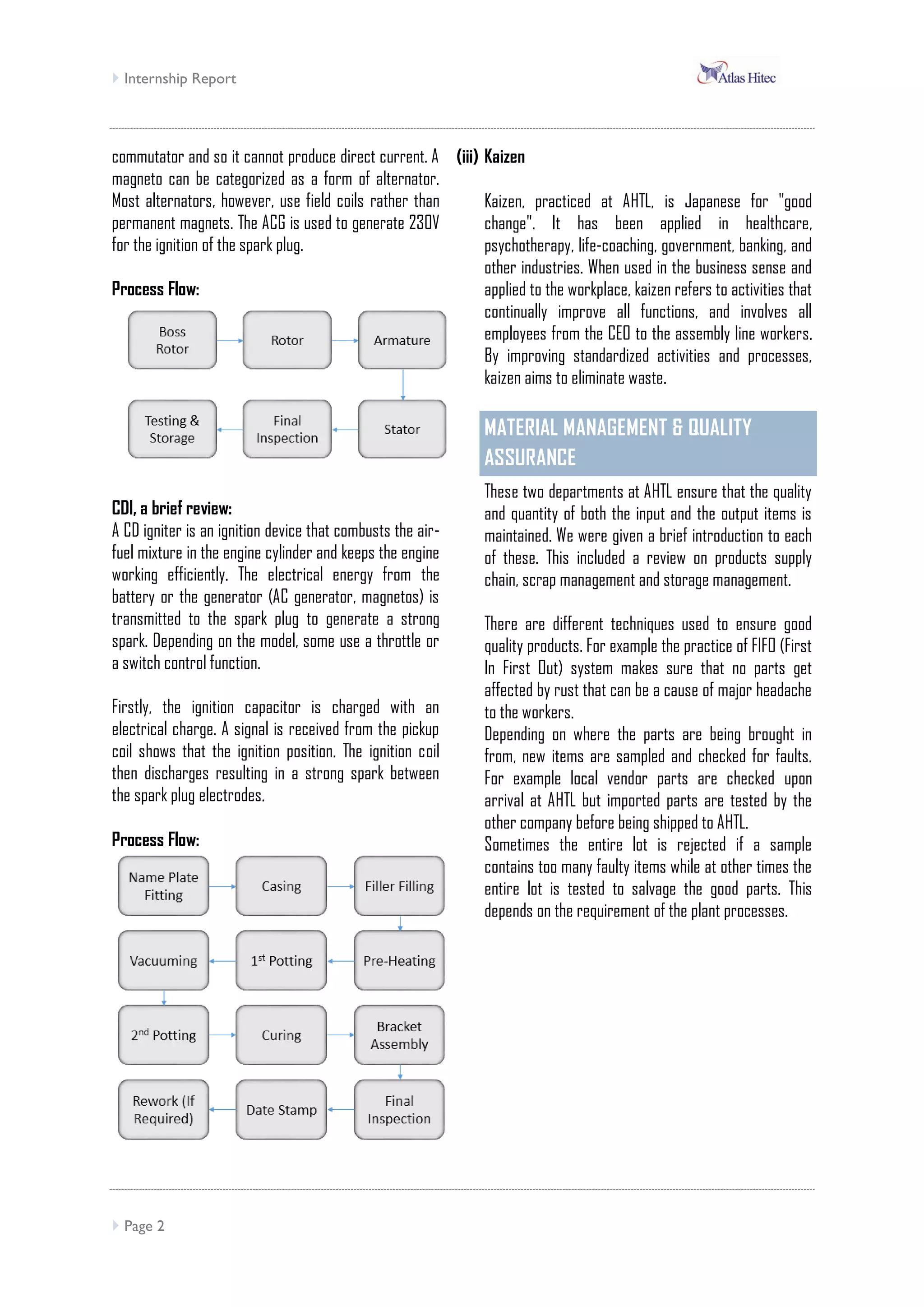
Process Flow:
CDI, a brief review:
A CD igniter is an ignition device that combusts the air-
fuel mixture in the engine cylinder and keeps the engine
working efficiently. The electrical energy from the
battery or the generator (AC generator, magnetos) is
transmitted to the spark plug to generate a strong
spark. Depending on the model, some use a throttle or
a switch control function.
Firstly, the ignition capacitor is charged with an
electrical charge. A signal is received from the pickup
coil shows that the ignition position. The ignition coil
then discharges resulting in a strong spark between
the spark plug electrodes.
Process Flow:
(iii) Kaizen
Kaizen, practiced at AHTL, is Japanese for "good
change". It has been applied in healthcare,
psychotherapy, life-coaching, government, banking, and
other industries. When used in the business sense and
applied to the workplace, kaizen refers to activities that
continually improve all functions, and involves all
employees from the CEO to the assembly line workers.
By improving standardized activities and processes,
kaizen aims to eliminate waste.
MATERIAL MANAGEMENT & QUALITY
ASSURANCE
These two departments at AHTL ensure that the quality
and quantity of both the input and the output items is
maintained. We were given a brief introduction to each
of these. This included a review on products supply
chain, scrap management and storage management.
There are different techniques used to ensure good
quality products. For example the practice of FIFO (First
In First Out) system makes sure that no parts get
affected by rust that can be a cause of major headache
to the workers.
Depending on where the parts are being brought in
from, new items are sampled and checked for faults.
For example local vendor parts are checked upon
arrival at AHTL but imported parts are tested by the
other company before being shipped to AHTL.
Sometimes the entire lot is rejected if a sample
contains too many faulty items while at other times the
entire lot is tested to salvage the good parts. This
depends on the requirement of the plant processes.
 Internship Report
 Page 3
PROCESS TRAINING
Our process training began with the ACG’s parts:
1. Boss Rotor
2. Rotor
3. Armature
4. Stator
After completion of ACG we began with the study of CDI
assembly. The process flow has been mentioned above.
 Internship Report
 Page 4
MINI PROJECT
At the end of our training each group was given a
project that would in one way or another improve the
quality of work taking place at AHTL.
The project assigned to us was to design an LED based
display that would turn on when there is a shortage of
material at a specific station. This sort of a system was
already functioning in the CDI shop but not in the ACG
lines.
Current System in ACG lines:
At present, each station is supplied with material at the
beginning of each work day. Workers assigned to each
station get to work and continue to do so until break
time arrives.
Problem arises when, at a particular station, the
material gets finished and new items do not arrive. The
worker then has to notify the concerned personnel and
then wait for the material to arrive. Precious time is
wasted in this process. Even if the worker notifies the
concerned person while there is still some material
left, he still has to stop his work and leave his station to
do so.
Solution:
The solution to this problem was to design a system
that would allow the worker to notify the concerned
person without having to physically go to that person or
call out to him. A display was to be designed such that it
would contain the number of all the stations. When
there is a shortage of material at a particular station,
the worker can press a remote switch that would cause
his station number to light up. An addition to this
system could be in the form of a buzzer. This way the
waiting period for a worker can be reduced and he
could work non-stop apart from the official break time.
For our internship, we used a microcontroller with
some other external components to design a circuit
that would allow us to replicate the task and produce
the exact same result. The following items were
required:
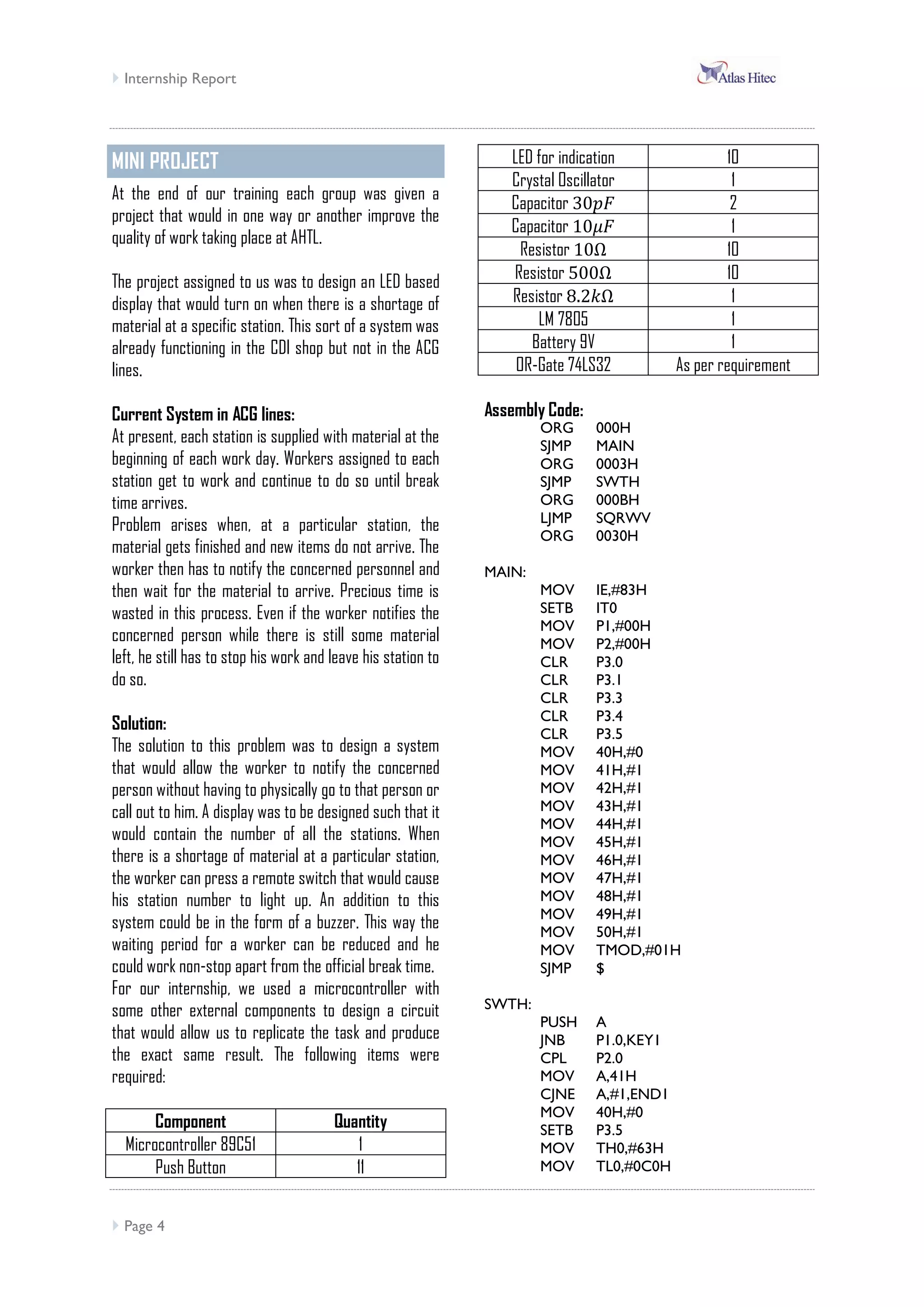
Component Quantity
Microcontroller 89C51 1
Push Button 11
LED for indication 10
Crystal Oscillator 1
Capacitor 30𝑝𝐹 2
Capacitor 10𝜇𝐹 1
Resistor 10Ω 10
Resistor 500Ω 10
Resistor 8.2𝑘Ω 1
LM 7805 1
Battery 9V 1
OR-Gate 74LS32 As per requirement
Assembly Code:
ORG 000H
SJMP MAIN
ORG 0003H
SJMP SWTH
ORG 000BH
LJMP SQRWV
ORG 0030H
MAIN:
MOV IE,#83H
SETB IT0
MOV P1,#00H
MOV P2,#00H
CLR P3.0
CLR P3.1
CLR P3.3
CLR P3.4
CLR P3.5
MOV 40H,#0
MOV 41H,#1
MOV 42H,#1
MOV 43H,#1
MOV 44H,#1
MOV 45H,#1
MOV 46H,#1
MOV 47H,#1
MOV 48H,#1
MOV 49H,#1
MOV 50H,#1
MOV TMOD,#01H
SJMP $
SWTH:
PUSH A
JNB P1.0,KEY1
CPL P2.0
MOV A,41H
CJNE A,#1,END1
MOV 40H,#0
SETB P3.5
MOV TH0,#63H
MOV TL0,#0C0H
 Internship Report
 Page 5
SETB TR0
DEC 41H
LJMP END
END1:
INC 41H
LJMP END
KEY1:
JNB P1.1,KEY2
CPL P2.1
MOV A,42H
CJNE A,#1,END2
MOV 40H,#0
SETB P3.5
MOV TH0,#63H
MOV TL0,#0C0H
SETB TR0
DEC 42H
LJMP END
END2:
INC 42H
LJMP END
KEY2:
JNB P1.2,KEY3
CPL P2.2
MOV A,43H
CJNE A,#1,END3
MOV 40H,#0
SETB P3.5
MOV TH0,#63H
MOV TL0,#0C0H
SETB TR0
DEC 43H
LJMP END
END3:
INC 43H
LJMP END
KEY3:
JNB P1.3,KEY4
CPL P2.3
MOV A,44H
CJNE A,#1,END4
MOV 40H,#0
SETB P3.5
MOV TH0,#63H
MOV TL0,#0C0H
SETB TR0
DEC 44H
LJMP END
END4:
INC 44H
LJMP END
KEY4:
JNB P1.4,KEY5
CPL P2.4
MOV A,45H
CJNE A,#1,END5
MOV 40H,#0
SETB P3.5
MOV TH0,#63H
MOV TL0,#0C0H
SETB TR0
DEC 45H
LJMP END
END5:
INC 45H
LJMP END
KEY5:
JNB P1.5,KEY6
CPL P2.5
MOV A,46H
CJNE A,#1,END6
MOV 40H,#0
SETB P3.5
MOV TH0,#63H
MOV TL0,#0C0H
SETB TR0
DEC 46H
LJMP END
END6:
INC 46H
LJMP END
KEY6:
JNB P1.6,KEY7
CPL P2.6
MOV A,47H
CJNE A,#1,END7
MOV 40H,#0
SETB P3.5
MOV TH0,#63H
MOV TL0,#0C0H
SETB TR0
DEC 47H
SJMP END
END7:
INC 47H
SJMP END
KEY7:
JNB P1.7,KEY8
CPL P2.7
MOV A,48H
CJNE A,#1,END8
MOV 40H,#0
 Internship Report
 Page 6
SETB P3.5
MOV TH0,#63H
MOV TL0,#0C0H
SETB TR0
DEC 48H
SJMP END
END8:
INC 48H
SJMP END
KEY8:
JNB P3.0,KEY9
CPL P3.3
MOV A,49H
CJNE A,#1,END9
MOV 40H,#0
SETB P3.5
MOV TH0,#63H
MOV TL0,#0C0H
SETB TR0
DEC 49H
SJMP END
END9:
INC 49H
SJMP END
KEY9:
JNB P3.1,KEY10
CPL P3.4
MOV A,50H
CJNE A,#1,END10
MOV 40H,#0
SETB P3.5
MOV TH0,#63H
MOV TL0,#0C0H
SETB TR0
DEC 50H
SJMP END
END10:
INC 50H
SJMP END
KEY10:
SJMP END
END:
POP A
RETI
SQRWV:
CLR TR0
PUSH A
MOV A,40H
CJNE A,#250,SQR1
CLR P3.5
SJMP SQR2
SQR1:
INC 40H
MOV TH0,#63H
MOV TL0,#0C0H
SETB TR0
SQR2:
POP A
RETI
 Internship Report
 Page 7
Schematic Diagram:
Project Conclusion:
This circuit is a prototype designed specifically to
generate a signal that would light up an LED as well as
turn on a buzzer. Depending on which switch is
pressed, that particular LED will light up. Pressing the
same switch would cause that specific LED to turn off.
The components used are easily available in the
market at a low price.
The circuit can be implemented with only a few minor
changes to achieve the company’s exact goals.
 Internship Report
 Page 8
RECOMMENDATIONS
For the entire duration of our internship, we observed
that all the employees focused on certain levels of
quality and maintenance. We were asked to visit the
plant often and try to find ways to improve the overall
efficiency of the plant in any possible way.
Although it was difficult to improve something that’s
already so productive and efficient, there are a few
minor changes that can be made which may result in
improvement in overall work environment.
They include:
 At the end of the rotor line where anti-rust spray is
used, a metal plate is screwed in to close the spray
container. It can be made using hinges and magnetic
lock as frequent refilling of that oil is necessary.
 There is no permanent power supply to the
maintenance/training area. Currently, extension cables
are used which has its own safety hazards. A power
socket underneath the tables can help ensure the
safety of the workers.
 A tool trolley should be used to carry the tools
wherever they are needed.
 Trolleys that carry items should have conveyers
instead of fixed surfaces which would make it easier to
transfer the items from trolley to station and vice
versa.
 The waste trolleys should have broom holders attached
with them in case some chips fall off while transporting
the waste.
 At the point where the waste trolley is attached to the
machine, a lot of chips fall off. Its height can be
increased with a window for waste input from machine.
 Kaizen gallery is not properly displayed at present. A
wall display can be made specifically for it that would
highlight how the company has improved its working
conditions in the past.

Internship Report honda

  • 1.
    INTERNSHIP REPORT 4-7-2014 to 8-8-2014 SUBMITTEDBY: Student of IU: Muhammad Hassan Students of NUST: Agha Zain Abid Asad Rehmaan M. Saadi Aziz Student of SSUET: Shaikh Babar Tanveer
  • 2.
     Internship Report Page 1 Internship Report 4-7-2014 to 8-8-2014 ABOUT THE COMPANY Atlas Hitec (Private) Limited (AHTL) is a private limited company incorporated in Pakistan on September 13, 2013. AHTL is a Joint Venture between Atlas Autos (Private) Limited, Atlas Honda Limited and Denso Corporation, Japan. AHTL is engaged in the manufacturing and sale of automotive parts and components i.e.: (i) Magnetos (ACGs) (ii) CDIs. Vision: A world class manufacturer of high quality auto parts and components at competitive prices. Mission: To be a growth oriented company seeking innovative and technological developments and producing high quality, reliable, safe and cost competitive products and meeting customers and all stakeholders satisfaction. Committed to live as a good corporate citizen fulfilling its social responsibilities in all respect. THE INTERNSHIP Our internship began on 4th of July 2014 with an introductory visit of the plant. We learnt some of the basics of the work policy and the processes involved in the assembly of Alternating Current Generator (ACG) and Capacitor Discharge Ignition (CDI). We visited the AHTL plant and observed all the machines and assembly lines briefly for both the ACG and CDI. After the plant visit we were divided into two groups and provided with a detailed internship plan. From that day on we were to spend a day in learning about 2 or 3 of the numerous processes involved in ACG and CDI assembly. Sir Zeeshan was to be our supervisor for the duration of the internship. GENERAL EDUCATION TRAINING Our in-depth training began with general education about the company’s policies, methods, products and their function. This included: (i) Atlas Culture (ii) AHTL Production Policy (iii) 5S (iv) ACG Product Education (v) CDI Product Education (vi) Standards (DWG. Process) (vii) Control Charts (viii) Safety (ix) Kaizen Of all the things mentioned above, the primary focus was on: (i) 5S This is a workplace organization method practiced at AHTL that uses a list of five Japanese words: 1. Seiri (Sort): Remove unnecessary items and dispose of them properly. 2. Seiton (Set in order): Arrange all necessary items in order so they can be easily picked for use. 3. Seiso (Sweep): Clean work place completely. 4. Seiketsu (Standardize): Maintain high standard of housekeeping and workplace organization at all times. 5. Shitsuke (Self-Discipline): Do things spontaneously. (ii) ACG and CDI Product Education ACG, a brief review: An ACG, also called a magneto, is an electrical generator that uses permanent magnets to produce alternating current. Unlike a dynamo, there is no
  • 3.
     Internship Report Page 2 commutator and so it cannot produce direct current. A magneto can be categorized as a form of alternator. Most alternators, however, use field coils rather than permanent magnets. The ACG is used to generate 230V for the ignition of the spark plug. Process Flow: CDI, a brief review: A CD igniter is an ignition device that combusts the air- fuel mixture in the engine cylinder and keeps the engine working efficiently. The electrical energy from the battery or the generator (AC generator, magnetos) is transmitted to the spark plug to generate a strong spark. Depending on the model, some use a throttle or a switch control function. Firstly, the ignition capacitor is charged with an electrical charge. A signal is received from the pickup coil shows that the ignition position. The ignition coil then discharges resulting in a strong spark between the spark plug electrodes. Process Flow: (iii) Kaizen Kaizen, practiced at AHTL, is Japanese for "good change". It has been applied in healthcare, psychotherapy, life-coaching, government, banking, and other industries. When used in the business sense and applied to the workplace, kaizen refers to activities that continually improve all functions, and involves all employees from the CEO to the assembly line workers. By improving standardized activities and processes, kaizen aims to eliminate waste. MATERIAL MANAGEMENT & QUALITY ASSURANCE These two departments at AHTL ensure that the quality and quantity of both the input and the output items is maintained. We were given a brief introduction to each of these. This included a review on products supply chain, scrap management and storage management. There are different techniques used to ensure good quality products. For example the practice of FIFO (First In First Out) system makes sure that no parts get affected by rust that can be a cause of major headache to the workers. Depending on where the parts are being brought in from, new items are sampled and checked for faults. For example local vendor parts are checked upon arrival at AHTL but imported parts are tested by the other company before being shipped to AHTL. Sometimes the entire lot is rejected if a sample contains too many faulty items while at other times the entire lot is tested to salvage the good parts. This depends on the requirement of the plant processes.
  • 4.
     Internship Report Page 3 PROCESS TRAINING Our process training began with the ACG’s parts: 1. Boss Rotor 2. Rotor 3. Armature 4. Stator After completion of ACG we began with the study of CDI assembly. The process flow has been mentioned above.
  • 5.
     Internship Report Page 4 MINI PROJECT At the end of our training each group was given a project that would in one way or another improve the quality of work taking place at AHTL. The project assigned to us was to design an LED based display that would turn on when there is a shortage of material at a specific station. This sort of a system was already functioning in the CDI shop but not in the ACG lines. Current System in ACG lines: At present, each station is supplied with material at the beginning of each work day. Workers assigned to each station get to work and continue to do so until break time arrives. Problem arises when, at a particular station, the material gets finished and new items do not arrive. The worker then has to notify the concerned personnel and then wait for the material to arrive. Precious time is wasted in this process. Even if the worker notifies the concerned person while there is still some material left, he still has to stop his work and leave his station to do so. Solution: The solution to this problem was to design a system that would allow the worker to notify the concerned person without having to physically go to that person or call out to him. A display was to be designed such that it would contain the number of all the stations. When there is a shortage of material at a particular station, the worker can press a remote switch that would cause his station number to light up. An addition to this system could be in the form of a buzzer. This way the waiting period for a worker can be reduced and he could work non-stop apart from the official break time. For our internship, we used a microcontroller with some other external components to design a circuit that would allow us to replicate the task and produce the exact same result. The following items were required: Component Quantity Microcontroller 89C51 1 Push Button 11 LED for indication 10 Crystal Oscillator 1 Capacitor 30𝑝𝐹 2 Capacitor 10𝜇𝐹 1 Resistor 10Ω 10 Resistor 500Ω 10 Resistor 8.2𝑘Ω 1 LM 7805 1 Battery 9V 1 OR-Gate 74LS32 As per requirement Assembly Code: ORG 000H SJMP MAIN ORG 0003H SJMP SWTH ORG 000BH LJMP SQRWV ORG 0030H MAIN: MOV IE,#83H SETB IT0 MOV P1,#00H MOV P2,#00H CLR P3.0 CLR P3.1 CLR P3.3 CLR P3.4 CLR P3.5 MOV 40H,#0 MOV 41H,#1 MOV 42H,#1 MOV 43H,#1 MOV 44H,#1 MOV 45H,#1 MOV 46H,#1 MOV 47H,#1 MOV 48H,#1 MOV 49H,#1 MOV 50H,#1 MOV TMOD,#01H SJMP $ SWTH: PUSH A JNB P1.0,KEY1 CPL P2.0 MOV A,41H CJNE A,#1,END1 MOV 40H,#0 SETB P3.5 MOV TH0,#63H MOV TL0,#0C0H
  • 6.
     Internship Report Page 5 SETB TR0 DEC 41H LJMP END END1: INC 41H LJMP END KEY1: JNB P1.1,KEY2 CPL P2.1 MOV A,42H CJNE A,#1,END2 MOV 40H,#0 SETB P3.5 MOV TH0,#63H MOV TL0,#0C0H SETB TR0 DEC 42H LJMP END END2: INC 42H LJMP END KEY2: JNB P1.2,KEY3 CPL P2.2 MOV A,43H CJNE A,#1,END3 MOV 40H,#0 SETB P3.5 MOV TH0,#63H MOV TL0,#0C0H SETB TR0 DEC 43H LJMP END END3: INC 43H LJMP END KEY3: JNB P1.3,KEY4 CPL P2.3 MOV A,44H CJNE A,#1,END4 MOV 40H,#0 SETB P3.5 MOV TH0,#63H MOV TL0,#0C0H SETB TR0 DEC 44H LJMP END END4: INC 44H LJMP END KEY4: JNB P1.4,KEY5 CPL P2.4 MOV A,45H CJNE A,#1,END5 MOV 40H,#0 SETB P3.5 MOV TH0,#63H MOV TL0,#0C0H SETB TR0 DEC 45H LJMP END END5: INC 45H LJMP END KEY5: JNB P1.5,KEY6 CPL P2.5 MOV A,46H CJNE A,#1,END6 MOV 40H,#0 SETB P3.5 MOV TH0,#63H MOV TL0,#0C0H SETB TR0 DEC 46H LJMP END END6: INC 46H LJMP END KEY6: JNB P1.6,KEY7 CPL P2.6 MOV A,47H CJNE A,#1,END7 MOV 40H,#0 SETB P3.5 MOV TH0,#63H MOV TL0,#0C0H SETB TR0 DEC 47H SJMP END END7: INC 47H SJMP END KEY7: JNB P1.7,KEY8 CPL P2.7 MOV A,48H CJNE A,#1,END8 MOV 40H,#0
  • 7.
     Internship Report Page 6 SETB P3.5 MOV TH0,#63H MOV TL0,#0C0H SETB TR0 DEC 48H SJMP END END8: INC 48H SJMP END KEY8: JNB P3.0,KEY9 CPL P3.3 MOV A,49H CJNE A,#1,END9 MOV 40H,#0 SETB P3.5 MOV TH0,#63H MOV TL0,#0C0H SETB TR0 DEC 49H SJMP END END9: INC 49H SJMP END KEY9: JNB P3.1,KEY10 CPL P3.4 MOV A,50H CJNE A,#1,END10 MOV 40H,#0 SETB P3.5 MOV TH0,#63H MOV TL0,#0C0H SETB TR0 DEC 50H SJMP END END10: INC 50H SJMP END KEY10: SJMP END END: POP A RETI SQRWV: CLR TR0 PUSH A MOV A,40H CJNE A,#250,SQR1 CLR P3.5 SJMP SQR2 SQR1: INC 40H MOV TH0,#63H MOV TL0,#0C0H SETB TR0 SQR2: POP A RETI
  • 8.
     Internship Report Page 7 Schematic Diagram: Project Conclusion: This circuit is a prototype designed specifically to generate a signal that would light up an LED as well as turn on a buzzer. Depending on which switch is pressed, that particular LED will light up. Pressing the same switch would cause that specific LED to turn off. The components used are easily available in the market at a low price. The circuit can be implemented with only a few minor changes to achieve the company’s exact goals.
  • 9.
     Internship Report Page 8 RECOMMENDATIONS For the entire duration of our internship, we observed that all the employees focused on certain levels of quality and maintenance. We were asked to visit the plant often and try to find ways to improve the overall efficiency of the plant in any possible way. Although it was difficult to improve something that’s already so productive and efficient, there are a few minor changes that can be made which may result in improvement in overall work environment. They include:  At the end of the rotor line where anti-rust spray is used, a metal plate is screwed in to close the spray container. It can be made using hinges and magnetic lock as frequent refilling of that oil is necessary.  There is no permanent power supply to the maintenance/training area. Currently, extension cables are used which has its own safety hazards. A power socket underneath the tables can help ensure the safety of the workers.  A tool trolley should be used to carry the tools wherever they are needed.  Trolleys that carry items should have conveyers instead of fixed surfaces which would make it easier to transfer the items from trolley to station and vice versa.  The waste trolleys should have broom holders attached with them in case some chips fall off while transporting the waste.  At the point where the waste trolley is attached to the machine, a lot of chips fall off. Its height can be increased with a window for waste input from machine.  Kaizen gallery is not properly displayed at present. A wall display can be made specifically for it that would highlight how the company has improved its working conditions in the past.