PES Institute of Technology and Management, Shivamogga
Department of Mechanical Engineering
Presentation on
INTERNSHIP CARRIED AT GOVT. TOOL ROOM &
TRAINING CENTRE
Presented by
Sagar N D 4PM19ME020
Under the Guidance of
Dr. Manjunath patel G C (Ph.D., M.Tech, B.E)
Assistant Professor
Dept. of Mechanical Engineering
PESITM, SHIVAMOGGA-577204
CNC Milling Programming & Machining
INTRODUCTION TO MILLING
• The process of milling involves the use of a rotating cutter against the work piece to
remove material.
• This may be done by varying direction on one or several axes, cutter head speed, and
pressure.
• Milling covers a wide variety of different operations and machines, on scales from small
individual parts to large, heavy-duty gang milling operations.
• It is one of the most commonly used processes for machining custom parts to precise
tolerances.
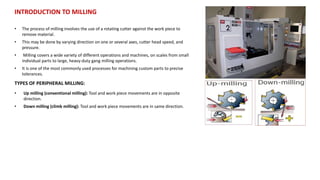
TYPES OF PERIPHERAL MILLING:
• Up milling (conventional milling): Tool and work piece movements are in opposite
direction.
• Down milling (climb milling): Tool and work piece movements are in same direction.
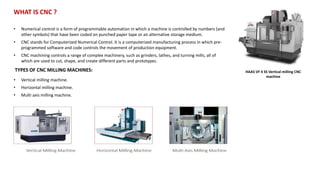
TYPES OF CNC MILLING MACHINES:
• Vertical milling machine.
• Horizontal milling machine.
• Multi axis milling machine.
WHAT IS CNC ?
• Numerical control is a form of programmable automation in which a machine is controlled by numbers (and
other symbols) that have been coded on punched paper tape or an alternative storage medium.
• CNC stands for Computerized Numerical Control. It is a computerized manufacturing process in which pre-
programmed software and code controls the movement of production equipment.
• CNC machining controls a range of complex machinery, such as grinders, lathes, and turning mills, all of
which are used to cut, shape, and create different parts and prototypes.
HAAS VF 4 SS Vertical milling CNC
machine
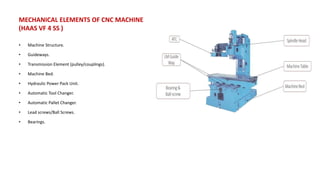
MECHANICAL ELEMENTS OF CNC MACHINE
(HAAS VF 4 SS )
• Machine Structure.
• Guideways.
• Transmission Element (pulley/couplings).
• Machine Bed.
• Hydraulic Power Pack Unit.
• Automatic Tool Changer.
• Automatic Pallet Changer.
• Lead screws/Ball Screws.
• Bearings.
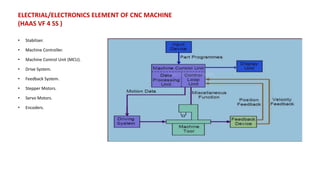
ELECTRIAL/ELECTRONICS ELEMENT OF CNC MACHINE
(HAAS VF 4 SS )
• Stabilizer.
• Machine Controller.
• Machine Control Unit (MCU).
• Drive System.
• Feedback System.
• Stepper Motors.
• Servo Motors.
• Encoders.
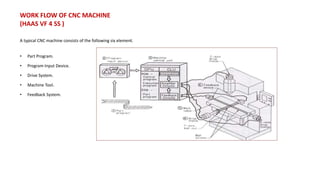
WORK FLOW OF CNC MACHINE
(HAAS VF 4 SS )
A typical CNC machine consists of the following six element.
• Part Program.
• Program Input Device.
• Drive System.
• Machine Tool.
• Feedback System.
INTRODUCTION TO CNC PROGRAMMING
(HAAS VF 4 SS )
A CNC program is a set of alpha-numerical codes which is given as input to human machine
interface of CNC machine for manufacturing.
Steps involved in CNC program:
1. PROGRAM NAME: Each program has its own name. When creating, the program
name can be freely selected, observing the following rules:
• The program O number is required, File name and file comment are
optional.
• Program O number(required for files created in memory): Enter a
program number upto 5 digits long.
• The control adds the letter O automatically. If you enter a number shorter
than 5 digits, the control adds leading zero’s to the program number to
make it 5 digits long.
• For example: if you enter 1, the control adds zero’s to make it 00001.
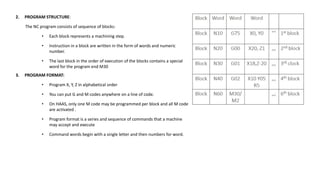
2. PROGRAM STRUCTURE:
The NC program consists of sequence of blocks:
• Each block represents a machining step.
• Instruction in a block are written in the form of words and numeric
number.
• The last block in the order of execution of the blocks contains a special
word for the program end M30
3. PROGRAM FORMAT:
• Program X, Y, Z in alphabetical order
• You can put G and M codes anywhere on a line of code.
• On HAAS, only one M code may be programmed per block and all M code
are activated .
• Program format is a series and sequence of commands that a machine
may accept and execute
• Command words begin with a single letter and then numbers for word.
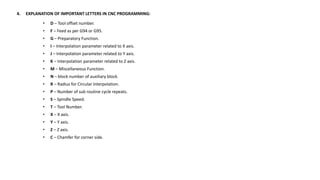
4. EXPLANATION OF IMPORTANT LETTERS IN CNC PROGRAMMING:
• D – Tool offset number.
• F – Feed as per G94 or G95.
• G – Preparatory Function.
• I – Interpolation parameter related to X axis.
• J – Interpolation parameter related to Y axis.
• K – Interpolation parameter related to Z axis.
• M – Miscellaneous Function.
• N – block number of auxiliary block.
• R – Radius for Circular Interpolation.
• P – Number of sub routine cycle repeats.
• S – Spindle Speed.
• T – Tool Number.
• X – X axis.
• Y – Y axis.
• Z – Z axis.
• C – Chamfer for corner side.
PREPARATORY (G) CODES
• G00 – Rapid positioning.
• G01 – Linear Interpolation
• G02 – Circular interpolation, clockwise
• G03 – Circular interpolation, counterclockwise
• G04 – Dwell
• G12 – Circular Pocket Milling Clockwise.
• G13 – Circular Pocket Milling Counter Clockwise.
• G17 – XY Plane Selection.
• G18 – YZ Plane Selection.
• G19 – ZX Plane Selection.
• G20 – Input in Inches.
• G21 – Input in Millimeters.
• G28 – Return to Home Position.
• G40 – Tool Radius Compensation Cancel.
• G41 – Tool Radius Compensation Left Side.
• G42 – Tool Radius Compensation right Side.
• G43 – Tool Radius Compensation Positive.
• G44 – Tool Radius Compensation Negative.
• G49 – Tool Length Compensation Cancel.
• G54 to G59 – Work coordinate systems.
• G64 – Exact Stop Cancel.
• G80 – Canned Cycle Cancel.
• G81 – Drill Canned Cancel.
• G82 – Spot Drill Canned Cancel.
• G83 – Peck Drill Canned Cancel.
• G84 – Tapped Canned Cancel.
• G90 – Absolute Dimensioning.
• G91 – Incremental Dimensioning.
• G94 – Feed in mm/min.
• G98 – Canned Cycle Initial Point Return.
• G99 – Canned Cycle “R” Plane Return.
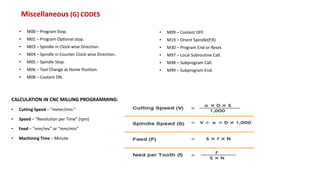
Miscellaneous (G) CODES
• M00 – Program Stop.
• M01 – Program Optional stop.
• M03 – Spindle in Clock-wise Direction.
• M04 – Spindle in Counter Clock-wise Direction.
• M05 – Spindle Stop.
• M06 – Tool Change at Home Position.
• M08 – Coolant ON.
• M09 – Coolant OFF.
• M19 – Orient Spindle(P,R)
• M30 – Program End or Reset.
• M97 – Local Subroutine Call.
• M98 – Subprogram Call.
• M99 – Subprogram End.
CALCULATION IN CNC MILLING PROGRAMMING:
• Cutting Speed – “meter/min.”
• Speed – “Revolution per Time” (rpm)
• Feed – “mm/rev” or “mm/min”
• Machining Time – Minute.
CO-ORDINATE SYSTEM
ISO machine Tool Axis definition:
• ISO machine tools mainly having 3 axes machining conditions:
• X axes which is called as longitudinal axes, Y axes is called as cross axes, Z axes which takes the tool
& work piece in contact for machining.
ISO machine tool axis
Cartesian Co-ordinates
ABSOLUTE DIMENSIONING:
• In absolute mode, the end points intended for all motions will be identified from the program zero
point.
• In this dimensioning method all positions are dimensioned from main origin.
Absolute dimensioning
Answer:
P1 X20 Y35
P2 X50 Y60
P3 X70 Y20
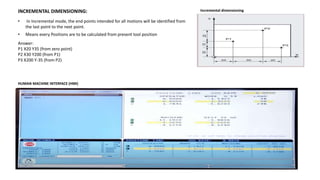
INCREMENTAL DIMENSIONING:
• In Incremental mode, the end points intended for all motions will be identified from
the last point to the next point.
• Means every Positions are to be calculated from present tool position
Incremental dimensioning
Answer:
P1 X20 Y35 (from zero point)
P2 X30 Y200 (from P1)
P3 X200 Y-35 (from P2)
HUMAN MACHINE INTERFACE (HMI)
TYPES OF CNC MILLING OPERATIONS
The main types of milling operations as seen from the effect on the
component or from a tool point of view include:
• Face Milling.
• Profile Milling.
• Circular Pocket Milling.
• Canned Cycle for drilling
FACING OPERATION:
• Face milling is a type of CNC milling process which means it involves removing portions
of material from a work piece using cutting tools.
• However, unlike conventional milling, this process involves placing the cutting tool so
that its rotating axis (or cutter axis) is perpendicular to the work piece
PROFILE MILLING OPERATION:
• Profile milling is used to rough or finish mill vertical or slanted surfaces.
• The surfaces selected must allow for a continuous tool path. The depth of the cut can
be specified using the step depth parameter
• Cutter Compensation is used to offset the center of cutter, and shift it the distance of
radius, to the specified side of program path.
CIRCULAR POCKET MILLING OPERATION:
• For a circular pocket milling, the cutter first plunges into the work piece, then moves
around to make a cut.
• G12 uses a clockwise direction and G13 uses a counterclockwise direction.
• Both G-codes use the default XY circular plane (G17) and imply the use of G42 cutter
compensation
CANNED CYCLE FOR DRILLING:
• A canned cycle is used to simplify the programming part. Once selected a canned cycle
is active until cancelled with G80.
• When active, canned cycle is executed every time an X and/or Y axis move is
programmed.
• G81 Drill Canned Cycle, this canned cycle uses the most recently commanded spindle
direction ( M03 , M04 , or M05 ).
Advantages of CNC machines:
• Machining is accurate and have very high precision.
• Time taken to perform a job is very less.
• Safe to operate.
• Number of operators required to operate a machine are
reduced.
• No possibility of human error.
• Reliable.
• Even very complex designs can also be made.
• Low maintenance required.
• They could run for all 24 hours a day
• It reduces overall production cost
• It is energy efficient
• One operator can supervise more than one machine at a time
ADVANTAGES AND DISADVANTAGES
Disadvantages of CNC machines:
• They are costly
• Trained operator is required to operate the machine
• In case of breakdown a highly skilled professional is required to
solve the problem
• Reduction in manual labor can lead to unemployment
• Its installation cost is high
Application of CNC machines:
• Metal removal industries.
• Material fabrication industries.
• For non-conventional machining industries where the
machining task is difficult to perform manually.
CONCLUSION
I have successfully studied about the CNC machine tool and their function with their codes and operation performed on these type of machine tool,
the importance of CNC milling machine.
I’d like thank Government Tool Room And Training Centre, Shivamogga for allowing me work in their training center and to acquire the knowledge
about CNC milling and machining.

internship presentation.pptx

  • 1.
    PES Institute ofTechnology and Management, Shivamogga Department of Mechanical Engineering Presentation on INTERNSHIP CARRIED AT GOVT. TOOL ROOM & TRAINING CENTRE Presented by Sagar N D 4PM19ME020 Under the Guidance of Dr. Manjunath patel G C (Ph.D., M.Tech, B.E) Assistant Professor Dept. of Mechanical Engineering PESITM, SHIVAMOGGA-577204 CNC Milling Programming & Machining
  • 2.
    INTRODUCTION TO MILLING •The process of milling involves the use of a rotating cutter against the work piece to remove material. • This may be done by varying direction on one or several axes, cutter head speed, and pressure. • Milling covers a wide variety of different operations and machines, on scales from small individual parts to large, heavy-duty gang milling operations. • It is one of the most commonly used processes for machining custom parts to precise tolerances. TYPES OF PERIPHERAL MILLING: • Up milling (conventional milling): Tool and work piece movements are in opposite direction. • Down milling (climb milling): Tool and work piece movements are in same direction.
  • 3.
    TYPES OF CNCMILLING MACHINES: • Vertical milling machine. • Horizontal milling machine. • Multi axis milling machine. WHAT IS CNC ? • Numerical control is a form of programmable automation in which a machine is controlled by numbers (and other symbols) that have been coded on punched paper tape or an alternative storage medium. • CNC stands for Computerized Numerical Control. It is a computerized manufacturing process in which pre- programmed software and code controls the movement of production equipment. • CNC machining controls a range of complex machinery, such as grinders, lathes, and turning mills, all of which are used to cut, shape, and create different parts and prototypes. HAAS VF 4 SS Vertical milling CNC machine
  • 4.
    MECHANICAL ELEMENTS OFCNC MACHINE (HAAS VF 4 SS ) • Machine Structure. • Guideways. • Transmission Element (pulley/couplings). • Machine Bed. • Hydraulic Power Pack Unit. • Automatic Tool Changer. • Automatic Pallet Changer. • Lead screws/Ball Screws. • Bearings.
  • 5.
    ELECTRIAL/ELECTRONICS ELEMENT OFCNC MACHINE (HAAS VF 4 SS ) • Stabilizer. • Machine Controller. • Machine Control Unit (MCU). • Drive System. • Feedback System. • Stepper Motors. • Servo Motors. • Encoders.
  • 6.
    WORK FLOW OFCNC MACHINE (HAAS VF 4 SS ) A typical CNC machine consists of the following six element. • Part Program. • Program Input Device. • Drive System. • Machine Tool. • Feedback System.
  • 7.
    INTRODUCTION TO CNCPROGRAMMING (HAAS VF 4 SS ) A CNC program is a set of alpha-numerical codes which is given as input to human machine interface of CNC machine for manufacturing. Steps involved in CNC program: 1. PROGRAM NAME: Each program has its own name. When creating, the program name can be freely selected, observing the following rules: • The program O number is required, File name and file comment are optional. • Program O number(required for files created in memory): Enter a program number upto 5 digits long. • The control adds the letter O automatically. If you enter a number shorter than 5 digits, the control adds leading zero’s to the program number to make it 5 digits long. • For example: if you enter 1, the control adds zero’s to make it 00001.
  • 8.
    2. PROGRAM STRUCTURE: TheNC program consists of sequence of blocks: • Each block represents a machining step. • Instruction in a block are written in the form of words and numeric number. • The last block in the order of execution of the blocks contains a special word for the program end M30 3. PROGRAM FORMAT: • Program X, Y, Z in alphabetical order • You can put G and M codes anywhere on a line of code. • On HAAS, only one M code may be programmed per block and all M code are activated . • Program format is a series and sequence of commands that a machine may accept and execute • Command words begin with a single letter and then numbers for word.
  • 9.
    4. EXPLANATION OFIMPORTANT LETTERS IN CNC PROGRAMMING: • D – Tool offset number. • F – Feed as per G94 or G95. • G – Preparatory Function. • I – Interpolation parameter related to X axis. • J – Interpolation parameter related to Y axis. • K – Interpolation parameter related to Z axis. • M – Miscellaneous Function. • N – block number of auxiliary block. • R – Radius for Circular Interpolation. • P – Number of sub routine cycle repeats. • S – Spindle Speed. • T – Tool Number. • X – X axis. • Y – Y axis. • Z – Z axis. • C – Chamfer for corner side.
  • 10.
    PREPARATORY (G) CODES •G00 – Rapid positioning. • G01 – Linear Interpolation • G02 – Circular interpolation, clockwise • G03 – Circular interpolation, counterclockwise • G04 – Dwell • G12 – Circular Pocket Milling Clockwise. • G13 – Circular Pocket Milling Counter Clockwise. • G17 – XY Plane Selection. • G18 – YZ Plane Selection. • G19 – ZX Plane Selection. • G20 – Input in Inches. • G21 – Input in Millimeters. • G28 – Return to Home Position. • G40 – Tool Radius Compensation Cancel. • G41 – Tool Radius Compensation Left Side. • G42 – Tool Radius Compensation right Side. • G43 – Tool Radius Compensation Positive. • G44 – Tool Radius Compensation Negative. • G49 – Tool Length Compensation Cancel. • G54 to G59 – Work coordinate systems. • G64 – Exact Stop Cancel. • G80 – Canned Cycle Cancel. • G81 – Drill Canned Cancel. • G82 – Spot Drill Canned Cancel. • G83 – Peck Drill Canned Cancel. • G84 – Tapped Canned Cancel. • G90 – Absolute Dimensioning. • G91 – Incremental Dimensioning. • G94 – Feed in mm/min. • G98 – Canned Cycle Initial Point Return. • G99 – Canned Cycle “R” Plane Return.
  • 11.
    Miscellaneous (G) CODES •M00 – Program Stop. • M01 – Program Optional stop. • M03 – Spindle in Clock-wise Direction. • M04 – Spindle in Counter Clock-wise Direction. • M05 – Spindle Stop. • M06 – Tool Change at Home Position. • M08 – Coolant ON. • M09 – Coolant OFF. • M19 – Orient Spindle(P,R) • M30 – Program End or Reset. • M97 – Local Subroutine Call. • M98 – Subprogram Call. • M99 – Subprogram End. CALCULATION IN CNC MILLING PROGRAMMING: • Cutting Speed – “meter/min.” • Speed – “Revolution per Time” (rpm) • Feed – “mm/rev” or “mm/min” • Machining Time – Minute.
  • 12.
    CO-ORDINATE SYSTEM ISO machineTool Axis definition: • ISO machine tools mainly having 3 axes machining conditions: • X axes which is called as longitudinal axes, Y axes is called as cross axes, Z axes which takes the tool & work piece in contact for machining. ISO machine tool axis Cartesian Co-ordinates ABSOLUTE DIMENSIONING: • In absolute mode, the end points intended for all motions will be identified from the program zero point. • In this dimensioning method all positions are dimensioned from main origin. Absolute dimensioning Answer: P1 X20 Y35 P2 X50 Y60 P3 X70 Y20
  • 13.
    INCREMENTAL DIMENSIONING: • InIncremental mode, the end points intended for all motions will be identified from the last point to the next point. • Means every Positions are to be calculated from present tool position Incremental dimensioning Answer: P1 X20 Y35 (from zero point) P2 X30 Y200 (from P1) P3 X200 Y-35 (from P2) HUMAN MACHINE INTERFACE (HMI)
  • 14.
    TYPES OF CNCMILLING OPERATIONS The main types of milling operations as seen from the effect on the component or from a tool point of view include: • Face Milling. • Profile Milling. • Circular Pocket Milling. • Canned Cycle for drilling FACING OPERATION: • Face milling is a type of CNC milling process which means it involves removing portions of material from a work piece using cutting tools. • However, unlike conventional milling, this process involves placing the cutting tool so that its rotating axis (or cutter axis) is perpendicular to the work piece PROFILE MILLING OPERATION: • Profile milling is used to rough or finish mill vertical or slanted surfaces. • The surfaces selected must allow for a continuous tool path. The depth of the cut can be specified using the step depth parameter • Cutter Compensation is used to offset the center of cutter, and shift it the distance of radius, to the specified side of program path.
  • 15.
    CIRCULAR POCKET MILLINGOPERATION: • For a circular pocket milling, the cutter first plunges into the work piece, then moves around to make a cut. • G12 uses a clockwise direction and G13 uses a counterclockwise direction. • Both G-codes use the default XY circular plane (G17) and imply the use of G42 cutter compensation CANNED CYCLE FOR DRILLING: • A canned cycle is used to simplify the programming part. Once selected a canned cycle is active until cancelled with G80. • When active, canned cycle is executed every time an X and/or Y axis move is programmed. • G81 Drill Canned Cycle, this canned cycle uses the most recently commanded spindle direction ( M03 , M04 , or M05 ).
  • 16.
    Advantages of CNCmachines: • Machining is accurate and have very high precision. • Time taken to perform a job is very less. • Safe to operate. • Number of operators required to operate a machine are reduced. • No possibility of human error. • Reliable. • Even very complex designs can also be made. • Low maintenance required. • They could run for all 24 hours a day • It reduces overall production cost • It is energy efficient • One operator can supervise more than one machine at a time ADVANTAGES AND DISADVANTAGES Disadvantages of CNC machines: • They are costly • Trained operator is required to operate the machine • In case of breakdown a highly skilled professional is required to solve the problem • Reduction in manual labor can lead to unemployment • Its installation cost is high Application of CNC machines: • Metal removal industries. • Material fabrication industries. • For non-conventional machining industries where the machining task is difficult to perform manually.
  • 17.
    CONCLUSION I have successfullystudied about the CNC machine tool and their function with their codes and operation performed on these type of machine tool, the importance of CNC milling machine. I’d like thank Government Tool Room And Training Centre, Shivamogga for allowing me work in their training center and to acquire the knowledge about CNC milling and machining.