Jnana Sangama, Belgaum-59018
A presentation on internship carried out at,
CENTRE FOR SYSTEM DESIGN (CSD), NITK Surathkal
Presented by,
JERIEL SEAN
4JK20ME009
Under the guidance of
Internal Guide
Dr. Sreejith B. K.
Associate Professor
Dept. of ME,AJIET
External Guide
DR. K. V. GANGADHARAN
Co-Ordinator
CSD,NITK
Department Of Mechanical Engineering
A J INSTITUTE OF ENGINEERING AND TECHNOLOGY
MANGALURU-575006
1
VISVESVARAYA TECHNOLOGICALUNIVERSITY
Contents
• Introduction
• Task Performed
• Reflection
• Conclusion
• Reference
Dept of Mechanical Engineering 2
Introduction
COMPANY PROFILE
Dept of Mechanical Engineering 3
Name Centre for System Design (CSD)
Address 2Q6V+9XX, NITK Rd, Srinivas Nagar, Surathkal, Mangalore, Karnataka
575025
Contact Number 0824 247 3915
Email csd@nitk.edu.in
Website https://csd.nitk.ac.in/
About the Company
Dept of Mechanical Engineering 4
• Centre for System Design - a centre of excellence at NITK
Surathkal provides an interdisciplinary approach and means to
enable the realization of successful engineering systems.
• It is a key component for realizing a successful engineering system
is system modeling & simulation, understanding system dynamics,
system optimization, virtual and physical experimentation.
• The Centre aims at facilitating and providing required environment
and facilities for all the key components of system design.
Fig.1: Working area of CSD
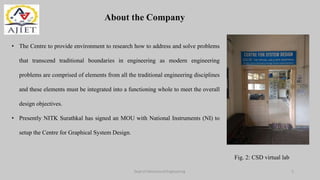
Fig. 2: CSD virtual lab
• The Centre to provide environment to research how to address and solve problems
that transcend traditional boundaries in engineering as modern engineering
problems are comprised of elements from all the traditional engineering disciplines
and these elements must be integrated into a functioning whole to meet the overall
design objectives.
• Presently NITK Surathkal has signed an MOU with National Instruments (NI) to
setup the Centre for Graphical System Design.
Dept of Mechanical Engineering 5
About the Company
Task Performed
Week One
Dept of Mechanical Engineering
6
Introduction to solid works:
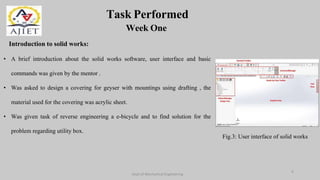
• A brief introduction about the solid works software, user interface and basic
commands was given by the mentor .
• Was asked to design a covering for geyser with mountings using drafting , the
material used for the covering was acrylic sheet.
• Was given task of reverse engineering a e-bicycle and to find solution for the
problem regarding utility box.
Fig.3: User interface of solid works
Dept of Mechanical Engineering
Workshop on introduction to virtual labs & experimental learning:
• Attended a workshop on “Virtual Labs and Experimental
learning” which is an Initiative of Ministry of Education (MoE)
under the National mission of Education through ICT held on
18/08/2023.
• Virtual Labs enable the students to learn at their own pace and
enthuse them to conduct experiments.
• Virtual Labs also provide a complete learning management
system where the students can avail various tools for learning,
including additional web resources, video lectures, animated
demonstration, and self-evaluation.
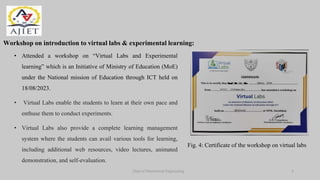
Fig. 4: Certificate of the workshop on virtual labs
7
Gathering of the required data:
Dept of Mechanical Engineering
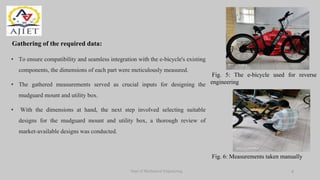
Fig. 5: The e-bicycle used for reverse
engineering
• To ensure compatibility and seamless integration with the e-bicycle's existing
components, the dimensions of each part were meticulously measured.
• The gathered measurements served as crucial inputs for designing the
mudguard mount and utility box.
• With the dimensions at hand, the next step involved selecting suitable
designs for the mudguard mount and utility box, a thorough review of
market-available designs was conducted.
8
Fig. 6: Measurements taken manually
Week Two
Dept of Mechanical Engineering 9
Design of the frame:
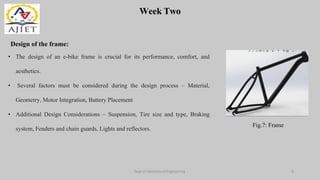
Fig.7: Frame
• The design of an e-bike frame is crucial for its performance, comfort, and
aesthetics.
• Several factors must be considered during the design process – Material,
Geometry, Motor Integration, Battery Placement
• Additional Design Considerations – Suspension, Tire size and type, Braking
system, Fenders and chain guards, Lights and reflectors.
Dept of Mechanical Engineering
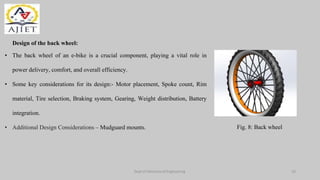
Fig. 8: Back wheel
• The back wheel of an e-bike is a crucial component, playing a vital role in
power delivery, comfort, and overall efficiency.
• Some key considerations for its design:- Motor placement, Spoke count, Rim
material, Tire selection, Braking system, Gearing, Weight distribution, Battery
integration.
• Additional Design Considerations – Mudguard mounts.
10
Design of the back wheel:
Dept of Mechanical Engineering
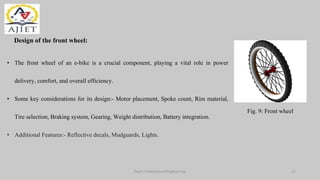
Design of the front wheel:
• The front wheel of an e-bike is a crucial component, playing a vital role in power
delivery, comfort, and overall efficiency.
• Some key considerations for its design:- Motor placement, Spoke count, Rim material,
Tire selection, Braking system, Gearing, Weight distribution, Battery integration.
• Additional Features:- Reflective decals, Mudguards, Lights.
Fig. 9: Front wheel
11
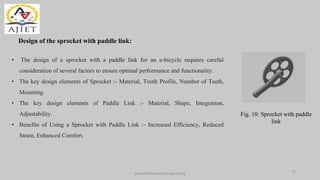
Design of the sprocket with paddle link:
Dept of Mechanical Engineering
• The design of a sprocket with a paddle link for an e-bicycle requires careful
consideration of several factors to ensure optimal performance and functionality.
• The key design elements of Sprocket :- Material, Tooth Profile, Number of Teeth,
Mounting.
• The key design elements of Paddle Link :- Material, Shape, Integration,
Adjustability.
• Benefits of Using a Sprocket with Paddle Link :- Increased Efficiency, Reduced
Strain, Enhanced Comfort.
Fig. 10: Sprocket with paddle
link
12
Week Three
Dept of Mechanical Engineering 13
Design of the locking pin:
• The locking pin plays a critical role in securing an e-bike, preventing
unauthorized removal of the battery or other critical components. Its design
needs to be robust, secure, and user-friendly.
• Some key considerations: - Materials, Locking mechanism, Mounting.
• The ideal design will strike a balance between security, convenience, and
aesthetics. It should be tailored to the specific needs of the e-bike and its
owner.
Fig.11: Locking pin
Dept of Mechanical Engineering
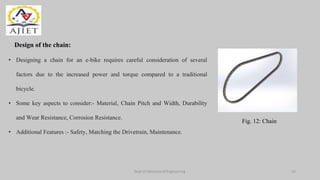
Design of the chain:
Fig. 12: Chain
• Designing a chain for an e-bike requires careful consideration of several
factors due to the increased power and torque compared to a traditional
bicycle.
• Some key aspects to consider:- Material, Chain Pitch and Width, Durability
and Wear Resistance, Corrosion Resistance.
• Additional Features :- Safety, Matching the Drivetrain, Maintenance.
14
Dept of Mechanical Engineering
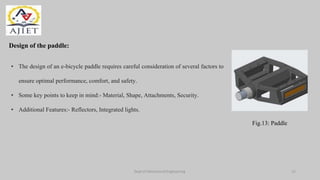
Design of the paddle:
Fig.13: Paddle
• The design of an e-bicycle paddle requires careful consideration of several factors to
ensure optimal performance, comfort, and safety.
• Some key points to keep in mind:- Material, Shape, Attachments, Security.
• Additional Features:- Reflectors, Integrated lights.
15
Dept of Mechanical Engineering
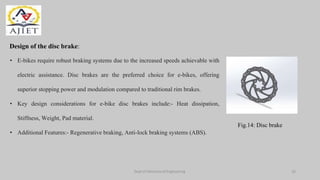
Design of the disc brake:
• E-bikes require robust braking systems due to the increased speeds achievable with
electric assistance. Disc brakes are the preferred choice for e-bikes, offering
superior stopping power and modulation compared to traditional rim brakes.
• Key design considerations for e-bike disc brakes include:- Heat dissipation,
Stiffness, Weight, Pad material.
• Additional Features:- Regenerative braking, Anti-lock braking systems (ABS).
Fig.14: Disc brake
16
Week Four
Dept of Mechanical Engineering 17
Design of the brake caliper:
• The brake caliper plays a vital role in the safety and performance of an e-bike.
Unlike traditional bicycles, e-bikes often boast higher speeds and greater
weight due to the electric motor and battery.
• This necessitates a well-designed brake caliper that can provide exceptional
stopping power, accurate control, and efficient heat dissipation.
• Several factors are crucial in designing a brake caliper for e-bikes:- Caliper
Type, Material, Piston Size, Rotor Compatibility, Pad Material, Weight.
Fig.15: Brake caliper
Dept of Mechanical Engineering
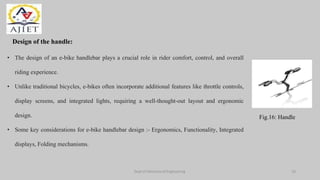
Design of the handle:
• The design of an e-bike handlebar plays a crucial role in rider comfort, control, and overall
riding experience.
• Unlike traditional bicycles, e-bikes often incorporate additional features like throttle controls,
display screens, and integrated lights, requiring a well-thought-out layout and ergonomic
design.
• Some key considerations for e-bike handlebar design :- Ergonomics, Functionality, Integrated
displays, Folding mechanisms.
Fig.16: Handle
18
Dept of Mechanical Engineering
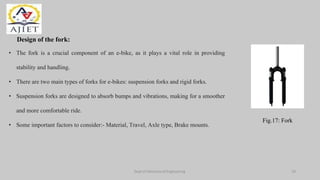
Design of the fork:
• The fork is a crucial component of an e-bike, as it plays a vital role in providing
stability and handling.
• There are two main types of forks for e-bikes: suspension forks and rigid forks.
• Suspension forks are designed to absorb bumps and vibrations, making for a smoother
and more comfortable ride.
• Some important factors to consider:- Material, Travel, Axle type, Brake mounts.
Fig.17: Fork
19
Dept of Mechanical Engineering
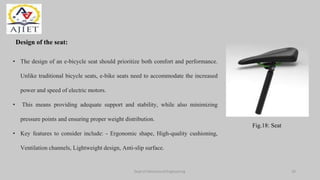
Design of the seat:
• The design of an e-bicycle seat should prioritize both comfort and performance.
Unlike traditional bicycle seats, e-bike seats need to accommodate the increased
power and speed of electric motors.
• This means providing adequate support and stability, while also minimizing
pressure points and ensuring proper weight distribution.
• Key features to consider include: - Ergonomic shape, High-quality cushioning,
Ventilation channels, Lightweight design, Anti-slip surface.
Fig.18: Seat
20
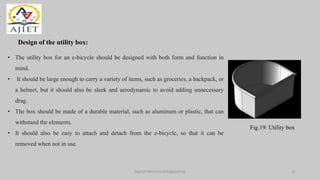
Design of the utility box:
• The utility box for an e-bicycle should be designed with both form and function in
mind.
• It should be large enough to carry a variety of items, such as groceries, a backpack, or
a helmet, but it should also be sleek and aerodynamic to avoid adding unnecessary
drag.
• The box should be made of a durable material, such as aluminum or plastic, that can
withstand the elements.
• It should also be easy to attach and detach from the e-bicycle, so that it can be
removed when not in use.
Fig.19: Utility box
Dept of Mechanical Engineering 21
Reflection
Dept of Mechanical Engineering 22
The internship assisted with career development by providing real work experience that provide students with opportunities
to explore their interests and develop professional skills and competencies. During my internship experience with CSD
NITK, I was able to reverse engineer the existing e-bicycle and find solution to the problem faced with the mudguard, also
designed a utility box. The internship opportunity has helped me to understand and learn the following aspects:
 Navigate through the user interface of Solid works.
 Understand design process in Solid works.
 Design mechanical parts using solid modeling tools.
 Create mechanical assemblies.
 Collaborate with other members of the project and manage the data in the cloud.
 Managing Time and Prioritizing Tasks.
 Create drawings and renderings.
Conclusion
Dept of Mechanical Engineering 23
• The process of reverse engineering an e-bicycle in SolidWorks has proven to be a valuable learning experience. It has
provided a deeper understanding of the design and functionality of the e-bicycle, while also offering insights into the
manufacturing process.
• The use of SolidWorks software has been instrumental in this project. Its powerful 3D modeling tools have allowed for
the creation of detailed and realistic models of the e-bicycle components.
• Overall, this project has been a success, demonstrating the effectiveness of using SolidWorks for reverse engineering
purposes.
• This project has also opened up the possibility for further research and development, paving the way for future projects in
the field of e-bicycle design and engineering.

References
Dept of Mechanical Engineering 24
1. https://csd.nitk.ac.in
2. https://grabcad.com
3. https://solidworks.com
Dept of Mechanical Engineering 25
Certificate
Dept of Mechanical Engineering 26
THANK YOU!

Internship presentation on solid works model

  • 1.
    Jnana Sangama, Belgaum-59018 Apresentation on internship carried out at, CENTRE FOR SYSTEM DESIGN (CSD), NITK Surathkal Presented by, JERIEL SEAN 4JK20ME009 Under the guidance of Internal Guide Dr. Sreejith B. K. Associate Professor Dept. of ME,AJIET External Guide DR. K. V. GANGADHARAN Co-Ordinator CSD,NITK Department Of Mechanical Engineering A J INSTITUTE OF ENGINEERING AND TECHNOLOGY MANGALURU-575006 1 VISVESVARAYA TECHNOLOGICALUNIVERSITY
  • 2.
    Contents • Introduction • TaskPerformed • Reflection • Conclusion • Reference Dept of Mechanical Engineering 2
  • 3.
    Introduction COMPANY PROFILE Dept ofMechanical Engineering 3 Name Centre for System Design (CSD) Address 2Q6V+9XX, NITK Rd, Srinivas Nagar, Surathkal, Mangalore, Karnataka 575025 Contact Number 0824 247 3915 Email csd@nitk.edu.in Website https://csd.nitk.ac.in/
  • 4.
    About the Company Deptof Mechanical Engineering 4 • Centre for System Design - a centre of excellence at NITK Surathkal provides an interdisciplinary approach and means to enable the realization of successful engineering systems. • It is a key component for realizing a successful engineering system is system modeling & simulation, understanding system dynamics, system optimization, virtual and physical experimentation. • The Centre aims at facilitating and providing required environment and facilities for all the key components of system design. Fig.1: Working area of CSD
  • 5.
    Fig. 2: CSDvirtual lab • The Centre to provide environment to research how to address and solve problems that transcend traditional boundaries in engineering as modern engineering problems are comprised of elements from all the traditional engineering disciplines and these elements must be integrated into a functioning whole to meet the overall design objectives. • Presently NITK Surathkal has signed an MOU with National Instruments (NI) to setup the Centre for Graphical System Design. Dept of Mechanical Engineering 5 About the Company
  • 6.
    Task Performed Week One Deptof Mechanical Engineering 6 Introduction to solid works: • A brief introduction about the solid works software, user interface and basic commands was given by the mentor . • Was asked to design a covering for geyser with mountings using drafting , the material used for the covering was acrylic sheet. • Was given task of reverse engineering a e-bicycle and to find solution for the problem regarding utility box. Fig.3: User interface of solid works
  • 7.
    Dept of MechanicalEngineering Workshop on introduction to virtual labs & experimental learning: • Attended a workshop on “Virtual Labs and Experimental learning” which is an Initiative of Ministry of Education (MoE) under the National mission of Education through ICT held on 18/08/2023. • Virtual Labs enable the students to learn at their own pace and enthuse them to conduct experiments. • Virtual Labs also provide a complete learning management system where the students can avail various tools for learning, including additional web resources, video lectures, animated demonstration, and self-evaluation. Fig. 4: Certificate of the workshop on virtual labs 7
  • 8.
    Gathering of therequired data: Dept of Mechanical Engineering Fig. 5: The e-bicycle used for reverse engineering • To ensure compatibility and seamless integration with the e-bicycle's existing components, the dimensions of each part were meticulously measured. • The gathered measurements served as crucial inputs for designing the mudguard mount and utility box. • With the dimensions at hand, the next step involved selecting suitable designs for the mudguard mount and utility box, a thorough review of market-available designs was conducted. 8 Fig. 6: Measurements taken manually
  • 9.
    Week Two Dept ofMechanical Engineering 9 Design of the frame: Fig.7: Frame • The design of an e-bike frame is crucial for its performance, comfort, and aesthetics. • Several factors must be considered during the design process – Material, Geometry, Motor Integration, Battery Placement • Additional Design Considerations – Suspension, Tire size and type, Braking system, Fenders and chain guards, Lights and reflectors.
  • 10.
    Dept of MechanicalEngineering Fig. 8: Back wheel • The back wheel of an e-bike is a crucial component, playing a vital role in power delivery, comfort, and overall efficiency. • Some key considerations for its design:- Motor placement, Spoke count, Rim material, Tire selection, Braking system, Gearing, Weight distribution, Battery integration. • Additional Design Considerations – Mudguard mounts. 10 Design of the back wheel:
  • 11.
    Dept of MechanicalEngineering Design of the front wheel: • The front wheel of an e-bike is a crucial component, playing a vital role in power delivery, comfort, and overall efficiency. • Some key considerations for its design:- Motor placement, Spoke count, Rim material, Tire selection, Braking system, Gearing, Weight distribution, Battery integration. • Additional Features:- Reflective decals, Mudguards, Lights. Fig. 9: Front wheel 11
  • 12.
    Design of thesprocket with paddle link: Dept of Mechanical Engineering • The design of a sprocket with a paddle link for an e-bicycle requires careful consideration of several factors to ensure optimal performance and functionality. • The key design elements of Sprocket :- Material, Tooth Profile, Number of Teeth, Mounting. • The key design elements of Paddle Link :- Material, Shape, Integration, Adjustability. • Benefits of Using a Sprocket with Paddle Link :- Increased Efficiency, Reduced Strain, Enhanced Comfort. Fig. 10: Sprocket with paddle link 12
  • 13.
    Week Three Dept ofMechanical Engineering 13 Design of the locking pin: • The locking pin plays a critical role in securing an e-bike, preventing unauthorized removal of the battery or other critical components. Its design needs to be robust, secure, and user-friendly. • Some key considerations: - Materials, Locking mechanism, Mounting. • The ideal design will strike a balance between security, convenience, and aesthetics. It should be tailored to the specific needs of the e-bike and its owner. Fig.11: Locking pin
  • 14.
    Dept of MechanicalEngineering Design of the chain: Fig. 12: Chain • Designing a chain for an e-bike requires careful consideration of several factors due to the increased power and torque compared to a traditional bicycle. • Some key aspects to consider:- Material, Chain Pitch and Width, Durability and Wear Resistance, Corrosion Resistance. • Additional Features :- Safety, Matching the Drivetrain, Maintenance. 14
  • 15.
    Dept of MechanicalEngineering Design of the paddle: Fig.13: Paddle • The design of an e-bicycle paddle requires careful consideration of several factors to ensure optimal performance, comfort, and safety. • Some key points to keep in mind:- Material, Shape, Attachments, Security. • Additional Features:- Reflectors, Integrated lights. 15
  • 16.
    Dept of MechanicalEngineering Design of the disc brake: • E-bikes require robust braking systems due to the increased speeds achievable with electric assistance. Disc brakes are the preferred choice for e-bikes, offering superior stopping power and modulation compared to traditional rim brakes. • Key design considerations for e-bike disc brakes include:- Heat dissipation, Stiffness, Weight, Pad material. • Additional Features:- Regenerative braking, Anti-lock braking systems (ABS). Fig.14: Disc brake 16
  • 17.
    Week Four Dept ofMechanical Engineering 17 Design of the brake caliper: • The brake caliper plays a vital role in the safety and performance of an e-bike. Unlike traditional bicycles, e-bikes often boast higher speeds and greater weight due to the electric motor and battery. • This necessitates a well-designed brake caliper that can provide exceptional stopping power, accurate control, and efficient heat dissipation. • Several factors are crucial in designing a brake caliper for e-bikes:- Caliper Type, Material, Piston Size, Rotor Compatibility, Pad Material, Weight. Fig.15: Brake caliper
  • 18.
    Dept of MechanicalEngineering Design of the handle: • The design of an e-bike handlebar plays a crucial role in rider comfort, control, and overall riding experience. • Unlike traditional bicycles, e-bikes often incorporate additional features like throttle controls, display screens, and integrated lights, requiring a well-thought-out layout and ergonomic design. • Some key considerations for e-bike handlebar design :- Ergonomics, Functionality, Integrated displays, Folding mechanisms. Fig.16: Handle 18
  • 19.
    Dept of MechanicalEngineering Design of the fork: • The fork is a crucial component of an e-bike, as it plays a vital role in providing stability and handling. • There are two main types of forks for e-bikes: suspension forks and rigid forks. • Suspension forks are designed to absorb bumps and vibrations, making for a smoother and more comfortable ride. • Some important factors to consider:- Material, Travel, Axle type, Brake mounts. Fig.17: Fork 19
  • 20.
    Dept of MechanicalEngineering Design of the seat: • The design of an e-bicycle seat should prioritize both comfort and performance. Unlike traditional bicycle seats, e-bike seats need to accommodate the increased power and speed of electric motors. • This means providing adequate support and stability, while also minimizing pressure points and ensuring proper weight distribution. • Key features to consider include: - Ergonomic shape, High-quality cushioning, Ventilation channels, Lightweight design, Anti-slip surface. Fig.18: Seat 20
  • 21.
    Design of theutility box: • The utility box for an e-bicycle should be designed with both form and function in mind. • It should be large enough to carry a variety of items, such as groceries, a backpack, or a helmet, but it should also be sleek and aerodynamic to avoid adding unnecessary drag. • The box should be made of a durable material, such as aluminum or plastic, that can withstand the elements. • It should also be easy to attach and detach from the e-bicycle, so that it can be removed when not in use. Fig.19: Utility box Dept of Mechanical Engineering 21
  • 22.
    Reflection Dept of MechanicalEngineering 22 The internship assisted with career development by providing real work experience that provide students with opportunities to explore their interests and develop professional skills and competencies. During my internship experience with CSD NITK, I was able to reverse engineer the existing e-bicycle and find solution to the problem faced with the mudguard, also designed a utility box. The internship opportunity has helped me to understand and learn the following aspects:  Navigate through the user interface of Solid works.  Understand design process in Solid works.  Design mechanical parts using solid modeling tools.  Create mechanical assemblies.  Collaborate with other members of the project and manage the data in the cloud.  Managing Time and Prioritizing Tasks.  Create drawings and renderings.
  • 23.
    Conclusion Dept of MechanicalEngineering 23 • The process of reverse engineering an e-bicycle in SolidWorks has proven to be a valuable learning experience. It has provided a deeper understanding of the design and functionality of the e-bicycle, while also offering insights into the manufacturing process. • The use of SolidWorks software has been instrumental in this project. Its powerful 3D modeling tools have allowed for the creation of detailed and realistic models of the e-bicycle components. • Overall, this project has been a success, demonstrating the effectiveness of using SolidWorks for reverse engineering purposes. • This project has also opened up the possibility for further research and development, paving the way for future projects in the field of e-bicycle design and engineering.
  • 24.
    References Dept of MechanicalEngineering 24 1. https://csd.nitk.ac.in 2. https://grabcad.com 3. https://solidworks.com
  • 25.
    Dept of MechanicalEngineering 25 Certificate
  • 26.
    Dept of MechanicalEngineering 26 THANK YOU!