N A T A L I A C A R O L I N A G O N Z A L E Z V A R E L A
Pediatric Internship
Introduction
 As a Health Science student, I am required to
complete 180 hours of internship experience at a
medical facility approved by my internship
coordinator. To contrast my geriatric background, I
chose to intern at a pediatric office in the spring
semester of 2016. This PowerPoint is a narration of
my four-month experience.
Clemson-Seneca Pediatrics
 Located at 207 Main St.,
Seneca Pediatrics (will
soon be moving to new
location)
 Multi-physician, multi-
office pediatric group
focused on preventive care
 Areas of specialty include
food/environmental
allergies, ADHD/ADHD,
special needs/learning
disabilities, newborn care,
breastfeeding support,
asthma, obesity and
nutrition
Services
Here is a general
overview of the services
provided at Clemson-
Seneca Pediatrics.
 Health Maintenance
 Newborn and well-baby care
 Complete physical exams and immunizations
 School and sports physicals
 Nutritional counseling (obesity cholesterol, eating
disorders)
 Adolescent medicine (adolescent girls who prefer a
female provider may see one of their choice)
 Acute Care
 Colds, flu, sore throats ear infections
 Bronchitis, croup, laryngitis, pneumonia
 Emergency Care
 Minor lacerations, strains, burns
 Chronic Medical Care
 Allergies and asthma
 Attention deficit disorder (ADD) and learning
disabilities
 Skin care: acne, rashes, eczema
GHS: Mission, Vision, Values
 Clemson-Seneca Pediatrics was adopted by the
Greenville Health System
 Greenville Health System (GHS) is a public not-for-profit
academic healthcare delivery system committed to
medical excellence through clinical care, education and
research. The organization is governed by a volunteer
board made up of 14 members
 Our Mission: Heal compassionately. Teach innovatively. Improve
constantly
 Our Vision: Transform health care for the benefit of the people and
communities we serve
 Our Values: Together we serve with integrity, respect, trust and
openness
Responsibilities
 My daily responsibilities varied, mostly depending
on the cases seen that day and availability of the
staff. The following pictures demonstrate the most
common tasks I had during my internship.
Urinalysis
• Urinalyses are
normally performed if
the patient has
urinary complaints,
back/side pain, or
annual well-checks .
• After working up the
patient, I would ask
him/her to wipe the
area with an
obstetrical towelette
and collect the urine. I
would then dip the
urine stick into the
specimen, and after
two minutes, interpret
the results . These
results would then be
recorded manually
and electronically.
Streptococcus
Test
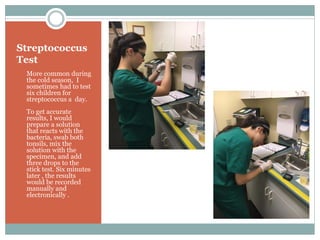
• More common during
the cold season, I
sometimes had to test
six children for
streptococcus a day.
• To get accurate
results, I would
prepare a solution
that reacts with the
bacteria, swab both
tonsils, mix the
solution with the
specimen, and add
three drops to the
stick test. Six minutes
later , the results
would be recorded
manually and
electronically .
Flu (A and B)
Test
Also common during
the colder months,
children who presented
flu-like signs and
symptoms were
swabbed upon arrival.
A small, brush-like
swab was inserted into
both nostrils and the
specimen was dipped
into a solution that
would react with the
virus. After ten
minutes, results were
read and recorded both
electronically and
manually.
Culture
Examination
After administering the
strep test, if the results
were negative but the
doctor suspected a
positive result, he or
she could ask for the
specimen to be cultured
and sent to the
laboratory. After a few
days, the specimen
would be returned and
if there was noticeable
bacterial presence, I
would notify the
pediatrician for further
confirmation.
Hemoglobin
Test
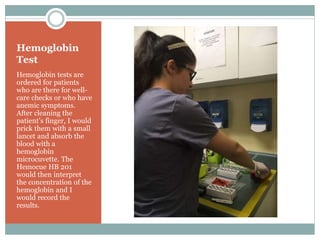
Hemoglobin tests are
ordered for patients
who are there for well-
care checks or who have
anemic symptoms.
After cleaning the
patient’s finger, I would
prick them with a small
lancet and absorb the
blood with a
hemoglobin
microcuvette. The
Hemocue HB 201
would then interpret
the concentration of the
hemoglobin and I
would record the
results.
Vaccine
Preparation
• My CNA certification
could allow me to
vaccinate patients in
some states, however,
this is not permitted
in South Carolina.
• My only duties
involving vaccines
include d taking the
medication out of the
appropriate fridge
(private insurance or
Medicaid) and
preparing the shots
for the nurse to
administer them.
Work-Up
My favorite task, working-up a
patient requires patience and
acute listening skills. My
responsibilities included
calling back the patient,
obtaining vital signs (weight,
height, blood pressure,
temperature, and oxygen
saturation), asking follow-up
questions regarding the main
medical concern, and ordering
the necessary tests. After
taking the patient to the
examination room, I would
then clean up the work-up
area and submit the acquired
information . The number of
patients varied, but the
average number of work-ups
I performed were 12 per day.
Sanitizing
Rooms
I took it upon myself to
ensure that all the
rooms were properly
sanitized and stocked
during my four months
there. I would spray the
rooms, the waiting
room, and the work-up
room with disinfectant
spray before opening
time, during lunch
break, and after the last
appointment of the day.
This decreased the risk
of nosocomial
infections affecting
other patients.
Vanderbilt
Scoring
 Implemented by the National Institute
for Children's Health Quality
(NICHQ), it is used by pediatricians to
diagnose ADHD in children between the
ages of 6 and 12
 Can also be used to screen for co-
morbidities: oppositional-defiant
disorder, conduct disorder, and
anxiety/depression
 Patients coming to begin treatment or for
a follow-up are required to have a parent
and teacher complete this form. My
responsibilities included scoring both
forms before working up the patient and
asking about the behavior or efficiency of
the medication.
Inventorying
Vaccines
There are two fridges in
the building: the first
fridge is for the private
insurance patients,
while the second fridge
is for the Medicaid-
insured patients. I had
to take inventory of
both fridges every
month, annotating
dosages, expiration
dates, and lot numbers.
Projects
 As part of the course, interns were required to
complete projects they believed could help the
internship site and further their understanding of
their role in public health. The following slides
contain my six favorite projects or contributions to
Clemson-Seneca Pediatrics.
Book Drive
The average waiting
period at Clemson-
Seneca Pediatrics
ranges from 1 hour to
1.5 hours. Younger
children can become
uneasy during this time
and are often given
electronics as a form of
distraction. I decided to
provide 3 new books to
each of the seven rooms
to instill the love for
books at a young age,
thus promoting child
literacy.
Flyers
Under my Planning
Goal, I set out to
complete four
educational flyers
covering common
diseases that affect
young children. Using
health literacy skills, I
designed the
information to be
concise and relevant,
hoping this would
engage the reader and
provoke some change.
Door
Decorating
Younger children often
remember their
previous visits to the
pediatrician. These
memories often result
problematic when
measuring their weight
and height since they
become uneasy, so I
decided decorating the
door could provide
some comfort or
distraction as we
measured their vitals.
Medical
Supplies
Cabinet
Located at the nurse’s
station, this seven-
leveled cabinet stores
supplies that are often
distributed to the
examination rooms and
the lab area. My
responsibilities
included checking for
expiration dates every
month, rearranging the
products based on
expiration dates (soon-
to-expire products
towards the front), and
re-stocking the rooms
and lab area every
week.
Medicine
Cabinet
Also located at the
nurse’s station, one of
my duties was to
organize this medicine
cabinet based on
expiration dates (soon-
to-be expired products
towards the front) and
check for said expired
products every month.
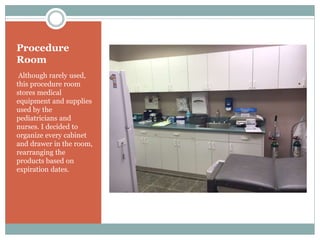
Procedure
Room
Although rarely used,
this procedure room
stores medical
equipment and supplies
used by the
pediatricians and
nurses. I decided to
organize every cabinet
and drawer in the room,
rearranging the
products based on
expiration dates.
What I Learned
 Besides improving my clinical skills, my time at
Clemson-Seneca Pediatrics helped me:
 Become more comfortable around children and the parents.
 Understand the developmental milestones of each age group,
from birth to young adulthood
 Recognize the most common types of illnesses that affect
children
 Comprehend the impact of social determinants on the type of
care received by the patient
 Advocate for the importance of preventive care instead of
focusing on curative care
 View pediatrics as a potential field of interest
Conclusion
 I am very grateful that I had the opportunity to
spend four months at Clemson-Seneca Pediatrics.
My previous experiences have concentrated on
migrant workers and the geriatric community, but
now I know how to interact with both ends of the age
spectrum and what to expect at each stage of life. The
situations I have witnessed shaped me into a more
comprehensive individual, someone who
sympathizes with the different backgrounds of the
patients.

Internship PowerPoint

  • 1.
    N A TA L I A C A R O L I N A G O N Z A L E Z V A R E L A Pediatric Internship
  • 2.
    Introduction  As aHealth Science student, I am required to complete 180 hours of internship experience at a medical facility approved by my internship coordinator. To contrast my geriatric background, I chose to intern at a pediatric office in the spring semester of 2016. This PowerPoint is a narration of my four-month experience.
  • 3.
    Clemson-Seneca Pediatrics  Locatedat 207 Main St., Seneca Pediatrics (will soon be moving to new location)  Multi-physician, multi- office pediatric group focused on preventive care  Areas of specialty include food/environmental allergies, ADHD/ADHD, special needs/learning disabilities, newborn care, breastfeeding support, asthma, obesity and nutrition
  • 4.
    Services Here is ageneral overview of the services provided at Clemson- Seneca Pediatrics.  Health Maintenance  Newborn and well-baby care  Complete physical exams and immunizations  School and sports physicals  Nutritional counseling (obesity cholesterol, eating disorders)  Adolescent medicine (adolescent girls who prefer a female provider may see one of their choice)  Acute Care  Colds, flu, sore throats ear infections  Bronchitis, croup, laryngitis, pneumonia  Emergency Care  Minor lacerations, strains, burns  Chronic Medical Care  Allergies and asthma  Attention deficit disorder (ADD) and learning disabilities  Skin care: acne, rashes, eczema
  • 5.
    GHS: Mission, Vision,Values  Clemson-Seneca Pediatrics was adopted by the Greenville Health System  Greenville Health System (GHS) is a public not-for-profit academic healthcare delivery system committed to medical excellence through clinical care, education and research. The organization is governed by a volunteer board made up of 14 members  Our Mission: Heal compassionately. Teach innovatively. Improve constantly  Our Vision: Transform health care for the benefit of the people and communities we serve  Our Values: Together we serve with integrity, respect, trust and openness
  • 6.
    Responsibilities  My dailyresponsibilities varied, mostly depending on the cases seen that day and availability of the staff. The following pictures demonstrate the most common tasks I had during my internship.
  • 7.
    Urinalysis • Urinalyses are normallyperformed if the patient has urinary complaints, back/side pain, or annual well-checks . • After working up the patient, I would ask him/her to wipe the area with an obstetrical towelette and collect the urine. I would then dip the urine stick into the specimen, and after two minutes, interpret the results . These results would then be recorded manually and electronically.
  • 8.
    Streptococcus Test • More commonduring the cold season, I sometimes had to test six children for streptococcus a day. • To get accurate results, I would prepare a solution that reacts with the bacteria, swab both tonsils, mix the solution with the specimen, and add three drops to the stick test. Six minutes later , the results would be recorded manually and electronically .
  • 9.
    Flu (A andB) Test Also common during the colder months, children who presented flu-like signs and symptoms were swabbed upon arrival. A small, brush-like swab was inserted into both nostrils and the specimen was dipped into a solution that would react with the virus. After ten minutes, results were read and recorded both electronically and manually.
  • 10.
    Culture Examination After administering the streptest, if the results were negative but the doctor suspected a positive result, he or she could ask for the specimen to be cultured and sent to the laboratory. After a few days, the specimen would be returned and if there was noticeable bacterial presence, I would notify the pediatrician for further confirmation.
  • 11.
    Hemoglobin Test Hemoglobin tests are orderedfor patients who are there for well- care checks or who have anemic symptoms. After cleaning the patient’s finger, I would prick them with a small lancet and absorb the blood with a hemoglobin microcuvette. The Hemocue HB 201 would then interpret the concentration of the hemoglobin and I would record the results.
  • 12.
    Vaccine Preparation • My CNAcertification could allow me to vaccinate patients in some states, however, this is not permitted in South Carolina. • My only duties involving vaccines include d taking the medication out of the appropriate fridge (private insurance or Medicaid) and preparing the shots for the nurse to administer them.
  • 13.
    Work-Up My favorite task,working-up a patient requires patience and acute listening skills. My responsibilities included calling back the patient, obtaining vital signs (weight, height, blood pressure, temperature, and oxygen saturation), asking follow-up questions regarding the main medical concern, and ordering the necessary tests. After taking the patient to the examination room, I would then clean up the work-up area and submit the acquired information . The number of patients varied, but the average number of work-ups I performed were 12 per day.
  • 14.
    Sanitizing Rooms I took itupon myself to ensure that all the rooms were properly sanitized and stocked during my four months there. I would spray the rooms, the waiting room, and the work-up room with disinfectant spray before opening time, during lunch break, and after the last appointment of the day. This decreased the risk of nosocomial infections affecting other patients.
  • 15.
    Vanderbilt Scoring  Implemented bythe National Institute for Children's Health Quality (NICHQ), it is used by pediatricians to diagnose ADHD in children between the ages of 6 and 12  Can also be used to screen for co- morbidities: oppositional-defiant disorder, conduct disorder, and anxiety/depression  Patients coming to begin treatment or for a follow-up are required to have a parent and teacher complete this form. My responsibilities included scoring both forms before working up the patient and asking about the behavior or efficiency of the medication.
  • 16.
    Inventorying Vaccines There are twofridges in the building: the first fridge is for the private insurance patients, while the second fridge is for the Medicaid- insured patients. I had to take inventory of both fridges every month, annotating dosages, expiration dates, and lot numbers.
  • 17.
    Projects  As partof the course, interns were required to complete projects they believed could help the internship site and further their understanding of their role in public health. The following slides contain my six favorite projects or contributions to Clemson-Seneca Pediatrics.
  • 18.
    Book Drive The averagewaiting period at Clemson- Seneca Pediatrics ranges from 1 hour to 1.5 hours. Younger children can become uneasy during this time and are often given electronics as a form of distraction. I decided to provide 3 new books to each of the seven rooms to instill the love for books at a young age, thus promoting child literacy.
  • 19.
    Flyers Under my Planning Goal,I set out to complete four educational flyers covering common diseases that affect young children. Using health literacy skills, I designed the information to be concise and relevant, hoping this would engage the reader and provoke some change.
  • 20.
    Door Decorating Younger children often remembertheir previous visits to the pediatrician. These memories often result problematic when measuring their weight and height since they become uneasy, so I decided decorating the door could provide some comfort or distraction as we measured their vitals.
  • 21.
    Medical Supplies Cabinet Located at thenurse’s station, this seven- leveled cabinet stores supplies that are often distributed to the examination rooms and the lab area. My responsibilities included checking for expiration dates every month, rearranging the products based on expiration dates (soon- to-expire products towards the front), and re-stocking the rooms and lab area every week.
  • 22.
    Medicine Cabinet Also located atthe nurse’s station, one of my duties was to organize this medicine cabinet based on expiration dates (soon- to-be expired products towards the front) and check for said expired products every month.
  • 23.
    Procedure Room Although rarely used, thisprocedure room stores medical equipment and supplies used by the pediatricians and nurses. I decided to organize every cabinet and drawer in the room, rearranging the products based on expiration dates.
  • 24.
    What I Learned Besides improving my clinical skills, my time at Clemson-Seneca Pediatrics helped me:  Become more comfortable around children and the parents.  Understand the developmental milestones of each age group, from birth to young adulthood  Recognize the most common types of illnesses that affect children  Comprehend the impact of social determinants on the type of care received by the patient  Advocate for the importance of preventive care instead of focusing on curative care  View pediatrics as a potential field of interest
  • 25.
    Conclusion  I amvery grateful that I had the opportunity to spend four months at Clemson-Seneca Pediatrics. My previous experiences have concentrated on migrant workers and the geriatric community, but now I know how to interact with both ends of the age spectrum and what to expect at each stage of life. The situations I have witnessed shaped me into a more comprehensive individual, someone who sympathizes with the different backgrounds of the patients.