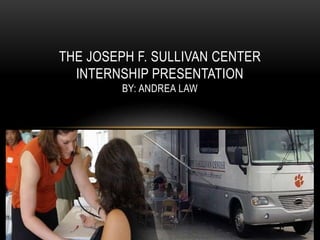
THE JOSEPH F. SULLIVAN CENTER
INTERNSHIP PRESENTATION
BY: ANDREA LAW
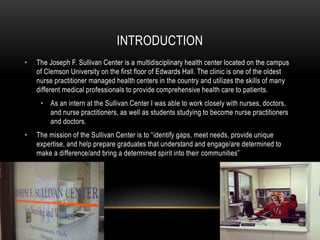
INTRODUCTION
• The Joseph F. Sullivan Center is a multidisciplinary health center located on the campus
of Clemson University on the first floor of Edwards Hall. The clinic is one of the oldest
nurse practitioner managed health centers in the country and utilizes the skills of many
different medical professionals to provide comprehensive health care to patients.
• As an intern at the Sullivan Center I was able to work closely with nurses, doctors,
and nurse practitioners, as well as students studying to become nurse practitioners
and doctors.
• The mission of the Sullivan Center is to “identify gaps, meet needs, provide unique
expertise, and help prepare graduates that understand and engage/are determined to
make a difference/and bring a determined spirit into their communities”
• When I first arrive in the morning I am
responsible for opening all rooms and
turning on all lights and computers
• I must then have someone log me
onto the internet for each computer
so everyone has access to
Allscripts for the day
• I am responsible for making sure rooms
are consistently clean and stocked with
the necessary items
• I am responsible for triaging each patient
that comes in for the day by taking vitals
and health histories and asking questions
pertaining to the reason for visit
GENERAL DUTIES
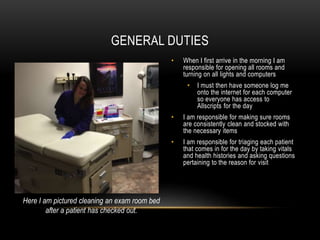
Here I am pictured cleaning an exam room bed
after a patient has checked out.
• Taking vitals is one of the most important
duties that I perform as an intern. Each
patient must have a set of vitals charted
per visit so that providers have some
basic background information.
• When a patient first arrives, I am given a
paper chart for them that states their
name and reason for visit. I am
responsible for going to get the patient
from the waiting room and taking them to
get their blood pressure, pulse,
temperature, height, and weight (and in
some cases waist circumference)
• Once I have acquired this data on
the patient, I take them in an exam
room and go through their health
history and reason for visit in detail
TAKING VITALS
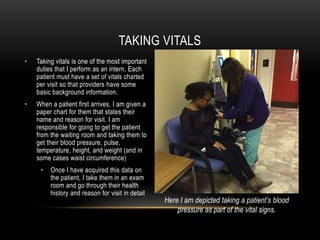
Here I am depicted taking a patient’s blood
pressure as part of the vital signs.
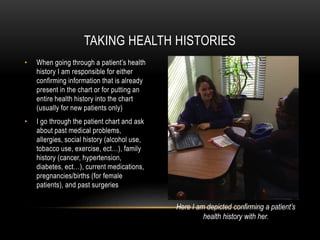
• When going through a patient’s health
history I am responsible for either
confirming information that is already
present in the chart or for putting an
entire health history into the chart
(usually for new patients only)
• I go through the patient chart and ask
about past medical problems,
allergies, social history (alcohol use,
tobacco use, exercise, ect…), family
history (cancer, hypertension,
diabetes, ect…), current medications,
pregnancies/births (for female
patients), and past surgeries
TAKING HEALTH HISTORIES
Here I am depicted confirming a patient’s
health history with her.
THE REASON FOR VISIT
• The reason for visit is the most important piece of information that I gather when
interacting with patients. I am responsible for putting a reason for visit in each and every
patient’s chart. Once I have put in a reason for visit, I go through and ask as many
questions as necessary pertaining to the reason for visit to gather a full understanding of
the patient’s problem.
• Each reason for visit has a specific set of questions such as onset, symptoms,
quality of symptoms, location of symptoms, duration of symptoms, etc…
• Each day is different at the Sullivan
Center. We have a different set of
patients with different reasons for visit,
different practitioners, and different
students working.
• In addition to my general duties, I am
also responsible for various
miscellaneous tasks that arise
throughout the day. These include
things such as organizing the stock
room, restocking exam rooms,
analyzing urine and blood samples,
and creating Medical Surveillance
Program files.
SPECIFIC DUTIES
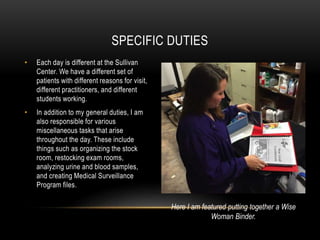
Here I am featured putting together a Wise
Woman Binder.
• Some patients that come in require a
urinalysis in order to diagnose their medical
problem
• I usually perform urinalysis for patients
complaining of a urinary tract infection or
for patients coming in for physicals
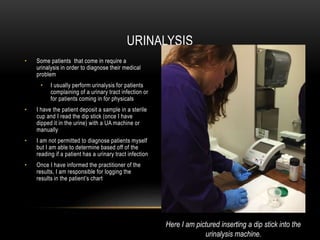
• I have the patient deposit a sample in a sterile
cup and I read the dip stick (once I have
dipped it in the urine) with a UA machine or
manually
• I am not permitted to diagnose patients myself
but I am able to determine based off of the
reading if a patient has a urinary tract infection
• Once I have informed the practitioner of the
results, I am responsible for logging the
results in the patient’s chart
URINALYSIS
Here I am pictured inserting a dip stick into the
urinalysis machine.
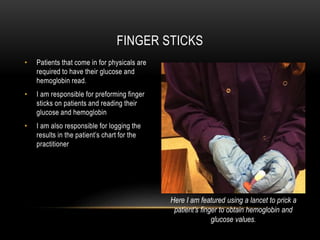
• Patients that come in for physicals are
required to have their glucose and
hemoglobin read.
• I am responsible for preforming finger
sticks on patients and reading their
glucose and hemoglobin
• I am also responsible for logging the
results in the patient’s chart for the
practitioner
FINGER STICKS
Here I am featured using a lancet to prick a
patient’s finger to obtain hemoglobin and
glucose values.
• CU4Health is a wellness program that
the Sullivan Center does for Clemson
University employees. This program is
designed to educate individuals based on
a tailored annual program.
• Patient’s come in for a standard lab draw
in which they receive a complete blood
count, basic metabolic panel, and lipid
panel and are then required to schedule
a follow up appointment. Patients are
asked to fill out an online survey
pertaining to their daily lifestyle prior to
their follow up appointment.
• Based on both the blood work and online
survey results, I then educate the
individual on ways to improve their
overall health in a one on one counseling
session on their follow up date.
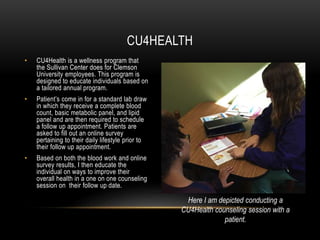
CU4HEALTH
Here I am depicted conducting a
CU4Health counseling session with a
patient.
• Wise Woman is another program that
the Sullivan Center does for low
income women to educate them on
ways to improve nutrition and overall
health.
• These women receive binders with
nutrition fact sheets, stretch bands for
exercise, recipe books, and contact
sheets in addition to free dietary
counseling for up to 6 months.
• I am responsible for putting together
the Wise Women binders in both
Spanish and English in my spare time.
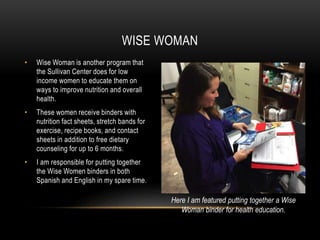
WISE WOMAN
Here I am featured putting together a Wise
Woman binder for health education.
• In my spare time I keep myself
occupied by organizing the stock
room, restocking exam rooms and the
lab, and preparing the suitcase for off-
site clinics.
• I have rearranged the stock room to
have a logical order of supplies and
stock the lab and exam rooms weekly.
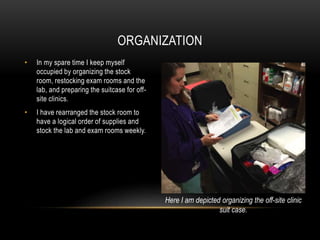
ORGANIZATION
Here I am depicted organizing the off-site clinic
suit case.
MEDICAL SURVEILLANCE PROFILE FILES
• When patient flow is light , one of the ways I keep myself occupied is by creating medical
surveillance files for patients. Will Mayo runs the medical surveillance program here at the
Sullivan Center and acquires basic information from individuals pertaining to risk factors
for health. Based off of the files I create, Mr. Mayo is then able to see which patients are
at highest risk for certain diseases and which patient’s need updated vaccinations. I am
responsible for creating a chart for each individual I receive a chart for and for scanning
their information into the chart once I have created it. These charts are then used to put
individuals into groups based on their risk factors in order to keep immunizations up to
date (per group).
LABS
• In addition to assisting with lab draw, I also check for lab results in patient charts when
patient flow is light. The Sullivan Center prints out a lab manifest each day that
documents each individual lab draw per day. I am then responsible for taking the manifest
and checking for lab results for each listing on the manifest. I then highlight the lab result
that is present and leave labs that do not yet have results alone. Once I have an entire
manifest highlighted, I put it in the manifest binder (which is organized by date).
• This allows the Sullivan Center to keep up with patient results and keep patients informed
of their results as they become available.
• Each intern at the Sullivan Center is assigned an
end of the year project in addition to daily duties.
I was assigned to design an Intern Guideline
Portfolio, which details daily duties, common
reasons for visit, how to log results and perform
urinalysis and finger sticks, and various
miscellaneous advice. I designed the portfolio on
a word document which is six pages in length
with a twenty question quiz at the end.
• This project is meaningful to me because it
has the potential to reach all future interns
and help them through their initial few
weeks of work as Sullivan Center interns.
It also holds them accountable for the
information due to the quiz at the end of
the portfolio.
• Another “project” I am involved with is CU4Health
counseling. When I interviewed for the internship
position I voiced my interest in counseling and
my preceptor told me she would involve me with
CU4Health as part of my internship experience. I
was trained by shadowing Jasmine Thomas
conduct counseling sessions with patients. I also
studied optimum ranges for blood work so as to
properly inform patients of their health
information. I am now conducting CU4Health
counseling sessions on my own with patients.
PROJECTS
Featured is a snap shot of my Internship
Guidelines Portfolio as assigned by my
preceptor.
CONCLUSION
• The main goal I set for myself for this internship was to determine if the medical field was
the right career choice for me. Through my work at the Sullivan Center, I am confident
that the medical profession is the best occupation for me not only as an individual but as
a citizen of the world. My aspirations in life center around helping people in whatever way
I am able. I feel that the Sullivan Center has given me the opportunity to explore the
medical field in ways I had never considered before. Having the chance to become
involved in CU4Health especially opened my eyes to all of the different career options
within the medical profession.

Internship powerpoint for portfolio

  • 1.
    THE JOSEPH F.SULLIVAN CENTER INTERNSHIP PRESENTATION BY: ANDREA LAW
  • 2.
    INTRODUCTION • The JosephF. Sullivan Center is a multidisciplinary health center located on the campus of Clemson University on the first floor of Edwards Hall. The clinic is one of the oldest nurse practitioner managed health centers in the country and utilizes the skills of many different medical professionals to provide comprehensive health care to patients. • As an intern at the Sullivan Center I was able to work closely with nurses, doctors, and nurse practitioners, as well as students studying to become nurse practitioners and doctors. • The mission of the Sullivan Center is to “identify gaps, meet needs, provide unique expertise, and help prepare graduates that understand and engage/are determined to make a difference/and bring a determined spirit into their communities”
  • 3.
    • When Ifirst arrive in the morning I am responsible for opening all rooms and turning on all lights and computers • I must then have someone log me onto the internet for each computer so everyone has access to Allscripts for the day • I am responsible for making sure rooms are consistently clean and stocked with the necessary items • I am responsible for triaging each patient that comes in for the day by taking vitals and health histories and asking questions pertaining to the reason for visit GENERAL DUTIES Here I am pictured cleaning an exam room bed after a patient has checked out.
  • 4.
    • Taking vitalsis one of the most important duties that I perform as an intern. Each patient must have a set of vitals charted per visit so that providers have some basic background information. • When a patient first arrives, I am given a paper chart for them that states their name and reason for visit. I am responsible for going to get the patient from the waiting room and taking them to get their blood pressure, pulse, temperature, height, and weight (and in some cases waist circumference) • Once I have acquired this data on the patient, I take them in an exam room and go through their health history and reason for visit in detail TAKING VITALS Here I am depicted taking a patient’s blood pressure as part of the vital signs.
  • 5.
    • When goingthrough a patient’s health history I am responsible for either confirming information that is already present in the chart or for putting an entire health history into the chart (usually for new patients only) • I go through the patient chart and ask about past medical problems, allergies, social history (alcohol use, tobacco use, exercise, ect…), family history (cancer, hypertension, diabetes, ect…), current medications, pregnancies/births (for female patients), and past surgeries TAKING HEALTH HISTORIES Here I am depicted confirming a patient’s health history with her.
  • 6.
    THE REASON FORVISIT • The reason for visit is the most important piece of information that I gather when interacting with patients. I am responsible for putting a reason for visit in each and every patient’s chart. Once I have put in a reason for visit, I go through and ask as many questions as necessary pertaining to the reason for visit to gather a full understanding of the patient’s problem. • Each reason for visit has a specific set of questions such as onset, symptoms, quality of symptoms, location of symptoms, duration of symptoms, etc…
  • 7.
    • Each dayis different at the Sullivan Center. We have a different set of patients with different reasons for visit, different practitioners, and different students working. • In addition to my general duties, I am also responsible for various miscellaneous tasks that arise throughout the day. These include things such as organizing the stock room, restocking exam rooms, analyzing urine and blood samples, and creating Medical Surveillance Program files. SPECIFIC DUTIES Here I am featured putting together a Wise Woman Binder.
  • 8.
    • Some patientsthat come in require a urinalysis in order to diagnose their medical problem • I usually perform urinalysis for patients complaining of a urinary tract infection or for patients coming in for physicals • I have the patient deposit a sample in a sterile cup and I read the dip stick (once I have dipped it in the urine) with a UA machine or manually • I am not permitted to diagnose patients myself but I am able to determine based off of the reading if a patient has a urinary tract infection • Once I have informed the practitioner of the results, I am responsible for logging the results in the patient’s chart URINALYSIS Here I am pictured inserting a dip stick into the urinalysis machine.
  • 9.
    • Patients thatcome in for physicals are required to have their glucose and hemoglobin read. • I am responsible for preforming finger sticks on patients and reading their glucose and hemoglobin • I am also responsible for logging the results in the patient’s chart for the practitioner FINGER STICKS Here I am featured using a lancet to prick a patient’s finger to obtain hemoglobin and glucose values.
  • 10.
    • CU4Health isa wellness program that the Sullivan Center does for Clemson University employees. This program is designed to educate individuals based on a tailored annual program. • Patient’s come in for a standard lab draw in which they receive a complete blood count, basic metabolic panel, and lipid panel and are then required to schedule a follow up appointment. Patients are asked to fill out an online survey pertaining to their daily lifestyle prior to their follow up appointment. • Based on both the blood work and online survey results, I then educate the individual on ways to improve their overall health in a one on one counseling session on their follow up date. CU4HEALTH Here I am depicted conducting a CU4Health counseling session with a patient.
  • 11.
    • Wise Womanis another program that the Sullivan Center does for low income women to educate them on ways to improve nutrition and overall health. • These women receive binders with nutrition fact sheets, stretch bands for exercise, recipe books, and contact sheets in addition to free dietary counseling for up to 6 months. • I am responsible for putting together the Wise Women binders in both Spanish and English in my spare time. WISE WOMAN Here I am featured putting together a Wise Woman binder for health education.
  • 12.
    • In myspare time I keep myself occupied by organizing the stock room, restocking exam rooms and the lab, and preparing the suitcase for off- site clinics. • I have rearranged the stock room to have a logical order of supplies and stock the lab and exam rooms weekly. ORGANIZATION Here I am depicted organizing the off-site clinic suit case.
  • 13.
    MEDICAL SURVEILLANCE PROFILEFILES • When patient flow is light , one of the ways I keep myself occupied is by creating medical surveillance files for patients. Will Mayo runs the medical surveillance program here at the Sullivan Center and acquires basic information from individuals pertaining to risk factors for health. Based off of the files I create, Mr. Mayo is then able to see which patients are at highest risk for certain diseases and which patient’s need updated vaccinations. I am responsible for creating a chart for each individual I receive a chart for and for scanning their information into the chart once I have created it. These charts are then used to put individuals into groups based on their risk factors in order to keep immunizations up to date (per group).
  • 14.
    LABS • In additionto assisting with lab draw, I also check for lab results in patient charts when patient flow is light. The Sullivan Center prints out a lab manifest each day that documents each individual lab draw per day. I am then responsible for taking the manifest and checking for lab results for each listing on the manifest. I then highlight the lab result that is present and leave labs that do not yet have results alone. Once I have an entire manifest highlighted, I put it in the manifest binder (which is organized by date). • This allows the Sullivan Center to keep up with patient results and keep patients informed of their results as they become available.
  • 15.
    • Each internat the Sullivan Center is assigned an end of the year project in addition to daily duties. I was assigned to design an Intern Guideline Portfolio, which details daily duties, common reasons for visit, how to log results and perform urinalysis and finger sticks, and various miscellaneous advice. I designed the portfolio on a word document which is six pages in length with a twenty question quiz at the end. • This project is meaningful to me because it has the potential to reach all future interns and help them through their initial few weeks of work as Sullivan Center interns. It also holds them accountable for the information due to the quiz at the end of the portfolio. • Another “project” I am involved with is CU4Health counseling. When I interviewed for the internship position I voiced my interest in counseling and my preceptor told me she would involve me with CU4Health as part of my internship experience. I was trained by shadowing Jasmine Thomas conduct counseling sessions with patients. I also studied optimum ranges for blood work so as to properly inform patients of their health information. I am now conducting CU4Health counseling sessions on my own with patients. PROJECTS Featured is a snap shot of my Internship Guidelines Portfolio as assigned by my preceptor.
  • 16.
    CONCLUSION • The maingoal I set for myself for this internship was to determine if the medical field was the right career choice for me. Through my work at the Sullivan Center, I am confident that the medical profession is the best occupation for me not only as an individual but as a citizen of the world. My aspirations in life center around helping people in whatever way I am able. I feel that the Sullivan Center has given me the opportunity to explore the medical field in ways I had never considered before. Having the chance to become involved in CU4Health especially opened my eyes to all of the different career options within the medical profession.